Changing stroke rehab and research worldwide now.Time is Brain! trillions and trillions of neurons that DIE each day because there are NO effective hyperacute therapies besides tPA(only 12% effective). I have 523 posts on hyperacute therapy, enough for researchers to spend decades proving them out. These are my personal ideas and blog on stroke rehabilitation and stroke research. Do not attempt any of these without checking with your medical provider. Unless you join me in agitating, when you need these therapies they won't be there.

What this blog is for:

My blog is not to help survivors recover, it is to have the 10 million yearly stroke survivors light fires underneath their doctors, stroke hospitals and stroke researchers to get stroke solved. 100% recovery. The stroke medical world is completely failing at that goal, they don't even have it as a goal. Shortly after getting out of the hospital and getting NO information on the process or protocols of stroke rehabilitation and recovery I started searching on the internet and found that no other survivor received useful information. This is an attempt to cover all stroke rehabilitation information that should be readily available to survivors so they can talk with informed knowledge to their medical staff. It lays out what needs to be done to get stroke survivors closer to 100% recovery. It's quite disgusting that this information is not available from every stroke association and doctors group.

Showing posts with label Sonification. Show all posts

Friday, October 6, 2023

Effect of sonification types in upper-limb movement: a quantitative and qualitative study in hemiparetic and healthy participants


You'll have to ask your doctor and therapists for sonification, it's only been out there for 10+ years.

Sonification has been written about for 10+ years. It is about time for our fucking failures of stroke associations to step up to the plate and write a stroke protocol on this. I can guarantee this won't occur.


sonification (13 posts to May 2012)

Effect of sonification types in upper-limb movement: a quantitative and qualitative study in hemiparetic and healthy participants

Abstract

Background

Movement sonification, the use of real-time auditory feedback linked to movement parameters, have been proposed to support rehabilitation. Nevertheless, if promising results have been reported, the effect of the type of sound used has not been studied systematically. The aim of this study was to investigate in a single session the effect of different types of sonification both quantitatively and qualitatively on patients with acquired brain lesions and healthy participants.

Methods

An experimental setup enabling arm sonification was developed using three different categories of sonification (direct sound modulation, musical interaction, and soundscape). Simple moving forward movements performed while sliding on a table with both arms were investigated with all participants. Quantitative analysis on the movement timing were performed considering various parameters (sound condition, affected arm and dominance, sonification categories). Qualitative analysis of semi-structured interviews were also conducted, as well as neuropsychological evaluation of music perception.

Results

For both the patient and healthy groups (15 participants each), average duration for performing the arm movement is significantly longer with sonification compared to the no-sound condition (p < 0.001). Qualitative analysis of semi-structured interviews revealed different aspects of motivational and affective aspects of sonification. Most participants of both groups preferred to complete the task with sound (29 of 30 participants), and described the experience as playful (22 of 30 participants). More precisely, the soundscape (nature sounds) was the most constantly preferred (selected first by 14 of 30 participants).

Conclusion

Overall, our results confirm that the sonification has an effect on the temporal execution of the movement during a single-session. Globally, sonification is welcomed by the participants, and we found convergent and differentiated appreciations of the different sonification types.

Background

Acquired brain lesions in adults, following stroke, head injury, or brain tumor, are major causes of acquired disability worldwide [11, 46]. These lesions induce multiple sensory, motor, and cognitive disorders. Among these disorders, motor impairments could affect 40% of patients after stroke [33]. In particular, we consider in this study the specific case of upper limb hemiparesis, characterized by impaired motor control and muscle weakness, greatly reduces autonomy in daily living activities, and thus, the long-term quality of life of patients [10].

The use of music is being studied in a wide range of rehabilitation settings [16, 39, 44, 47, 61], particularly in the case of acquired brain lesions [27, 68]. Several different methods have been investigated, such as audio-rhythmic stimulation (RAS) [65, 67], exercises with musical instruments (music-supported therapy) [1, 2, 13, 28, 52], and movement sonification devices [26, 36, 48, 58].

In this paper we focus on movement sonification, which concerns systems that enable translating in real-time motion parameters into sound or musical parameters [21, 30]. Movement sonification devices have many advantages [60]: access to a continuous 3D auditory information, fast adaptation of sound feedback to the movements performed, flexibility of use by participants with various profiles thanks to possible adaptation according to individual abilities [7, 23]. Thus, these devices present a potential added value in comparison with other sound/musical methods and tools, and offer perspectives in adequacy with the needs described in the rehabilitation framework [12, 66]. Moreover, compared to other feedback modalities such as visual feedback, the use of the auditory modality does not constrain the user's posture. In this case, the dependence to the external feedback, called the guidance effect, might be less important with auditory compared to visual feedback since sonification could encourage to focus attention on intrinsic proprioceptive information [19]. The potential interest of sonification devices as a rehabilitation support tool is therefore under investigation for different rehabilitation applications [25, 26, 37, 53, 63].

Concerning more specifically rehabilitation after acquired brain lesions, respectively in a pilot study [54] and a large-scale study [48], Schmitz et al. and Raglio et al. showed an encouraging evolution of the global dexterity scores (Box and Block Test) with sonification devices. In both situations, standard motor rehabilitation exercises were sonified.

In 2015, Scholz et al. proposed an innovative device where users learn to move in a virtual space associated with a musical scale, with the aim of playing melodies [57]. In this case, a decrease in pain scores was reported, as well as a trend towards improvement in the Stroke Impact Scale functional hand assessment scores. Nevertheless, this study did not show any improvement in scores on the other functional assessments performed (Action Research Arm Test, Box and Block Test, Nine Hole Peg Test). In a pilot study, Robertson et al. suggested that in the presence of audio feedback different results could be obtained depending on the hemispheric location of the brain lesion, and more precisely a deterioration in kinematic performances in the presence of audio feedback in the case of left hemispheric brain lesions [50].

Thus, although encouraging results have been obtained in different settings, limited functional benefits have also been reported [40]. One reason for contrasted effects could be related to the choice of sound and interaction design. In early works, the choice made was to sonify errors, by emitting “alarm” sounds when the participant does not follow the predicted trajectory model [36]. More recent approaches propose to favor the participant motivation and avoid negative reinforcement [7].

Moreover, the quality of the sound rendering has not always been a central concern, yet the choices of sound design and mapping could be fundamental to ensure the adequacy between the sound and the gesture to be performed, and thus, the effect of sonification on the movement control and learning [3, 15]. Questions about sound design and coupling modalities require further investigations [31]. In particular, these investigations must be considered with regard to the performed tasks, the user profiles they address, and individual singularities. Importantly, the need to consider multiple sonification modalities and to evaluate their effects was notably highlighted in two recent literature reviews [26, 41]. Moreover, the user perception and experience of sonification has been insufficiently studied.

In this perspective, the novelty of the present study was to evaluate, during a single session, different modalities of gesture-sound interactions, categories and types of sound feedback, with both adult patients with hemiparesis following an acquired brain lesion and healthy participants. An originality of our approach consists in using a mixed methodology, evaluating the effect of different sonification modalities both quantitatively and qualitatively. Our specific goal in this study was to measure the spontaneous effects of the sound feedback on the temporality of execution of the movement, and the subjective experience of each participant through semi-directed interviews. On the contrary to typical rehabilitation assessments where the motor task must be performed as quickly as possible (i.e. scores in assessments typically indexed on the number of objects moved [15, 17], or the number of repetitions of a movement or targets reached), we rather chose to give no instruction concerning the speed of execution of the 

More at link.task, and assess how the sonification could influence spontaneously the average movement speed.

Thursday, October 27, 2022

Serenity: exploring audio-based gaming for arm-hand rehabilitation after stroke

FYI

Serenity: exploring audio-based gaming for arm-hand rehabilitation after stroke

Published:22 October 2022Publication History

ABSTRACT

Recent studies have shown that adding sonification to stroke rehabilitation training is effective. It helps patients achieve better training results by positively affecting motor control, the somatosensory system, and patient engagement. This paper explores the concept of audio-based games in stroke rehabilitation, hypothesizing that the removal of a visual dimension might increase patient focus on the body part being trained. In an expert study with nine therapists we evaluated Serenity, an audio-based rehabilitation game, as a design probe to explore the potential of audio-based games in rehabilitation training. Results show promise for further exploring the concept of audio-based gaming in stroke rehabilitation.

Saturday, June 18, 2022

Hand rehabilitation with sonification techniques in the subacute stage of stroke

 You'll have to ask your doctor and therapists for sonification, it's only been out there for 10 years.

Sonification has been written about for 10 years. It is about time for our fucking failures of stroke associations to step up to the plate and write a stroke protocol on this. I can guarantee this won't occur.


sonification (11 posts to May 2012)

After a stroke event, most survivors suffer from arm paresis, poor motor control and other disabilities that make activities of daily living difficult, severely affecting quality of life and personal independence. This randomized controlled trial aimed at evaluating the efficacy of a music-based sonification approach on upper limbs motor functions, quality of life and pain perceived during rehabilitation. The study involved 65 subacute stroke individuals during inpatient rehabilitation allocated into 2 groups which underwent usual care dayweek) respectively of standard upper extremity motor rehabilitation or upper extremity treatment with sonification techniques. The FuglMeyer Upper Extremity Scale, Box and Block Test and the Modified Ashworth Scale were used to perform motor assessment and the McGill Quality of Life-it and the Numerical Pain Rating Scale to assess quality of life and pain. The assessment was performed at baseline, after 2 weeks, at the end of treatment and at follow-up (1 month after the end of treatment). Total scores of the Fugl-Meyer Upper Extremity Scale (primary outcome measure) and hand and wrist sub scores, manual dexterity scores of the affected and unaffected limb in the Box and Block Test, pain scores of the Numerical Pain Rating Scale (secondary outcomes measures) significantly improved in the sonification group compared to the standard of care group (time*group interaction < 0.05). Our findings suggest that music-based sonification sessions can be considered an effective standardized intervention for the upper limb in subacute stroke rehabilitation. After a stroke event, most survivors (80–90%) suffer from arm paresis, poor motor control and other disabilities, which evolve in a chronic condition in about 30–40% of cases1,2 . Consequently, patients have difficulty in performing activities of daily living, a fact that severely affects their quality of life and independence3 . Task-oriented sensory-motor training, which allows to transmit the sensory information of the feedback to the central nervous system during task execution, and movements adaptation, is recognized as significant in increasing poststroke arm function and dexterity2,4 . Beside other factors, such as patient’s compliance and subjective interest in stimulus, the intensity of training and patient’s motivation have been indicated as key features for a successful rehabilitation therapy5,6 . The development of technologies for rehabilitation has made it possible to formulate new application paradigms obtained by integrating the current rehabilitation pathways with instrumental interventions7,8 . Sensory motor rehabilitation techniques, obtained through technological devices (such as virtual reality, robots, noninvasive stimulations , motion capture) and used in support of traditional rehabilitation techniques, seem to provide objective parameters for patient evaluation, accelerate the process of motor recovery and improve motor performance at discharge by means of a top-down approach9,10 . Although the results obtained with the currently available devices are encouraging, we are only at an early stage for the exploitation of these technologies. In fact, while technology-assisted rehabilitation of the upper limb has demonstrated to have a significant impact on motor outcomes, especially at the proximal level (shoulder 
  • 14 pages at link.

Wednesday, November 24, 2021

Body Perception Manipulation with Movement Sonification for Stroke Survivors Rehabilitation

Not useful yet, tested on healthy participants.

Body Perception Manipulation with Movement Sonification for Stroke Survivors Rehabilitation

 Sonification for Stroke Survivors Rehabilitation Filipa Oliveira Instituto Superior Tecnico ´ University of Lisbon Portugal maria.oliveira@tecnico.ulisboa.pt Isabel Neto INESC-ID, IST University of Lisbon Portugal isabel.neto@tecnico.ulisboa.pt Daniel Simoes Lopes ˜ INESC-ID, IST University of Lisbon Portugal daniel.lopes@inesc-id.pt Hugo Nicolau ITI/LARSyS, IST University of Lisbon Portugal hugo.nicolau@tecnico.ulisboa.pt Abstract—Physical rehabilitation plays an essencial role in recovering from a stroke, but it can become repetitive and boring. We present an innovative sound-based prototype for realtime sonification of an upper limb exercise. The prototype is designed to engage stroke survivors in upper body exercises and influence their body perceptions. We ran a preliminary study with ten healthy participants to validate our sonification approach. Findings suggested that movement sonification has the potential for patient engagement and positively influences perceived body weight and capability. Moreover, the proposed approach holds promising results for future research with stroke survivors. erms—Sonification; Stroke; Rehabilitation; Body perception;

Sunday, April 4, 2021

Hand rehabilitation with sonification techniques in the subacute stage of stroke


Sonification has been written about for 8 years. It is about time for our fucking failures of stroke associations to step up to the plate and write a stroke protocol on this. I can guarantee this won't occur.


Hand rehabilitation with sonification techniques in the subacute stage of stroke

Scientific Reports volume 11, Article number: 7237 (2021)

Abstract

After a stroke event, most survivors suffer from arm paresis, poor motor control and other disabilities that make activities of daily living difficult, severely affecting quality of life and personal independence. This randomized controlled trial aimed at evaluating the efficacy of a music-based sonification approach on upper limbs motor functions, quality of life and pain perceived during rehabilitation. The study involved 65 subacute stroke individuals during inpatient rehabilitation allocated into 2 groups which underwent usual care dayweek) respectively of standard upper extremity motor rehabilitation or upper extremity treatment with sonification techniques. The Fugl-Meyer Upper Extremity Scale, Box and Block Test and the Modified Ashworth Scale were used to perform motor assessment and the McGill Quality of Life-it and the Numerical Pain Rating Scale to assess quality of life and pain. The assessment was performed at baseline, after 2 weeks, at the end of treatment and at follow-up (1 month after the end of treatment). Total scores of the Fugl-Meyer Upper Extremity Scale (primary outcome measure) and hand and wrist sub scores, manual dexterity scores of the affected and unaffected limb in the Box and Block Test, pain scores of the Numerical Pain Rating Scale (secondary outcomes measures) significantly improved in the sonification group compared to the standard of care group (time*group interaction < 0.05). Our findings suggest that music-based sonification sessions can be considered an effective standardized intervention for the upper limb in subacute stroke rehabilitation.

Introduction

After a stroke event, most survivors (80–90%) suffer from arm paresis, poor motor control and other disabilities, which evolve in a chronic condition in about 30–40% of cases2. Consequently, patients have difficulty in performing activities of daily living, a fact that severely affects their quality of life and independence3. Task-oriented sensory-motor training, which allows to transmit the sensory information of the feedback to the central nervous system during task execution, and movements adaptation, is recognized as significant in increasing post-stroke arm function and dexterity2,4. Beside other factors, such as patient’s compliance and subjective interest in stimulus, the intensity of training and patient’s motivation have been indicated as key features for a successful rehabilitation therapy5,6.

The development of technologies for rehabilitation has made it possible to formulate new application paradigms obtained by integrating the current rehabilitation pathways with instrumental interventions7,8. Sensory-motor rehabilitation techniques, obtained through technological devices (such as virtual reality, robots, non-invasive stimulations , motion capture) and used in support of traditional rehabilitation techniques, seem to provide objective parameters for patient evaluation, accelerate the process of motor recovery and improve motor performance at discharge by means of a top-down approach9,10.

Although the results obtained with the currently available devices are encouraging, we are only at an early stage for the exploitation of these technologies. In fact, while technology-assisted rehabilitation of the upper limb has demonstrated to have a significant impact on motor outcomes, especially at the proximal level (shoulder and elbow)11, the functional recovery of the hand (in particular of the prehension function) still presents some issues12,13.

Music and its elements (especially the rhythm) are widely used in rehabilitation14.This is due to the activation of the neuronal networks, in the limbic and paralimbic areas, and in the brain areas involved in movement (motor cortex, supplementary motor area, cerebellum, basal ganglia, etc.)15,16. Many studies document the possibility that exposure to music during training, but, also through specific rehabilitation interventions, may induce plastic changes15,16,17,18,19 in the sensory-auditory circuits and motor areas20,21. These changes, resulting in a neuronal reorganization in the nodal points of the brain networks and in fiber bundles, can determine effects lasting beyond the actual duration of the rehabilitation intervention15. Moreover, music in the rehabilitation process determines an emotional involvement, creating a strong motivational basis15,16.

The recent literature shows how the use of music in stroke rehabilitation can improve gait (speed, cadence and step length, balance)22,23, movement of the upper limbs24,25, language26,27, but also mood and other psychological aspects28,29,30. More recent studies use, for the rehabilitation of the upper limbs, the mapping of the patient’s movements to whom a sonorous stimulus is associated (sonification)31,32,33,34. Sonification can improve motor functions rehabilitation and can facilitate the integration of auditory and sensory-motor systems35,36,37. This technique can also strengthen and support the damaged proprioceptive system and can make the rehabilitative process more pleasant and stimulating from an emotional and motivational point of view15,37. In some studies, the kinematic data of the gesture are translated into modulations of some parameters (typically frequency and amplitude) of a continuous synthetic sound38,39,40.

In other post-stroke hand rehabilitation studies, the sonification action was based on the execution of short scales or melodic intervals that the patient had to reproduce through specific movements, with the final goal of creating "simple nursery rhymes or other familiar tunes", modulating music timbre and intensity41. Further, Reh et al.42 supported the rehabilitation of walking by a combination of an ecological sound (noise produced by a step in the snow) together with a predetermined glissando effect.

In this study the sonification can be considered as a properly selected set of sonorous-music stimuli activated by patient’s movements with the mediation of a sensor (in this specific case the Leap Motion Controller). Synthesized sounds/musical texture and their parameters (mainly rhythm, pitch/melody, intensity/dynamics, harmony and timbre) are used to represent movements characteristics, especially from a temporal and spatial point of view. Sonification makes possible the improvement of sensorimotor learning, proprioception, movements planning and execution37.

In particular music elements used in this study were automatically associated to the patient’s movements without involvement of any cognitive tasks. This allows the patient to focus attention mainly on the motor outcome. In particular, given the importance of hand functions in activities of daily living and manipulation, the protocol (Sonichand) was developed and validated for the training of pronation and supination of the forearm, ulnar and radial deviation of the wrist and hand grasping movements43.

The main objective of this randomized controlled study conducted in subacute stroke patients during inpatient rehabilitation, was to verify the effectiveness (evaluated through the assessment of the upper limb level of impairment at baseline and end of treatment) of a new rehabilitative hand treatment based on a musical sonification approach compared to a conventional intervention. The secondary aim was to evaluate if this technique could be beneficial for reduction of pain perceived during training and improve the patient's perceived quality of life. The main hypothesis of this study was that our sonification approach could be more effective than a conventional intervention for the rehabilitation of subacute stroke patients, especially for the recovery of hand motor function.

Results

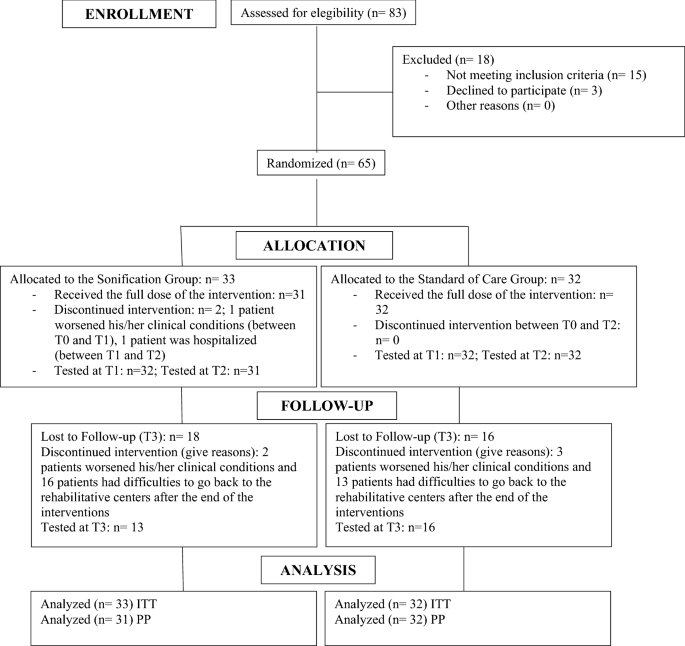
Clinical characteristics of the sample at baseline are reported in Table 1. Two patients allocated to the Sonification Group interrupted the trial between T0 and T2: the first one worsened his/her clinical condition and the second one was hospitalized. In addition, 18 patients in the Sonification Group and 16 patients in the Standard of Care Group were lost to follow-up due to the clinical worsening (2 patients in the Sonification Group and 3 patients in the Standard of Care Group) or to the difficulty to go back to the rehabilitative centers after the end of the interventions (16 patients in the Sonification Group and 13 patients in the Standard of Care Group) (Flow Diagram is reported in Fig. 1). No side effects were observed in both the experimental and control groups after training.

Table 1 Baseline clinical characteristics of patients in Sonification Group (SG) and Standard of Care Group (SoCG).
Figure 1
figure1

The flow chart of the study. All randomized patients received the allocated intervention. Between baseline and the 4-week evaluation two patients in the Sonification group discontinued the treatment. No discontinuation occurred in the Standard Care Group. After 1 month from the beginning of treatment (T3 follow-up) 18 and 16 patients were lost to follow-up in the Sonification and Standard Care Groups, respectively. The primary analysis (T2, end of the 4-week treatment) was performed on the Intention To Treat (ITT) and Per Protocol (PP) populations, with the numbers reported in the figure.

Primary outcome

The upper limb impairment assessed by the Fugl-Meyer Upper Extremity scale total score44 , showed a significantly greater improvement between T0 and T2 (Table 2, Fig. 2) in the Sonification Group compared to the Standard of Care Group (time*group interaction: p = 0.024), as pointed out by the Intention To Treat analysis.

Friday, December 27, 2019

Musical Sonification of Arm Movements in Stroke Rehabilitation Yields Limited Benefits

The possibility of using auditory information supplementary to visual feedback in order to inform patients about movements of their impaired arms is a promising new method, referred to as “sonification”.  This is way too new and novel to get to your rehab center for another 100 years. 

Sonification has been written about for 6 years. It is about time for our fucking failures of stroke associations to step up to the plate and write a stroke protocol on this. I can guarantee this won't occur. You ask your stroke patient if these limited benefits are good enough to try. THERAPISTS do not make the decision on rehab provided, the patient does by looking at the efficacy ratings of the rehab protocols.  Survivors are in charge of their rehab, do not limit their options.

Musical Sonification of Arm Movements in Stroke Rehabilitation Yields Limited Benefits


  • 1Institute of Music Physiology and Musicians’ Medicine, Hanover University of Music, Drama and Media, Hanover, Germany
  • 2Institute for Neurorehabilitational Research (InFo), BDH-Clinic Hessisch Oldendorf, Associated Institute of Hannover Medical School (MHH), Hessisch Oldendorf, Germany
  • 3Department of Neurology & Stroke, Hertie-Institute for Clinical Brain Research, Eberhard Karls University of Tübingen, Tübingen, Germany
  • 4Department of Psychiatry and Psychotherapy, University Medical Center Mainz, Mainz, Germany
  • 5SRH Hochschule der Populären Künste (HDPK), Berlin, Germany
Neurologic music therapy in rehabilitation of stroke patients has been shown to be a promising supplement to the often strenuous conventional rehabilitation strategies. The aim of this study was threefold: (i) replicate results from a previous study with a sample from one clinic (henceforth called Site 1; N = 12) using an already established recording system, and (ii) conceptually replicate previous findings with a less costly hand-tracking system in Site 2 (N = 30), and (iii) compare both sub-studies’ outcomes to estimate the efficiency of neurologic music therapy. Stroke patients in both sites were randomly assigned to treatment or control groups and received daily training of guided sequential upper limb movements additional to their standard stroke rehabilitation protocol. Treatment groups received sonification (i.e., changes in musical pitch) of their movements when they moved their affected hand up and down to reproduce a sequence of the first six notes of a C major scale. Controls received the same movement protocol, however, without auditory feedback. Sensors at the upper arm and the forearm (Xsens) or an optic sensor device (Leapmotion) allowed to measure kinematics of movements and movement smoothness. Behavioral measures pre and post intervention included the Fugl-Meyer assessment (FMA) and the Stroke Impact Scale (SIS) and movement data. Bayesian regression did not show evidence supporting an additional effect of sonification on clinical mobility assessments. However, combined movement data from both sites showed slight improvements in movement smoothness for the treatment group, and an advantage for one of the two motion capturing systems. Exploratory analyses of EEG-EMG phase coherence during movement of the paretic arm in a subset of patients suggested increases in cortico-muscular phase coherence specifically in the ipsilesional hemisphere after sonification therapy, but not after standard rehabilitation therapy. Our findings show that musical sonification is a viable treatment supplement to current neurorehabilitation methods, with limited clinical benefits. However, given patients’ enthusiasm during training and the low hardware price of one of the systems it may be considered as an add-on home-based neurorehabilitation therapy.

Introduction

Stroke survivors frequently suffer from severe disabilities. Stroke may lead to impairments in motor and sensory systems, emotion regulation, language perception, and cognitive functions (Morris and Taub, 2008). Impaired arm function caused by gross-motor disability is also a common consequence of stroke immensely affecting quality of life in a considerable number of patients. In this case, regaining control over body movements is one of the crucial components in post-stroke recovery. There is an urgent need for effective motor rehabilitation approaches to improve quality of life in stroke survivors. Different therapeutic approaches such as Constraint Induced Movement Therapy (CIMT), mental practice, robot-aided therapy, electromyographic biofeedback, and repetitive task training have been applied to improve arm function after stroke (Langhorne et al., 2009). Of note, in a recent review it has been suggested that neurologic music therapy might be more effective than conventional physiotherapy (for a recent review see Sihvonen et al., 2017).
Motivational factors seem to play an important role for the beneficial effects of neurologic music therapy. From the patients’ informal descriptions of their experience with music-supported training, it appears that this is frequently highly enjoyable and a highlight of their rehabilitation process, regardless of the form of auditory stimulation, be it piano tones, or sonification of movement with other timbres [for a review see Altenmüller and Stewart (2018)]. However, effects of music supported therapy in stroke rehabilitation are not always consistent. In a recent review, seven controlled studies that evaluated the efficacy of music as an add-on therapy in stroke rehabilitation were identified (Sihvonen et al., 2017). In these studies, training of finger dexterity of the paretic hand was done using either a piano-keyboard, or, for wrist movements, drum-pads tuned to a C major scale. Superiority of the music group over fine motor training without music and over conventional physiotherapy was evident in one study after intervention comprising five 30-min sessions per week for 3 weeks (Schneider et al., 2010). The beneficial effect seen in the music group could be specifically attributed to the musical component of the training rather than the motor training per se, since patients practicing with mute instruments remained inferior to the music group. Here, the Fugl-Meyer Assessment (FMA) was applied before and after 20 sessions of either music supported therapy on a keyboard or equivalent therapy without sound. FMA scores of the motor functions of the upper limb improved by 16 in the music group and by 5 in the control group, both improvements being statistically significant although to a lesser degree in the control group (p = 0.02 vs. p = 0.04; Tong et al. (2015)).
With regard to the neurophysiological mechanisms of neurological music therapy, it was demonstrated that patients undergoing music supported therapy not only regained their motor abilities at a faster rate but also improved in timing, precision and smoothness of fine motor skills as well as showing increases in neuronal connectivity between sensorimotor and auditory cortices as assessed by means of EEG-EEG-coherence (Altenmüller et al., 2009; Schneider et al., 2010).
These findings are corroborated by a case study of a patient who underwent music supported training 20 months after suffering a stroke. Along with the clinical improvement, functional magnetic resonance imaging (fMRI) demonstrated activation of motor and premotor areas, when listening to simple piano tunes, thus providing additional evidence for the establishment of an auditory-sensorimotor co-representation due to the training procedure (Rojo et al., 2011). Likewise, in a larger group of 20 chronic stroke patients, increases in motor cortex excitability following 4 weeks of music-supported therapy were demonstrated using transcranial magnetic stimulation (TMS), which were accompanied by marked improvements of fine motor skills (Amengual et al., 2013).
In addition to functional reorganization of the auditory-sensorimotor network, recent findings have reported changes in cognition and emotion after music-supported therapy in chronic stroke patients. Fujioka et al. (2018) demonstrated in a 10-week-long randomized controlled trial (RCT), including 14 patients with music supported therapy and 14 patients receiving conventional physiotherapy, that both groups only showed minor improvements. However, the music group performed significantly better in the trail making test, indicating an improvement in cognitive flexibility, and furthermore showed enhanced social and communal participation in the Stroke Impairment Scale and in PANAS (Positive and Negative Affect Schedule, Watson et al., 1988), lending support to the prosocial and motivational effects of music. In another RCT with an intervention of only 4 weeks, Grau-Sánchez et al. (2018) demonstrated no superiority in fine motor skills in the music group as compared to a control group, but instead an increase in general quality of life as assessed by the Profile of Mood states and the stroke specific quality of live questionnaire. Despite growing evidence, the neurophysiological mechanisms of neurological music therapy remain poorly understood.
Most of the existing studies on music-supported therapy have focused on rehabilitation of fine motor functions of the hand. Much less evidence exists on post-stroke rehabilitation of gross motor functions of the upper limbs. In a previous study we thus developed a movement sonification therapy in order to train upper arm and shoulder functions (Scholz et al., 2015). Gross movements of the arm were transformed into discrete sounds, providing a continuous feedback in a melodic way, tuned to a major scale (i.e., patients could use movements of their paretic arms as a musical instrument). In this way, sound perception substituted for defective proprioception. In a first pilot study in subacute stroke patients we were able to demonstrate that musical sonification therapy reduced joint pain in the Fugl-Meyer pain subscale (difference between groups: −10; d = 1.96) and improved smoothness of movements (d = 1.16) in comparison to movement therapy without sound (Scholz et al., 2016). Here, we extend these findings by comparing the effects of the established musical sonification setup (Scholz et al., 2016) with a newly developed, less expensive sonification device in a group of subacute stroke patients with upper limb motor impairments. The only apparent differences between both data acquisition methods were the improved sound quality and the loss of need to strap sensors to patient limbs. In order to further elucidate the neurophysiological underpinnings of musical sonification therapy we simultaneously recorded EEG and EMG data from a subset of patients to analyze cortico-muscular phase coherence during upper limb movements (Chen et al., 2018; Pan et al., 2018). According to previous studies (Pan et al., 2018) we hypothesized that cortico-muscular phase coherence increases in the ipsilesional hemisphere after musical sonification therapy.