Changing stroke rehab and research worldwide now.Time is Brain! trillions and trillions of neurons that DIE each day because there are NO effective hyperacute therapies besides tPA(only 12% effective). I have 523 posts on hyperacute therapy, enough for researchers to spend decades proving them out. These are my personal ideas and blog on stroke rehabilitation and stroke research. Do not attempt any of these without checking with your medical provider. Unless you join me in agitating, when you need these therapies they won't be there.

What this blog is for:

My blog is not to help survivors recover, it is to have the 10 million yearly stroke survivors light fires underneath their doctors, stroke hospitals and stroke researchers to get stroke solved. 100% recovery. The stroke medical world is completely failing at that goal, they don't even have it as a goal. Shortly after getting out of the hospital and getting NO information on the process or protocols of stroke rehabilitation and recovery I started searching on the internet and found that no other survivor received useful information. This is an attempt to cover all stroke rehabilitation information that should be readily available to survivors so they can talk with informed knowledge to their medical staff. It lays out what needs to be done to get stroke survivors closer to 100% recovery. It's quite disgusting that this information is not available from every stroke association and doctors group.

Showing posts with label Kynurenine Pathway. Show all posts

Monday, August 26, 2024

Blocking a Brain Pathway Reverses Memory Loss in Alzheimer’s

This is in mice so your competent? doctor will need to contact non-existent stroke leadership to get human testing done. But that won't occur will it?

Do you prefer your  doctor and hospital  incompetence NOT KNOWING? OR NOT DOING?

 Blocking a Brain Pathway Reverses Memory Loss in Alzheimer’s

Summary: Blocking the kynurenine pathway, a regulator of brain metabolism, can restore cognitive function in lab mice with Alzheimer’s disease. The pathway is overactivated in Alzheimer’s, disrupting glucose metabolism and starving neurons of energy.

By inhibiting this pathway, researchers improved memory and brain plasticity in mice, offering hope for new treatments in humans. IDO1 inhibitors, currently in cancer trials, could be repurposed for Alzheimer’s treatment.

Key Facts:

  • Blocking the kynurenine pathway in mice with Alzheimer’s restored brain metabolism and improved memory.
  • The kynurenine pathway is overactivated in Alzheimer’s, disrupting glucose metabolism in the brain.
  • Drugs targeting this pathway, initially developed for cancer, show promise for Alzheimer’s treatment.

Source: Stanford

Among the many ways neuroscientists think Alzheimer’s disease may strip away brain function is by disrupting the glucose metabolism needed to fuel the healthy brain. In essence, declining metabolism robs the brain of energy, impairing thinking and memory.

Against that backdrop, a team of neuroscientists at the Knight Initiative for Brain Resilience at Stanford’s Wu Tsai Neurosciences Institute have zeroed in on a critical regulator of brain metabolism known as the kynurenine pathway.
This shows a person holding a brain model.
Better yet, this intersection between neuroscience, oncology, and pharmacology could help speed drugs to market if proved effective in ongoing human clinical trials for cancer. Credit: Neuroscience News

They hypothesize that the kynurenine pathway is overactivated as a result of amyloid plaque and tau proteins that accumulate in the brains of patients with Alzheimer’s disease.

Now, with support from research and training grants from the Knight Initiative, they have shown that by blocking the kynurenine pathway in lab mice with Alzheimer’s Disease, they can improve, or even restore, cognitive function by reinstating healthy brain metabolism.

“We were surprised that these metabolic improvements were so effective at not just preserving healthy synapses, but in actually rescuing behavior. The mice performed better in cognitive and memory tests when we gave them drugs that block the kynurenine pathway,” said senior author, Katrin Andreasson, a neurologist at the Stanford School of Medicine and member of the Wu Tsai Neurosciences Institute.

The study, which included collaborations with researchers at the Salk Institute for Biological Studies, Penn State University, and others, appeared August 22, 2024 in the journal Science.

Hungry neurons

In the brain, kynurenine regulates production of the energy molecule lactate, which nourishes the brain’s neurons and helps maintain healthy synapses. Andreasson and her fellow researchers specifically looked at the enzyme indoleamine-2,3-dioxygenase 1 — or IDO1, for short  — which generates kynurenine.

Their hypothesis was that increases in IDO1 and kynurenine triggered by accumulation of amyloid and tau proteins would disrupt healthy brain metabolism and lead to cognitive decline.

“The kynurenine pathway is over activated in astrocytes, a critical cell type that metabolically supports neurons.  When this happens, astrocytes cannot produce enough lactate as an energy source for neurons, and this disrupts healthy brain metabolism and harms synapses” Andreasson said.

Blocking production of kynurenine by blocking IDO1 restores the ability of astrocytes to nourish neurons with lactate.

Best of all for Andreasson, and for Alzheimer’s patients, IDO1 is well known in oncology and there are already drugs in clinical trials to suppress IDO1 activity and production of kynurenine. That meant Andreasson could circumvent the time-intensive work of identifying new drugs and to begin testing in lab mice almost immediately.

In those tests, in which mice with Alzheimer’s Disease must navigate an obstacle course before and after drug intervention, Andreasson and team found that the drugs improved hippocampal glucose metabolism, corrected deficient astrocytic performance, and improved the mice’s spatial memory.

Promise kept

“We also can’t overlook the fact that we saw this improvement in brain plasticity in mice with both amyloid and tau mice models. These are completely different pathologies, and the drugs appear to work for both,” Andreasson noted. “That was really exciting to us.”

Better yet, this intersection between neuroscience, oncology, and pharmacology could help speed drugs to market if proved effective in ongoing human clinical trials for cancer.

“We’re hopeful that IDO1 inhibitors developed for cancer could be repurposed for treatment of AD,” Andreasson stressed.

The next step is to test IDO1 inhibitors in human Alzheimer’s patients to see if they show similar improvements in cognition and memory. Prior clinical tests in cancer patients tested the effectiveness of IDO1 inhibitors on cancer but did not anticipate or measure improvements in cognition and memory. Andreasson is hoping to  investigate IDO1 inhibitors in human trials for Alzheimer’s disease in the near future.

About this Alzheimer’s disease and memory research news

Author: Nicholas Weiler
Source: Stanford
Contact: Nicholas Weiler – Stanford
Image: The image is credited to Neuroscience News

Original Research: Closed access.
Restoring hippocampal glucose metabolism rescues cognition across Alzheimer's disease pathologies” by Katrin Andreasson et al. Science

Saturday, July 27, 2024

Systematic Insights into the Relationship between the Microbiota–Gut–Brain Axis and Stroke with the Focus on Tryptophan Metabolism

 Will your competent? doctor GUARANTEE they will ensure further research gets done? NO? Then you don't have a functioning stroke doctor or hospital!

Systematic Insights into the Relationship between the Microbiota–Gut–Brain Axis and Stroke with the Focus on Tryptophan Metabolism

by Xinyu Shen 1,2 and
1
Genomics Research Center, Key Laboratory of Gut Microbiota and Pharmacogenomics of Heilongjiang Province, College of Pharmacy, Harbin Medical University, Harbin 150081, China
2
Translational Medicine Research and Cooperation Center of Northern China, Heilongjiang Academy of Medical Sciences, Harbin 150081, China
*
Author to whom correspondence should be addressed.
Metabolites 2024, 14(8), 399; https://doi.org/10.3390/metabo14080399
Submission received: 18 June 2024 / Revised: 15 July 2024 / Accepted: 15 July 2024 / Published: 24 July 2024

Abstract

Stroke, as a serious cerebral vascular disease with high incidence and high rates of disability and mortality, has limited therapeutic options due to the narrow time window. Compelling evidence has highlighted the significance of the gut microbiota and gut–brain axis as critical regulatory factors affecting stroke. Along the microbiota–gut–brain axis, tryptophan metabolism further acquires increasing attention for its intimate association with central nervous system diseases. For the purpose of exploring the potential role of tryptophan metabolism in stroke and providing systematic insights into the intricate connection of the microbiota–gut–brain axis with the pathological procedure of stroke, this review first summarized the practical relationship between microbiota and stroke by compiling the latest case-control research. Then, the microbiota–gut–brain axis, as well as its interaction with stroke, were comprehensively elucidated on the basis of the basic anatomical structure and physiological function. Based on the crosstalk of microbiota–gut–brain, we further focused on the tryptophan metabolism from the three major metabolic pathways, namely, the kynurenine pathway, serotonin pathway, and microbial pathway, within the axis. Moreover, the effects of tryptophan metabolism on stroke were appreciated and elaborated here, which is scarcely found in other reviews. Hopefully, the systematic illustration of the mechanisms and pathways along the microbiota–gut–brain axis will inspire more translational research from metabolic perspectives, along with more attention paid to tryptophan metabolism as a promising pharmaceutical target in order to reduce the risk of stroke, mitigate the stroke progression, and ameliorate the stroke prognosis.

1. Introduction

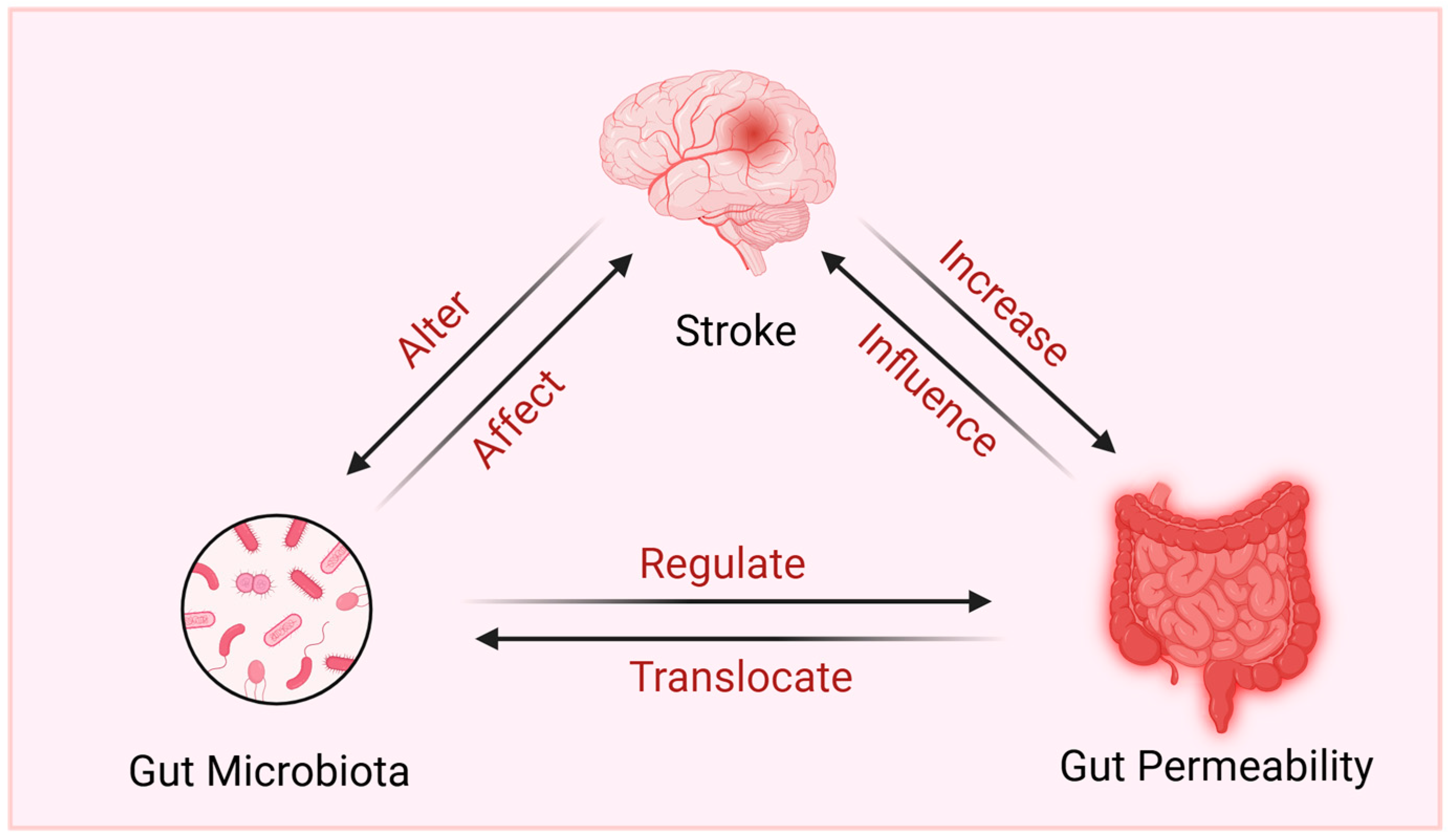
As an acute cerebrovascular condition, stroke is one of the most important contributors to long-term disability and mortality, affecting millions of people each year worldwide. Ischemic stroke (IS) and hemorrhage stroke (HS) are the two main types of strokes, among which 87% are ischemic, 10% are intracerebral hemorrhage (ICH), and 3% are subarachnoid hemorrhage (SAH) according to the 2024 American Heart Association statistical update [1,2], implying the structural or functional damage to brain tissue caused by the blockage or rupture of cerebral blood vessels. Recent years have witnessed alarming growth as well as the youthful trend of stroke incidence with the prevalence of unhealthy lifestyle and eating habits. In the US, there is a projection that an additional 3.4 million adults over 18 will suffer a stroke by 2030 [1]. Although the therapy of stroke has improved during the past few decades, including intravenous thrombolysis, intra-arterial thrombectomy, recombinant tissue plasminogen activator therapy, and so on, it is limited due to the narrow therapeutic window, individual differences, as well as the potential risk [3]. In addition, dementia, cognitive impairment [4], anxiety, depression [5], and communication disorder [6] can be observed in a large amount of post-stroke cases. Thus, early prevention and intervention of stroke and understanding potential therapeutic targets are particularly essential.
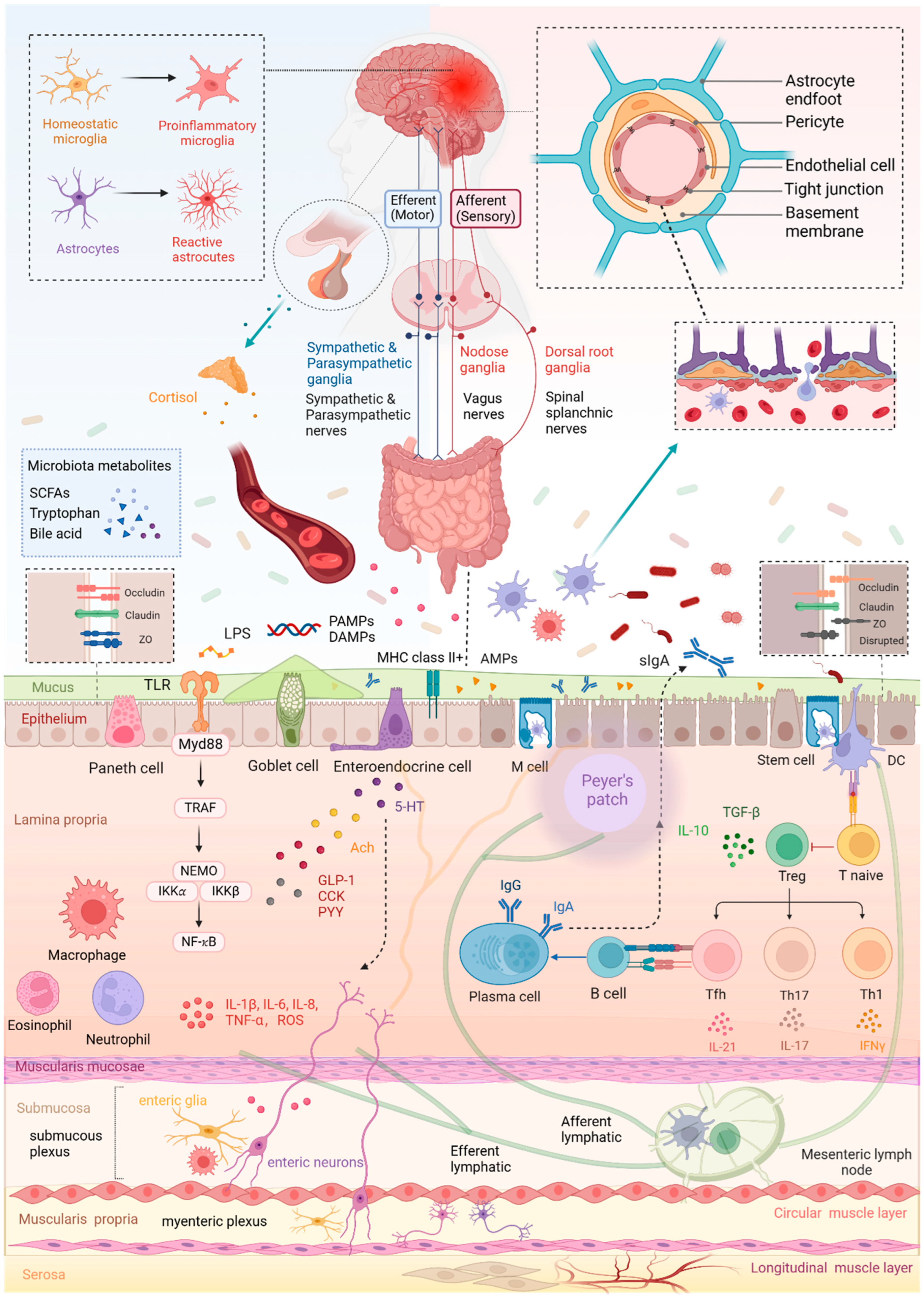
Numerous studies suggested that intestinal disorders accompanied by gut microbial alteration, such as inflammatory bowel disease, irritable bowel syndrome, and constipation, have complex interactions with stroke [7,8,9,10]. Gastrointestinal disorders or gut dysbiosis, on the one hand, often appear as complications in stroke patients; on the other hand, they may increase the risk of stroke [11] or worsen cerebral infarction [12]. The gut environment influences brain function in many ways, involving the central nervous system (CNS), enteric nervous system (ENS), autonomic nervous system (ANS), neuroendocrine system (hypothalamic–pituitary–adrenal axis), and immune system [13]. Likewise, the brain fine-tunes gut activities. The intricate bidirectional communication system between the gastrointestinal tract (GIT) and the brain is called the gut–brain axis (GBA). Since gut microbiota act as an integral regulator in the GBA, the GBA was further extended to the microbiota–gut–brain axis (MGBA) [14].
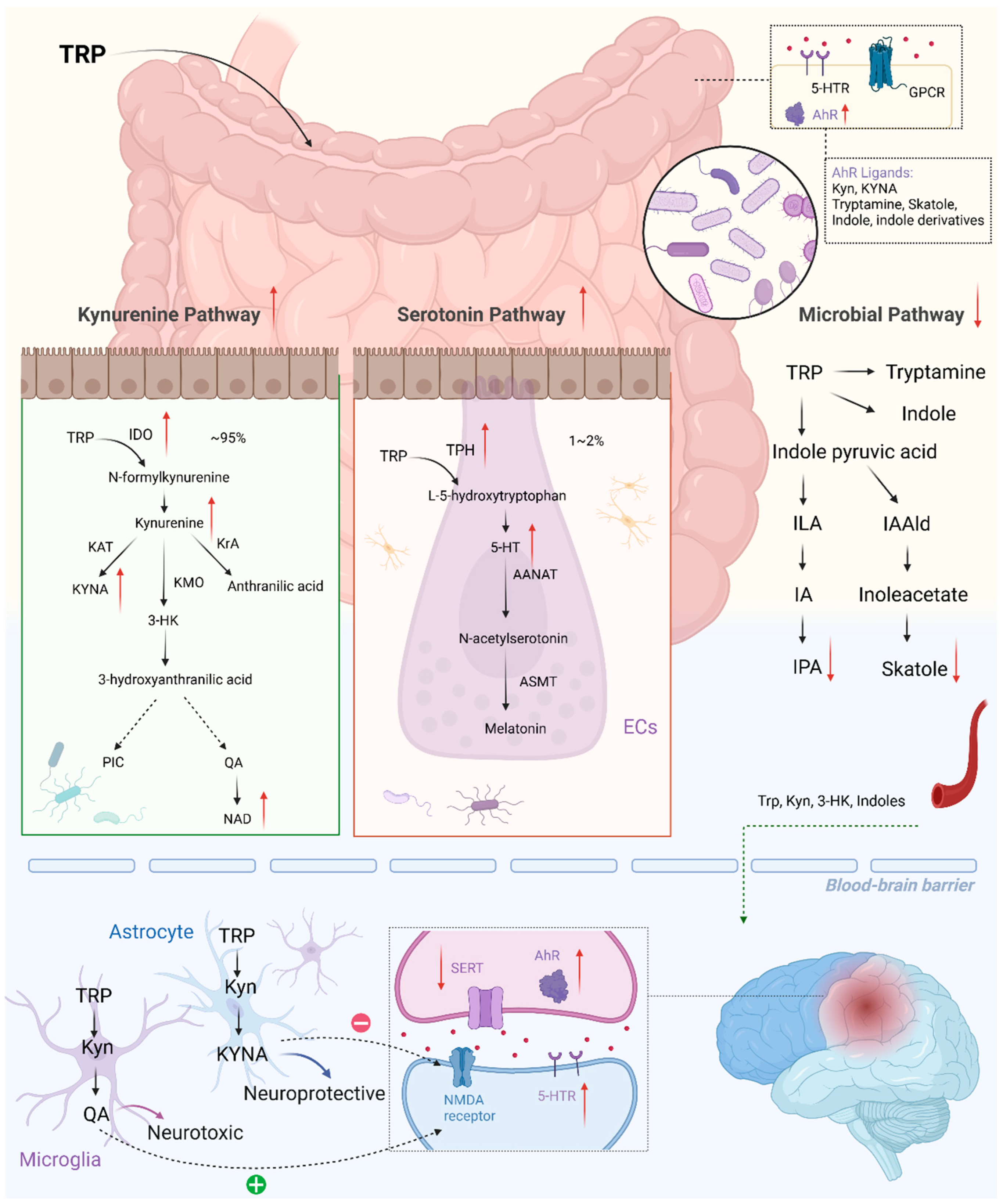
A key component of the MGBA is tryptophan, an essential amino acid whose metabolism is directly or indirectly regulated by the gut microbiota [15]. Products of tryptophan metabolism, including 5-hydroxytryptamine (serotonin, 5-HT), kynurenines, indole derivatives, etc., exert profound impacts on the pathways related to MGBA [16]. Mounting evidence supports a clear correlation between stroke and Trp metabolism in the MGBA with regard to enzyme activities, metabolite level changes, and related genes [17,18,19]. Promisingly, tryptophan and its metabolites serve as potential biomarkers as well as therapeutic targets of neurological disorders, including stroke, endorsing high precision of diagnosis and alternative treatments.
In this review, we systematically summarize the mechanism of MGBA and comprehensively discuss the role of MGBA in stroke, with a focus on the correlation between tryptophan metabolism and the pathogenesis and progression of stroke, combining the latest knowledge so as to provide a reference for further exploration of the prevention, treatment, and rehabilitation of stroke.
 
More at link.

Tuesday, July 23, 2019

Systematic Review on the Involvement of the Kynurenine Pathway in Stroke: Pre-clinical and Clinical Evidence

Way beyond my pay grade, ask your doctor.

Systematic Review on the Involvement of the Kynurenine Pathway in Stroke: Pre-clinical and Clinical Evidence

  • 1Neuropsychiatry Program, Department of Psychiatry and Behavioral Sciences, University of Texas Health Science Center at Houston, Houston, TX, United States
  • 2BRAINS Lab, Department of Neurology, University of Texas Health Science Center at Houston, Houston, TX, United States
Background: Stroke is the second leading cause of death after ischemic heart disease and the third leading cause of disability-adjusted life-years lost worldwide. There is a great need for developing more effective strategies to treat stroke and its resulting impairments. Among several neuroprotective strategies tested so far, the kynurenine pathway (KP) seems to be promising, but the evidence is still sparse.
Methods: Here, we performed a systematic review of preclinical and clinical studies evaluating the involvement of KP in stroke. We searched for the keywords: (“kynurenine” or “kynurenic acid” or “quinolinic acid”) AND (“ischemia” or “stroke” or “occlusion) in the electronic databases PubMed, Scopus, and Embase. A total of 1,130 papers was initially retrieved.
Results: After careful screening, forty-five studies were included in this systematic review, being 39 pre-clinical and six clinical studies. Despite different experimental models of cerebral ischemia, the results are concordant in implicating the KP in the pathophysiology of stroke. Preclinical evidence also suggests that treatment with kynurenine and KMO inhibitors decrease infarct size and improve behavioral and cognitive outcomes. Few studies have investigated the KP in human stroke, and results are consistent with the experimental findings that the KP is activated after stroke.
Conclusion: Well-designed preclinical studies addressing the expression of KP enzymes and metabolites in specific cell types and their potential effects at cellular levels alongside more clinical studies are warranted to confirm the translational potential of this pathway as a pharmacological target for stroke and related complications.

Introduction

Stroke is clinically defined by the sudden onset of focal neurological symptoms (motor, sensory, cognitive) due to ischemia or hemorrhage in the brain. It is the second leading cause of death after ischemic heart disease and the third leading cause of disability-adjusted life-years lost worldwide (1). In the last two decades, there has been significant advance in the acute management of stroke, including the establishment of dedicated stroke inpatient units and the use of thrombolysis for eligible patients with ischemic stroke. Despite this progress, stroke-related deaths and morbidity remain a major health problem with personal and societal implications.
To address the great need of advancing stroke management, several mechanisms implicated in the pathophysiology of stroke, such as mitochondria dysfunction, glutamate-induced excitotoxicity, neuroinflammation, oxidative stress, among others, have been investigated as therapeutic targets. Among putative candidates, the kynurenine pathway (KP) received attention in the 1990's with a renewed interest recently on the wave of inflammatory-centric perspective of central nervous system diseases, including stroke (2).
The KP is the major route of tryptophan (TRP) catabolism in mammals. TRP is an essential amino acid used in the biosynthesis of proteins, being also a precursor of several bioactive molecules, such as serotonin and melatonin. Around 90% of TRP is metabolized by tryptophan 2,3-dioxygenase (TDO) into kynurenine (KYN) in the liver, with a much lower contribution of extra-hepatic KP on TRP degradation (5–10%) (3). TDO is liver specific, but two TDO variants been identified in mouse brain structures during development (4).
In extrahepatic tissues, especially cells of the immune and central nervous systems, the KP is initiated by the degradation of TRP by indoleamine 2, 3-dioxygenase 1 (IDO), the rate limiting enzyme of the pathway. This enzyme is potently upregulated by pro-inflammatory stimuli (2). After this step, the KP branches into two major pathways–one implicated in neuroprotection, the other in neurotoxicity–that are segregated across cell types (Figure 1). Under physiological conditions, the neuroprotective branch is more active as most of kynurenine in the brain is metabolized into kynurenic acid, a NMDA and α7-nicotinic acetylcholine receptor antagonist, through the action of kynurenine aminotransferases (KATs) expressed mainly in astrocytes (5). Under inflammatory conditions, the metabolism is shifted through kynurenine-3-monooxygenase (KMO) to produce 3-hydroxykynurenine and other toxic metabolites, including quinolinic acid, a NMDA receptor agonist and an oxidative stressor (3, 6). KMO is primarily expressed in microglia, the resident immune cells in the brain, and is also expressed at high levels in peripheral immune cells such as monocytes/macrophages (7).