Changing stroke rehab and research worldwide now.Time is Brain! trillions and trillions of neurons that DIE each day because there are NO effective hyperacute therapies besides tPA(only 12% effective). I have 523 posts on hyperacute therapy, enough for researchers to spend decades proving them out. These are my personal ideas and blog on stroke rehabilitation and stroke research. Do not attempt any of these without checking with your medical provider. Unless you join me in agitating, when you need these therapies they won't be there.

What this blog is for:

My blog is not to help survivors recover, it is to have the 10 million yearly stroke survivors light fires underneath their doctors, stroke hospitals and stroke researchers to get stroke solved. 100% recovery. The stroke medical world is completely failing at that goal, they don't even have it as a goal. Shortly after getting out of the hospital and getting NO information on the process or protocols of stroke rehabilitation and recovery I started searching on the internet and found that no other survivor received useful information. This is an attempt to cover all stroke rehabilitation information that should be readily available to survivors so they can talk with informed knowledge to their medical staff. It lays out what needs to be done to get stroke survivors closer to 100% recovery. It's quite disgusting that this information is not available from every stroke association and doctors group.

Showing posts with label ground reaction forces. Show all posts

Tuesday, September 22, 2026

Task-oriented treadmill training with versus without posterior elastic resistance in chronic stroke survivors with limited walking function: a randomised controlled trial with exploratory strength-GRF-speed associations

 With NO protocol created and NO objective starting point this research is nonrepeatable, totally fucking useless!

Task-oriented treadmill training with versus without posterior elastic resistance in chronic stroke survivors with limited walking function: a randomised controlled trial with exploratory strength-GRF-speed associations

    We’re sharing this article early to provide faster access to peer-reviewed, accepted research. It is citable and carries a permanent DOI. This version is subject to further edits and will be replaced automatically by the final Version of Record. All legal disclaimers apply.

    Abstract

    Background

    Reduced gait speed, impaired ground reaction force (GRF) generation, and lower-limb weakness are common in chronic stroke survivors and contribute to limited functional mobility. Although treadmill training can improve walking capacity, it remains unclear whether adding posterior elastic resistance provides incremental benefits in propulsion-related kinetics and in the functional linkage among strength, GRF, and walking performance, particularly in individuals with limited walking function. This study compared intensity-matched task-oriented treadmill training with versus without posterior resistance and secondarily explored changes in strength-GRF-speed relationships.

    Methods

    Forty chronic stroke participants were randomly assigned to conventional treadmill training (CON) or treadmill training with posterior resistance (EXP). Both groups received training for 30 min/session, twice weekly for eight weeks. Primary outcomes included preferred and maximum gait speed, bilateral vertical and anterior-posterior GRFs during walking, and lower-limb muscle strength. Secondary outcomes included walking energy expenditure (V̇O₂). Multivariate repeated-measures ANOVA was used to assess training effects. Pre-post associations among gait speed, GRFs, and strength were evaluated as secondary exploratory analyses.

    Results

    In the primary unadjusted analyses, both groups demonstrated significant time effects for preferred and maximum gait speed, walking energy expenditure, and affected-side knee flexor, knee extensor, and ankle plantarflexor strength (all p < 0.05). However, sensitivity analyses adjusted for stroke onset duration showed that several time effects were attenuated. A significant between-group difference was observed only for the second vertical GRF peak on the affected side at maximum speed, which was higher in EXP than CON and remained significant after adjustment (p = 0.049). No broad group × time interaction effects were observed. Exploratory analyses showed that post-training associations among gait speed, affected-side strength, and anterior-posterior GRF appeared more consistent.

    Conclusions

    In chronic stroke survivors with limited walking function, intensity-matched treadmill-based gait training improved walking speed, oxygen uptake, and lower-limb strength, although several time effects were attenuated after adjusting for stroke onset duration. Adding posterior resistance showed a condition-specific between-group difference in paretic late-stance vertical loading at maximum speed but did not result in broad superiority in functional outcomes. Posterior elastic resistance may serve as a feasible adjunct to augment paretic-limb loading during high-demand walking.

    Trial registration ClinicalTrials.gov Protocol Registration: trial number NCT04974840

    Monday, July 27, 2026

    Data-driven analysis of heterogeneous gait subgroups and ground reaction forces based on integrated center of pressure–center of mass dynamics in poststroke hemiparesis

     This didn't tell me ONE DAMN THING that will get survivors recovered! You're all fired!

    Maybe you could get something from these instead, I'm sure your doctor isn't up-to-date on all this.

    Data-driven analysis of heterogeneous gait subgroups and ground reaction forces based on integrated center of pressure–center of mass dynamics in poststroke hemiparesis

    Kimihiko Mori ,Tatsuya Teramae,Masanori Wakida,Naoto Mano,Yuta Chujo,Takayuki Kuwabara,Meguru Taguchi,Kimitaka Hase,Tomoyuki Noda

    Abstract

    Introduction

    Hemiparetic gait is characterized by abnormal ground reaction forces (GRFs) with impaired control of the center of mass (CoM) relative to the center of pressure (CoP). Although both anteroposterior and mediolateral gait control have been examined separately, how their integrated stance-phase–derived CoP–CoM interactions and local CoP-based features relate to GRF characteristics remains unclear.

    Objective

    This exploratory study aimed to explore the relationships between CoP–CoM and CoP-based dynamics and GRFs and descriptively identify candidate gait subgroups of individuals with poststroke hemiparesis using a data-driven clustering approach.

    Methods

    Seventy-eight community-dwelling individuals with poststroke hemiparesis participated in a three-dimensional gait analysis. Stance-phase–derived CoP–CoM parameters of the transverse plane and local CoP-based loading metrics were extracted during the paretic stance phase. Relationships between these gait metrics and GRFs, particularly early braking force, propulsion, and late braking force, were examined using nonparametric correlation analyses. K-means clustering was performed to explore candidate gait subgroups, and inter-cluster differences were exploratorily examined.

    Results

    Across all participants, several CoP–CoM interaction metrics showed significant correlations with GRFs. In particular, insufficient forward progression of the CoM relative to the CoP during late stance showed a strong correlation with late braking force (rs = 0.79). Clustering suggested the presence of four candidate gait subgroups characterized by differing combinations of anteroposterior and mediolateral CoP–CoM dynamics and local CoP loading features. However, the results of clusters with small sample sizes warrant cautious interpretation.

    Conclusions

    Integrated stance-phase–derived CoP–CoM dynamics and CoP-based parameters may highlight heterogeneity in hemiparetic gait and may have meaningful associations with GRF characteristics. The candidate gait subgroups should be interpreted as hypothesis-generating and may offer a descriptive framework for understanding diverse gait disorders.

    Friday, January 24, 2025

    Comparison of cognitive functional therapy and neurofeedback training on kinetic gait in patients with chronic non-specific low back pain: a randomised controlled trial

     My left side low back pain is because the gluteus medius is overworked because my gait is off, no pushoff and my left foot angles 15 degrees to the left due to spasticity. None of which my doctors or therapists told me would occur and not do anything about it!

    Comparison of cognitive functional therapy and neurofeedback training on kinetic gait in patients with chronic non-specific low back pain: a randomised controlled trial

    Received 07 Aug 2024, Accepted 05 Jan 2025, Published online: 22 Jan 2025
     

    Abstract

    Purpose of the article

    Walking disorders are a significant issue for patients with low back pain. The aim of clinical trials is to compare the effects of cognitive functional therapy (CFT) and neurofeedback training (NFBT) on gait kinetics in chronic non-specific low back pain (CNSLBP) patients.

    Materials and Methods

    Sixty females with chronic non-specific low back pain were recruitment for clinical trials. They were randomly divided into experimental and one control groups (Each group 20 patients). The experimental group received the relevant interventions for eight weeks. The primary outcome was pain, kinesiophobia and disability. The secondary outcome was vertical ground reaction force (VGRF) parameters. Two-Way Repeated Measures ANOVA statistical method was used for data analysis.

    Results

    Within-group comparisons showed that neurofeedback training and cognitive functional therapy groups experienced significant improvement in pain intensity, disability and kinesiophobia after eight-week (p < 0.05). However, the cognitive functional therapy group improved the vertical ground reaction force parameters better than the neurofeedback training group (p < 0.05).

    Conclusions

    cognitive functional therapy intervention had a greater effect on the vertical ground reaction force parameters. The reason for the greater effect of cognitive functional therapy intervention on vertical ground reaction force parameters can be partially explained due to the multimodal therapy used through cognitive exercises and motor control.

    IMPLICATIONS FOR REHABILITATION

    • Cognitive functional therapy and neurofeedback training was shown to reduce pain intensity, disability, and kinesiophobia, Consequently improving vertical ground reaction force parameters in patients with Chronic non-specific low back pain.

    • Among the psychological interventions used, the cognitive functional therapy significantly showed more effectiveness in improving the vertical ground reaction force parameters of patients with chronic non-specific low back pain.

    • Our research may inform clinical decision-making and guide the development of therapeutic interventions for patients with chronic non-specific low back pain.

    Tuesday, June 30, 2020

    Indirect measurement of anterior-posterior ground reaction forces using a minimal set of wearable inertial sensors: from healthy to hemiparetic walking

    I got absolutely nothing out of this. NO SOLUTION  to the gait problems of stroke survivors, so useless. 

    Indirect measurement of anterior-posterior ground reaction forces using a minimal set of wearable inertial sensors: from healthy to hemiparetic walking


    Abstract

    Background

    The anterior-posterior a (AP-GRF) and propulsion and braking point metrics derived from the AP-GRF time series are indicators of locomotor function across healthy and neurological diagnostic groups. In this paper, we describe the use of a minimal set of wearable inertial measurement units (IMUs) to indirectly measure the AP-GRFs generated during healthy and hemiparetic walking.

    Methods

    Ten healthy individuals and five individuals with chronic post-stroke hemiparesis completed a 6-minute walk test over a walking track instrumented with six forceplates while wearing three IMUs securely attached to the pelvis, thigh, and shank. Subject-specific models driven by IMU-measured thigh and shank angles and an estimate of body acceleration provided by the pelvis IMU were used to generate indirect estimates of the AP-GRF time series. Propulsion and braking point metrics (i.e., peaks, peak timings, and impulses) were extracted from the IMU-generated time series. Peaks and impulses were expressed as % bodyweight (%bw) and peak timing was expressed as % stance phase (%sp). A 75%-25% split of 6-minute walk test data was used to train and validate the models. Indirect estimates of the AP-GRF time series and point metrics were compared to direct measurements made by the forceplates.

    Results

    Indirect measurements of the AP-GRF time series approximated the direct measurements made by force plates, with low error and high consistency in both the healthy (RMSE= 4.5%bw; R2= 0.93) and post-stroke (RMSE= 2.64%bw; R2= 0.90) cohorts. In the healthy cohort, the average errors between indirect and direct measurements of the peak propulsion magnitude, peak propulsion timing, and propulsion impulse point estimates were 2.37%bw, 0.67%sp, and 0.43%bw. In the post-stroke cohort, the average errors for these point estimates were 1.07%bw, 1.27%sp, and 0.31%bw. Average errors for the braking estimates were higher, but comparable.

    Conclusions

    Accurate estimates of AP-GRF metrics can be generated using three strategically mounted IMUs and subject-specific calibrations. This study advances the development of point-of-care diagnostic systems that can catalyze the routine assessment and management of propulsion and braking locomotor deficits during rehabilitation.

    The neuromechanical processes underlying healthy bipedal locomotion are multi-factorial [1–3] and converge on locomotor patterns that are characteristically fast, efficient, and stable [1, 4]. An impaired ability to transition from step to step is a locomotor deficit common across diagnostic groups [5–13]. During the step-to-step transition of each gait cycle, a braking force is generated by the leading limb as it makes contact with the ground in front of the body. To efficiently accelerate the body into the next step, coordination of the timing and magnitude of the forward propulsion force generated by the trailing limb is required [1, 14–16]. Moreover, to walk faster, healthy individuals symmetrically increase the magnitude of propulsion generated by each limb while maintaining the relative timing of the propulsion peak [15, 17, 18]. In individuals with impaired propulsion function, walking is often slow, metabolically expensive, and unstable [19–22].
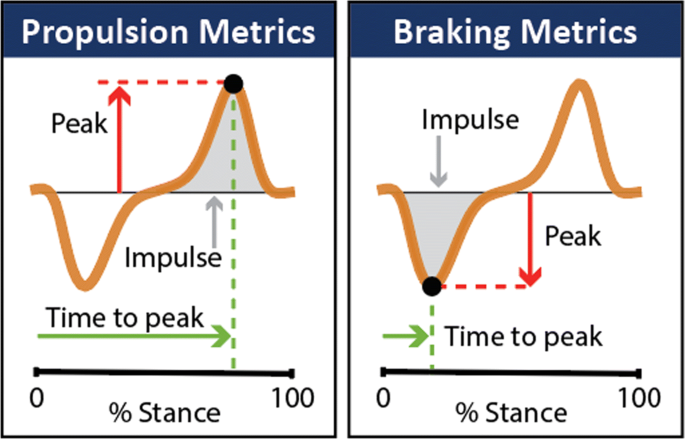
    Laboratory equipment such as instrumented treadmills and forceplates are the gold standard in characterizing propulsion and braking function during healthy [23, 24] and impaired [5, 6, 9, 10, 20, 25–27] walking by way of direct measurements of the anterior-posterior ground reaction forces (AP-GRFs) generated during walking and point metrics extracted from the AP-GRF time series (Fig. 1). For example, older adults are reported to generate up to 22% less peak propulsion (i.e., the peak of the anterior ground reaction force) compared to young adults [23, 24], and in people post-stroke, the propulsion generated by the paretic limb is up to 68% less than the non-paretic limb [9, 20, 26, 27]. Studies that have combined AP-GRF measurements with clinical evaluations have shown the clinical consequences of impaired propulsion function. Indeed, asymmetry in the propulsion impulses generated by the paretic and non-paretic limbs is correlated with hemiparetic severity [9, 28]. Moreover, deficits in propulsion function are highly related to walking speed [29] and long distance walking [30] after stroke—key determinants of community participation and perceived quality of life [19, 31, 32].

    Fig. 1
    figure1
    Anterior-posterior ground reaction force (AP-GRF) time series and salient propulsion and braking metrics
    Despite the importance of propulsion to a functional bipedal gait, conventional rehabilitation efforts have, by and large, been unable to restore propulsion function after neurological injury or dysfunction. The development and study of interventions that target propulsion function is a highly active area of research [12, 33–41]; however, the clinical translation of these experimental approaches is hindered by the limited access that rehabilitation clinicians have to the sophisticated instrumentation (i.e., forceplates and instrumented treadmills) and personnel with advanced training required to collect, analyze, and interpret ground reaction force data. Moreover, even in settings with access to a motion analysis laboratory, locomotor differences inherent to treadmill walking and the small collection footprint of most overground forceplate walkways limit ecological validity. Together, these limitations of the current state-of-the-art motivate the development of point-of-care propulsion diagnostic systems. The clinical management of locomotor propulsion deficits will remain untenable if the measurement instruments used to assess limb propulsion remain inaccessible.
    Wearable sensors are a promising solution for this measurement gap. Indeed, wearable sensors have been used to extend gait measurements outside of the laboratory [42–47] and a wide range of methods and sensors have proven effective in providing indirect measurements of the ground reaction forces generated during walking [48–51]. These methods, however, have largely not been effective for the AP-GRFs and depend on assumptions of healthy, consistent walking patterns that may not translate to impaired locomotor patterns [51, 52]. Recent work has shown that inertial measurement units (IMUs) can be used to make measurements during healthy [44] and hemiparetic walking [53] that are highly correlated to key features of propulsion. The aims of this study were to extend this work by describing the use of a minimal set of IMUs to indirectly measure the AP-GRF generated during healthy and hemiparetic walking and provide estimates of: (i) the AP-GRF time series and (ii) salient propulsion and braking point metrics (i.e., peak magnitudes, peak timings, and impulses) extracted from the time series (see Fig. 1).

    Tuesday, January 14, 2020

    Characteristics of Intralimb Kinetic Coordination in the Lower Limbs During Gait in Patients with Hemiparesis Due to Stroke

    I got absolutely nothing out of this and can't see anyway this could help recovery. 

    Characteristics of Intralimb Kinetic Coordination in the Lower Limbs During Gait in Patients with Hemiparesis Due to Stroke

    Abstract

    Background:
    The main objective of the present study is to investigate the relationship
    between the principal components (PCs) of the sagittal kinetic variables in the lower limb and
    the ground reaction forces (GRFs) during gait in patients with hemiparesis. 
    Methods:
    We recruited 21 patients with hemiparesis and 12 healthy controls. The 3
    dimensional (3-D) coordinates of 33 markers were measured with a 3-D motion analysis
    system operating at 120 Hz and force plates as the subjects walked along a 7-meter walkway.
    The correlation coefficients between the over-time series of PCs, which is calculated using
    principle component analysis (PCA), and GRFs were compared among the left side of the
    controls and the paretic side (PS) and non-PS of the patients by using analysis of variance
    (ANOVA). 
    Results: 
    The correlation coefficient of the non-PS between the first PC and GRF in the
    anteroposterior-direction was significantly higher than that on the PS (P < 0.05) and that of
    the non-PS in the vertical-direction was lower than the PS (P < 0.05). 
    Conclusions:
    The results indicated that intralimb kinetic coordination on the PS plays an
    essential role in weight support in patients with hemiparesis, whereas the kinetic coordination
    on the non-PS plays a role in generation of propulsion.