Changing stroke rehab and research worldwide now.Time is Brain! trillions and trillions of neurons that DIE each day because there are NO effective hyperacute therapies besides tPA(only 12% effective). I have 523 posts on hyperacute therapy, enough for researchers to spend decades proving them out. These are my personal ideas and blog on stroke rehabilitation and stroke research. Do not attempt any of these without checking with your medical provider. Unless you join me in agitating, when you need these therapies they won't be there.

What this blog is for:

My blog is not to help survivors recover, it is to have the 10 million yearly stroke survivors light fires underneath their doctors, stroke hospitals and stroke researchers to get stroke solved. 100% recovery. The stroke medical world is completely failing at that goal, they don't even have it as a goal. Shortly after getting out of the hospital and getting NO information on the process or protocols of stroke rehabilitation and recovery I started searching on the internet and found that no other survivor received useful information. This is an attempt to cover all stroke rehabilitation information that should be readily available to survivors so they can talk with informed knowledge to their medical staff. It lays out what needs to be done to get stroke survivors closer to 100% recovery. It's quite disgusting that this information is not available from every stroke association and doctors group.

Showing posts with label saebo. Show all posts

Saturday, June 25, 2022

Thumb Stabilization and Assistance in a Robotic Hand Orthosis for Post-Stroke Hemiparesis

When I was using the Saebo-flex, the thumb was the problem with only one cable.

Thumb Stabilization and Assistance in a Robotic Hand Orthosis for Post-Stroke Hemiparesis

Publisher: IEEE

Abstract:

We propose a dual-cable method of stabilizing the thumb in the context of a hand orthosis designed for individuals with upper extremity hemiparesis after stroke. This cable network adds opposition/reposition capabilities to the thumb, and increases the likelihood of forming a hand pose that can successfully manipulate objects. In addition to a passive-thumb version (where both cables are of fixed length), our approach also allows for a single-actuator active-thumb version (where the extension cable is actuated while the abductor remains passive), which allows a range of motion intended to facilitate creating and maintaining grasps. We performed experiments with five chronic stroke survivors consisting of unimanual resistive-pull tasks and bimanual twisting tasks with simulated real-world objects; these explored the effects of thumb assistance on grasp stability and functional range of motion. Our results show that both active- and passive-thumb versions achieved similar performance in terms of improving grasp force generation over a no-device baseline, but active thumb stabilization enabled users to maintain grasps for longer durations.
Published in: IEEE Robotics and Automation Letters ( Early Access )
Page(s): 1 - 7
Date of Publication: 22 June 2022
ISSN Information:
Publisher: IEEE

Sunday, September 6, 2020

Application of Novel Graphite Flex Sensors in Closed-Loop Angle Feedback on a Soft Robotic Glove for Stroke Rehabilitation

This will require protocol instructions for use. 

Many gloves out there. Which is the best? Your doctor better know the answer.

Application of Novel Graphite Flex Sensors in Closed-Loop Angle Feedback on a Soft Robotic Glove for Stroke Rehabilitation


Goh, Aaron Jing-Yuan BEng; Yap, Hong-Kai PhD; Ramachandran, Gokula Krishnan PhD; Yeow, Chen-Hua PhD

Author Information
Journal of Prosthetics and Orthotics: August 31, 2020 - Volume Online First - Issue -
doi: 10.1097/JPO.0000000000000337
  • Buy
  • PAP

Abstract

Introduction 

Stroke survivors require physiotherapy and rehabilitation programs to restore their hand function so that they can carry out activities of daily living (ADLs) independently. Soft robotic gloves are designed to assist in these rehabilitation programs and reduce manpower costs, but their pressure-activated actuation mechanisms require closed-loop position feedback to allow for finer motor coordination for the hands, thereby improving hand rehabilitation for patients who had stroke. We present a novel design of graphite-based flex sensors that we implemented in a soft robotic glove to evaluate its performance in closed-loop metacarpophalangeal (MCP) joint angle feedback.

Materials and Methods 

The graphite-based flex sensors are embedded into a sensor glove and characterized in terms of baseline stability and drift, over 20 continuous loading cycles per trial for five times. Curve-fitting using both linear and nonlinear equations was done to determine the relationship between resistance and MCP joint angle, using Vicon MX motion capture system to obtain 3D coordinates and joint angles, as well as separate Arduino circuitry to obtain signal voltage samples.

Pneumatic pressures are regulated using proportional-integral-derivative (PID) control, with a safety factor (SF) of 1.2. Two control algorithms were developed to make use of angular feedback to control set point pressures: 1) Intent Recognition Mode makes use of a single MCP angle threshold at 50° to activate a maximum output pressure was set at 100 kPa (83.33 kPa after SF); and 2) Fixed Interval Assist Mode makes use of different MCP joint angle values (30°, 45°, 60°, and 90°) to derive corresponding set point pressures set at 25, 50, 75, and 100 kPa (20.83, 41.67, 62.50, and 83.33 kPa after SF).

Results 

Nonlinear equations consistently provided a reasonably better fit as compared with the linear equation fit. However, in this work, the linear MCP joint angle models are preferred as a calibration method, because nonlinear equations are hard to implement in control algorithms in practice. PID control for Intent Recognition activates and deactivates at approximately 18% and 95% of each full flexion-extension exercise cycle progression, respectively. For Fixed Interval Assist Mode, thumb MCP joint angle feedback is less repeatable compared with that of the other fingers in the same experiment, possibly because of the difficulty in placement of the sensor at the thumb MCP joint, close proximity to other sensors, and physiological crosstalk between the fingers.

Conclusions 

This work has presented a novel integration and implementation of graphite-based flex sensors with a soft robotic glove for stroke rehabilitation. The relationship between the signal voltage and the MCP joint angle varies greatly with anatomical differences between each individual, and with sensor placement. However, based on the experimental results, a linear mapping calibration algorithm for the graphite-based flex sensors was implemented, which also complements its robustness for the potential application on stroke rehabilitation. The effectiveness of the calibration algorithm is also thus demonstrated via the Intent Recognition and Fixed Angle Assist control algorithms.

© 2020 by the American Academy of Orthotists and Prosthetists.

Wednesday, May 13, 2020

Perfect world of stroke rehab - recovery plan

From a conversation with another survivor points out the current situation.
Not good.


Lead, Follow, or GET OUT OF THE WAY!


Doesn't this just about sum up our feelings about the role doctors and therapists should play?

The one thing that pisses me off more than any other is this.  The identification and implementation of a recovery plan is apparently NOT the responsibility of doctors or therapists.  Isn't it ironic that they still maintain that proprietary attitude when a patient appears to be trespassing into what they perceive as their realm.  They manage to dismiss our ideas while effectively providing none of their own.

I once brought in an article on hand recovery using the Saeboflex. My doctor totally dismissed it, I don't think he had even thought or researched it at all. He was just never going to listen to a patient's ideas. I was so fucking mad I left him and went to a different doctor telling him the only reason I was using him was to get the Saeboflex even though my extension was not enough to meet the criteria for use. I really hated the Saeboflex, the bead chains for adjusting the tension are almost impossible to adjust one-handed and just getting it on was an extreme challenge. When I complained to Saeboflex their excuse was that the unit was supposed to be used with a therapists help. In my opinion, bad design since all stroke rehab implements should be able to be put on solo one handed with no outside interventions. 


Perfect World!!!

With decent scientific therapy protocols this could be resolved.  
This is the 100% recovery plan.

Wednesday, August 8, 2018

Guide to Helping Young People Recovering From a Stroke

This guide from Saebo is necessary because your doctor and stroke hospital have completely failed at getting you anywhere close to 100% recovery. If that is not their goal you need to fire them. I don't care how hard that goal is to solve. You try to recover from a stroke with NO rehab protocols. Everything for your recovery will need to be found by yourself, including the frequency and timing of rehab.  You are completely on your own.

Guide to Helping Young People Recovering From a Stroke

Friday, October 27, 2017

Sunday, July 16, 2017

Saebo Announces FDA Clearance of SaeboVR - World's First Virtual ADL Rehabilitation System

My doctor pooh-poohed the idea of Saebo-Flex when I brought an article about it to him. I don't think he even knew about it at the time. That there showed his incompetence along with never telling me I had a stroke, just a CVA with no explanation. No clue what this is like, you'll have to google it yourself, your doctor will never mention it. 

Saebo Announces FDA Clearance of SaeboVR - World's First Virtual ADL Rehabilitation System 


News provided by
Saebo, Inc.
Jul 12, 2017, 08:11 ET

CHARLOTTE, N.C., July 12, 2017 /PRNewswire/ -- Saebo, Inc. announced on Wednesday that the U.S. Food and Drug Administration (FDA) has cleared SaeboVR, a virtual ADL (activities of daily living) rehabilitation system designed to engage neurological clients in both physical and cognitive challenges involving simulated functional tasks. This first-of-its-kind software system is grounded in National Institutes of Health (NIH)-sponsored research demonstrating the efficacy of virtual ADL practice for upper extremity rehabilitation.
SaeboVR's ADL-focused virtual world provides clients with real-life challenges. Users will incorporate their impaired upper limb to perform simulated self-care tasks that involve picking up, transferring and manipulating virtual objects. The proprietary platform recreates real, everyday life experiences including, but not limited to, grocery shopping, making breakfast, taking care of a pet, or planting a virtual garden.  In addition to interacting with meaningful self-care tasks, SaeboVR uses a virtual assistant that appears on the screen to educate and facilitate performance by providing real-time feedback. As an added benefit, SaeboVR can be customized to challenge endurance, speed, range of motion, coordination, timing, and cognitive demand, thereby ensuring maximum success. After each session, SaeboVR displays graphical reports for easy viewing.
"As an occupational therapist working with individuals with neurological diagnoses, I want to provide realistic and meaningful activities that also offer many repetitions of movements to promote neuroplasticity," stated Allison Ellington, OTD, OTR/L. "SaeboVR is a motivating, engaging, and occupation-based product that allows for customizable and safe practice of activities that are meaningful to clients.  Individuals who have used this system tell me they notice improvements in how they are able to use their impaired arm more functionally, which is so important."
This great excitement for SaeboVR is fueled by years of clinical research, as well. "Barron Associates, Inc. is excited to partner with Saebo in making virtual ADL practice a reality for patients and therapists," said Richard Adams, Ph.D. "The release of SaeboVR culminates five years of NIH-sponsored R&D and successful clinical trials that have provided a solid body of evidence for the efficacy of simulated ADLs in improving upper extremity motor function in individuals with acquired brain injury."
Saebo's Co-Founder, Henry Hoffman, notes that the SaeboVR is opening new opportunities for clinicians and patients alike. "As the world's only provider of a virtual reality system solely focused on simulated self-care tasks, SaeboVR opens new possibilities for clinicians and patients," he noted. "Prior to this break-through technology, motion capture programs were primarily focused on games rather than real-life functional tasks. Although computer-based exercises can be beneficial, often times, therapists report that games are not always appropriate for a certain patient population or lack significance to maintain a client's motivation and engagement. Thankfully, SaeboVR fills the void by not only being meaningful and relevant, but truly functional and appropriate for all ages."

Friday, July 14, 2017

Saebo, Inc. Awarded Patent for Low-Profile Stroke Recovery Glove

I do wonder how you get the glove on over spastic fingers by yourself. 

Saebo, Inc. Awarded Patent for Low-Profile Stroke Recovery Glove


Charlotte, NC, July 08, 2017 --(PR.com)-- Saebo, Inc., a medical device company specializing in affordable and novel clinical solutions designed to improve mobility and function, announced on Thursday a new patent awarded for the SaeboGlove, a hand rehabilitation product launched in the Summer of 2016 that has since gained international attention as one of the most effective and comfortable hand solutions on the market.

The SaeboGlove is designed to help patients suffering from neurological and orthopedic injuries incorporate their hand functionally during therapy and at home. Its proprietary tension system extends the fingers and thumb after grasping an object. The SaeboGlove is lightweight, low-profile, and features a secure, spiral forearm design and a non-slip silicon liner and fingertips to improve traction and maintain proper alignment. The device is based on the latest advances in neurorehabilitation research documenting the brain’s ability to “re-program” itself through mass practice, task-oriented arm training.

Saebo developed the SaeboGlove after many years of success with their flagship product, the SaeboFlex, another hand recovery device designed to assist in extension of the fingers. The SaeboFlex is a higher-profile device made from durable rigid parts used to support and assist individuals with increased spasticity. The new SaeboGlove device offers a lower profile version, designed specifically for clients that exhibit mild tone or less. Many patients often “graduate” to the SaeboGlove after several months with the SaeboFlex.

“The research is clear that clients with limited hand function do not use their affected arm enough throughout the day,” states Saebo co-founder Henry Hoffman. “This lack of use curbs further progress and sets the clients on a path for a plateau in their recovery. In the past, Saebo was able to address this concern by offering the SaeboFlex which allows moderately to severely impaired clients to use their hand for grasp and release tasks and exercises. With the addition of the SaeboGlove for mildly affected clients, we now have 2 options available for stroke hand recovery."

“Saebo's mission is to provide affordable and accessible break-through home recovery products that will assist with mobility and function. For under $300 USD, many clients will now have the ability to not only use their hand functionally, but reverse the impairment. No other hand stroke technology for that price exists on the market today."

The SaeboGlove has been used by thousands of patients around the world, and is recommended by therapists for anyone who experiences hand weakness following a neurological or orthopedic injury. The SaeboGlove is available in multiple sizes, can be ordered online, directly from the Saebo website, and does not require a prescription from a doctor; however, it is recommended that the patient consult with a licensed therapist before ordering the device.

About Saebo
Saebo, Inc. is a medical device company primarily engaged in the discovery, development and commercialization of affordable and novel clinical solutions designed to improve mobility and function in individuals suffering from neurological and orthopedic conditions. With a vast network of Saebo-trained clinicians spanning six continents, Saebo has helped over 250,000 clients around the globe achieve a new level of independence. For more information about Saebo, please visit: www.saebo.com.

Facebook: https://www.facebook.com/saeboinc/
Twitter: https://twitter.com/saeboinc
LinkedIn: https://www.linkedin.com/company-beta/1542162/
YouTube: https://www.youtube.com/user/SaeboInc

Thursday, April 27, 2017

Video Game Helping Patients Rehab from Stroke

Minor help, too expensive and not enough repetitions available in the time periods therapists are allowed with patients.  52 posts on video games here so your stroke hospital can compare them to see which has the best efficacy. 

Video Game Helping Patients Rehab from Stroke 


CHARLOTTESVILLE, Va. (WVIR) - A type of video game could be the new way patients rehab from strokes.
Albemarle County based Barron Associates developed the Saebo V-R, it'll be distributed starting this summer to clinics nationwide. The starting cost is nearly $10,000.
Occupational therapists think it could be the key to getting patients back to normal, and to having a little fun while they do it.
"There's a lot of new technology coming out influencing the way we do rehabilitation," said Allison Ellington, an occupational therapist.
This could be the new way to come back from a difficult diagnosis, and now with FDA approval experts are rolling out Saebo V-R.
The virtual reality system was designed in central Virginia, and has patients moving their arms.
"We developed our own algorithms to do the motion tracking," said Eileen Krepkovich, a research scientist with Barrons Associates. "I think it's a great tool for the clients because it uses real life activities, it lets them practice things that they're inherently motivated to get back to doing."
Those activities might include laundry or gardening.
Ellington has her occupational therapy students at Mary Baldwin University's Murphy Deming School studying the system as a tool for working with patients.
And with her own patients at UVA-Healthsouth Rehabilitation Hospital she's seeing success.
"We have measured patient satisfaction with this system, which has been really high, but most exciting, we were able to show a significant improvement in upper-extremity function after just eight weeks of using the system three times a week," said Ellington.

Tuesday, September 6, 2016

SaeboStim Micro

If the glove is required then I could never use it unless I have two other people cranking my fingers open. But then that much spasticity would probably mean it had never been tested on persons like myself . Companies can decline to figure out how to treat the wicked problems. A great stroke association would tackle those difficult problems rather than running away. 

SaeboStim Micro 


Saebo, Inc., is a leading global provider of innovative rehabilitation products for stroke survivors and other neurologically impaired individuals. Headquartered in Charlotte, NC, the company was founded in 2001 by two occupational therapists specializing in stroke rehabilitation. As the leading cause of long-term disability in the U.S., stroke affects over 700,000 Americans every year, leaving many with crippling side affects including the loss of hand function. Saebos pioneering treatment protocols are based on new research documenting the brains remarkable ability to re-program itself following injury.

The companys neurological orthotic devices, including the ground-breaking SaeboFlex and SaeboReach, allow patients with very little residual arm and hand function to immediately begin performing task-oriented, grasp and release activities, thereby forging new pathways in the brain. Named Most Valuable Product in 2008 by Therapy Times, the Saebo Program is now offered as a treatment option at over 2,000 clinics and hospitals nationwide, including 22 of the Top 25 Rehabilitation Hospitals as ranked by U.S. News & World Report. The Saebo orthoses are also eligible for reimbursement by Medicare and most commercial insurers. With a network of over 6,000 trained clinicians spanning four continents, Saebo is committed to helping stroke survivors around the globe achieve a new level of independence.

Visit us at: http://www.saebo.com/saebostim-micro/

Sunday, May 29, 2016

SaeboReJoyce is an upper extremity rehabilitation workstation

What stroke protocol is your doctor following to get your arm recovered? 'Winging it' or 'We'll see' is not allowed. You might need to start screaming at the lack of knowledge your doctors have about stroke recovery. DEMAND to know exactly how you are getting 100% recovery. They should feel damned uncomfortable not being able to answer that question. That embarrassment might be the only way they will contact their doctor associations to see what can be done to solve all the problems in stroke.
Do not let them off the hook if they start using the fuckingly stupid response, 'All strokes are different, all stroke recoveries are different'. That is a sign of incompetence.
http://www.saebo.com/saebo-rejoyce/
The SaeboReJoyce is an upper extremity rehabilitation workstation designed for orthopedic and neurological patients who exhibit impaired function of the arm and hand. The computerized task-oriented training system provides standardized upper limb exercises representing activities of daily living (ADL). The SaeboReJoyce was designed to be used in the clinic and in home-based settings.
View brochure

Thursday, February 11, 2016

Partial weight support of the arm affects corticomotor selectivity of biceps brachii - SaeboMAS

How is your therapist accomplishing this without this device? I used a cane

Partial weight support of the arm affects corticomotor selectivity of biceps brachii - SaeboMAS


Abstract

BACKGROUND:

Weight support of the arm (WS) can be used in stroke rehabilitation to facilitate upper limb therapy, but the neurophysiological effects of this technique are not well understood. While an overall reduction in muscle activity is expected, the mechanism by which WS may alter the expression of muscle synergies has not been examined until now. We explored the neurophysiological effect of WS on the selectivity of biceps brachii (BB) activation in healthy adults.

METHODS:

Thirteen participants completed counterbalanced movement tasks in a repeated measures design. Three levels of WS (0, 45, and 90 % of full support) were provided to the arm using a commercial device (Saebo Mobile Arm Support). At each level of WS, participants maintained a flexed shoulder posture while performing rhythmic isometric elbow flexion (BB agonist) or forearm pronation (BB antagonist). Single-pulse transcranial magnetic stimulation of primary motor cortex was used to elicit motor-evoked potentials (MEPs) in BB 100-300 ms before muscle contraction. Baseline muscle activity and MEP amplitude were the primary dependent measures. Effects of movement TASK and SUPPORT LEVEL were statistically analyzed using linear mixed effects models.

RESULTS:

As expected, with increased support tonic activity was reduced across all muscles. This effect was greatest in the anti-gravity muscle anterior deltoid, and evident in biceps brachii and pronator teres as well. For BB MEP amplitude, TASK and SUPPORT LEVEL, interacted such that for elbow flexion, MEP amplitudes were smaller with incrementally greater WS whereas, for forearm pronation MEP amplitudes were smaller only at high WS.

CONCLUSIONS:

Weight support of the arm influences corticomotor selectivity of biceps brachii. WS may impact coordination independently of a global reduction in muscle activity. The amount of supportive force applied to the arm influences the neuromechanical control profile for the limb. These findings may inform the application of WS in upper limb stroke rehabilitation.
PMID:
26502933
[PubMed - in process]

PMCID:
PMC4623918

Free PMC Article

Thursday, January 14, 2016

Saebo glove

This looks much better than the contraption(Saeboflex) I have and never use.
http://www.saebo.com/saeboglove-details/
But your doctor should already know which of these others turns out the best based upon your needs. I know I'm lying thru my teeth on that last sentence.
Your doctor should have already analyzed these 36 posts on gloves and 127 posts on hand and 36 on fingers to know exactly how to recover your hand and see if this new one is better. But I bet s/he doesn't have any clue how to recover your hand.
Saebo glove


Saeboflex

Thursday, April 2, 2015

Strengthening a Spastic Muscle. Why the Kerfuffle?

A writeup from Henry Hoffman of Saebo. I wonder how many years before this gets into textbooks so we can have therapists properly trained.
https://saebotechknowlogy.wordpress.com/
Not as much now, but in the recent past, discussing strength training a hyperactive or spastic muscle was a very controversial topic amongst clinicians at happy hour, in the clinic, or at CEU’s. For many, the thought of having upper motor neuron lesion clients squeeze their hyperactive finger flexors or flex their spastic biceps in the late 1980-90’s (and earlier) would have made many clinicians cringe. The visual that comes to mind for me is something out of a CSI show, but instead of a homicide, you were looking at a clinical “assault and battery” where security would have been called and the crime scene tape would have been wrapped around the patient and the plinth. The suspected serial criminal then would have collected his or her belongings and performed the famous perp walk out of the clinic for all of the fellow clinicians to see. Yes, the media would have eventually covered this story and learned that this inept clinician, known publically now as “high toner”, would be linked to previous clinical crimes ranging from “excessive upper trap activation” to “absence of manual cues”. OK, maybe a bit melodramatic and a tad over-exaggerated, but I think you get the idea.

More at link.

Thursday, December 11, 2014

Evidenced-Based Treatment for the Neurologically Impaired Upper Limb - What is the Bottom Line?


A much easier way to see what is out there. I'm sure I have the research to back up each of these but that will be for Saebo to do. Ask your doctor for specific stroke protocols for each of these. If s/he doesn't have any call up the hospital president and demand that the personnel file be updated with this incompetence.You need to do this to pay it forward for all the stroke survivors that follow you. A few neurologist jobs may need to be sacrificed for the common good
From Saebo; https://www.facebook.com/photo.php?fbid=948584648500210
Although it is missing thermal stimulation and mirror therapy

Friday, September 13, 2013

PM&R doctors

Physical Medicine and Rehabilitation. This is the type of doctor I had in the hospital.  Also called physiatrist.
My comments on mine;
My PMR doctor for stroke  had obviously never opened a research paper since school. He wrote 3 prescriptions, for OT, PT, ST all for ET(Evaluate and Treat). From talking to my therapists none had ever seen my MRI or received any directions from this doctor.  It's why I now firmly believe in Pay for performance. I had my OT running interference to get botox instead of him. He pooh-poohed the article I brought him on Saeboflex.


FAQs about PM&R

Toni Patt talking about this in her blog posting;

What's the Purpose of a PM & R Doctor?

 For what my doctor did he should have never been paid for anything.

Friday, November 9, 2012

Effect of intensive training with a spring-assisted hand orthosis on movement smoothness in upper extremity following stroke: A pilot clinical trial

If you are interested in Saeboflex. 

Effect of intensive training with a spring-assisted hand orthosis on movement smoothness in upper extremity following stroke: A pilot clinical trial


 Abstract: Study assessed the feasibility of intensive training using a spring-assisted hand orthosis on upper extremity in individuals with chronic hemiparetic stroke. Five participants for the experimental group and 5 for the control group were recruited from a local rehabilitation hospital. Subjects in the experimental group participated in 4 weeks of training using a SaeboFlex orthosis for 1 hour per day, 5 times per week. Each subject in the control group wore the same orthosis for 1 hour per day without participating in upper extremity training. Outcome measures included the Fugl-Meyer Assessment (FMA), Box and Block Test (BBT), and Action Research Arm Test; kinematic parameters were collected using a three-dimensional motion analysis system. The FMA and the BBT score were increased significantly in the experimental group after the intervention. The resultant velocity of the wrist joint for the reach-to-grasp task decreased significantly, and the resultant velocity of the shoulder joint while performing a reach-to-grasp task at acromion height decreased significantly in the experimental group. The study results indicate that the spring-assisted dynamic hand orthosis training is a feasible and effective treatment options for recovering the movement of the hemiparetic upper extremity of patients after stroke.

Friday, November 2, 2012

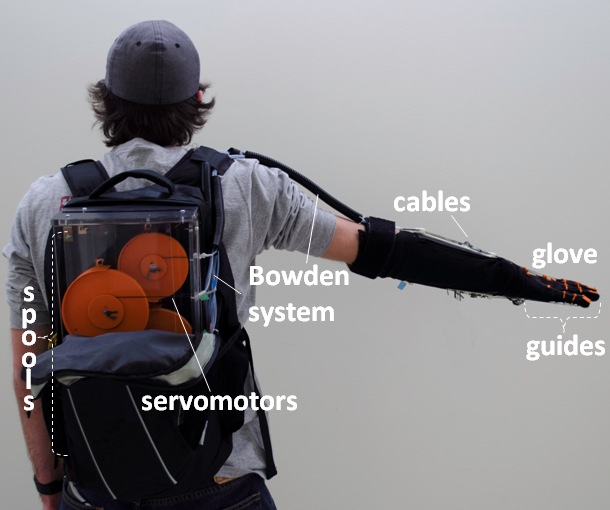
Cable Actuated Exomusculature Glove for Stroke Rehabilitation and Assistance

Have your therapist compare this to the possessed hand. 

Cable Actuated Exomusculature Glove for Stroke Rehabilitation and Assistance

http://aimlab.wpi.edu/research/projects/Stroke_Rehabilitation_Glove
We are developing a glove that can be used for rehabilitation and assistive grasping for those suffering from a stroke or with physical disabilities. The glove can support EMG-controlled active assistance, active resistance, and pre-programmed motions.
I hope they give Saeboflex a run for their money.
video at link.


Photo diagram of arm

Saturday, October 6, 2012

Preparation for biking - saebo-flex

In preparation for another biking attempt I thought I'd see what the Saebo-flex might do for being able to get my left hand off the handlebar in a hurry.  Once again I found out why I hate it so much. It is absolutely not built for stroke survivors to get on by themselves. Velcro that sticks to itself is almost impossible to untangle one-handed.  Bead chains are stupid for survivors.  Even with the maximum spring it was not enough to pull the fingers straight. I know that I was never the candidate for this, they took the easy way out and recommend it for those who only have penumbra damage to finger flexors. But it was the only finger orthotic out there and I just told my doctor I wanted a prescription for it, and damn their requirements. My co-pay was only 10%

Wednesday, August 1, 2012

Saebo Launches New Biofeedback/Stim Device

I know this is commercialization but this is interesting.
 http://e2.ma/message/xosne/h0m6cc
This line is interesting.

What is the Patent Pending Reciprocal EMG

Triggered Stimulation (RETS) Program?
The RETS (Reciprocal EMG Triggered Stimulation) program is ideal for clients with increased tone that have difficulty relaxing the spastic muscles.  The biofeedback stimulation program involves both the agonist and antagonist muscles and is triggered upon relaxation of a muscle instead of activation.
Stimulation is triggered to the desired muscle group (i.e., finger extensors, elbow extensors, etc.) once the client relaxes the opposing hypertonic muscle group (i.e., spastic finger flexors, elbow flexors, etc).  Therefore, the emphasis is placed on relaxing the hypertonic muscles in order for stimulation to be triggered to the opposing weakened muscle group.

Is it even possible to willfully relax the tonic muscles? I'd love to see the research on that.