Changing stroke rehab and research worldwide now.Time is Brain! trillions and trillions of neurons that DIE each day because there are NO effective hyperacute therapies besides tPA(only 12% effective). I have 523 posts on hyperacute therapy, enough for researchers to spend decades proving them out. These are my personal ideas and blog on stroke rehabilitation and stroke research. Do not attempt any of these without checking with your medical provider. Unless you join me in agitating, when you need these therapies they won't be there.

What this blog is for:

My blog is not to help survivors recover, it is to have the 10 million yearly stroke survivors light fires underneath their doctors, stroke hospitals and stroke researchers to get stroke solved. 100% recovery. The stroke medical world is completely failing at that goal, they don't even have it as a goal. Shortly after getting out of the hospital and getting NO information on the process or protocols of stroke rehabilitation and recovery I started searching on the internet and found that no other survivor received useful information. This is an attempt to cover all stroke rehabilitation information that should be readily available to survivors so they can talk with informed knowledge to their medical staff. It lays out what needs to be done to get stroke survivors closer to 100% recovery. It's quite disgusting that this information is not available from every stroke association and doctors group.

Showing posts with label Mechanical thrombectomy. Show all posts

Monday, June 22, 2026

Toward a paradigm shift in post-stroke management New HOPE trial explores individualized approach based on reperfusion pathophysiology

 Still NO PROTOCOL!  And no delivery of that non-existent protocol to all stroke hospitals1
OBVIOULY USELESS RESEARCH!

Toward a paradigm shift in post-stroke management: New HOPE trial explores individualized approach based on reperfusion pathophysiology

 Blood pressure management after thrombectomy for acute ischemic stroke may require a change in approach. The HOPE clinical trial—short for Hemodynamic Optimization of Cerebral Perfusion after Endovascular Therapy—led by the Sant Pau Research Institute (IR Sant Pau), has shown that adapting blood pressure targets to the degree of cerebral reperfusion significantly improves patients’ functional recovery without increasing the risk of complications.  “Until now, we have applied fairly uniform strategies after thrombectomy, but probably not all patients need the same approach,” says Dr. Pol Camps-Renom, head of the Cerebrovascular Diseases Research Group at IR Sant Pau and one of the study coordinators. “Our results suggest that adjusting blood pressure according to the degree of reperfusion can have a direct impact on recovery.” The findings, presented during a plenary session at the annual European Stroke Organisation conference—the leading European scientific society dedicated to stroke—and now published in JAMA Neurology position this work among the most important recent contributions in the stroke field. They have the potential to guide new hemodynamic management strategies after thrombectomy.  Rather than applying rigid targets, the key is to better understand each patient's physiology
Pol Camps-Renom

Mechanical thrombectomy has been a major advance in the treatment of large-vessel occlusion stroke because it can restore blood flow in previously blocked arteries. However, a well-known paradox remains in clinical practice: despite successful angiographic reperfusion, a substantial proportion of patients—around half—do not achieve satisfactory functional recovery in the medium term.(You blithering idiots don't understand the neuronal cascade of death then! Killing off hundreds of millions of neurons in the first week because you haven't stopped the neuronal cascade of death. You're all fired for absolute stupidity!)

 This phenomenon, known as “clinically ineffective reperfusion,” reflects the fact that reopening the vessel does not always result in effective restoration of cerebral perfusion at the tissue level. Mechanisms involved include reperfusion injury, microcirculatory dysfunction, loss of cerebral autoregulation, and hemorrhagic transformation, all of which can compromise brain tissue viability even after a technically successful intervention.  “Many times we can reopen the artery, but the brain tissue does not respond as expected,” explains Dr. Pol Camps-Renom. “The reason is that microvascular perfusion and autoregulatory mechanisms may be impaired, and this is where factors such as blood pressure become critical.” As a result, blood pressure control during the hours following thrombectomy has become a key component of clinical management because it directly influences the balance between maintaining adequate perfusion and avoiding hemorrhagic complications. However, the evidence available so far has been limited and, at times, contradictory. Previous trials based on uniform intensive blood pressure reduction strategies have not demonstrated consistent benefits and have even suggested possible adverse effects. 

Recommended article

News • Research, diagnostics, therapies

Focus on stroke

Strokes are among the most common cause of death worldwide and one of the most common causes of disability. Mortality rates are decreasing due to improving care. Nevertheless, experts expect the absolute number of cases to rise in view of the ageing population. Read more about current research and treatment options here.

 The HOPE trial introduces a different approach based on the concept that hemodynamic management should be adapted to each patient's physiological condition after thrombectomy. The study included 440 patients treated at 11 Spanish hospitals, who were randomly assigned either to a conventional strategy or to blood pressure management tailored to the degree of reperfusion achieved.  Unlike previous trials, HOPE implemented a differentiated strategy according to the final angiographic result. Patients with near-complete or complete reperfusion were treated with lower blood pressure targets to reduce the risk of reperfusion injury, whereas patients with incomplete reperfusion maintained higher blood pressure levels to preserve cerebral perfusion.  This approach recognizes that the brain may be in extremely diverse hemodynamic states, in which both excessively high blood pressure and overly aggressive reductions can be harmful. For this reason, the protocol included close monitoring during the first 72 hours, with dynamic treatment adjustments.  This strategy resulted in a significant and consistent improvement in clinical outcomes. At 90 days, 60.0% of patients in the intervention group achieved functional independence, compared with 47.1% in the control group, representing an absolute difference of 13.3 percentage points, a clinically meaningful improvement. In addition, the overall analysis showed a favorable trend toward better levels of recovery, reinforcing the consistency of the benefit.  In terms of safety, the strategy was associated with a lower incidence of hemorrhagic transformation, without increasing mortality or serious complications, confirming a favorable balance between efficacy and safety. “We have shown that it is possible to improve patient recovery without adding risk,” adds Dr. Joan Martí-Fàbregas, another investigator involved in the study. “This balance between efficacy and safety is probably one of the most relevant aspects of the findings.”  The results of the HOPE trial point toward a more individualized model for blood pressure control after thrombectomy. In a setting where previous trials had produced neutral or unfavorable results, this study introduces a physiology-based approach that can optimize the balance between perfusion and hemorrhagic risk.  Beyond its findings, HOPE provides key elements for the design of future studies, including the stratification of therapeutic targets and prolonged hemodynamic monitoring. The study also reinforces the idea that stroke treatment does not end with recanalization but continues during the hours that follow. “Rather than applying rigid targets, the key is to better understand each patient's physiology,” concludes Dr. Camps-Renom.  Although the trial was stopped before reaching the planned sample size, its results demonstrate a clinically meaningful effect size. Nevertheless, additional studies will be required to confirm these findings before they can be broadly incorporated into routine clinical practice.  Overall, the HOPE trial positions blood pressure control as a key component in optimizing stroke treatment after thrombectomy and opens the door to more precise strategies tailored to individual patients.  Source: Institut de Recerca Sant Pau 

Sunday, May 3, 2026

Stroke survivors 'face life of disability' due to brutal NHS postcode lottery

 The vast majority of stroke survivors are facing a life of disability since only 10% fully recover. The lottery is NOT THE PROBLEM!  The problem is your stroke medical 'professionals' aren't even working on 100% recovery protocols!

The thrombectomy is only the first step towards recovery! Why aren't your 'professionals' doing the rest of the work for 100% recovery?

Laziness? Incompetence? Or just don't care? NO leadership? NO strategy? Not my job? Not my Problem!

Stroke survivors 'face life of disability' due to brutal NHS postcode lottery

Stroke victims are missing out on a potentially lifesaving procedure due to an NHS postcode lottery.
A thrombectomy removes a blood clot from a blocked blood vessel in the brain and must be performed in the 24 hours after a stroke. Experts warn patchy access to it at hospitals in the UK means “some stroke patients are left facing a life of disability when others are not”.
Analysis from the Stroke Association suggests that in the three months from October to December last year, 1,222 stroke patients missed out on a thrombectomy. The charity’s medical director Professor Deb Lowe said: "There are thousands of stroke survivors in the UK who could be living very different lives from the realities they now face if they had received a thrombectomy.

"They could potentially work, live independently, easily hold a conversation, and simply enjoy a sense of normality. Instead, they may not be able to even leave the house without help. We can - and must - do better, so the 240 people who survive stroke every day have the chance to live well."

Over 85,000 people survive a stroke every year in the UK. Brain damage caused by a stroke can leave survivors unable to move, see, speak or even swallow.

The NHS is missing a target set out in 2019 to expand thrombectomy from 1% to 10% of stroke patients, saying the move would lead 1,600 more people to be independent after their stroke each year.

The Sentinel Stroke National Audit Programme, which covers England, Wales and Northern Ireland, found that just 4.8% of stroke patients had a thrombectomy between October and December 2025.

The Stroke Association said that of the 24 specialist neuroscience centres across England, only 17 currently deliver a thrombectomy regardless of the day or time. This is despite funding reportedly being made available to try to prepare services for 24/7 care.

Phil Woodford, aged 55, had a stroke on a weekend in 2016, which meant he missed out on a thrombectomy because his nearest service was yet to introduce 24/7 care. He has been left with significant disability including reduced movement on his left-hand side, permanent pain and fatigue.

Phil, from Preson, was forced to take early retirement from his career as an NHS director. He said: "I will never know for sure but I am confident that, if I'd had a thrombectomy, I wouldn't have been forced to retire due to the extent of disability I had been left with.

"It's still frustratingly not as widely available as it needs to be. People can obviously be unwell at any time of the day or week, so it makes no sense to not offer such a vital service around the clock too."

Professor Deb Lowe added: "There are a multitude of reasons given as to why thrombectomy is still subject to stark inequalities which mean some stroke patients are left facing a life of disability when others are not. Gaps in the stroke workforce are a major factor here as is targeted funding, prioritisation by commissioners and hospital leaders, as well as timing delays due to ambulance response times or hospital handovers.”

A spokeswoman for NHS England said: “The NHS continues to expand thrombectomy services for those eligible, with more stroke patients receiving it each year, but it is not the right course of treatment for all and new clot-busting treatments are also helping to improve patient care and reduce the need for more invasive procedures.

“Over 8 in 10 now have access to 24/7 thrombectomy centres, with remaining sites opening in the coming months, and we’re investing an extra £14 million to further expand services, and training additional staff to carry out mechanical thrombectomy.”

Thrombectomy centres are at the following NHS hospitals

* = do not provide 24/7 service
  • Addenbrooke’s Hospital
  • Southmead Hospital
  • Charing Cross Hospital
  • Derriford Hospital
  • Hull Royal Infirmary*
  • James Cook University Hospital*
  • John Radcliffe Hospital
  • King’s College Hospital
  • Leeds General Infirmary*
  • Queen Elizabeth Hospital
  • Queen’s Medical Centre – Nottingham
  • Queens Hospital Romford
  • Royal Hallamshire Hospital*
  • Royal London Hospital
  • Royal Preston Hospital
  • Royal Stoke University Hospital
  • Royal Sussex County Hospital*
  • Royal Victoria Infirmary*
  • Salford Royal Hospital
  • Southampton General Hospital
  • St George’s Hospital
  • University College Hospital
  • University Hospital Coventry*
  • Walton Centre

Tuesday, March 17, 2026

Relationship between relevant inflammatory markers and short-term functional outcomes of acute ischemic stroke treated with mechanical thrombectomy: a retrospective cohort study

 Predicting failure to recover DOES NOTHING FOR SURVIVORS! You're fired!

Relationship between relevant inflammatory markers and short-term functional outcomes of acute ischemic stroke treated with mechanical thrombectomy: a retrospective cohort study


  • 1. Department of Neurology, The Second Affiliated Hospital of Anhui Medical University, Hefei, Anhui, China

  • 2. Department of Neurology, Xiangyang Hospital of Traditional Chinese Medicine, Xiangyang, Hubei, China

Abstract

Background and purpose: 

Perioperative inflammatory markers are considered critical factors influencing long-term postoperative survival. This study evaluated the neutrophil-to-high-density lipoprotein ratio (NHR), neutrophil-to-lymphocyte ratio (NLR), lymphocyte-to-monocyte ratio (LMR), platelet-to-lymphocyte ratio (PLR), systemic immune-inflammatory response index (SII), and systemic inflammatory response index (SIRI) in relation to functional outcomes in patients with acute ischemic stroke who underwent mechanical thrombectomy (MT). Our objective is to determine the prognostic value of inflammatory composite indices for 90-day functional outcomes in patients with acute ischemic stroke undergoing mechanical thrombectomy and to develop a multivariable prediction model integrating these indices for individualized outcome risk stratification.


Method: 

A total of 112 patients who underwent MT were enrolled between April 2021 and December 2023. Blood tests were performed at admission. Logistic regression analysis was used to evaluate the relationship between NHR, NLR, PLR, LMR, SII, SIRI and poor functional outcomes at 3 months (mRS Score 3–6). Receiver operating characteristic (ROC) curve analysis was conducted to assess the ability of NHR, NLR, PLR, LMR, SII, and SIRI to predict 90-day functional outcomes.


Results: 

A total of 54 patients (48%) had poor functional outcomes at 3 months. The median stroke onset to admission time was [6.7] hours (IQR, [3.45]–[8.05]) for poor functional outcome and [9.0] hours (IQR, [7.45]–[14.15]) for good functional outcome. Mean age of the study cohort was 67.5 years, and 64.3% were male. Multivariate logistic regression analysis revealed that NHR (odds ratio [OR], 1.150; 95% confidence interval [CI] 1.002–1.320, p = 0.046) was an independent predictor for poor functional outcome after adjusting for other clinical and imaging parameters.


Conclusion: 

NHR was independently associated with poor functional outcomes at 3 months in patients with acute ischemic stroke who underwent MT. These findings need to be confirmed in larger samples.(The research you should be doing is PREVNTING THAT POOR FUNCTIONAL OUTCOME! And you're so blitheringly stupid you can't figure that out?

Wednesday, March 11, 2026

Thrombectomy limitations laid bare

So what? The GOAL IS 100% RECIOVERY! Thrombectomy is only the first step, leaders would deliver 100% recovery protocols regardless of failure of intermediate steps! But there are NO LEADERS IN STROKE! You're screwed if you have a stroke!

Thrombectomy limitations laid bare


John Watson, Associate Director for the Stroke Association in Scotland

by John Watson, Stroke Association


Tuesday 10th March 2026

Around one in 10 people who have a stroke will benefit from thrombectomy, a procedure to remove blood clots from their brain which, if undertaken within six hours, can reduce the risk of long-term paralysis, blindness and speech problems. But across most of the country, says John Watson, Associate Director for the Stroke Association in Scotland, unless you manage to get to a specialist centre during weekday working hours, the intervention is not an option.

(This is whining rather than stepping up and delivering recovery. 

Wonder if he will be singing the same tune after he becomes the 1 in 4 per WHO that has a stroke, will he be satisfied with not getting recovered? Leaders deliver step by step plans to get to 100% recovery! Are you a leader or a mouse?)

“Imagine your house is on fire. It’s 4pm. You dial 999. The call handler says: ”We’ll be there first thing tomorrow morning.” How do you feel about that?

Now imagine your brain is on fire. Same time - 4pm. You dial 999 and the call handler says the same thing. Except by then, you could be dead or left profoundly disabled.

None of us would accept the fire brigade scenario. So, why do we accept it when it comes to stroke? It happens every day in Scotland to eligible thrombectomy patients.

Until we have a national 24/7 thrombectomy service, Scotland’s stroke clinicians will continue to be placed in the terrible position of not being able to treat patients they could potentially help. They have a procedure which could get the stroke patient walking, talking, back to work and living independently. They might be able to administer thrombolysis, a clot-busting drug, but the patient will likely have a poorer outcome.

Thrombectomy removes the large blood clot, which causes stroke, from the brain. It is considered the basic standard of care for those who are clinically suitable.

In terms of numbers of patients treated, Scotland sits at 2.2% of eligible patients -around 10% of patients who have an ischaemic stroke could benefit from a thrombectomy This means Scotland’s thrombectomy rate is less than half that of the rest of the UK.

It’s a procedure available only at Ninewells Hospital in Dundee, the Royal Infirmary of Edinburgh (RIE) and Queen Elizabeth University Hospital (QEUH) in Glasgow. Eligible patients are transferred by ambulance from hospitals across the country to their nearest thrombectomy centre.

Ninewells, which serves the north of Scotland for thrombectomy, and the QEUH, which serves the west of Scotland, both provide the procedure Monday to Friday, 8am to 8pm.

RIE is the only thrombectomy centre which operates seven days a week 8am to 8pm – for RIE patients. The service is truncated to Monday to Friday, 8am to 8pm for patients referred from eastern NHS hospitals. 

Thursday, February 5, 2026

Stroke Trial Tips Scale Further to Favor Intra-Arterial Lytic After EVT

 This doesn't get you 100% recovered, so you're STILL APPROVING FAILURE AS A MATTER OF COURSE!

Stroke Trial Tips Scale Further to Favor Intra-Arterial Lytic After EVT

CHOICE-2 supports intra-arterial alteplase after successful reperfusion(Success is 100% recovery, quit trying to justify failure by using your tyranny of low expectations!)

NEW ORLEANS -- A stronger case could be made for intra-arterial (IA) alteplase after successful mechanical thrombectomy based on more randomized data, this time the CHOICE-2 trial from Spain.

In acute ischemic stroke patients with large vessel occlusions who achieved majority-complete reperfusion with endovascular therapy (EVT), adjunctive IA alteplase further increased the likelihood of good functional outcomes when given in the 24-hour window. Ninety-day modified Rankin Scale (mRS) scores of 0-1 were significantly more likely after alteplase treatment compared with EVT alone (57.5% vs 42.9%, P=0.002).

Moreover, alteplase improved the secondary outcomes of CT perfusion and patient-reported quality of life.

"Let me announce happily that CHOICE-2 is a positive clinical trial," said Ángel Chamorro, MD, PhD, of the University of Barcelona and Hospital Clinic of Barcelona, to applause at the International Stroke Conference.

With the number needed to treat being seven patients, "let me remind you that this is approximately the number needed to treat patients with IV thrombolysis within 3 hours from the onset of symptoms, compared to placebo. So I think this is a remarkable figure," he added.

As for the safety of IA alteplase, the results were mixed: no excess symptomatic intracerebral hemorrhage was detected at 36 hours (1.4% vs 0.5% for controls, P=0.33), but death at 90 days was significantly more likely in the treated group (12.1% vs 6.4%, P=0.04).

Chamorro argued that the apparent difference in mortality likely reflects an "extremely low" event rate among control patients in CHOICE-2. Indeed, in the older PEARL trial, all-cause mortality occurred in 17.1% of patients who received adjunctive IA alteplase and 11.3% of those who received EVT alone, a nonsignificant difference.

The benefit of using adjunctive IA thrombolytics is based on frequent observations that EVT patients often still have functional impairments; lingering microvascular hypoperfusion is believed to be the culprit.

The original CHOICE trial had been stopped early due to a shortage of the placebo, Chamorro said. However, it did suggest benefit with IA alteplase for stroke patients with successful angiographic reperfusion: there was an improvement in the mRS score at 90 days with alteplase 0.225 mg/kg, maximum 22.5 mg (a slightly different dose to CHOICE-2's maximum 20 mg over a 15-minute infusion).

More recently, promising results have been reported with clot-busters after successful EVT, namely IA tenecteplase in ANGEL-TNK and IA alteplase in PEARL, both presented last year. However, there's also been disappointing results in the POST-TNK and POST-UK trials in which adjunctive IA tenecteplase and urokinase, respectively, fell short in achieving longer survival without disability after EVT.

American stroke guidelines, updated last week, thus state that adjunctive IA thrombolytics with urokinase, alteplase, or tenecteplase "may be reasonable" to improve cerebral reperfusion and 90-day functional outcomes in stroke patients with complete or near-complete EVT (class IIb recommendation).

"The usefulness of administration of adjunctive intra-arterial thrombolytics, namely urokinase and tenecteplase, after successful thrombectomy remains uncertain, as data from four major [randomized controlled trials] are conflicting," the guideline authors reasoned.

The open-label CHOICE-2 trial was conducted at 14 Spanish centers with blinded assessment of clinical and imaging outcomes.

The study included stroke patients with large vessel occlusions with majority-complete reperfusion (expanded Thrombolysis in Cerebral Infarction grade [eTICI] 2b50-3) post-EVT who had been treated within 24 hours of stroke onset. The Alberta Stroke Program Early CT Score (ASPECTS) could not be below 6, and patients were excluded if they had an NIH Stroke Score of 25 or higher or if they had contraindications to alteplase.

Ultimately, 440 participants were randomized to EVT alone or with IA alteplase. The median cohort age was around 76 years, and the group was roughly split between the sexes. Median NIH Stroke Score was 15, about 64% had a preceding IV thrombolysis, and cause of stroke was cardioembolic in nearly half of cases.

Sunday, January 4, 2026

SPONSORED CONTENT: Mary Washington Hospital launches lifesaving stroke procedure

 Still NOT GOOD ENOUGH! You have NOTHING for getting to 100% recovery! Are you that blitheringly stupid you managed to miss the only goal in stroke? 100% recovery! You think 'care' is what survivors want? Talk to them sometimes, they'll bend your ear off on what their goals are compared to yours!

SPONSORED CONTENT: Mary Washington Hospital launches lifesaving stroke procedure

Residents of the Fredericksburg region now have access to one of the most advanced stroke treatments available, thanks to a major expansion at Mary Washington Hospital. Mary Washington Healthcare has introduced thrombectomy procedures at its Primary Stroke Center, a move that will save lives and reduce long-term disability for patients experiencing severe strokes.

A thrombectomy is an emergency procedure in which a neurosurgeon uses a catheter and imaging technology to remove a blood clot from the brain, restoring blood flow. When performed quickly—often within hours of the first symptoms—the treatment can dramatically improve recovery and survival rates.

“With a stroke, seconds count,” said Dr. John C. Muse, the cerebrovascular neurosurgeon leading the new program. “Having the tools and the talent for thrombectomy procedures means even the most critical stroke patients can be treated quickly and safely right here in Fredericksburg.”

Mary Washington Hospital has invested in a state-of-the-art neurointerventional suite equipped with advanced 3D imaging, allowing surgeons to navigate delicate blood vessels and place stents with precision. The addition of thrombectomy services is part of a broader plan to expand neurological care(NOT RECOVERY!) in the region. Mary Washington Healthcare is recruiting more specialists and aims to achieve Comprehensive Stroke Center status within three years.According to the Centers for Disease Control and Prevention, nearly 795,000 Americans suffer a stroke each year. Warning signs include sudden loss of balance, vision changes, slurred speech, weakness in the arms or legs, or facial drooping. Experts urge anyone experiencing these symptoms to call 911 immediately.

Muse says the goal is not only to treat strokes but also to provide full-spectrum care(NOT RECOVERY!)—from diagnosis and surgery to rehabilitation—without patients having to leave the community.

“This is how we build the next generation of neuroscience care(NOT RECOVERY!) for our region,” he said.

For more information about advanced stroke care(NOT RECOVERY!) at Mary Washington Healthcare, visit: stroke.mwhc.com.

Editor’s note: This article was provided by Mary Washington Healthcare, a corporate sponsor of the Fredericksburg Free Press. As part of its continued partnership with MWHC, the Free Press will publish monthly public health awareness content on topics such as wellness, preventative care and the latest advancements in healthcare. This partnership seeks to help the community make informed health decisions while offering a behind-the-scenes look at local care and services. Content has been edited for clarity and style by the editorial staff.

Monday, December 1, 2025

Administration of eptifibatide as rescue therapy during mechanical thrombectomy in acute ischemic stroke

Your competent? doctor has known of eptifibatide use for over a decade, right?


  • Eptifibatide (5 posts to February 2013)
  •  Administration of eptifibatide as rescue therapy during mechanical thrombectomy in acute ischemic stroke

    David Cernik,David Cernik1,2*Jiri NeumannJiri Neumann3Jarmila NeradovaJarmila Neradova2Veronika HlinenaVeronika Hlinena2Pavol Viglas,Pavol Viglas2,5David CihlarDavid Cihlar5Filip CihlarFilip Cihlar6
    • 1Department of Neurology, Univerzita Palackeho v Olomouci Lekarska fakulta, Olomouc, Czechia
    • 2Department of Neurology, Masarykova nemocnice Usti nad Labem oz, Ústí nad Labem, Czechia
    • 3Department of Neurology, Krajska zdravotni as Nemocnice Chomutov oz, Chomutov, Czechia
    • 4Department of Physical Education and Sport, Faculty of Education, Univerzita Jana Evangelisty Purkyne v Usti nad Labem, Ústí nad Labem, Czechia
    • 5Department of Radiology, Faculty of Medicine in Hradec Kralove, Charles University, Hradec Kralove, Czechia
    • 6Department of Radiology, J. E. Purkinje University, Masaryk Hospital Krajska zdravotni as, Ústí nad Labem, Czechia

    Background: The success of the technical implementation of mechanical thrombectomy (MT) depends on many factors. Considering the experience of the interventional radiologist and the anatomical vascular differences of individual patients, it has technical limits. In our group, we focused on verifying the effectiveness and safety of eptifibatide intra-arterial administration when a sufficient degree of recanalization was not achieved with standard instruments.

    Methods: The study included 1,350 patients who underwent MT between 2008 and 2022. Neurological deficit was assessed with National Institutes of Health Stroke Scale (NIHSS) and clinical outcome with modified Rankin scale (mRS). Presence of symptomatic intracerebral hemorrhage (SICH) was assessed according to the SITS-MOST criteria. In some patients, eptifibatide was administered in the case of insufficient recanalization or in the case of an acute periprocedural tendency to reocclusion. Achieved recanalization using the Thrombolysis in Cerebral Infarction scale (TICI).

    Results: Eptifibatide was administered during the procedure to 181 patients (age 67.8 ± 12.2 years, 57.5% men). In the eptifibatide group, successful recanalization (≥TICI2b) was achieved in 80.1%, the incidence of ICH was 21.6% and SICH 3.9%. In the group without eptifibatide, successful recanalization was achieved in 80.5%, ICH 19.9% and SICH 5.2%.

    Conclusion: The use of eptifibatide is an effective and safe procedure in technically more difficult cases of MT. It enables a similar degree of recanalization to be achieved without increasing the risk of SICH.

    Introduction

    Mechanical thrombectomy (MT) is a standard, highly effective and safe treatment for symptomatic cerebral artery occlusion in patients with acute ischemic stroke (AIS). Unfortunately, not all patients achieve a good clinical outcome. One of the most important factors is successful recanalization. Currently, a wide range of instruments are available, which differ in size, design and principle of use. The choice of instrument or technique can have a major impact on the outcome of the intervention. In positive randomized studies, stent-retrievers were used exclusively, which are currently completely dominant worldwide. Another technique is aspiration thrombectomy. In 2017, a randomized study ASTER (The Contact Aspiration vs. Stent Retriever for Successful Revascularization) was published, which did not demonstrate a significant difference in the number of achieved recanalizations between stent-retrievers and aspiration, however, patients treated with aspiration more often needed additional treatment compared to stent-retrievers (1). The combination of aspiration and stent-retriever after failure of the primary thrombectomy method can increase the success rate of recanalization, so some centers primarily use various combinations of aspiration thrombectomy and stent-retriever, e.g., the ARTS (Aspiration-Retriever Technique for Stroke, ARTS) method (2). Despite the use of various techniques, a significant proportion of procedures still fail to achieve successful recanalization of the occluded artery. Currently, the ADAPT (A Direct Aspiration first-Pass Technique) technique is increasingly used, where the primary recanalization technique is the use of aspiration (6). Despite various techniques and instruments, a significant proportion of patients still fail to achieve a sufficient level of recanalization. Eptifibatide is a glycoprotein IIB/IIIA receptor antagonist that is used in combination with a fibrinolytic agent to treat myocardial infarction. Efforts to improve recanalization rates by administering eptifibatide (or other glycoprotein IIb/IIIa inhibitors) in endovascular procedures have generally not yielded conclusive results. The approach in our work is different. Eptifibatide is administered only in the case of primary endovascular failure. The aim of the work is to show that this rescue technique can achieve a significant degree of recanalization in previously almost hopeless cases.

    Methods

    Patients with acute ischemic stroke due to large vessel occlusion who underwent mechanical thrombectomy were included into a monocentric retrospective study. Intravenous thrombolysis was administered to most patients.

    Initial neurological deficit was assessed using the National Institutes of Health Stroke Scale (NIHSS). The achieved recanalization was evaluated using the Thrombolysis in Cerebral Infarction scale (TICI). Eptifibatide (Integrilin, Glaxo Operations UK Ltd.) was applied as rescue therapy after careful consideration of the risks in case of unsuccessful recanalization (TICI <2b) or a clear tendency for immediate reocclusion already during the endovascular procedure.

    The indication criteria for the use of eptifibatide were intracranial artery occlusion intractable to mechanical thrombectomy, periprocedural rethrombosis of atherosclerotic stenosis of intracranial arteries, implantation of an intracranial stent with a clear periprocedural tendency to reocclusion, acute stent thrombosis of carotid or vertebral arteries. In the case of rethrombosis of stenosis and occlusion of the intracranial artery, eptifibatide was administered intraarterially according to the effect of the treatment. The maximum dose for an i.v. bolus (180 micrograms/kg) was not exceeded. Continuous administration was followed by continuous infusion at a dose of 2 micrograms/kg/min if the bolus intra-arterial administration was ineffective until the patient was switched to dual antiplatelet therapy (but not longer than 8 h). Before starting eptifibatide administration, cone beam CT was performed since 2015 to exclude periprocedural hemorrhage.

    We evaluated the safety of the chosen procedure (occurrence of bleeding), the resulting degree of recanalization at the end of the procedure and the clinical effect.

    Symptomatic intracerebral hemorrhage (SICH) on follow-up CT scan 24 h later was assessed according to the SITS-MOST criteria. The presence of intracerebral hemorrhage (ICH) was strictly defined as any new hyperdensity on follow-up CT. As part of secondary prevention, a statin and antiplatelet therapy were used (preferably dual antiplatelet therapy in the form of acetylsalicylic acid and clopidogrel, if ICH was not present on the control CT). In the case of ICH, antiplatelet monotherapy (acetylsalicylic acid) was used at a safe interval according to the size of the ICH. In the case of cardioembolization etiology of AIS, secondary anticoagulant prevention was preferred. Clinical outcome was assessed using the modified Rankin Scale (mRS).

    The aim of the study was to determine efficacy, qualified by achieving successful recanalization of TICI2b ≥2b and achieving self-sufficiency at a three-month interval, assessed by the mRS scale ≤2. The second, equally important endpoint was the assessment of safety, qualified by the rate of hemorrhagic complications during rescue therapy.

    STATISTICA 13.0 (Tibco Software Inc., 2018, United States) was used for statistical data processing. The Shapiro–Wilk test was used to determine the normality of the data. Due to the non-normal distribution of frequencies, non-parametric statistical procedures were used. The Mann Whitney test was used to determine any differences and the chi-square test for possible connections. For both tests, statistical significance was defined as p < 0.05.

    Results

    Patients who underwent mechanical thrombectomy from 2008 to 2022 were included in the study.

    Of the 1,350 MTs, 409 patients (30.3% of all MTs performed) failed to achieve successful recanalization. 181 patients were given eptifibatide (44.3% of MTs with primary inadequate recanalization) and 145 of them subsequently achieved successful recanalization (35.5% of MTs with primary inadequate recanalization, 80.1% of MTs in which eptifibatide was administered).

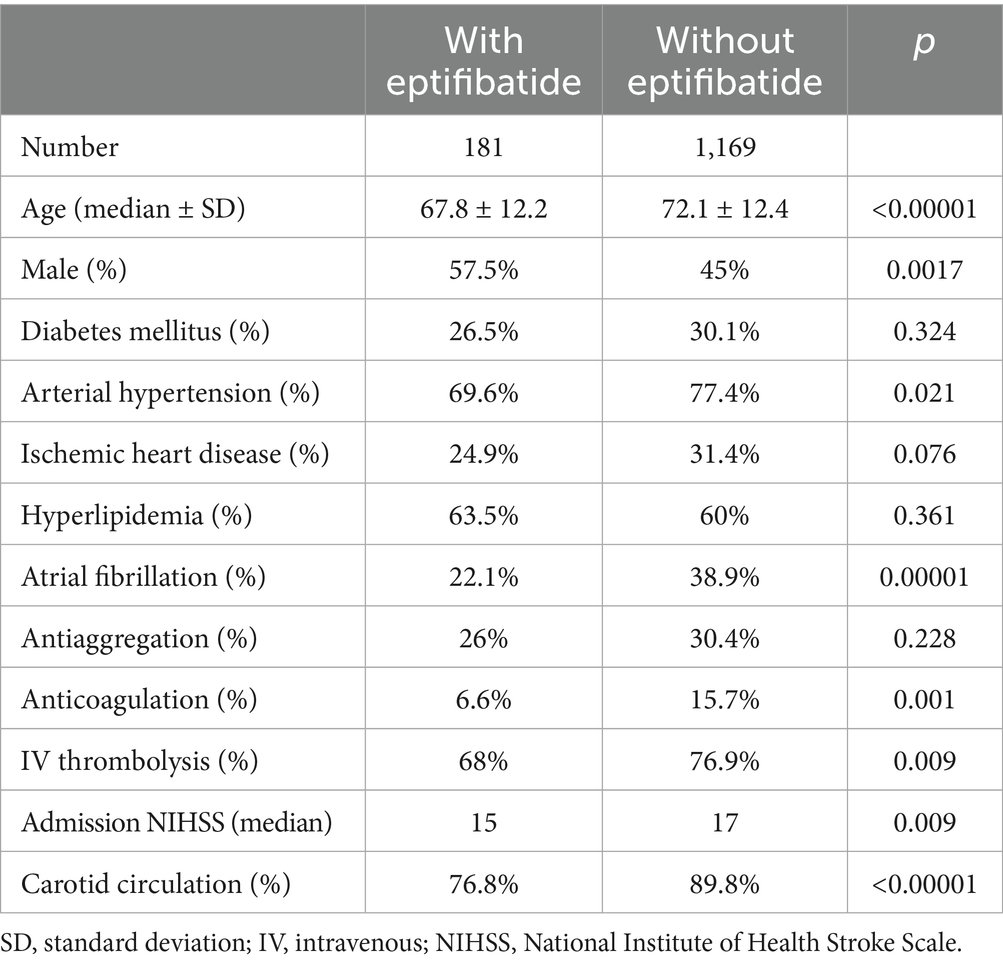
    Patients with eptifibatide were younger (67.8 vs. 73.7%, p < 0.00001), more often male (57.5 vs. 45%, p = 0.002), with a milder baseline clinical condition (15 vs. 17 points in NIHSS, p = 0.009). Patients also suffered from fewer comorbidities. The incidence of arterial hypertension was lower (69.6 vs. 77.4%, p = 0.021), the incidence of atrial fibrillation was also lower (22.1 vs. 38.9%, p = 0.00001) and occlusion in the carotid basin was significantly less common (76.8 vs. 89.8%, p < 0.00001). There were also significant differences in previous use of anticoagulant therapy (6.6 vs. 15.7, p = 0.001) and administration of intravenous thrombolysis before endovascular procedure (68 vs. 76.9%, p = 0.009). The basic and demographic characteristics of the group are summarized in Table 1.

    Table 1
    www.frontiersin.org

    Table 1. Demographic and baseline clinical characteristics of enrolled patients.

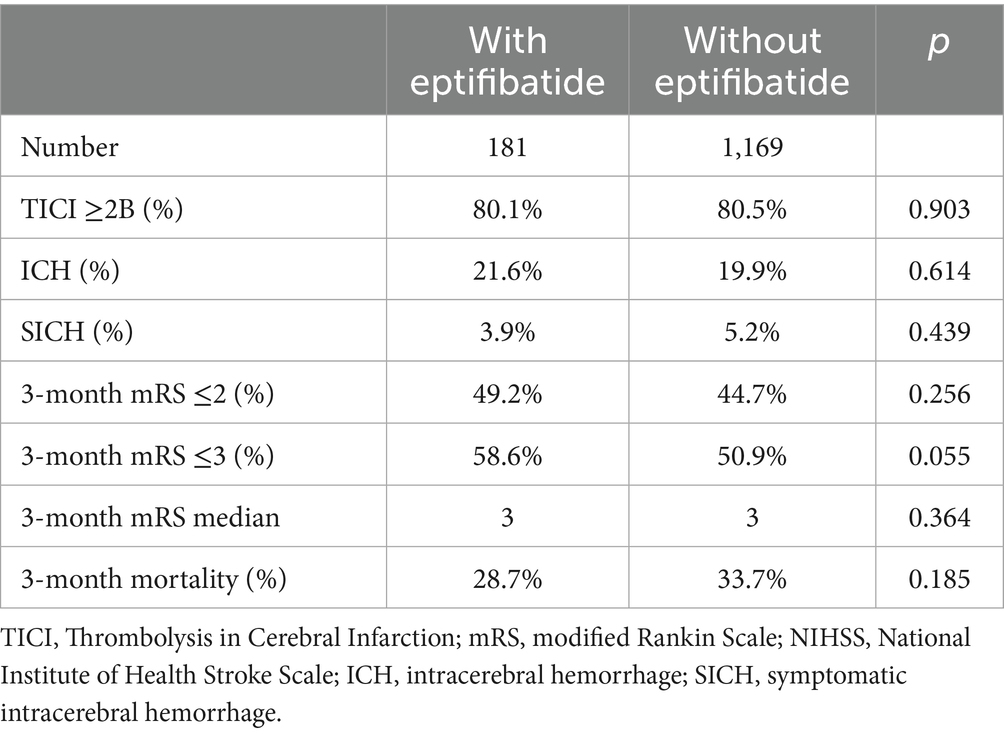
    In the group initially treated with endovascular failure, successful recanalization was achieved in 80.1% (TICI ≥2b) thanks to the administration of eptifibatide. No statistically significant difference was found compared to the group without eptifibatide (80.5%, p = 0.903).

    The incidence of complicating intracerebral hemorrhage was statistically insignificantly higher in the eptifibatide group (21.6 vs. 19.9%, p = 0.614). However, the incidence of symptomatic intracerebral hemorrhage was statistically insignificantly lower (3.9 vs. 5.2%, p = 0.439).

    The clinical outcome tended to be better in the eptifibatide group, but no statistically significant difference was found. Good clinical status was achieved by 49.2 vs. 44.7% (mRS ≤2, p = 0.256) at 3 months. Relatively good outcome (mRS ≤3) was achieved by 58.6 vs. 50.9%, when the difference was already on the verge of statistical significance (p = 0.055). Three-month mortality was also lower (28.7 vs. 33.7%, p = 0.185). The results are summarized in Table 2.

    Table 2
    www.frontiersin.org

    Table 2. Results—comparison between the patients with eptifibatide and standard treatment.

    Discussion

    In our study, no difference in the recanalization rate was found between the eptifibatide group and the group without eptifibatide. However, this result is excellent with regard to our basic criterion for administering eptifibatide (primary failure of the basic endovascular procedure). Without salvage therapy, successful recanalization would not have occurred in this group. With the use of eptifibatide, the rate of successful recanalization reached 80%. The clinical outcome is significantly dependent on the success of recanalization. Full self-sufficiency was achieved with the use of salvage therapy in 49% of patients (without successful recanalization, the chance of a good clinical outcome is at the level of a few percent according to common clinical experience). The safety profile of the selected treatment was favorable. There was no significantly higher incidence of ICH and SICH. The number of ICHs was numerically slightly higher in the eptifibatide group, however, the difference was not statistically significant. Such a small difference may also be significantly influenced by the asymmetry of the two groups (there are numerically one order of magnitude fewer patients with eptifibatide).

    Ma et al. (3) in a matched control analysis show the effectiveness of eptifibatide administration within the framework of endovascular procedure (162 patients, 81 with eptifibatide and 81 controls, successful recanalization 91.3% versus 81.5%). No significant difference in ICH or SICH was found. Latacz et al. (4) in a cohort with AIS treatment for tandem lesions (115 patients with eptifibatide) also did not find an increased incidence of ICH or SICH. Rana et al. (5) (54 patients with eptifibatide for MT) also report a favorable safety profile with the use of eptifibatide (no significant difference in the incidence of ICH or SICH compared to the two control groups). The mentioned studies are consistent with our safety results. They also show efficacy similar to our case. However, there is a fundamental difference in the approach to administering eptifibatide. In our case, it is only in the case of primary failure of mechanical thrombectomy. For the same reason, we cannot compare the clinical results with these studies. Here again, we can state that the patients who were administered eptifibatide largely benefited.

    In our study, patients with eptifibatide tended to have a better clinical outcome (58.6 vs. 50.9%, assessed for mRS ≤3, p = 0.055). However, this group was younger and had fewer significant comorbidities (see Table 1).

    The limitations of our study are primarily its retrospective nature and the absence of an appropriate control group. The administration of eptifibatide was entirely at the discretion of the interventional radiologist. As shown by the basic characteristics of the group, there is a certain tendency to treat younger patients more intensively. Another limitation of the study is that clinical status was monitored only after 3 months. However, clinical outcome is traditionally dependent on the achievement of recanalization, not on the method by which it is achieved. Due to the safety profile of the treatment, longer follow-up is irrelevant. Given the indication for eptifibatide administration only as salvage therapy, based on our data we cannot clearly comment on the general benefit of eptifibatide as adjuvant therapy to MT, nor was this our goal. However, our data show that if eptifibatide is rationally administered, it does not carry a statistically significant risk of hemorrhagic complications and, on the contrary, provides a very significant chance of successful recanalization.

    Conclusion

    Despite advances in endovascular treatment, there are still patients in whom this procedure fails. In our study, eptifibatide was used as salvage therapy in primary failure of endovascular treatment. In 80% of patients primarily without the possibility of recanalization with standard endovascular techniques, this procedure led to successful recanalization. Given the above limitations, we draw two conclusions from our data. The administration of eptifibatide, after careful individual consideration, can be a highly effective salvage therapy in primary failure of mechanical thrombectomy (the last therapeutic option). The second conclusion is the favorable safety profile of the treatment in this indication, which is consistent with the general results of previously published studies using eptifibatide as adjuvant therapy to mechanical thrombectomy. A larger randomized trial would be needed to verify the results.

    Data availability statement

    The raw data supporting the conclusions of this article will be made available by the authors, without undue reservation.