Changing stroke rehab and research worldwide now.Time is Brain! trillions and trillions of neurons that DIE each day because there are NO effective hyperacute therapies besides tPA(only 12% effective). I have 523 posts on hyperacute therapy, enough for researchers to spend decades proving them out. These are my personal ideas and blog on stroke rehabilitation and stroke research. Do not attempt any of these without checking with your medical provider. Unless you join me in agitating, when you need these therapies they won't be there.

What this blog is for:

My blog is not to help survivors recover, it is to have the 10 million yearly stroke survivors light fires underneath their doctors, stroke hospitals and stroke researchers to get stroke solved. 100% recovery. The stroke medical world is completely failing at that goal, they don't even have it as a goal. Shortly after getting out of the hospital and getting NO information on the process or protocols of stroke rehabilitation and recovery I started searching on the internet and found that no other survivor received useful information. This is an attempt to cover all stroke rehabilitation information that should be readily available to survivors so they can talk with informed knowledge to their medical staff. It lays out what needs to be done to get stroke survivors closer to 100% recovery. It's quite disgusting that this information is not available from every stroke association and doctors group.

Showing posts with label Senolytics. Show all posts

Friday, March 21, 2025

Senolytics: Zombie Cells, Longevity, and What’s Possible


 Hasn't your competent? doctor already gotten human testing done for all this earlier research on senescent cells? NO? So you DON'T have a functioning stroke doctor, do you?

  • senescent cells (9 posts to January 2016)
  • And for your entertainment as your struggle to recover, hopefully you're walking better than zombies.

    The latest here:

    Senolytics: Zombie Cells, Longevity, and What’s Possible

    For many people, living longer brings health challenges: Osteoporosis, diabetes, Alzheimer’s disease. And of course, zombie cells.

    The technical term is senescent cells. They’re damaged and unable to repair themselves. They’re also more likely to linger in the body as we age — like zombies — secreting inflammatory molecules that can hasten our decline.

    “They have this very robust secretory phenotype,” said Nathan K. LeBrasseur, PhD, director of the Robert and Arlene Kogod Center on Aging at Mayo Clinic. “They drive things such as impaired tissue regeneration, fibrosis, degeneration, inflammation — a lot of the conditions that are clearly central to age-related diseases. And that’s what’s exciting about these cells as therapeutic targets.”

    That is, targets for senolytics, the still-experimental drugs and supplements that eliminate senescent cells or tamp down their ill effects. Cancer is a particularly promising research area for senolytics (some existing chemo drugs have senolytic properties).

    Proponents like LeBrasseur aren’t preaching about extreme longevity, but the health span/lifespan argument. They speak in practical terms about making life easier for people as they get older.

    “We’re really not interested in making drugs to help us live until we’re 120 and feel like we’re 120,” he said. “If we have no effect on lifespan, that’s perfectly fine, but let’s increase the number of active and productive years that are not overly burdened by disease and disability.”

    It sounds tantalizingly possible — and sort of gimmicky. The internet teems with products claiming to be “antiaging” senolytics. But the internet teems with a lot of things.

    What’s real about senolytics as a future therapeutic option and how might they truly affect how people age?

    The State of Senolytics

    Since the first senolytics were discovered in 2015, much of the promising research has been in mice. Some early senolytics, like navitoclax (ABT-263) and ABT-737, have stalled out (they ended up killing platelets in people and speeding up ovarian aging in older female mice). So far, the most effective senolytics are existing chemotherapy drugs.

    “We don’t have this medicine cabinet full of options to take into humans,” LeBrasseur said. “There’s a couple of repurposed drugs that are being tried and trialed.”

    Here’s where things stand now. Roughly 20 clinical trials are underway, and at least 10 more are planned or have published some results. There are trials on senolytics for osteoarthritis, COVID-19, Alzheimer’s, and Parkinson’s diseases, according to Paul Robbins, PhD, associate director of the Masonic Institute on the Biology of Aging and Metabolism and a professor at the University of Minnesota. Another trial is treating grafts from older donors with senolytics before transplant. Amid these investigations, emerging evidence shows that senolytics can reduce senescence in humans and provide other benefits.

    Robbins points to the results of a “very positive trial” led by Unity Biotechnology, published last year. It showed that a senolytic called foselutoclax benefited people with advanced diabetic macular edema. A single injection in the back of the eye improved their sight, especially in the dark, for at least 6 months. The drug works by inhibiting a protein that regulates cell death, leading to a removal of senescent cells that researchers believe spurs healing in the eye.

    Another standout senolytic is known as D+Q, a combination of dasatinib (a US Food and Drug Administration [FDA]–-approved chemotherapy drug) and quercetin (a flavonoid found naturally in many foods). Dasatinib targets certain classes of receptors on the surface of some — but not all — senescent cells, triggering “a natural death process,” LeBrasseur explained. “It’s kind of flipping off a light switch in the cell, so it goes to sleep.”

    Research published in 2017 and 2018 found that D+Q improved bone density, lifespan, and physical function in older mice. Co-author Ming Xu, PhD, an associate professor at the University of Minnesota, said those studies “laid the foundation for a number of ongoing clinical trials.”

    A phase 1 clinical trial showed that intermittent doses of D+Q improved physical function in 12 older people with idiopathic pulmonary fibrosis, a serious lung disease. And a phase 2 trial in 60 healthy postmenopausal women showed that D+Q boosted formation of new bone tissue, but did not reduce bone resorption (the breakdown and removal of old bone tissue).

    Importantly, 10 women with the highest baseline biomarkers for senescent cell burden benefited more — with increases in bone formation, less bone resorption, and enhanced wrist bone mineral density.

    That kind of finding can help move the needle, according to LeBrasseur. “One challenge in our field is, how do we select individuals who best respond to these interventions?” he said.

    Major Roadblock: The Heterogeneity of Senescent Cells

    Senescent cells are extremely heterogeneous, and researchers are still determining what that looks like in a broad sense. The SenNet Consortium, funded by the National Institutes of Health Common Fund, is a vast research network striving to spatially map senescent cells in human tissues.

    “It’s turned out to be a monster of a task,” said Robbins. “A senescent cell in the kidney is different than the liver, which is different than the brain.”

    Even within the same tissues, there can be numerous distinct subpopulations of senescent cells, according to Xu. And totally different cells might share senescence features. Take p16 and p21, two proteins identified as drivers of cell senescence. Even if some cells highly express p16, whereas others highly express p21, they might have senescent features in common, causing a drug to clear cells that shouldn’t be cleared.

    “The problem is, we can’t really differentiate between them. We don’t have good markers that separate them,” Robbins said. “But it seems that functionally, if you treat with senolytics in an old animal, that’s beneficial. There’s conflicting data in young animals about whether there’s good or bad effects of trying to clear these cells.”

    Adding to the mystery: Not all senescent cells are bad. In fact, “senescence has sort of evolved as an anticancer mechanism,” Robbins said. Some senescent cells are linked to tumor suppression, wound healing, and tissue repair. Generally speaking, the immune system clears these cells not long after detecting them but immune dysfunction and other factors like old age may prevent that and the cells can become pro-inflammatory and not so friendly.

    Senescent cells are damaged and unable to repair themselves, but not so damaged that they self-destruct — a process called apoptosis. For reasons scientists don’t fully understand, senescent cells upregulate pathways that keep them from dying. It could be that the body has an “immune memory” against senescent cells.

    “There must be an advantage to having the cells survive and then have the immune system kill them,” Robbins said.

    To that end, many researchers are developing immunotherapies to target and clear senescent cells. A team at Memorial Sloan Kettering Cancer Center and Cold Spring Harbor Laboratory showed that engineered immune cells used for treating blood cancers had a senolytic effect in aging mice. Their metabolic function improved when CAR T cells eliminated urokinase plasminogen activator receptor, a senescent-associated protein. The treatment also protected against metabolic decline in younger mice.

    A Senolytic ‘Cocktail’

    Chemotherapy drugs, senolytic cell inhibitors, and immunotherapy are just some of the emerging senolytic options. Robbins and his colleagues are working on a senolytic lipid, a senolytic RNA, and senolytic natural compounds. They’re part of a phase 2 clinical trial investigating if the senolytic drug Fisetin (a flavonoid found in many fruits and vegetables) can thwart severe COVID-19.

    All these senolytics “seem to target different classes of senescent cells,” Robbins said. And different senescent cells could contribute to a single disease. That’s why a “cocktail” of senolytics could ultimately emerge, he said. Your cocktail could depend on whether “you’re just trying to maintain your health vs trying to treat Alzheimer’s vs trying to treat other conditions.”

    Felix Wong, PhD, co-founder of biotechnology company Integrated Biosciences, agrees. “There’s not going to be just one blockbuster senolytic, but perhaps many multiple different senolytics,” Wong said.

    Two years ago, Wong’s team used deep learning to discover three potential senolytic compounds from a database of 800,000 molecules. They trained a graph neural network, a type of artificial intelligence model, to make predictions of senolytic activity based on chemical structure alone. When injected into aged mice, the compounds decreased the accumulation of senescent cells. Promising — but still a long way from your medicine cabinet. Wong said that Integrated Biosciences is still examining which disease models the compounds might be efficacious in.

    “The FDA doesn’t recognize aging as a disease, so you’ll have to go after a specific indication,” Wong said.

    That’s true, at least for now. Last December, Advanced Research Projects Agency for Health (ARPA H), an agency within the US Department of Health and Human Services, launched Proactive Solutions for Prolonging Resilience (PROSPR). The initiative could lead to a measurement of “intrinsic capacity” — a potential yardstick for testing drugs that target aging more broadly — according to LeBrasseur. Even so, he suggests it might be another decade before the field can say with confidence that a senolytic works.

    What About Nature’s Senolytic?

    In the meantime, of course, there’s exercise. LeBrasseur’s research has shown that higher levels of “habitual physical activity” — daily activities like walking and getting up out of your chair that make you “a little less sedentary” — is associated with lower biomarkers of senescence in adults in their 70s and 80s.

    “Exercise can prevent senescence from occurring,” LeBrasseur said. “And there’s a lot of favorable data to show exercise can help optimize immune health and function, creating healthier environments and tissues for immune cells to recognize, target, and eliminate senescent cells.”

    Wong is still hoping for a shift in thinking about the ability to treat aging. He pointed out that glucagon-like peptide 1 (GLP-1) agonists show benefits well beyond obesity, treating neurodegenerative and kidney diseases associated with aging, for instance.

    “The battle call is out there. We all know that GLP-1 agonists are broadly, quote-unquote, antiaging, and I think that represents a paradigm shift,” Wong said. “There’s a growing appreciation for the fact that we can, using therapeutic interventions, actually move the needle across different age-related diseases.”

    Tuesday, November 28, 2023

    Senolytics show promise in combating brain aging and COVID-19 neuropathology

     Didn't your competent doctor already have this in your interventions? OH NO, you don't have a competent doctor?


    Senolytics show promise in combating brain aging and COVID-19 neuropathology

    In a recent study published in the journal Nature Aging, an international team of researchers observed that senolytics can alleviate physiologic brain aging and coronavirus disease 2019 (COVID-19) neuropathology. Senolytics are a class of drugs that selectively target and eliminate senescent cells, which are cells that have stopped dividing and contribute to aging and age-related diseases.

    Most COVID-19 patients often experience diverse neurologic complications. Further, autopsied brain tissue transcriptomic data suggest associations between severe COVID patients' cognitive decline and brain aging signatures. While recent reports implicate senescent cells in neurodegeneration and cognitive decline in aged mice and in vivo neuropathology models, their contribution to human brain tissue aging and COVID-19 pathology in the central nervous system remains unknown.

    Study: Senolytic therapy alleviates physiological human brain aging and COVID-19 neuropathology. Image Credit: Jose Luis Calvo / Shutterstock

    Study: Senolytic therapy alleviates physiological human brain aging and COVID-19 neuropathology. Image Credit: Jose Luis Calvo / Shutterstock

    The study and findings

    In the present study, researchers tested the effects of senolytics on physiological brain aging and COVID-19 neuropathology. First, they generated human brain organoids (BOs) from embryonic stem cells and physiologically aged them for eight months. Subsequently, the BOs were treated with two doses of senolytics, such as the dasatinib-quercetin (D+Q) combination, ABT-737, and navitoclax, for one month at a two-week interval.

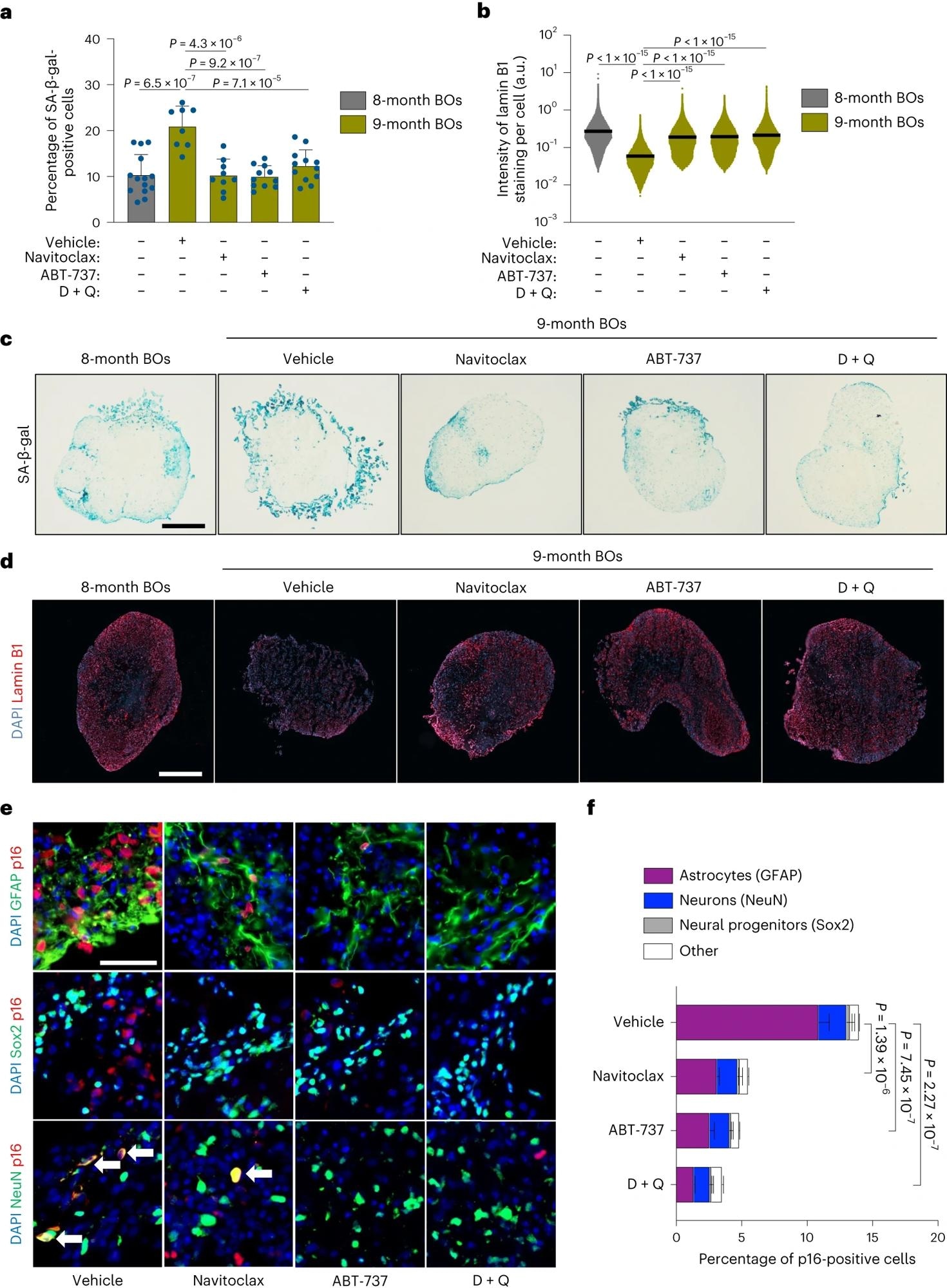
    Senolytic interventions significantly reduced senescence-associated β-galactosidase (SA-β-gal) activity, indicating the elimination of senescent cells. This was further confirmed by significantly higher levels of lamin B1 (a nuclear marker downregulated in senescence) in treated BOs. Next, the team investigated the cell types involved in senescence phenotypes by co-immunolabeling with a senescence marker (p16).

    Over three-fourths of p16-positive cells coimmunostained with astrocytes (positive for glial fibrillary acidic protein), while approximately 15% co-localized with mature neurons (positive for neuronal nuclei antigen). These two brain cell populations represented a majority (> 90%) of p16-positive cells. The team found a significant reduction in senescent astrocyte populations following treatment, with the D+Q combination being the most potent. However, the effect of senolytics in reducing senescent neurons was less apparent.

    RNA sequencing revealed the upregulation of lamin B1 messenger RNA (mRNA) levels across all senolytic treatments. Additionally, 81 senescence-related mRNAs were consistently suppressed with senolytic treatments. Further, aging clock predictions were performed based on whole-transcriptome sequencing. D+Q treatment of nine-month-old organoids returned their gene expression age to levels of eight-month-old organoids.

    This phenotype was not observed with other tested senolytic interventions. D+Q treatment-induced changes in gene expression correlated with mammalian signatures of pro-longevity interventions, such as rapamycin administration and caloric restriction. Next, the team estimated the prevalence of senescent cells in the autopsied frontal cortex from the brains of age-matched patients who died due to severe COVID-19 or non-neurologic and non-infectious causes.

    Brains of COVID-19 decedents showed over seven-fold increase in p16-positive cells than those from non-COVID-19 controls. Next, human BOs were exposed to different viral pathogens to examine how (neurotropic) viruses contribute to aging-induced neuropathology. Severe acute respiratory syndrome coronavirus 2 (SARS-CoV-2) infection was mainly detected in neurons, microglia, and neural progenitors.

    Seven SARS-CoV-2 variants were also tested, and their senescence phenotypes were ranked by SA-β-gal activity. Most variants significantly increased SA-β-gal, but the Delta variant exhibited the most potent induction. Moreover, there was a distinctive colocalization of viral spike and SA-β-gal in Delta-infected BOs. Besides, a statistically higher induction of senescence was evident between organoids infected for five and 10 days.

    Increased senescence observed at 10 days post-infection (dpi) relative to 5 dpi suggested that SARS-CoV-2 infection may have triggered secondary senescence. Interestingly, non-infected senescent cells were enriched within 150 µm of infected senescent cells, supporting the putative bystander effect of infected cells in triggering secondary senescence. Senescence was also triggered by infection of BOs with Japanese encephalitis virus (JEV), Zika virus (ZIKV), or Rocio virus (ROCV).

    The researchers examined the associations of transcriptomic changes between COVID-19 patients and SARS-CoV-2-infected BOs. Among nearly 1,600 genes with differential expression between infected and non-infected BOs, there were 485 differentially expressed genes in COVID-19 patients' brain samples. Notably, known senescence and aging pathways were enriched in this common gene set.

    Long-term senolytic treatment prevents selective accumulation of senescent cells in physiologically aged human BOs. a–f, BOs were generated and grown in vitro for 8 months and subsequently exposed to two doses (one every 2 weeks) of either navitoclax (2.5 μM), ABT-737 (10 μM) or D + Q (D, 10 μM; Q, 25 μM) within the following month, after which organoids (n = 8–14) were collected for in situ analysis. a, SA-β-gal assay was performed on organoid sections. Each data point in the bar graph represents a single organoid analyzed. Data presented as mean ± s.d.; at least eight individual organoids were analyzed per condition; one-way analysis of variance (ANOVA) with Tukey’s multiple-comparison post hoc corrections. b, Lamin B1 staining was performed on organoid sections. Each data point in the scatter plot represents the integrated intensity of each cell within organoid sections. At least eight individual organoids were analyzed per condition; one-way ANOVA with Tukey’s multiple-comparison post hoc corrections. c,d, Representative images from quantifications shown in a,b, respectively. Scale bar, 0.3 mm. e, Representative immunofluorescent images of regions from organoids treated with the indicated senolytics and vehicle control. Samples were individually immunolabeled with antibodies against GFAP, Sox2 and NeuN and co-stained for p16. Arrows indicate coimmunoreactivity of NeuN and p16. Scale bar, 50 µm. f, Bar graphs showing colocalization quantification performed on organoid sections. Data presented as mean ± s.d.; three individual organoids were analyzed per condition; one-way ANOVA with Tukey’s multiple-comparison post hoc corrections. a.u., arbitrary units.

    Next, the team evaluated the impact of the selective elimination of senescent cells with senolytic interventions. Senolytics significantly reduced the number of BO cells with SA-β-gal activity five days after SARS-CoV-2 infection. Of note, the impact of senolytics was more prominent in BOs infected with the Delta variant, and senolytics reverted Delta variant-induced lamin B1 loss and p21 upregulation.

    Pretreating BOs with senolytics before infection resulted in a significant reduction of virus-induced senescence. Layer 6 corticothalamic neurons and gamma-aminobutyric acid (GABA)ergic ganglionic eminence neurons were the two populations with significantly higher incidence of senescence following infection, and senolytic interventions prevented cellular senescence in these populations.

    Finally, the researchers infected K18-hACE2 mice (that express the human angiotensin-converting enzyme 2 [hACE2] under the regulation of keratin 18 [K18] promoter) with SARS-CoV-2 Delta. Senolytics with blood-brain barrier permeability, such as D+Q, navitoclax, and fisetin, were administered 24 hours post-infection, with subsequent treatments every two days. Infected mice had shortened life spans, with a median survival of five days.

    However, fisetin or D+Q treatment significantly improved survival. All control animals died by 10 dpi, whereas 13% of navitoclax-, 38% of D+Q-, and 22% of fisetin-treated mice were alive at 12 dpi (experimental endpoint). Senolytics, especially D+Q, caused a profound decrease in COVID-19-related features and significantly reduced viral gene expression in mice brains.

    The brains of infected mice exhibited an increase in inflammatory senescence-associated secretory phenotype (SASP) and p16 senescence markers, and (all) senolytic treatments normalized senescence and SASP gene expression of infected animals to the levels observed in non-infected brains. Delta infection also caused a loss of dopaminergic neurons in the brainstem, with a concomitant increase in astrogliosis. However, recurrent administration of senolytics partially prevented the loss of dopaminergic neurons and abrogated the onset of astrogliosis.

    Conclusions

    Taken together, the study demonstrated that senescent cells accumulate in physiologically aged human BOs, with long-term senolytic intervention(s) substantially reducing cellular senescence and inflammation. Further, D+Q treatment uniquely induced anti-aging and pro-longevity gene expression changes in BOs.

    Besides, COVID-19 patients' brains exhibit rapid accumulation of cellular senescence relative to age-matched controls. Neurotropic viruses (ROCV, JEV, and ZIKV) and SARS-CoV-2 can infect BOs and induce cellular senescence, and the SARS-CoV-2 Delta variant triggers the most potent induction of senescence. Short-term senolytic interventions could reduce SARS-CoV-2 gene expression in infected BOs and prevent senescence of GABAergic and corticothalamic neurons.

    Notably, senolytics ameliorated COVID-19 neuropathology in infected K18-hACE2 mice, improved their survival and clinical score, and reduced SASP, senescence, and viral gene expression. Overall, the findings highlight the vital role of cellular senescence in brain aging, COVID-19, neuropathology, and the therapeutic impact of senolytics.

    Source:

    Tuesday, September 12, 2023

    Phase I trial of senolytic therapy shows promise in Alzheimer's disease

    You might need this. Is your competent doctor closely following this? 

    Your risk of dementia, has your doctor told you of this?  Your doctor is responsible for preventing this!

    1. A documented 33% dementia chance post-stroke from an Australian study?   May 2012.

    2. Then this study came out and seems to have a range from 17-66%. December 2013.`    

    3. A 20% chance in this research.   July 2013.

    4. Dementia Risk Doubled in Patients Following Stroke September 2018 

    The latest here:

    Phase I trial of senolytic therapy shows promise in Alzheimer's disease

    Alzheimer's disease is the most common cause of dementia that affects more than 6.5 million Americans, according to the Alzheimer's Association. To find effective treatments and slow the progression of this debilitating disease, researchers have made much progress in developing new drugs that target beta-amyloid plaques, one of the hallmarks of Alzheimer's disease.

    Beta-amyloid plaques are accumulations of brain protein fragments, which can impact cognition. However, these recent drugs have only yielded modest results.

    Now, scientists at Wake Forest University School of Medicine are reporting results from a Phase I trial in another area of promising research-;cellular senescence.

    The findings appear online today in Nature Medicine.

    Senescent cells are old, sick cells that cannot properly repair themselves and don't die off when they should. Instead, they function abnormally and release substances that kill surrounding healthy cells and cause inflammation. Over time, they continue to build up in tissues throughout the body contributing to the aging process, neurocognitive decline and cancer.

    In 2018, we found evidence of senescent cells in human Alzheimer's disease. In mouse models, we also found that they contribute to brain cell loss, inflammation and memory impairment."

    Miranda Orr, Ph.D., associate professor of gerontology and geriatric medicine at Wake Forest University School of Medicine

    Researchers repurposed a U.S. Food and Drug Administration-approved drug designed to clear cancer cells (dasatinib) in combination with a flavonoid, a plant-derived antioxidant (quercetin).

    "Our previous research has shown that the combination of these two drugs target senescent cells and allow them to die," Orr said. "We know that they cleared senescent brain cells in Alzheimer's disease mouse models, and they had already been shown to be safe in patients with other ailments."

    For the current study, which was co-led by Mitzi Gonzales, Ph.D., of The University of Texas Health Science Center at San Antonio, the research team enrolled five participants aged 65 and older with symptoms of early-stage Alzheimer's disease. Participants received oral dasatinib plus quercetin over two consecutive days, followed by two weeks of no drugs. The cycle repeated six times for a total of 12 weeks.

    "Our primary goal was to determine whether the medicines penetrated the central nervous system," Orr said. "We collected samples of patients' cerebrospinal fluid (CSF) before the first dose of medicine was given and after the last dose of medicine was given."

    The research team also collected data on the safety and efficacy of the two drugs by monitoring side effects. They assessed biomarkers of senescence in CSF and blood, and also evaluated patients' cognition and brain images before treatment and after they completed the 12-week study.

    They found that both dasatinib and quercetin levels increased in the blood, and dasatinib was detected in the CSF in four subjects. Quercetin was not detected in the CSF of any participants.

    "We also determined that the treatment was safe, feasible and well-tolerated," Orr said. "There were no significant changes in brain function as determined by assessing memory and brain imaging to provide additional evidence that it is a safe therapy to evaluate further."

    Researchers also saw evidence to suggest that the combination therapy cleared amyloid from the brain and lowered inflammation in the blood.

    "However, we shouldn't over-interpret these results," Orr said. "There was a small number of people enrolled, there was no placebo arm to compare results."

    Researchers also noted an increase in inflammation in CSF biomarkers. According to Orr, one possible explanation is a transient increase in inflammation when senescent cells are cleared. This increase could also be a marker of senescent cells dying or could potentially indicate inflammation associated with the treatment.

    "We will need to monitor this closely in our next trial," said Orr, whose cellular senescence research is currently featured in a special issue of National Geographic focused on aging.

    "Dr. Orr's research is a critical part of this pivotal moment in Alzheimer's research as the focus shifts from amyloid and tau, the classic disease hallmarks, toward how the biology of aging underlies the disease," said Howard Fillit, M.D., co-founder and chief science officer at the Alzheimer's Drug Discovery Foundation (ADDF). "Aging is the leading risk factor for Alzheimer's, and it is important that the field explores new approaches for developing therapeutics, like senolytics, that target biological aging. Alzheimer's is a multifaceted disease, and similar to cancer, we will need multiple treatment options that can be combined and personalized to improve the outlook for millions of patients living with Alzheimer's."

    Orr's research team is in the process of a larger $3 million, Phase II clinical trial funded by the ADDF to test the effects of clearing senescent cells with the combination therapy.

    "We can confidently move forward with a larger study population and placebo arm knowing that the treatment is safe," Orr said. "We will also look forward to learning more about how the treatment may impact Alzheimer's disease biomarkers."

    Source:
    Journal reference:

    Gonzales, M. M., et al. (2023). Senolytic therapy in mild Alzheimer’s disease: a phase 1 feasibility trial. Nature Medicine. doi.org/10.1038/s41591-023-02543-w.

    Friday, February 24, 2023

    Is reverse aging already possible? Drugs that could treat aging might already be on the pharmacy shelves

    What has your doctor done with this senolytic research? ANYTHING AT ALL? Or are you allowing incompetence to continue to exist until it affects your children and grandchildren?

    Is reverse aging already possible? Drugs that could treat aging might already be on the pharmacy shelves

    At 67 years old, Dr. Nir Barzilai looks about the same as, if not younger than, he did 10 years ago. It’s apparent in side-by-side photographs, and it’s what most people who know him say. Barzilai lives a healthy lifestyle. He exercises every day, eats right, and practices intermittent fasting.

    He’s also been taking the diabetes drug metformin off label for 10 years. He has never been diagnosed with diabetes or prediabetes—the conditions for which the drug is approved and prescribed—but takes it for a different off-label reason.

    “We know that it targets aging,” said Barzilai, who is a professor of medicine and genetics at Albert Einstein College of Medicine and director of the American Federation for Aging Research.

    “People on metformin have 30% lower rates of almost every kind of cancer. It delays cognitive decline. Even people with diabetes who are obese and have more disease to start with but are on metformin have lower mortality rates than people without diabetes who aren’t on the drug.”

    What he says is born out in numerous studies. Overall, this safe, super-cheap, decades-old drug not only treats diabetes, but it also seems to delay and compress the years of chronic illness associated with the final stage of life and extend what geroscientists call the “healthspan.”

    Metformin is just one of many medications, including other old ones and some brand new inventions, that academic researchers and biotech startups are exploring to slow, stop, or perhaps even reverse aging.

    What is aging

    All sorts of processes are happening in our bodies as we age. Some of which make us more vulnerable to the diseases most linked to old age: cancer, dementia, heart disease, stroke, macular degeneration and so forth.

    Doctors and scientists in the longevity field are trying to determine which of those processes is the strongest hallmark of overall aging and declining health and how to target that process with a drug in the same way that current drugs target specific diseases.

    “We can target aging,” Barzilai said. “We can delay it. And in several instances, we can stop and reverse it. At one point we had hope. Then we moved to promise. Now, we need to move to realize that promise. That’s where we are.”

    Dr. Nir Barzilai has been taking the diabetes drug metformin off label to treat aging.
    Dr. Nir Barzilai has been taking the diabetes drug metformin off label to treat aging.

    Targeting undead cells

    Dozens of biotechs want to be the first to realize that promise through drugs called senolytics. In certain diseases, these pharmaceuticals can clear out toxic, old, dysfunctional cells and leave only young, healthy, well functioning ones behind. Senolytic Dasatinib (Sprycel) is FDA-approved for certain types of chronic myelogenous leukemia.

    Here’s why researchers think senolytics could do more than treat one specific disease.

    Your cells constantly reproduce and divide throughout their lifespan to create new, healthy cells. When they stop doing this, they die. But with some cells, even though they’ve stopped reproducing, they don’t die off like they should. These undead cells, called senescent cells, stick around and give off toxic substances that can harm the healthy cells around them—like the one bad apple that spoils the whole bunch.

    As you get older, your aging body becomes less efficient at clearing out senescent cells, so they accumulate, especially around the sites where chronic diseases develop, like macular degeneration.

    Unity Biotechnology has a senolytic, dubbed UBX1325, in phase 2 clinical trials for diabetic macular edema (DME) and age-related macular degeneration (AMD). In both conditions, damage to the retina can lead to vision loss.

    Preliminary findings in DME patients in the trial suggest that the drug clears out problem-causing senescent cells in the eye and allows the remaining healthy cells to repair and regenerate the retina and bring lost vision back.

    “It takes about 8 weeks to kick in, and at 24 weeks, you can see that the tissue has dramatically remodeled,” said Anirvan Ghosh, PhD, Unity CEO. “We had patients who had big gains in vision and big improvements in retinal structure.”

    As incredible as these results are, vision restoration isn’t the endgame for Unity or most any company invested in senolytics development. The idea is to develop another drug that will have this same effect on another progressive disease and another and another until, ideally, researchers can figure out how to make a drug that would clear out all senescent cells, not just the one type behind a certain disease.

    “In different tissues, it’s not always the same cell type that becomes senescent. I think next we will have tissue-specific senolytics for a specific disease or if you’re high-risk for that disease.” But to target aging, rather than just individual diseases, he says, “We’d have to have something that clears these cells from multiple tissue types.” That’s the long-term goal. And it may still be a long road to get there.

    Understanding biological age

    While zombie cells build up in the aging body, wreaking havoc as their numbers grow, critical changes are taking place on the surface of DNA, too. That is, in the epigenome, a landscape of proteins and chemicals that sits atop your genetic material.

    These changes over time are the result of your environment, behaviors and exposures throughout your lifetime. Think: pollution, trauma, diet, exercise, and secondhand smoke. They don’t change your DNA, but they change the way your DNA acts. Genes that once functioned perfectly may at some point in life slow down, speed up, shut off, or just go generally haywire. Any dysregulation can cause disease or the signs and symptoms of old age.

    Epigenetic changes are like scratches on a record: You can still hear the music, but it’s not what it used to be.

    Led by Harvard Medical School professor and molecular geneticist David Sinclair, PhD, Tally Health is already bringing epigenetic approaches to aging directly to consumers. The company offers a cheek swab test that estimates customers’ biological age—how old they seem based on their epigenetics rather than their birth year.

    “Biological age is a much better representation of health status than birthday candles,” Sinclair says. “Birthday candles don’t tell you how well you’ve been living and they certainly don’t tell you how many years you’ve got left.”

    Tally Health creates personalized recommendations based on customers’ biological age for how they might reduce that age because, as Sinclair points out, “Your biological clock is not unidirectional.”

    For now, the means to turn back the clock are mostly lifestyle changes. But Sinclair, who has founded several biotechs, and others are researching and developing drugs that might slow or restart the clock so genes will act like they are young again.

    Sinclair and his collaborators have shown that this is possible in the eyes of blind mice. In newborn mice, if the optic nerve – the nerve that carries messages from the retina to the brain—is damaged, it will recover. But in old mice, it can no longer heal.

    In Sinclair’s lab, they crushed the optic nerves of mice to blind them. The serious injury to the eye caused epigenetic changes that resemble those that happen in old age. They then injected the nerves with genes that contained factors they expected would reprogram the genes to behave like they were young again.

    The treatment reversed the age-related epigenetic changes in the eyes, rescued retinal cells, and led to regeneration of neurons. Since then, Sinclair and his colleagues have corrected similar age-related epigenetic changes in muscle and kidney tissue. Other researchers have successfully used the technique to extend the overall lifespan of mice. Sinclair expects to release results of his study which tests this concept in primates in a few months.

    The holy grail, of course, is to erase the scratches that time puts on our own epigenetic records. Sinclair says that’s coming.

    “Resetting the whole human body in this way is a different matter,” he says. “Are we one day going to be able to turn ourselves back 20 years? I don’t see any reason why that won’t be possible. It’s just a question of when.”

    Drugs that treat aging

    But some drugs that could lower risk for multiple age-related diseases at once and, perhaps, treat aging as a whole, might already be on the shelves of the pharmacy.

    Rapamycin, an mTOR inhibitor, got FDA approval in 1991 as an immune suppressor that prevents organ recipients from rejecting a new organ. By shutting off the mTOR protein, it prevents immune system cells from proliferating to attack the donated organ.

    “But in every species that’s been studied to date – yeast, worms, flies, mice – when they are given rapamycin, healthspan and lifespan are extended. No other therapeutic has that degree of validation,” says Joan Mannick, MD, CEO of Tornado Therapeutics.

    Mannick and other mTOR researchers believe that, among the other deleterious processes of aging, mTOR proteins might start to malfunction, too. In a healthy, young person, mTOR, which supports cell growth, is active when we eat. That’s critical for growth, development and reproduction. When we fast, like during the night, mTOR is inactive, which allows for cell repair.

    This, by the way, is probably one of the reasons intermittent fasting has so many health benefits, Mannick says, because it blocks mTOR and allows for more cell repair.

    As we get older, mTOR may stay active all the time—opening the door to out-of-control cell growth that can lead to cancer and closing the door on cell repair. In older adults, low doses of rapamycin, an mTOR inhibitor, seem to set mTOR activity back to its youthful state: on when you need it, off when you don’t.

    “When they get rapamycin, their immune systems, which have already been damaged by old age, start to function better,” Mannick says. “There’s research to suggest that when you rejuvenate the immune system, you make a lot of other organ systems function better. But we need well-powered, placebo-controlled clinical trials to find out the dose, what conditions it improves, and who responds best.”

    To carry out that research, Tornado Therapeutics has acquired a portfolio of rapamycin derivatives, or “rapalogs,” from Novartis, which they are studying as treatments for aging. If it can increase the lifespan of every plant and animal that’s been exposed to it, Mannick and the company’s investors, such as Cambrian Bio, bet it might increase the human lifespan, too.

    “I think in the next 5 to 10 years, FDA will have approved the first drug to target aging biology,” Mannick says. “It very well could be a new rapalog that is going to have benefits for an aging-related condition as our first step to a much broader aging medicine advance.”

    Type 2 diabetes is an age-related condition. Numerous studies show that metformin, a drug that’s FDA-approved to treat it, may also lower risk for cancer, heart disease, stroke, dementia, or death for any other reason, including COVID-19.

    The benefits, researchers suspect, are a result of metformin’s ability to control blood sugar, blunt the effects of a lifetime of oxidative stress on the body, and protect cardiovascular function. That is, it may meet a host of needs that grow greater as we age.

    Of course, the overwhelming majority of data on metformin’s benefits comes from people with diabetes. Numerous clinical trials currently underway are looking at its effects on specific diseases in people who don’t have diabetes. But longevity researchers, like Barzilai, want to prove to the FDA that it doesn’t have to be taken for a specific disease. Older adults should simply take it for aging.

    Barzilai’s TAME (Targeting Aging with Metformin) trial, which will last six years, aims to prove that anyone between the ages of 65 and 79 can extend their healthspan with metformin.

    “We’re using metformin as a tool,” he says, “to show the FDA that aging itself can be targeted.”

    Targeting the healthspan

    No matter which approach becomes the first prescription drug for aging, researchers in the area tend to agree it’s coming soon. It would be expected to improve and extend life not only for average older adults, but also for those who currently tend to get chronic diseases and die sooner: childhood cancer survivors, people living with HIV, people living in poverty.

    Researchers predict the implications will be huge when the healthy years of life last longer for everyone.  Economist Andrew Scott calculated that a slowdown in aging that increases life expectancy by just one year would be worth $38 trillion. A ten-year increase would be worth $367 trillion.

    “That’s because with this kind of increase in life expectancy, we are not spending that time in the hospital, we are not sick,” Barzilai says. “We’re shopping, we’re traveling, we are participating in society. We are living life. And that’s what we want.”

    This story was originally featured on Fortune.com

    Wednesday, December 7, 2022

    Ageless:The New Science of Getting Older Without getting Old

    Ask your doctor to investigate these two points in this book.

     D+Quercetain to aged mice senolytic page 114

    dietary restriction  page 120

    Wednesday, July 7, 2021

    'Zombie cells' hold clues to spinal cord injury repair

     Will this do the same for stroke? WHOM do we ask to do the followup research? Specific names only. With NO LEADERSHIP AND NO STRATEGY NOTHING WILL BE DONE.


    'Zombie cells' hold clues to spinal cord injury repair

    The image represents a transversal cross-section of a mouse spinal cord. Neuronal cell bodies are represented in light blue delineating the butterfly shape characteristic of the gray matter, while glial projections are represented in orange-red. Credit: Diogo Paramos-de-Carvalho

    Mammals have a poor ability to recover after a spinal cord injury, which can result in paralysis. A main reason for this is the formation of a complex scar associated with chronic inflammation that produces a cellular microenvironment blocking tissue repair. Now, a research team led by Leonor Saude, group leader at Instituto de Medicina Molecular Joao Lobo Antunes (iMM; Portugal) and Professor at Faculdade de Medicina da Universidade de Lisboa, have shown that the administration of drugs that target specific cellular components of this scar improve functional recovery after injury. The results now published in the scientific journal Cell Reports set the basis for a new promising therapeutic strategy not only for spinal cord injuries, but potentially for other organs that lack regenerative competence.

    This study was performed at iMM with collaboration from researchers at CEDOC NOVA Medical School and was funded by "la Caixa" Foundation—CaixaResearch Call and Fundacao para a Ciencia e a Tecnologia (Portugal).

    Leonor Saude and her team have been studying spinal cord using two different models: zebrafish, which exhibit spinal injury recovery, and mammals, which show poor recovery. The dense scar that forms at the lesion site has been of particular interest. In mammals, upon spinal cord injury, researchers observed that cells start to accumulate at the lesion periphery. But not any cells: "These cells are known as senescent cells. They have specific features and markers and are what we can call 'zombie cells', where growth and division is interrupted, but where the normal cell death program is not activated," explains Leonor Saude.

    "While in zebrafish, the accumulation of these cells at the injury periphery is cleared out over time, in mammals, these cells persist and are important components of the dense scar observed. Because senescent cells have specific molecular markers, there are specific drugs that could be tested in this context," says Diogo Paramos-de-Carvalho, first author of the study. "With the administration of different senolytic drugs, that specifically target these , we have observed a progressive decrease of these , a decrease in the scar extension and lower levels of inflammation due to a decreased secretion of pro-fibrotic and pro-inflammatory factors. The observed changes at the underlie the improved locomotor, sensory and bladder functions that we have also found," explains Isaura Martins, also first author of the study.

    "Although we are still far from healing spinal cord injuries in humans, we are learning more about the molecular signatures of these lesions and these new promising results can open new therapeutic strategies that can be applied not only to but in other conditions that lack regenerative competence," says Leonor Saude.


    Monday, March 1, 2021

    Cellular Senescence in Brain Aging

     You'll have to ask your doctor how you get senolytics in your brain to eliminate senescent cells.

    Cellular Senescence in Brain Aging

    Ewa Sikora1*, Anna Bielak-Zmijewska1, Magdalena Dudkowska1, Adam Krzystyniak1, Grazyna Mosieniak1, Malgorzata Wesierska2 and Jakub Wlodarczyk3
    • 1Laboratory of Molecular Bases of Aging, Nencki Institute of Experimental Biology, PAS, Warsaw, Poland
    • 2Laboratory of Neuropsychology, Nencki Institute of Experimental Biology, PAS, Warsaw, Poland
    • 3Laboratory of Cell Biophysics, Nencki Institute of Experimental Biology, PAS, Warsaw, Poland

    Aging of the brain can manifest itself as a memory and cognitive decline, which has been shown to frequently coincide with changes in the structural plasticity of dendritic spines. Decreased number and maturity of spines in aged animals and humans, together with changes in synaptic transmission, may reflect aberrant neuronal plasticity directly associated with impaired brain functions. In extreme, a neurodegenerative disease, which completely devastates the basic functions of the brain, may develop. While cellular senescence in peripheral tissues has recently been linked to aging and a number of aging-related disorders, its involvement in brain aging is just beginning to be explored. However, accumulated evidence suggests that cell senescence may play a role in the aging of the brain, as it has been documented in other organs. Senescent cells stop dividing and shift their activity to strengthen the secretory function, which leads to the acquisition of the so called senescence-associated secretory phenotype (SASP). Senescent cells have also other characteristics, such as altered morphology and proteostasis, decreased propensity to undergo apoptosis, autophagy impairment, accumulation of lipid droplets, increased activity of senescence-associated-β-galactosidase (SA-β-gal), and epigenetic alterations, including DNA methylation, chromatin remodeling, and histone post-translational modifications that, in consequence, result in altered gene expression. Proliferation-competent glial cells can undergo senescence both in vitro and in vivo, and they likely participate in neuroinflammation, which is characteristic for the aging brain. However, apart from proliferation-competent glial cells, the brain consists of post-mitotic neurons. Interestingly, it has emerged recently, that non-proliferating neuronal cells present in the brain or cultivated in vitro can also have some hallmarks, including SASP, typical for senescent cells that ceased to divide. It has been documented that so called senolytics, which by definition, eliminate senescent cells, can improve cognitive ability in mice models. In this review, we ask questions about the role of senescent brain cells in brain plasticity and cognitive functions impairments and how senolytics can improve them. We will discuss whether neuronal plasticity, defined as morphological and functional changes at the level of neurons and dendritic spines, can be the hallmark of neuronal senescence susceptible to the effects of senolytics.

    Introduction

    As with other organs and systems, the functional capabilities of the brain decline progressively during aging. As we age, cognitive performance generally declines which manifests as decrements in learning and memory, attention, decision-making speed, sensory perception (vision, hearing, touch, smell, and taste), and motor coordination (reviewed in Mattson and Arumugam, 2018). Aging is the leading risk factor of age-related diseases (ARDs), including neurodegenerative disorders. The aging process and ARDs are considered as a sort of a continuum with two extremes. One is represented by centenarians, who largely avoided or postponed most ARDs and are characterized by decelerated aging. Individuals 60+, 70+, 80+ who suffered from one or more severe ARDs, represent another extremum and show signs of accelerated aging. In between, there are relatively healthy aged people (Franceschi et al., 2018). Thus, precise boundaries between “normal” and “pathological” aging do not exist, especially when molecular and cellular mechanisms at the roots of aging are considered. Particularly, little is known about healthy brain aging outside of the realm of neurogenerative diseases, such as Alzheimer's disease (AD) and Parkinson's disease (PD). Nonetheless, we must remember that the current consensus in geroscience (Kennedy et al., 2014) considers AD as a more severe form of pathologies associated with normal aging. With age physical fitness and cognitive functions often decline in human and animals (Leal and Yassa, 2015). However, we must not forget that in nature exist animal species, such as naked mole rats, ocean quahog, rockfish and Greenland shark, and many others that exhibit negligible senescence and superior resistance to age-related diseases (Finch, 2009).

    In humans, cognitive abilities can be divided into such domains as: processing speed, attention, memory, language, visuospatial abilities, and executive functioning (Harada et al., 2013). Similarly, animal behavior is based on attention and different kinds of memory. Age-associated deterioration of cognitive functions correlates with impaired motor coordination of both animals and humans, who lose their independence and experience a decrease in the quality of life. The age-related cognitive impairment is associated with changes in the central nervous system, mainly in the prefrontal cortex and hippocampus. These changes may lead to development of not only neurodegenerative diseases, but also psychiatric diseases, for example, depression and schizophrenias (Baker and Petersen, 2018). However, in agreement with the idea of a continuum of the aging process (Franceschi et al., 2018), healthy aging, free of mental disabilities, is not a rare exception.

    Transcriptional profiling of the human frontal cortex from individuals ranging from 26 to 106 years of age defines a set of genes with reduced expression after the age of 40. Genes that play a role in synaptic function and neuronal plasticity that underlies learning and memory, were among those most significantly affected in the aging human cortex. Significantly reduced expression of several neurotransmitter receptors that play a key role in synaptic plasticity, including the GluR1 AMPA (a-amino-3-hydroxy-5-methyl-4-isoxazole propionic acid) receptor subunit, the NMDA (Nmethyl- D-aspartate) R2A receptor subunit, and subunits of the GABA receptor, was shown in people over 40. Moreover, the expression of genes that mediate synaptic vesicle release and recycling, involved in protein transport, involved in protein turnover, also showed reduced expression in the aged cortex. Interestingly, most of the age-downregulated genes showed significantly greater oxidative DNA damage in the aged cortex. In line with this, the aging of the human frontal cortex was associated with increased expression of genes that mediate stress responses and repair. Those included genes involved in protein folding, DNA damage repair, antioxidant defense, metal ion homeostasis, and neuroinflammation (Lu et al., 2004). Generally, the study of Lu et al. may suggest that the main culprit of aging could be cellular senescence of brain cells.

    Actually, the hallmarks of aging that are common to neurons and other cells have been described recently (Mattson and Arumugam, 2018). They include: mitochondrial dysfunction, intracellular accumulation of oxidatively damaged proteins, nucleic acids, and lipids, dysregulated energy metabolism, impaired cellular “waste disposal” mechanisms (autophagy-lysosome and proteasome functionality), impaired adaptive stress response signaling, compromised DNA repair, dysregulated neuronal Ca2+ homeostasis, stem cell exhaustion, and inflammation. Since the brain function relies on the neuronal network connectivity, the effects of aging are manifested at the level of synaptic plasticity, as shown by the age-associated decline in the number of synapses and in aberrant synaptic transmission in several brain regions. Moreover, a landmark of the aged brain is an increased level of neuroinflammation generated by glial cells, which can contribute to alterations in neuronal/synaptic function (Lupo et al., 2019).

    Very recently an outstanding progress in elucidating molecular changes associated with cognitive decline through genome-wide profiling of aging brain cells at different molecular levels, namely genomic, epigenomic, transcriptomic, and proteomic, has been made (Ximerakis et al., 2019). Although the research of the role of cellular senescence in the aging brain is still in its infancy the concept has been laid (Tan et al., 2014; Baker and Petersen, 2018; Kritsilis et al., 2018; Wengerodt et al., 2019) (Figure 1). Therefore, in these review, we will focus on cellular senescence of the brain and discuss recent studies, which have shown that elimination of senescent cells can lead to alleviation of brain associated age-related diseases in many genetically modified mouse models (reviewed by Sikora et al., 2019). Accordingly, we ask the question of whether elimination of senescent brain cells may lead to brain rejuvenation.


    Wednesday, July 18, 2018

    Eliminating senescent cells extends healthy life in mice

    I assume you want a healthy life into old age. So ask your doctor to follow this up with human research.

    Eliminating senescent cells extends healthy life in mice 


    As the body ages, physical abilities decline. This can lead to difficulty with daily tasks and eventually loss of the ability to live independently. Senescent cells are thought to play a role in this aspect of the aging process. Cells that are senescent no longer do their jobs or divide, but are still alive. In addition, they release molecules that can harm healthy cells around them and may even induce other cells to become senescent.
    A team of researchers led by Dr. James Kirkland of the Mayo Clinic wanted to understand how senescent cells contribute to the physical effects of aging. Their study was supported by NIH’s National Institute on Aging (NIA) and others. The findings were published on July 9, 2018, in Nature Medicine.
    The scientists first transplanted a small number of senescent fat cells into healthy young and middle-aged mice, and measured how those cells impacted strength, endurance, and other measures of physical health. For comparison, control mice were given fat cells that weren’t senescent. 
    One month after transplantation, mice who received the senescent cells had impaired walking speed, physical endurance, and grip strength compared to control mice. Larger doses of senescent cells caused greater impairment over time. Notably, middle-aged mice transplanted with senescent cells had a 5-fold higher risk of death than control mice over the following year.
    The negative physical effects observed didn’t appear to be due to rejection of the transplanted cells by the body. The effects of the senescent cells also lasted longer in the body than the cells themselves. Results suggested that the senescent cells may have caused previously healthy cells to become senescent.
    The team next tested whether drugs that are known to eliminate senescent cells, called senolytics, could slow or reverse these effects. A cocktail of two senolytic drugs, dasatinib and quercetin, was given to young mice either at the same time as transplantation of senescent cells or 5 weeks afterward. In both cases, the drug combination improved physical functioning. The effects of a single treatment lasted several months.
    When the researchers gave the cocktail over 4 months to mice who had aged naturally to the human equivalent of 75 to 90 years of age, they saw similar improvements in physical abilities compared with untreated mice. Mice who received the drugs also lived 36% longer on average and were no more frail near their delayed time of death than controls.
    “We can say with certainty that senescent cells can cause health problems in young mice, including causing physical dysfunction and lowering survival rates, and that the use of senolytics can significantly improve both health span and life span in much older naturally aged animals,” Kirkland says.
    The authors caution that clinical trials are needed to test the safety and effectiveness of this approach in people.

    Thursday, March 12, 2015

    Why Old Age May Soon Look Very Different: Senolytics, A New Class Of Drugs, Slows Aging Process

    By properly studying this our researchers might be able to identify and stop the apoptosis process occurring post-stroke. But with no stroke strategy to read and comment on, this will never occur. That strategy should be a publically updateable document managed by one of the great stroke associations. Of which we have none right now, either strategy or great stroke association.

    http://www.medicaldaily.com/why-old-age-may-soon-look-very-different-senolytics-new-class-drugs-slows-aging-325268