Changing stroke rehab and research worldwide now.Time is Brain! trillions and trillions of neurons that DIE each day because there are NO effective hyperacute therapies besides tPA(only 12% effective). I have 523 posts on hyperacute therapy, enough for researchers to spend decades proving them out. These are my personal ideas and blog on stroke rehabilitation and stroke research. Do not attempt any of these without checking with your medical provider. Unless you join me in agitating, when you need these therapies they won't be there.

What this blog is for:

My blog is not to help survivors recover, it is to have the 10 million yearly stroke survivors light fires underneath their doctors, stroke hospitals and stroke researchers to get stroke solved. 100% recovery. The stroke medical world is completely failing at that goal, they don't even have it as a goal. Shortly after getting out of the hospital and getting NO information on the process or protocols of stroke rehabilitation and recovery I started searching on the internet and found that no other survivor received useful information. This is an attempt to cover all stroke rehabilitation information that should be readily available to survivors so they can talk with informed knowledge to their medical staff. It lays out what needs to be done to get stroke survivors closer to 100% recovery. It's quite disgusting that this information is not available from every stroke association and doctors group.

Showing posts with label sit on asses. Show all posts

Thursday, September 18, 2025

This Slow Movement Grows New Neurons and Repairs Old Ones


 Didn't your competent? doctor prescribe tai chi a decade ago? NO? And a BDNF protocol even sooner!  So, you don't have a functioning stroke doctor, do you? In my opinion a competent stroke doctor is up-to-date on all stroke research and should know more than me! If your doctor does know all that stuff, why hasn't ANY STROKE PROTOCOLS BEEN WRITTEN? The information is all there in the research! So do something with it, RATHER THAN SITTING ON YOUR ASS!

  • tai chi (22 posts to April 2013)

  • Qigong (4 posts to October 2020)
  • BDNF (181 posts to April 2011)

Or is the benefit because of the slow nose breathing during Qigong and Tai Chi. Doesn't your incompetent? doctor know that simple answer?
  • breathing (24 posts to May 2016)
  • This Slow Movement Grows New Neurons and Repairs Old Ones

    You’ve probably heard that traditional Chinese exercises like Tai Chi and Qigong are good for you.

    They’re slow, graceful, and kind of meditative, sure, but maybe you’ve wondered if they really do anything beyond helping you feel a little calmer or more flexible.

    Turns out something is happening deep under the hood.

    A new meta-analysis in the Journal of Exercise Science & Fitness pulled together data from 11 randomized controlled trials and found that traditional Chinese exercises (TCEs, for short) significantly increase brain-derived neurotrophic factor (BDNF) in middle-aged and older adults. Why does that matter? Because BDNF is like Miracle-Gro for your brain. It helps grow new neurons, repair old ones, and keep your cognitive functions sharp as you age.

    BDNF is closely linked to learning, memory, and 

    [noor-oh-plas-tis-i-tee] noun

    The brain’s ability to change and adapt through experience.

    Learn More
    neuroplasticity, your brain’s ability to adapt and change. Low levels have been associated with Alzheimer’s, depression, and cognitive decline. So the fact that something as low-impact and accessible as Tai Chi can help boost it? That’s kind of major.

    The Exercise Technique That Sharpens Your Mind

    Traditional Chinese exercises like Tai Chi and Qigong integrate breathing, intentional movement, and mental focus. This trifecta seems to activate the body’s parasympathetic nervous system (the “rest and restore” mode), while subtly challenging balance, coordination, and attention. The result is a kind of moving 

    [mahynd-fuhl-nis] noun

    The practice of paying attention to the present moment with non-judgmental awareness.

    Learn More
    mindfulness that appears to shift brain chemistry in your favor.

    What makes this study especially compelling is the population: healthy adults over 45. So we’re not just talking about people recovering from illness or already in cognitive decline, we’re talking about prevention and optimization in the prime of life.

    This isn’t the first time TCEs have shown promising brain benefits. Other studies have linked Tai Chi to:

    1. Improved Working Memory and Executive Function:

    2. Reduced 
    [in-fluh-mey-shuhn] noun

    Your body’s response to an illness, injury or something that doesn’t belong in your body (like germs or toxic chemicals).

    Learn More
    Inflammation
     Markers Impacting Brain Health:

    3. Better Sleep, Supporting BDNF Production and Memory Consolidation:

    • Regular exercise, including practices like Tai Chi, can indirectly boost memory and thinking skills by improving mood and sleep, and by reducing stress and anxiety.

    Even the Mayo Clinic has called Tai Chi “meditation in motion,” noting its role in reducing stress and improving mood.

    Tai Chi For Beginners

    These ancient practices aren’t just about “balance” in the philosophical sense—they’re turning out to be legit tools for brain 

    [lon-jev-i-tee] noun

    Living a long life; influenced by genetics, environment, and lifestyle.

    Learn More
    longevity. And for those of us who want to stay sharp, curious, and vibrant deep into our later decades, that’s a serious win. Here’s an overview of the top Tai Chi moves for beginnersYour move.

    The best part? You don’t need to train for a marathon or even break a sweat. Just 20 to 40 minutes a few times a week seems to be enough to see benefits. Bonus points if you practice outside—sunshine, nature, and gentle movement make an excellent neuroprotective cocktail.

    Sunday, June 15, 2025

    Brain Adapts to Neuron Loss Through Rapid Rewiring

     Ask your competent? doctor EXACTLY HOW TO ENGAGE THIS post stroke!

    This is what your doctor is up against, I'd suggest charging your hospital $1000 a dead neuron, that might get them to solve stroke, nothing else gets them off their asses!

     In each  untreated minute,

    1.9 million neurons die

    14 billion synapses die

    12 km (7.5 miles) of myelinated fibers die

    brain ages 3.6 years each hour without treatment

    If Pedro Bach-y-Rita can recover you can solve most stroke problems.

    Pedro Bach-y-Rita had a stroke in 1958, it destroyed a large portion of his brain stem and yet over the last 7 years of his life he recovered most of his faculties.  We have the methods he used, your doctor should be able to modify them to help you. If you have a competent doctor!

    Brainstem stroke recovery How Pedro recovered in here.

    And negative Nellie here, don't listen to her, she knows nothing!

    Brain can't rewire itself: A new study on brain damage and recovery

    The latest here:

    Brain Adapts to Neuron Loss Through Rapid Rewiring

    Summary: New research shows that the brain’s cortex can rapidly reorganize itself after losing neurons, allowing other nerve cells to take over lost functions. Scientists studied neural networks in the auditory cortex and found that although sound-processing patterns were briefly disrupted, the brain formed nearly identical patterns within days.

    Neurons previously uninvolved in processing stimuli stepped in to compensate for the loss. This adaptive mechanism could help explain how the brain maintains function during aging or in diseases like Alzheimer’s and Parkinson’s.

    Key Facts:

    • Rapid Reorganization: Neural networks re-establish activity patterns just days after neuron loss.
    • Functional Compensation: Unused neurons can adapt to take over the roles of lost cells.
    • Clinical Implication: May explain brain resilience in aging and neurodegenerative conditions.

    Source: Johannes Gutenberg University Mainz

    How the brain largely maintains its function when neurons are lost—this is what researchers at the University Medical Center Mainz, the Frankfurt Institute for Advanced Studies (FIAS) and Hebrew University (Jerusalem) have deciphered.

    They show that neuronal networks in the cerebral cortex reorganize within a short period of time, with other nerve cells taking over the tasks of the lost neurons.

    This shows a brain.
    Nerve cells (neurons) are the most important building blocks of the brain. Credit: Neuroscience News

    These findings could form the basis for future research into natural aging processes and neurodegenerative diseases such as Alzheimer’s or Parkinson’s.

    The study is published in the journal Nature Neuroscience.

    Nerve cells (neurons) are the most important building blocks of the brain.

    They form the basis for all mental and physical functions such as thinking, feeling, movement, and perception. In the course of life, nerve cells in the brain can be lost for various reasons: They die off due to age-related processes, are damaged by toxins such as alcohol, or neurodegenerative diseases such as Alzheimer’s and Parkinson’s lead to a more rapid progressive loss of neurons.

    While most body organs regularly replace old or damaged cells with new ones in order to maintain their organ function, new neurons only form in certain regions of the brain. In the cerebral cortex, which is responsible for complex thought processes and perception, the ability to form new neurons is very limited in adulthood.

    “Nevertheless, clinical studies have shown that cortical brain function is often surprisingly resistant to the loss of neurons that occurs in the course of aging or neurodegenerative diseases,” explains Simon Rumpel, head of the Systems Neurophysiology research group at the Institute of Physiology at the University Medical Center Mainz.

    Until now, it was not known how the brain can compensate for the loss of nerve cells and maintain its function. To find this out, the research team used an animal model to investigate the neuronal networks in the auditory cortex, which is responsible for processing acoustic stimuli.

    The perception of sounds is based on activity patterns that are triggered in the brain by acoustic stimuli. These patterns are very complex. Ph.D. student Bastian Eppler and Senior Fellow Matthias Kaschube at FIAS contributed significantly to the analysis of these data and the interpretation of the results with their expertise.

    The researchers found that the activity patterns initially destabilize when the loss of a few specific nerve cells is deliberately induced. This indicates that the neuronal network responsible for sound perception is in a delicate balance.

    After just a few days, very similar activity patterns form again. The nerve cells that were not previously activated by the acoustic stimuli now acquire the ability to take the place of the lost neurons.

    “We assume that this newly discovered neuronal mechanism plays an important role in the loss of nerve cells in natural aging processes as well as in neurodegenerative diseases,” says Rumpel. Future research efforts could aim to support this neuronal reorganization.

    About this neuroscience research news

    Author: Simon Rumpel
    Source: Johannes Gutenberg University Mainz
    Contact: Simon Rumpel – Johannes Gutenberg University Mainz
    Image: The image is credited to Neuroscience News

    Original Research: Open access.
    Homeostasis of a representational map in the neocortex” by Simon Rumpel et al. Nature Neuroscience

    Tuesday, April 30, 2024

    A sharper mind: tai chi can improve cognitive function

     Didn't your competent? doctor prescribe tai chi a decade ago? NO? So you don't have a functioning stroke doctor, do you? In my opinion a competent stroke doctor is up-to-date on all stroke research and should know more than me! If your doctor does know all that stuff, why hasn't ANY STROKE PROTOCOLS BEEN WRITTEN? The information is all there in the research! So do something with it, RATHER THAN SITTING ON YOUR ASS!

    A sharper mind: tai chi can improve cognitive function

    Up until about two decades ago, it was believed that your brain only produced new cells early in life. But research has shown that the brain has the ability to change throughout your entire life span, growing new cells, making new connections, and even increasing in size. These changes can improve cognitive function—and various forms of exercise, including tai chi, can help.
     

    In a meta-analysis of 20 studies on tai chi and cognition, tai chi appears to improve executive function—the ability to multitask, manage time, and make decisions—in people without any cognitive decline. In those with mild cognitive impairment, tai chi slowed the progression to dementia more than other types of exercise and improved their cognitive function in a comparable fashion to other types of exercise or cognitive training.

    In one study, researchers had nearly 400 Chinese men and women with some cognitive impairment perform either tai chi or a stretching and toning program three times a week. After a year, the tai chi group showed greater improvements, and only 2% of that group progressed to dementia, while 11% from the traditional exercise group did.

    In another study, tai chi outperformed walking. Following 40 weeks of either tai chi, walking, social interaction, or no intervention, researchers compared MRI images and discovered that brain volume increased the most in the tai chi group. In addition, that group also performed better on cognitive tests.

    To learn more about tai chi, its health benefits, and how to learn its movements, check out Introduction to Tai Chi, an Online Course from Harvard Medical School.

    Thursday, November 30, 2023

    This Wireless, Handheld, Non-invasive Device Detects Alzheimer’s and Parkinson’s Biomarkers

    Does your doctor and hospital have enough functioning brain cells to see that this gets fully tested because of your risks of dementia and Parkinsons post stroke? Or will they sit on their asses doing nothing like usual?

    Your chances of getting dementia.

    1. A documented 33% dementia chance post-stroke from an Australian study?   May 2012.

    2. Then this study came out and seems to have a range from 17-66%. December 2013.`    

    3. A 20% chance in this research.   July 2013.

    4. Dementia Risk Doubled in Patients Following Stroke September 2018 

    Parkinson’s Disease May Have Link to Stroke March 2017

    The latest here:

    This Wireless, Handheld, Non-invasive Device Detects Alzheimer’s and Parkinson’s Biomarkers

    Next steps include testing saliva and urine samples with the biosensor

    Published Date

    Article Content

    An international team of researchers has developed a handheld, non-invasive device that can detect biomarkers for Alzheimer’s and Parkinson’s Diseases. The biosensor can also transmit the results wirelessly to a laptop or smartphone. 

    The team tested the device on in vitro samples from patients. The tests showed the device is as accurate as the state of the art testing methods. Ultimately, researchers plan to test saliva and urine samples with the biosensor. The device could be modified to detect biomarkers for other conditions as well. 

    Researchers present their findings in the Nov. 13, 2023 issue of the Proceedings of the National Academy of Science. 

    The device relies on electrical rather than chemical detection, which researchers say is easier to implement and more accurate. 

    “This portable diagnostic system would allow testing at-home and at point of care, like clinics and nursing homes, for neurodegenerative diseases globally,” said Ratnesh Lal, a bioengineering, mechanical engineering and materials science professor at the UC San Diego Jacobs School of Engineering and one of the paper’s corresponding authors.

    By the year 2060, about 14 million Americans will suffer from Alzheimer’s Disease. Other neurodegenerative diseases, such as Parkinson’s, are also on the rise. Current state of the art testing methods for Alzheimer's and Parkinson’s require a spinal tap and imaging tests, including an MRI. As a result, early detection of the disease is difficult, as patients balk at the invasive procedures. Testing is also difficult for patients who are already exhibiting symptoms and have difficulty moving as well as those who have no early access to local hospitals or medical facilities. 

    One of the prevailing hypotheses in the field, which Lal has focused on, is that Alzheimer’s Disease is caused by soluble amyloid peptides that come together in larger molecules, which in turn form ion channels in the brain. 

    Lal wanted to develop a test that would be able to detect amyloid beta and tau peptides – biomarkers for Alzheimer’s – and alpha synuclein proteins – biomarker for Parkinson’s – non invasively, specifically from saliva and urine. He wanted to rely on electrical rather than chemical detection, as he believes it is easier to implement and more accurate. He also wanted to build a device that could wirelessly transmit the test results to the patient’s family and physicians. The device is the result of his three decades of expertise, as well as his collaboration with researchers globally, including those co-authors in this work from Texas and China.

    “I am trying to improve quality of life and save lives,” he said. 

    To realize Lal’s vision, he and colleagues adapted a device they developed during the COVID pandemic to detect the spike and nucleoprotein proteins in the live SARS-CoV-2 virus, which they described in PNAS in 2022. That breakthrough had been made possible by chip miniaturization and by large-scale automation of biosensor manufacturing. 
     

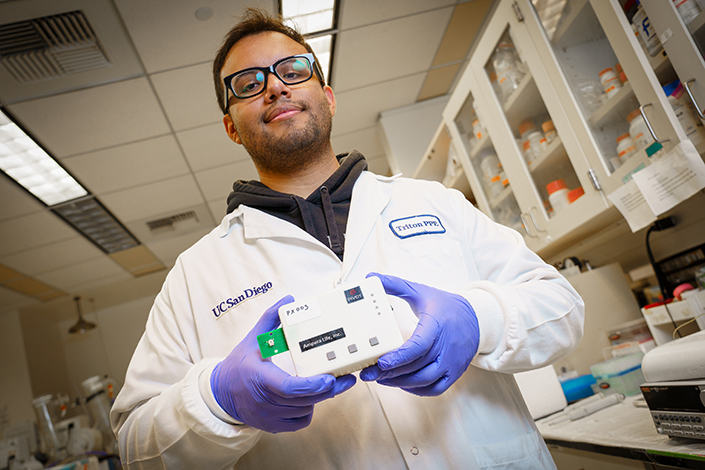
    Picture of a device held by a researcher

    Bioengineering senior Armando Ramil holds the biosensor.
    Photos: David Baillot/UC San Diego Jacobs School of Engineering

    Photo gallery

    How the device is made and how it works

    The device described in the 2023 PNAS study, consists of a chip with a high sensitivity transistor, commonly known as a field effect transistor (FET). In this case, each transistor is made of a graphene layer that is a single atom thick (GFET, with the G standing for graphene) and three electrodes–source and drain electrodes, connected to the positive and negative poles of a battery, to flow electric current, and a gate electrode to control the amount of current flow.

    Connected to the gate electrode is a single DNA strand, which serves as a probe that specifically binds to either amyloid beta, tau or synuclein proteins. The binding of these amyloids with their specific DNA strand probe, called an aptamer, changes the amount of current flow between the source and drain electrode. The change in this current or voltage is the signal used to detect the specific biomarkers, like amyloids or COVID 19 proteins. 

    The research team tested the device with brain-derived amyloid proteins from Alzheimer’s and Parkinson’s deceased patients. The experiments showed that the biosensors were able to detect the specific biomarkers for both conditions with great accuracy, on par with existing state of the art methods. The device also works at extremely low concentrations, meaning that it needs small quantities for samples–down to just a few microliters.

    In addition, the tests showed that the device performed well even when the samples analyzed contained other proteins. Tau proteins were more difficult to detect. But because the device looks at three different biomarkers, it can combine results from all three to arrive at a reliable overall result.

    The technology has been licensed from UC San Diego to a biotechnology startup Ampera Life. Lal is the company’s chairman but does not receive financial support for his research from the company. 

    Next steps include testing blood plasma and cerebro-spinal fluid with the device, then finally saliva and urine samples. The tests would take place  in hospital settings and nursing homes. If those tests go well, Ampera Life plans to apply for FDA approval for the device, hopefully in the next five or six months. The ultimate goal is to have the device on the market in a year. 

    Funding for the research came from the National Institutes of Health, the University of California San Diego and the Chinese Academy of Sciences. In addition, researchers used facilities that are a part of the NSF-funded UC San Diego Materials Research Science and Engineering Center. 

    In pursuit of degenerative brain disease diagnosis: dementia biomarkers detected by DNA aptamer-attached portable graphene biosensor

    University of California San Diego: Tyler A. Bodily, Anirudh Ramanathan, Abhijith Karkisaval, Armando Rami, Prachi Heda. M. Leite, Ratnesh Lal
    Shanghai Institute of Microsystem Information Technology Shahong Wei, Yi WAng, Tie Li, Jianlong Zhao

    University of the Chinese Academy of Sciences Shahong Wei 

    University of Texas Medical Branch, Galveston, Texas Nemil Bhatt, Cynthia Jerez, Md Anzarul Haque
    University of Illinois Urbana-Champaign Sanjeev Kumar

    Wednesday, March 1, 2023

    Oleic acid: Principal component of olive oil responsible for many health-promoting properties

     Good news but useless, since it tells us nothing about how much olive oil we need to consume on a daily basis to get these benefits. Human testing needed, Are your doctors and hospital going to ensure that testing occurs? Or are they fucking uselessly sitting on their asses doing nothing to help stroke survivors?

    Oleic acid: Principal component of olive oil responsible for many health-promoting properties

    Oleic acid, the principal component of olive oil, has properties that help to prevent cancer and Alzheimer's disease and to lower cholesterol.

    The health benefits of olive oil, which are commonly attributed to its minor components such as polyphenols, are now well recognized by science. But little attention has been paid to oleic acid, which represents 70 to 80 percent of its composition. That is why a group of professors from the Faculties of Pharmacy and Medicine at the University of Seville, in conjunction with professionals from the Seville North and Aljarafe Health District and the Costa del Sol Hospital, have produced a study on its main contributions to health.

    This fatty acid is the main constituent of olive oil and is responsible for many health-promoting properties. Oleic acid is produced by the diet and synthesis in the body itself. It is thereby the most abundant monounsaturated fatty acid (MUFA) in the human diet.

    The Mediterranean diet is the most widely recognized diet for preventing disease and aging. The olive tree (Olea europaea L.) is abundant in the Mediterranean basin and olive oil, which is extracted from its fruit, is the most characteristic nutrient and the main fat in this diet, which is also marked by a high vegetable intake, moderate fish consumption, low-moderate dairy consumption, low red meat intake and moderate wine consumption.

    Oleic acid is the principal MUFA in the human circulatory system. In the brain, it is a major component of membrane phospholipids and abounds in the neuronal myelin sheaths. A significantly decreased level of oleic acid has been observed in the brains of patients suffering from major depressive disorders and Alzheimer's disease.

    Like all free fatty acids, oleic acid's main function is that of an energy molecule and a component of cell membranes. One of its most characteristic effects is its antioxidant properties, since it can directly regulate both the synthesis and the activity of antioxidant enzymes. Another beneficial property is its hypocholesterolaemic effect: it inhibits the expression of proteins associated with cholesterol transport, reducing cholesterol absorption and thus preventing atherosclerosis.

    Oleic acid is also recognized to be an anti-cancer molecule because of its inhibitory effects on the overexpression of oncogenes and their effects on programmed cell death. Moreover, oleic acid is generally considered an anti-inflammatory molecule, although this quality is still under debate among scientists.

    On the other hand, oleoylethanolamide, a derivative of oleic acid, has anti-inflammatory and antioxidant effects of its own and has now been proposed as a potent therapeutic agent to treat obesity. This underlines the benefits of oleic acid for health. Emerging research suggests that it may influence epigenetic mechanisms (direct modifications of DNA and DNA-associated proteins) and modulation of the immune system, specifically by regulating cells involved in developing inflammation.

    Finally, the authors of this study have pointed out that most studies on olive oil have been conducted on animals, hence they warn of the need for further research to confirm the significant properties shown by this molecule and its derivative, oleoylethanolamide, in humans.

    Source:
    Journal reference:

    Santa-María, C., et al. (2023) Update on Anti-Inflammatory Molecular Mechanisms Induced by Oleic Acid. Nutrients. doi.org/10.3390/nu15010224.

    Sunday, January 1, 2023

    Arguing for inaction (as applied to stroke from Seth's blog)

    Why do anything new in stroke? The brain is hard to figure out and we have tPA working so it successfully blows out the clots most of the time. Let's just sit on our asses, collect our money and assure our patients that their lack of recovery is the best we can do. And since we are doctors, they look up to us as leaders and never question why they don't recover. 

    ANY RESPONSE? STROKE MEDICAL 'PROFESSIONALS'?

    Arguing for inaction

    …is surprisingly easy.

    “We’ve done all this work and things haven’t gotten better,” so, apparently, we should stop trying and go back to what we were doing.

    “We’ve done all this work and things are getting better,” so that means that there’s no need to keep trying and we can go back to what we were doing.

    The status quo might not be ideal, but if we’re afraid of change, if we focus on the costs of doing the work to make things better, it’s tempting to simply stay still.

    And the real fears of change are that it might work (which is scary) and that it might not work (which is heartbreaking).

    Easier to do nothing and simply settle.


    Thursday, December 23, 2021

    Butylphthalide Combined With Conventional Treatment Attenuates MMP-9 Levels and Increases VEGF Levels in Patients With Stroke: A Prospective Cohort Study

    More research needed, but is your doctor and hospital going to do one damn thing about that? Or just sit on their asses doing nothing? 

    Reasons for needing this in here:

    • MMP-9 (21 posts to May 2012)

    • VEGF (51 posts to April 2011)

    • vegf-A (2 posts to April 2013)

    Butylphthalide Combined With Conventional Treatment Attenuates MMP-9 Levels and Increases VEGF Levels in Patients With Stroke: A Prospective Cohort Study

    Yingqiong Xiong1,2, Juanjuan Liu3, Yang Xu3, Shu Xie2, Xinhua Zhou2 and Shaomin Cheng3*
    • 1Department of Neurology, the First Affiliated Hospital of Nanchang University, Nanchang, China
    • 2Department of Neurology, Jiangxi People's Hospital, Nanchang, China
    • 3School of Chinese Medicine, Jiangxi University of Traditional Chinese Medicine, Nanchang, China

    Background and Purpose: Butylphtalide increases the vascular endothelial growth factor (VEGF) and decreases matrix metalloproteinase (MMP)-9 in animal models of stroke and might be of use in the management of stroke. To explore whether butylphthalide combined with conventional treatment can change the levels of MMP-9 and VEGF and the National Institutes of Health Stroke Scale (NIHSS) scores of patients with stroke.

    Methods: This was a prospective cohort study involving inpatients admitted to the Jiangxi Provincial People's Hospital (January–June 2019) due to acute cerebral infarction. The patients received conventional treatments with or without butylphthalide. The changes in the NIHSS scores were compared between groups. Plasma MMP-9 and VEGF were measured by enzyme-linked immunosorbent assay.

    Results: A total of 24 patients were included in the conventional treatment group and 46 in the butylphthalide group. The butylphthalide group showed lower MMP-9 (130 ± 59 vs. 188 ± 65, p = 0.001) and higher VEGF (441 ± 121 vs. 378 ± 70, p = 0.034) levels on day 6 compared with the conventional treatment group. The changes in MMP-9 and VEGF were significant, starting on day 3 in the butylphthalide group but on day 6 in the conventional treatment group. There were no differences between the two groups in the NIHSS scores at admission and at discharge (p > 0.05). The overall response rate was higher in the butylphthalide group compared with the conventional treatment group (63.0 vs. 37.5%, p = 0.042).

    Conclusion: Butylphthalide combined with conventional treatment can decrease MMP-9 levels and increase VEGF levels. The patients showed the reduced NIHSS scores, possibly suggesting some improvement in prognosis after stroke. Still, the conclusions need to be confirmed in a larger sample and in different etiological subtypes of stroke.

    Introduction

    A stroke is an episode of acute neurological dysfunction from either ischemic infarction or a collection of blood within the brain or ventricular system with a resultant focal injury of the central nervous system (CNS) (1). Ischemic strokes (80–87% of strokes) result from cardioembolism (often from atrial fibrillation), large artery atherosclerosis (embolus or thrombosis), small vessel occlusion (lacunar), or systemic hypoperfusion (1). The estimated global incidence of stroke is 2–3 per 1,000 person-years, with older patients and patients with carotid artery stenosis or atrial fibrillation having the highest risk (1, 2). The mortality due to stroke every year in China accounts for nearly one-third of the total stroke-related deaths worldwide (3). Stroke disease is the main cause of non-traumatic disability and death in China (3). In Jiangxi Province, the incidence of cerebrovascular diseases is higher than in the other provinces of China, with ischemic stroke being predominant (about 73.5%) (4). The acute management of stroke includes blood pressure management, airway support, maintaining blood glucose levels, thrombolytics, endovascular therapy, aspirin, and decompressive surgery (2). In China, complementary traditional Chinese medicine (TCM) is also used for acute stroke management (5, 6).

    Matrix metalloproteinase (MMP)-9, also called gelatinase B, is the MMP with the highest expression after hypoxic-ischemic changes and is closely related to the occurrence and development of cerebral infarction (710). Normally, its expression in the brain is low, and it is present in the form of an inactive zymogen (710). During the inflammatory responses of brain ischemia and hypoxia, the white blood cells, microglia, and astrocytes can produce MMP-9, and the MMP-9 levels are closely associated with the severity of cerebral infarction (710). Other studies have also shown that elevated MMP-9 levels are present both in the infarcted tissues and the tissues around the infarction, indicating that MMP-9 might play a role in the expansion of the infarct size (1113).

    The vascular endothelial growth factor (VEGF)-A is the most abundant member of the VEGF family, and it is involved in angiogenesis, promoting neovascularization (14). VEGF is involved in many processes such as atherosclerosis, cerebral edema, arteriogenesis, neuroprotection, neurogenesis, angiogenesis, brain, and vascular repair after ischemia (1416). Normally, vascular endothelial cells, as the target cells of VEGF, cannot promote VEGF expression, but under pathological states, the concentration of VEGF can change rapidly, and increased VEGF levels are observed after stroke (17, 18).

    Butylphthalide is a novel drug independently developed by China to treat cerebral infarction, which includes dl-3-n-butylphthalide (NBP) as the main active component (C12H14O2). It is a phthalide, an oily liquid with a taste of celery. It has the same structure as the natural substance levorotatory butylphthalide and is a synthetic racemic mixture. It is present in TCM ingredients such as chuanxiong (Ligusticum chuanxiong hort), Chinese lovage, and Chinese angelica, among others. Butylphthalide is an important candidate for the management of neurologic diseases by favoring the reconstruction of the microcirculation and protecting the mitochondrial functions (19, 20). Previous studies showed that butylphthalide improves the local microcirculation, increases blood perfusion, and increases the number of capillaries in ischemic brain areas (2125). Butylphthalide also increases vasodilation and inhibits platelet aggregation (26). NBP can inhibit thrombus formation (27). One study showed that butylphthalide increases VEGF expression in animal models of stroke (24). Another animal study showed that butylphthalide decreases poststroke inflammation and MMP-9 expression (28). The effects of butylphthalide on VEGF and MMP-9 have to be confirmed in humans.

    Therefore, this study aims to explore whether butylphthalide combined with conventional treatment can change the levels of MMP-9 and VEGF and the National Institutes of Health Stroke Scale (NIHSS) scores of patients with stroke and improve their prognosis. The results could provide data for the eventual inclusion of butylphthalide in routine stroke management.


    Monday, November 15, 2021

    Optimized hip-knee-ankle exoskeleton assistance reduces the metabolic cost of walking with worn loads

     You'll need your doctors and stroke hospital to initiate research with this in stroke patients. Walking cost in stroke patients is vastly higher than normal so help is needed. Will your stroke doctors do one damn thing to initiate research? Or will they sit on their asses doing nothing like usual?

    Optimized hip-knee-ankle exoskeleton assistance reduces the metabolic cost of walking with worn loads

    Abstract

    Background

    Load carriage is common in a wide range of professions, but prolonged load carriage is associated with increased fatigue and overuse injuries. Exoskeletons could improve the quality of life of these professionals by reducing metabolic cost to combat fatigue and reducing muscle activity to prevent injuries. Current exoskeletons have reduced the metabolic cost of loaded walking by up to 22% relative to walking in the device with no assistance when assisting one or two joints. Greater metabolic reductions may be possible with optimized assistance of the entire leg.

    Methods

    We used human-in the-loop optimization to optimize hip-knee-ankle exoskeleton assistance with no additional load, a light load (15% of body weight), and a heavy load (30% of body weight) for three participants. All loads were applied through a weight vest with an attached waist belt. We measured metabolic cost, exoskeleton assistance, kinematics, and muscle activity. We performed Friedman’s tests to analyze trends across worn loads and paired t-tests to determine whether changes from the unassisted conditions to the assisted conditions were significant.

    Results

    Exoskeleton assistance reduced the metabolic cost of walking relative to walking in the device without assistance for all tested conditions. Exoskeleton assistance reduced the metabolic cost of walking by 48% with no load (p = 0.05), 41% with the light load (p = 0.01), and 43% with the heavy load (p = 0.04). The smaller metabolic reduction with the light load may be due to insufficient participant training or lack of optimizer convergence. The total applied positive power was similar for all tested conditions, and the positive knee power decreased slightly as load increased. Optimized torque timing parameters were consistent across participants and load conditions while optimized magnitude parameters varied.

    Conclusions

    Whole-leg exoskeleton assistance can reduce the metabolic cost of walking while carrying a range of loads. The consistent optimized timing parameters across participants and conditions suggest that metabolic cost reductions are sensitive to torque timing. The variable torque magnitude parameters could imply that torque magnitude should be customized to the individual, or that there is a range of useful torque magnitudes. Future work should test whether applying the load to the exoskeleton rather than the person’s torso results in larger benefits.

    Introduction

    Exoskeletons could reduce the effort associated with loaded walking. Load carriage is a common task in many professions, for example military personnel will carry loads over 80% of their body weight [1]. When applied to the waist or back, each kilogram of additional load will increase metabolic cost by about 2%, and the metabolic impact increases as the load is applied further from the participant’s center of gravity [2]. In addition to increased metabolic cost, prolonged load carriage is associated with overuse injuries such as stress fractures, back strain, and knee pain [3]. Exoskeletons could assist loaded walking by reducing the user’s metabolic cost and could, over the longer term, prevent overuse injuries.

    Some exoskeletons have reduced the metabolic cost of loaded walking when assisting one to two joints. Exoskeletons are typically evaluated by their ability to augment user performance, and reducing metabolic cost is an important evaluation metric [4]. Exoskeleton assistance has reduced the metabolic cost of loaded walking by up to 22% compared to walking in the device without assistance and up to 15% compared to walking without the device [5]. Many of the devices that have reduced the metabolic cost of loaded walking have assisted hip extension [6, 7], ankle plantarflexion [8,9,10,11], hip flexion and ankle plantarflexion [12, 13] or hip flexion, hip extension, and ankle plantarflexion [5, 7]. Some of these experiments applied the same mass to all participants, up to 24.5 kg in addition to the weight of the device [5,6,7,8, 11, 12, 14], while others have applied the load as a percentage of body weight, up to 30% [9, 10, 13]. Exoskeletons can reduce the metabolic cost during load carriage, but there has been limited research into optimal assistance or comparing assistance with different loads.

    With increasing worn load, exoskeleton assistance has produced similar absolute metabolic reductions and decreasing metabolic reductions as a percent of control conditions. Compared to walking in the unpowered device, a hip-ankle exosuit can reduce the metabolic cost of walking by 23% (1.02 W/kg) with no load when assisting hip flexion and ankle plantarflexion [15], by 22% (1.04 W/kg) with a 7 kg load when assisting hip flexion, hip extension, and ankle plantarflexion [5] and by 15% (0.67 W/kg) with a 24 kg load when assisting hip flexion, hip extension, and ankle plantarflexion [7]. In a single-participant pilot study with bilateral ankle exoskeletons, assistance reduced the metabolic cost of walking relative to walking in the device without assistance by 33% with no load and by 15% with a 20% body weight load [9]. It is unclear if the decreasing metabolic reductions with increasing worn load is a biological trend, a result of limited actuation capabilities, or a product of assisting only one or two joints. There may be greater metabolic reductions possible when assisting the hips, knees and ankle simultaneously.

    Providing assistance at all three joints (hips, knees, and ankles) may result in larger metabolic reductions for loaded walking. Biological hip extension, knee extension and ankle plantarflexion joint moments all increase with worn load [16], and optimal exoskeleton assistance may follow a similar pattern. Simulations of exoskeleton assistance when walking with a heavy load found the greatest metabolic reductions when assisting hip flexion, knee flexion, or hip abduction [17]. These simulations assume that the exoskeleton is massless, has a lossless transmission, and has unlimited torque and power capabilities. In unloaded walking, a comparison of optimized assistance for one joint, two joint, and three joint configurations found the greatest metabolic reductions when the hips, knees and ankles were assisted simultaneously [18]. The same may be true for loaded walking where optimized hip-knee-ankle exoskeleton assistance could produce greater metabolic reductions than assistance at one or two joints.

    We optimized hip-knee-ankle exoskeleton assistance to reduce the metabolic cost of loaded walking. We hypothesized that exoskeleton assistance would reduce metabolic cost for all loaded conditions and that the optimized extension torques would increase with load. Three participants wore a hip-knee-ankle exoskeleton emulator [19] while we used human-in-the-loop optimization to reduce the metabolic cost of walking with no load [18, 20], while carrying 15% of body weight, and while carrying 30% of body weight. The loads were applied with a weight vest with an attached waist strap such that the majority of the load was applied to the user’s iliac crests. We measured changes in metabolic cost, muscle activity, exoskeleton assistance and kinematics across loads. We used biomechanics measurements to gain insights into the mechanisms underlying changes in metabolic rate. We expected the results of this study to be used to prescribe effective load-dependent assistance for future exoskeleton products.