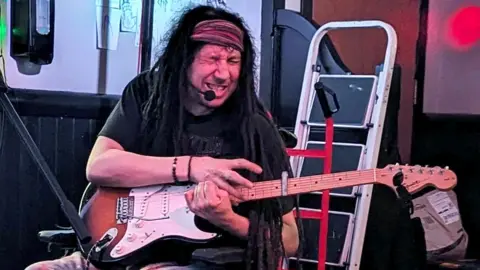
I can't tell from this if this is compensation and just one-handed playing or actual recovery working on the affected hand.
Stroke victims now have a creative option for their rehabilitation,
thanks to a team of University students who have built an adaptive
guitar specializing in restoring motor function.
The guitar, which
is the second of its kind, was originally the brainchild of Assistant
Professor of Kinesiology, Nikita Kuznetsov.
“I have a friend who
had a stroke and he was a musician,” Kuznetsov said. “He basically
couldn’t play anymore, and he had played the guitar. I thought this
might be one way to help him.”
Kuznetsov
said his friend tried to develop a similar device, but couldn’t get it
to work. Whenever Kuznetsov started his faculty position at the
University, he saw it as the perfect opportunity to continue his
friend’s work.
Kuznetsov
enlisted a diverse team ranging from undergraduate freshmen to alumni
to work on the project. Kinesiology graduate student Marcelline
Dechenaud immediately jumped on board, since it was a unique opportunity
to combine her academic interest in kinesiology with her musical hobby.
“I’m
a musician,” Dechenaud said. “When I heard about the project, I thought
that would be a very cool thing for me to be involved in.”
Dechenaud plays the cello but finds it difficult to devote time to music amidst her academic pursuits.
“I wouldn’t do it professionally, since I don’t have enough time, but I try to practice as much as I can,” Dechenaud said.
Kinesiology
freshman Sarah Cherry was excited to have been included in such a
meaningful project during her first year at the University.
“This
is my first experience with research at a university setting,” Cherry
said. “It’s such a great opportunity for me to be involved in during my
freshman year of college.”
Each year in the U.S., an estimated
795,000 people suffer from a stroke. Despite popular misconception, it
is not a rare condition that only affects the elderly. It is extremely
common, and can happen to anyone at anytime.Recovering from a stroke can
also be a lifelong process.
“I think this is something that I
think a lot of people can understand and relate to,” Cherry said. “It’s
easy for me to get excited about, because it has such an awesome impact
on people.”
Although the adaptive guitar has only been tested on
University student volunteers, the University will soon bring the device
to Baton Rouge General Hospital. Kuznetsov is currently working on a
grant to expand funding for the project.
“This project involves a lot of people, so it’s a great motivator,” Kuznetsov said. “We’re all in this together.”
The
project is still seeking volunteers and welcomes anyone who wants to
experiment with playing their adaptive guitar. Kuznetsov compared the
experience to the popular music game Guitar Hero, although the technique
involved is significantly more difficult. Students should not get
discouraged if they initially find playing the instrument challenging,
especially since they are instructed to play with their non-dominant
hand.
“Some students get very frustrated the first day,” Cherry said. “It moves very quickly, so they get overwhelmed at first.”
The
adaptive guitar has the added benefit of being like a starter guitar
for students who are not musical. Although it can be difficult at first,
most of the test subjects got the hang of it quickly.
“After the
first few days, it was so easy, they weren’t concentrating anymore, and
so then that’s the reason they would mess up,” Dechenaud said.
The
benefits of the adaptive guitar not only apply to stroke victims or
those seeking to learn how to play an instrument on a basic level.
Seasoned musicians might be fascinated by the guitar’s capability to
play chords that are impossible on a standard acoustic due to the
complex hand placement.
LSU alumnus James Kirsch, who graduated
with his bachelor’s in engineering but still remains closely involved
with the project, said the project had its fair share of doubters. The
idea has been attempted multiple times before, but this version is by
far the most complicated and the most successful.
“No one else
expected it to work,” Kirsch said. “They thought it was too complicated.
When we finally presented it, one of the guys who said there was no way
it was going to work said, ‘I don’t understand how you did this.’ He
called it black magic.”
Despite the skeptics, Kirsch said the team
always remained confident. It took a lot of long nights, but they
eventually accomplished their goals.
“A few days before, I
realized it wasn’t physically possible to put it together, so I had to
make a lot of last minute modifications,” Kirsch said.
Although
Kirsch emphasized the stress the team was under in the last few days
before the presentation, he mentioned his respect for Kuznetsov as an
inspiration.
“Nikita’s great,” Kirsch said. “Making him happy was worth it.”
Although
the difficult part of developing the device is over, Kuznetsov said
that his project has a higher ultimate goal of becoming a commonplace
rehabilitation method.
“I want to do something that helps with the
quality of life in the community,” Kuznetsov said. “Down the line, this
could be used for people with Parkinson’s, children with autism or
aging adults. It could really be helpful in a variety of situations.”
Picture at link.