Changing stroke rehab and research worldwide now.Time is Brain! trillions and trillions of neurons that DIE each day because there are NO effective hyperacute therapies besides tPA(only 12% effective). I have 523 posts on hyperacute therapy, enough for researchers to spend decades proving them out. These are my personal ideas and blog on stroke rehabilitation and stroke research. Do not attempt any of these without checking with your medical provider. Unless you join me in agitating, when you need these therapies they won't be there.

What this blog is for:

My blog is not to help survivors recover, it is to have the 10 million yearly stroke survivors light fires underneath their doctors, stroke hospitals and stroke researchers to get stroke solved. 100% recovery. The stroke medical world is completely failing at that goal, they don't even have it as a goal. Shortly after getting out of the hospital and getting NO information on the process or protocols of stroke rehabilitation and recovery I started searching on the internet and found that no other survivor received useful information. This is an attempt to cover all stroke rehabilitation information that should be readily available to survivors so they can talk with informed knowledge to their medical staff. It lays out what needs to be done to get stroke survivors closer to 100% recovery. It's quite disgusting that this information is not available from every stroke association and doctors group.

Showing posts with label activity monitors. Show all posts

Saturday, January 22, 2022

How Many Hours of Device Wear Time Are Required to Accurately Measure Physical Activity Post Stroke?


I would suggest having them wear accelerometers instead, that way you can get objective measurements of the movement for analysis and correction along with just basic movement time.  Now how do we get that suggestion to stroke leadership so research can be improved?

How Many Hours of Device Wear Time Are Required to Accurately Measure Physical Activity Post Stroke?

1
Physiotherapy Department, Alfred Health, Melbourne 3004, Australia
2
Physiotherapy Department, The University of Melbourne, Parkville 3010, Australia
3
Respiratory Research@Alfred, Central Clinical School, Monash University, Melbourne 3004, Australia
4
Stroke Division, Florey Institute of Neurosciences and Mental Health, Heidelberg 3084, Australia
*
Author to whom correspondence should be addressed.
Academic Editor: Veronica Cimolin
Int. J. Environ. Res. Public Health 2022, 19(3), 1191; https://doi.org/10.3390/ijerph19031191
Received: 25 November 2021 / Revised: 17 January 2022 / Accepted: 17 January 2022 / Published: 21 January 2022
Background. 
Inadequate physical activity participation is a risk factor for secondary stroke. Before implementing appropriate management strategies, we need to accurately measure the physical activity of stroke survivors. We aimed to determine the duration of physical activity monitoring post-stroke that constitutes a valid day. 
 
Methods.  
 
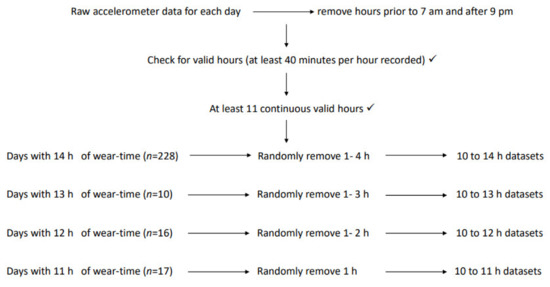
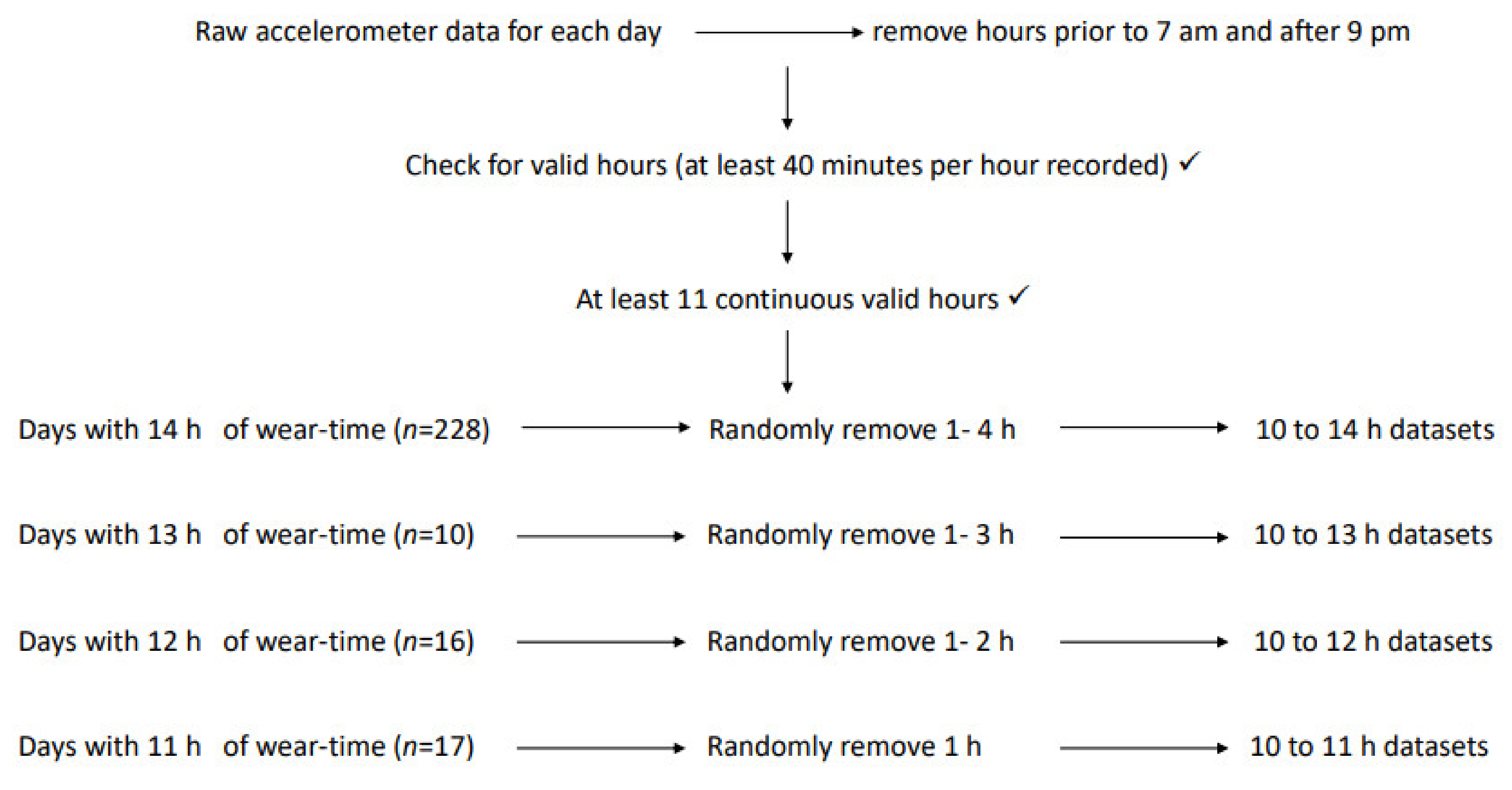
We sampled stroke survivors’ physical activity for one week following discharge from inpatient rehabilitation using the Sensewear Armband (Bodymedia, Pittsburgh, PA, USA). To determine the impact of total daily wear time on activity estimate (sedentary, light, and moderate to vigorous physical activity) accuracy, we performed simulations, removing one, two, three, or four hours from a 14-h reference day, and analysed them with linear mixed models. 
 
Results. 
 
Sixty-nine participants (46 male, 65 ± 15 years) with 271 days of physical activity data were included. All physical activity variables were significantly underestimated for all data sets (10, 11, 12, or 13 h) compared to the 14-h reference data set. The number of days classified as not meeting physical activity recommendations increased as daily monitoring duration decreased: 13% misclassification with 10-h compared to 14-h dataset (p = 0.011). 
 
Conclusions. 
 
The accuracy of physical activity estimates increases with longer daily monitoring periods following stroke, and researchers should aim to monitor post-stroke physical activity for 14 daytime hours. View Full-Text
▼ Show Figures

Figure 1


Tuesday, August 27, 2019

Unobtrusive Sensing Solution for Post-stroke Rehabilitation

WHOM is going to put together a monitoring system for your doctors and therapists to see the efficacy of the work they do?

Unobtrusive Sensing Solution for Post-stroke Rehabilitation


  • Idongesit EkereteEmail author
  • Chris Nugent
  • Oonagh M. Giggins
  • James McLaughlin
  • Idongesit Ekerete
    • 1
    Email author
  • Chris Nugent
    • 1
  • Oonagh M. Giggins
    • 2
  • James McLaughlin
    • 3
  1. 1.School of Computing, Ulster UniversityNewtownabbeyNorthern Ireland, UK
  2. 2.Dundalk Institute of Technology, NetwellCASALADundalkRepublic of Ireland
  3. 3.NIBEC, Ulster UniversityNewtownabbeyNorthern Ireland, UK
Chapter
Part of the Computer Communications and Networks book series (CCN)

Abstract

This Chapter proposes an unobtrusive sensing solution for monitoring post-stroke rehabilitation exercises within a home environment. It begins with the definition of stroke, its types, statistics and effects. An overview of stroke rehabilitation techniques ranging from multiple exercising and isolated approaches to motor skill learning, mirror imagery, adjuvant therapies and technology-based interventions are all presented in this Chapter. In addition, the potential for the use of unobtrusive sensing solutions such as thermal, radar, optical and ultrasound sensing are considered with practical examples. The Seebeck, time of flight (ToF) and Doppler principles, which are associated with a number of the sensing solutions, are also explained. Furthermore, sensor data fusion (SDF) and its architectures such as centralized, distributed and hybrid architectures are explained. A few examples of SDF applications in automobile and terrestrial light detection are included in addition to the advantages and disadvantages of the approaches. Unobtrusive sensing solutions and their applications in healthcare are captured in this Chapter. The Chapter includes details of initial experimental results on post-stroke rehabilitation exercises which were obtained using thermal and radar sensing solutions. The Chapter concludes with an outline of recommendations for future research.

Keywords

Rehabilitation Post-stroke Unobtrusive Wearable Radar Thermal Sensors 

Notes

Acknowledgements

This project is supported by the European Union’s INTERREG VA Programme, managed by the Special EU Programmes Body (SEUPB).

References

  1. 1.
    Wilson CB (1999) Sensors in medicine 319:13–15Google Scholar
  2. 2.
    Dhiraj A, Deepa P (2012) Sensors and their applications. J Phys E: Sci Instrum 1(5):60–68Google Scholar

Saturday, November 24, 2018

Activity monitors for increasing physical activity in adult stroke survivors

Well, useless and lazy. If you want to figure out if fitness monitors increase activity you set up your own clinical research. You create a setting where you tell survivors they get better fitness by walking x number of steps a day which increases their cognition and reduces their chances of dementia. With that incentive survivors would try to meet a step goal. Damn it all, doesn't anyone know how to set up research? Our senior researchers and mentors are incompetent also?  

Oops, I'm calling into question the intelligence of the stroke medical world. Bad, bad Dean.

I'm not playing by the polite rules of Dale Carnegie, 'How to Win Friends and Influence People'. 
Politeness will never solve anything in stroke.

Activity monitors for increasing physical activity in adult stroke survivors

Abstract

available in

Background

Stroke is the third leading cause of disability worldwide. Physical activity is important for secondary stroke prevention and for promoting functional recovery. However, people with stroke are more inactive than healthy age‐matched controls. Therefore, interventions to increase activity after stroke are vital to reduce stroke‐related disability.

Objectives

To summarise the available evidence regarding the effectiveness of commercially available, wearable activity monitors and smartphone applications for increasing physical activity levels in people with stroke.

Search methods

We searched the Cochrane Stroke Group Trials Register, CENTRAL, MEDLINE, Embase, CINAHL, SPORTDiscus, and the following clinical trial registers: WHO International Clinical Trials Registry Platform, Clinical Trials, EU Clinical Trial Register, ISRCTN Registry, Australian and New Zealand Clinical Trial Registry, and Stroke Trials Registry to 3 March 2018. We also searched reference lists, Web of Science forward tracking, and Google Scholar, and contacted trial authors to obtain further data if required. We did not restrict the search on language or publication status.

Selection criteria

We included all randomised controlled trials (RCTs) and randomised cross‐over trials that included use of activity monitors versus no intervention, another type of intervention, or other activity monitor. Participants were aged 18 years or older with a diagnosis of stroke, in hospital or living in the community. Primary outcome measures were steps per day and time in moderate‐to‐vigorous intensity activity. Secondary outcomes were sedentary time, time spent in light intensity physical activity, walking duration, fatigue, mood, quality of life, community participation and adverse events. We excluded upper limb monitors that only measured upper limb activity.

Data collection and analysis

We followed standard Cochrane methodology to analyse and interpret the data. At least two authors independently screened titles and abstracts for inclusion. We resolved disagreements by consulting a third review author. We extracted the following data from included studies into a standardised template: type of study, participant population, study setting, intervention and co‐interventions, time‐frame, and outcomes. We graded levels of bias as high, low, or unclear, and assessed the quality of evidence for each outcome using the GRADE approach.

Main results

We retrieved 28,098 references, from which we identified 29 potential articles. Four RCTs (in 11 reports) met the inclusion criteria.The sample sizes ranged from 27 to 135 (total 245 participants). Time poststroke varied from less than one week (n = 1), to one to three months (n = 2), or a median of 51 months (n = 1). Stroke severity ranged from a median of one to six on the National Institutes of Health Stroke Scale (NIHSS). Three studies were conducted in inpatient rehabilitation, and one was in a university laboratory. All studies compared use of activity monitor plus another intervention (e.g. a walking retraining programme or an inpatient rehabilitation programme) versus the other intervention alone. Three studies reported on the primary outcome of daily step counts.
There was no clear effect for the use of activity monitors in conjunction with other interventions on step count in a community setting (mean difference (MD) ‐1930 steps, 95% confidence interval (CI) ‐4410 to 550; 1 RCT, 27 participants; very low‐quality evidence), or in an inpatient rehabilitation setting (MD 1400 steps, 95% CI ‐40 to 2840; 2 RCTs, 83 participants; very low‐quality evidence). No studies reported the primary outcome moderate‐to‐vigorous physical activity, but one did report time spent in moderate and vigorous intensity activity separately: this study reported that an activity monitor in addition to usual inpatient rehabilitation increased the time spent on moderate intensity physical activity by 4.4 minutes per day (95% CI 0.28 to 8.52; 1 RCT, 48 participants; low‐quality evidence) compared with usual rehabilitation alone, but there was no clear effect for the use of an activity monitor plus usual rehabilitation for increasing time spent in vigorous intensity physical activity compared to usual rehabilitation (MD 2.6 minutes per day, 95% CI ‐0.8 to 6; 1 RCT, 48 participants; low‐quality evidence). The overall risk of bias was low, apart from high‐risk for blinding of participants and study personnel. None of the included studies reported any information relating to adverse effects.

Authors' conclusions

Only four small RCTs with 274 participants (three in inpatient rehabilitation and one in the community) have examined the efficacy of activity monitors for increasing physical activity after stroke. Although these studies showed activity monitors could be incorporated into practice, there is currently not enough evidence to support the use of activity monitors to increase physical activity after stroke.