Changing stroke rehab and research worldwide now.Time is Brain! trillions and trillions of neurons that DIE each day because there are NO effective hyperacute therapies besides tPA(only 12% effective). I have 523 posts on hyperacute therapy, enough for researchers to spend decades proving them out. These are my personal ideas and blog on stroke rehabilitation and stroke research. Do not attempt any of these without checking with your medical provider. Unless you join me in agitating, when you need these therapies they won't be there.

What this blog is for:

My blog is not to help survivors recover, it is to have the 10 million yearly stroke survivors light fires underneath their doctors, stroke hospitals and stroke researchers to get stroke solved. 100% recovery. The stroke medical world is completely failing at that goal, they don't even have it as a goal. Shortly after getting out of the hospital and getting NO information on the process or protocols of stroke rehabilitation and recovery I started searching on the internet and found that no other survivor received useful information. This is an attempt to cover all stroke rehabilitation information that should be readily available to survivors so they can talk with informed knowledge to their medical staff. It lays out what needs to be done to get stroke survivors closer to 100% recovery. It's quite disgusting that this information is not available from every stroke association and doctors group.

Showing posts with label good outcomes. Show all posts

Wednesday, February 21, 2024

Predictors of Good Functional Outcomes in Posterior Circulation Stroke After Mechanical Thrombectomy With Stent Retrievers: An Individual Patient‐Data Pooled Analysis From the TRACK and NASA Registries

Is this a 'good functional outcome' as described by the patients? By definition a good functional outcome for a survivor is 100%  recovery. DON'T YOU DARE SUGGEST ANYTHING LESS IS GOOD!

Predictors of Good Functional Outcomes in Posterior Circulation Stroke After Mechanical Thrombectomy With Stent Retrievers: An Individual Patient‐Data Pooled Analysis From the TRACK and NASA Registries

Originally publishedhttps://doi.org/10.1161/SVIN.123.001017Stroke: Vascular and Interventional Neurology. 2024;0:e001017

Abstract

BACKGROUND

Recent randomized clinical trials have demonstrated that endovascular therapy for basilar artery occlusion is safe and potentially effective, predominantly in the non‐White population. The aim of this study was to identify predictors of good functional outcome in posterior circulation strokes in US population after mechanical thrombectomy from the TRACK (Trevo Stent‐Retriever Acute Stroke) and the NASA (North American Solitaire Stent Retriever Acute Stroke) registries from North America.

METHODS

Patient‐level data from the TRACK and NASA registries were pooled, and patients with posterior circulation stroke were included in this analysis. Patients were dichotomized into those with 90‐day good functional outcome (modified Rankin scale [mRS] score 0–2) and poor functional outcome (mRS score ≥3). Baseline and procedural data were compared between the 2 cohorts. Multivariate logistic regression was performed to identify predictors of functional outcome. P < 0.05 was considered significant.

RESULTS

Of 119 posterior stroke patients (99 [83.2%] basilar artery, 16 [13.4%] vertebral artery, and 4 [3.4%] posterior cerebral artery), 110 patients had 90‐day mRS data available on follow‐up. Good functional outcome was observed in 44 patients (40%). Patients with mRS score 0–2 were less likely to have hypertension (61.4% versus 83.3%; P = 0.01), hyperlipidemia (38.6% versus 62.1%; P = 0.016), and diabetes (18.2% versus 36.4%; P = 0.040). Patients with mRS score 0–2 had a lower mean presentation National Institutes of Health Stroke Scale score (15.2±9.95 versus 22.6±9.50; P < 0.001) and more likelihood of achieving Thrombolysis in Cerebral Infarction 3 (79.5% versus 42.2%; P < 0.001). There was no difference between 2 cohorts in time to puncture, use of balloon guide catheter, use of general anesthesia, and number of passes. On multivariate analysis, higher presentation National Institutes of Health Stroke Scale and hypertension were associated with worse functional outcomes. Complete recanalization and the receipt of intravenous tissue‐type plasminogen activator were associated with higher odds of achieving good functional outcomes.

CONCLUSION

In this pooled analysis of the NASA and TRACK registries, patients with posterior circulation stroke achieving good outcomes were more likely to have lower presentation National Institutes of Health Stroke Scale and fewer comorbidities. Use of intravenous tissue‐type plasminogen activator, hypertension, final Thrombolysis in Cerebral Infarction 3, and lower baseline National Institutes of Health Stroke Scale score were independent predictors of functional outcome.

Friday, August 12, 2022

Endovascular thrombectomy in young patients with stroke

 Even young patients have to deal with the tyranny of low expectations; measuring 'good outcome'. NOT 100% RECOVERY. Until we beat into stroke researcher brains that the only goal in stroke to be measured is 100% RECOVERY, nothing will ever get stroke solved.

Endovascular thrombectomy in young patients with stroke

First Published August 1, 2022 Research Article 

Background: 

 Endovascular treatment (ET) is standard of care(NOT RECOVERY!) in patients with acute ischemic stroke due to large vessel occlusion, but data on ET in young patients remain limited.

Aim: 

To compare outcomes for young stroke patients undergoing ET in a matched cohort.

Methods:  

We analyzed patients from an observational multicenter cohort with acute ischemic stroke and endovascular treatment, the German Stroke Registry – Endovascular Treatment trial. Baseline characteristics, procedural parameters and functional outcome at 90 days were compared between young (<50 years) and older (≥50 years) patients with and without nearest-neighbour 1:1 propensity score matching.

Results:  

Out of 6628 acute ischemic stroke patients treated with ET, 363 (5.5%) were young. Young patients differed with regard to prognostic outcome characteristics. Specifically, NIHSS at admission was lower (median 13, interquartile range [IQR] 8-17 vs. 15, IQR 9-19, p<0.001) and prestroke dependence was less frequent (2.9 vs 12.2%, p<0.001) than in older patients. Compared to a matched cohort of older patients, ET was faster (time from groin puncture to flow restoration, 35 vs. 45 min, p<0.001) and intracranial hemorrhage was less frequent in young patients (10.0 vs 25.9%, p<0.001). Good functional outcome (mRS 0-2) at 3 months was achieved more frequently in young patients (71.6% vs. 44.1%, p<0.001), and overall mortality was lower (6.7 vs. 25.4%, p<0.001). Among previously employed young patients (n=177), 37.9% returned to work at 3-month follow-up, while 74.1% of the remaining patients were still undergoing rehabilitation.

Conclusion: 

Young stroke patients undergoing ET have better outcomes compared to older patients, even when matched for prestroke condition, comorbidities and stroke severity. Hence, more liberal guidelines to perform ET for younger patients may have to be established by future studies.

Thursday, August 11, 2022

Perfusion Imaging and Clinical Outcome in Acute Minor Stroke With Large Vessel Occlusion

Tyranny of low expectations here in full display: 'good outcome' NOT 100% RECOVERY! This is why we need survivors in charge ; we wouldn't accept crapola research like this.  The only goal in stroke is 100% recovery. GET THERE!

Perfusion Imaging and Clinical Outcome in Acute Minor Stroke With Large Vessel Occlusion

and on behalf of the MINOR-STROKE-Perfusion Collaborators
Originally publishedhttps://doi.org/10.1161/STROKEAHA.122.039182Stroke. 2022;0:STROKEAHA.122.039182

BACKGROUND:

Whether bridging therapy (intravenous thrombolysis [IVT] followed by mechanical thrombectomy) is superior to IVT alone in minor stroke with large vessel occlusion is unknown. Perfusion imaging may identify subsets of large vessel occlusion–related minor stroke patients with distinct response to bridging therapy.

METHODS:

We conducted a multicenter international observational study of consecutive IVT-treated patients with minor stroke (National Institutes of Health Stroke Scale score ≤5) who had an anterior circulation large vessel occlusion and perfusion imaging performed before IVT, with a subset undergoing immediate thrombectomy. Propensity score with inverse probability of treatment weighting was used to account for baseline between-groups differences. The primary outcome was 3-month modified Rankin Scale score 0 to 1. We searched for an interaction between treatment group and mismatch volume (critical hypoperfusion–core volume).

RESULTS:

Overall, 569 patients were included (172 and 397 in the bridging therapy and IVT groups, respectively). After propensity-score weighting, the distribution of baseline variables was similar across the 2 groups. In the entire population, bridging was associated with lower odds of achieving modified Rankin Scale score 0 to 1: odds ratio, 0.73 [95% CI, 0.55–0.96]; P=0.03. However, mismatch volume modified the effect of bridging on clinical outcome (Pinteraction=0.04 for continuous mismatch volume); bridging was associated with worse outcome in patients with, but not in those without, mismatch volume <40 mL (odds ratio, [95% CI] for modified Rankin Scale score 0–1: 0.48 [0.33–0.71] versus 1.14 [0.76–1.71], respectively). Bridging was associated with higher incidence of symptomatic intracranial hemorrhage in the entire population, but this effect was present in the small mismatch subset only (Pinteraction=0.002).

CONCLUSIONS:

In our population of large vessel occlusion-related minor stroke patients, bridging therapy was associated with lower rates of good outcome as compared with IVT alone. However, mismatch volume was a strong modifier of the effect of bridging therapy over IVT alone, notably with worse outcome with bridging therapy in patients with mismatch volume ≤40 mL. Randomized trials should consider adding perfusion imaging for patient selection.

Sunday, July 10, 2022

Rehabilitation of Motor Function after Stroke: A Multiple Systematic Review Focused on Techniques to Stimulate Upper Extremity Recovery

We don't need your tyranny of low expectations; 'promising outcomes'.  Survivors want 100% recovery!  WHEN THE HELL ARE YOU GOING TO GET THERE?

I'd have you all fired for incompetence!

Rehabilitation of Motor Function after Stroke: A Multiple Systematic Review Focused on Techniques to Stimulate Upper Extremity Recovery

Samar M. Hatem1,2,3*, Geoffroy Saussez2, Margaux della Faille2, Vincent Prist4, Xue Zhang5, Delphine Dispa2,6 and Yannick Bleyenheuft2
  • 1Physical and Rehabilitation Medicine, Brugmann University Hospital, Brussels, Belgium
  • 2Systems and Cognitive Neuroscience, Institute of Neuroscience, Université Catholique de Louvain, Brussels, Belgium
  • 3Faculty of Medicine and Pharmacy, Faculty of Physical Education and Physiotherapy, Vrije Universiteit Brussel, Brussels, Belgium
  • 4Physical and Rehabilitation Medicine, Centre Hospitalier de l'Ardenne, Libramont, Belgium
  • 5Movement Control and Neuroplasticity Research Group, Motor Control Laboratory, Department of Kinesiology, Katholieke Universiteit Leuven, Leuven, Belgium
  • 6Physical Medicine and Rehabilitation, Cliniques Universitaires Saint-Luc, Université Catholique de Louvain, Brussels, Belgium

Stroke is one of the leading causes for disability worldwide. Motor function deficits due to stroke affect the patients' mobility, their limitation in daily life activities, their participation in society and their odds of returning to professional activities. All of these factors contribute to a low overall quality of life. Rehabilitation training is the most effective way to reduce motor impairments in stroke patients. This multiple systematic review focuses both on standard treatment methods and on innovating rehabilitation techniques used to promote upper extremity motor function in stroke patients. A total number of 5712 publications on stroke rehabilitation was systematically reviewed for relevance and quality with regards to upper extremity motor outcome. This procedure yielded 270 publications corresponding to the inclusion criteria of the systematic review. Recent technology-based interventions in stroke rehabilitation including non-invasive brain stimulation, robot-assisted training, and virtual reality immersion are addressed. Finally, a decisional tree based on evidence from the literature and characteristics of stroke patients is proposed. At present, the stroke rehabilitation field faces the challenge to tailor evidence-based treatment strategies to the needs of the individual stroke patient. Interventions can be combined in order to achieve the maximal motor function recovery for each patient. Though the efficacy of some interventions may be under debate, motor skill learning, and some new technological approaches give promising outcome prognosis in stroke motor rehabilitation.

Introduction

The World Health Organization (WHO) estimates that stroke events in EU countries are likely to increase by 30% between 2000 and 2025 (Truelsen et al., 2006). The most common deficit after stroke is hemiparesis of the contralateral upper limb, with more than 80% of stroke patients experiencing this condition acutely and more than 40% chronically (Cramer et al., 1997). Common manifestations of upper extremity motor impairment include muscle weakness or contracture, changes in muscle tone, joint laxity, and impaired motor control. These impairments induce disabilities in common activities such as reaching, picking up objects, and holding onto objects (for a review on precision grip deficits, see Bleyenheuft and Gordon, 2014).

Motor paresis of the upper extremity may be associated with other neurological manifestations that affect the recovery of motor function and thus require focused therapeutic intervention. Deficits in somatic sensations (body senses such as touch, temperature, pain, and proprioception) after stroke are common with prevalence rates variously reported to be 11–85% (Carey et al., 1993; Yekutiel, 2000; Hunter, 2002). Functionally, the motor problems resulting from sensory deficits after stroke can be summarized as (1) impaired detection of sensory information, (2) disturbed motor tasks performance requiring somatosensory information, and (3) diminished upper extremity rehabilitation outcomes (Hunter, 2002). Sensation is essential for safety even if there is adequate motor recovery (Yekutiel, 2000). Also, up to 50% of patients experience pain of the upper extremity during the first year after stroke, especially shoulder pain and complex regional pain syndrome-type I (CRPS-type I), which may impede adequate early rehabilitation (Jönsson et al., 2006; Kocabas et al., 2007; Sackley et al., 2008; Lundström et al., 2009). Furthermore, joint subluxation and muscle contractures can lead to nociceptive musculoskeletal pain (de Oliveira et al., 2012). Among other complications of stroke the neglect syndrome (Ringman et al., 2004) and spasticity (Sommerfeld et al., 2004; Welmer et al., 2010) affect motor and functional outcomes.

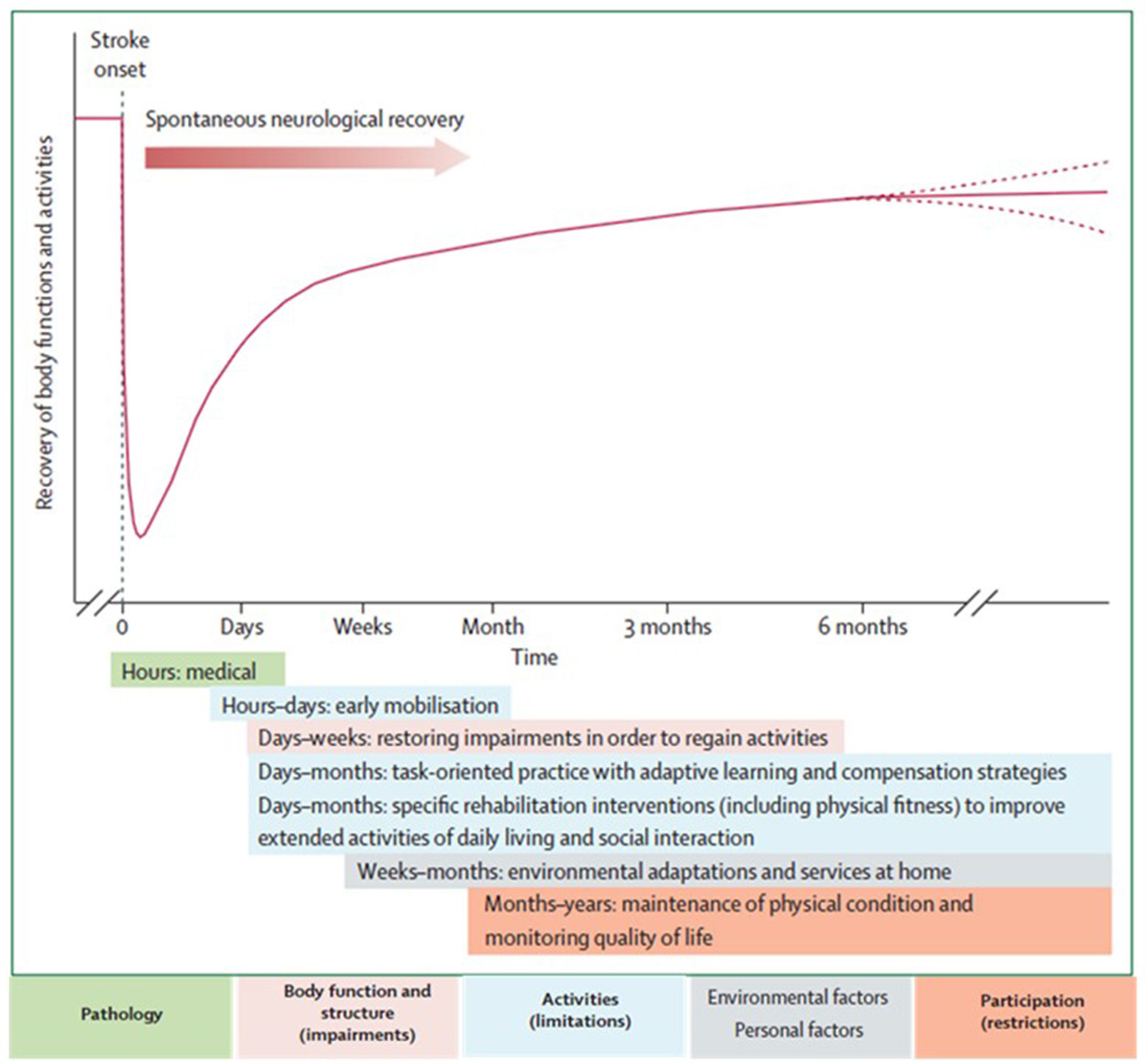
The neurological recovery after stroke displays a nonlinear, logarithmic pattern (Figure 1; Kwakkel et al., 2006; Langhorne et al., 2011). The greater part of recovery is reported to take place in the first 3 months following stroke (Wade et al., 1983). However, there is evidence that recovery is not limited to this time period; hand and upper extremity recovery has been reported many years after stroke (Carey et al., 1993; Yekutiel and Guttman, 1993). Improvement probably occurs through a complex combination of spontaneous and learning-dependent processes including: restitution, substitution, and compensation (Kwakkel et al., 2004; Langhorne et al., 2011). Until the third month after stroke onset, a variable spontaneous neurological recovery can be considered a confounder of rehabilitation intervention (Kwakkel et al., 2006). In the past, the observation of spontaneous recovery after stroke has misled some authors to believe that recovery of upper extremity function is intrinsic and that little can be done by therapists to influence it (Wade et al., 1983; Heller et al., 1987). Progresses in functional outcome appearing after 3 months seem largely dependent on learning adaptation strategies (Kwakkel et al., 2004). Evidence suggests that neurological repair through brain reorganization supporting true recovery or, alternatively through compensation, may also take place in the subacute and chronic phase after stroke (Krakauer, 2006).

FIGURE 1
www.frontiersin.org

Figure 1. Hypothetical pattern of recovery after stroke with timing of intervention strategies. The neurological recovery after stroke displays a nonlinear, logarithmic pattern. The greater part of recovery is reported to take place in the first three months following stroke. Rehabilitation interventions targeting at improving a stroke patients' performance should be implemented according to the phase of neurological recovery. Reprinted from Langhorne et al. (2011), Copyright [2011] by Elsevier. Reprinted with permission.

Functional imaging of stroke recovery corroborates this temporal pattern of activation shifts. Shortly after stroke, an initial contralesional shift of activation toward the “unaffected” hemisphere is observed, followed by the activation of learning-related brain structures (including the cerebellum, basal ganglia, and frontal cortices) (Hikosaka et al., 1998; Lehéricy et al., 2005). Finally, two activation patterns are described depending on the degree of recovery (related to the amount of remaining fibers in the impaired corticospinal tract), either a perilesional (refocusing), or a distributed recruitment pattern (Feydy et al., 2002; Ween, 2008). Rehme et al. (2012) confirmed this last assumption and concluded that a good functional outcome relies on the recruitment of the original functional network rather than on contralesional activity. The meta-analysis by Richards et al. (2008) concluded that brain activations increase within the lesioned hemisphere after an upper extremity rehabilitation program. Brain plasticity including reorganization and compensation processes is the base for neurological recovery, as described above, however the exact pathophysiological mechanisms underlying rehabilitation's efficacy remain unclear (Eliassen et al., 2008).

Stroke recovery is heterogeneous in terms of functional outcome. Patients with mild to moderate upper extremity paresis in acute phase have a good prognosis for functional recovery, as 71% of these patients achieve at least some dexterity at 6 months after stroke (Nijland et al., 2010). The prognosis in severely affected patients is poor with about 60% failing to achieve some dexterity at 6 months after stroke (Kwakkel et al., 2003; van Kuijk et al., 2009). Finally, only 5% of patients who initially experienced complete paralysis achieve functional use of their arm. Upper extremity impairments chronically affect the functional independence and satisfaction in 50–70% of all stroke patients. (Bonita and Beaglehole, 1988).

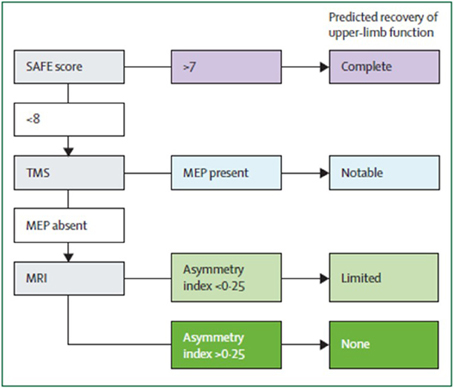
Algorithms have been developed to predict motor function recovery after stroke (Stinear et al., 2007). Predictor variables include age, sex, lesion site, initial motor impairment, motor-evoked potentials, and somatosensory-evoked potentials. Initial measures of upper extremity impairment and function were found to be the most significant predictors of upper extremity recovery (Coupar et al., 2012). Findings so far suggest that the first assessments should be quick and simple, such as bedside tests of motor impairment, with progression to more complex tests if uncertainty remains (Figure 2). Later tests can include neurophysiological assessments and neuroimagery of the motor system integrity.

FIGURE 2
www.frontiersin.org

Figure 2. Suggested sequence of tests to predict the recovery of motor function in patients with subacute stroke (weeks after stroke). Although this particular algorithm requires validation, it illustrates a potentially efficient progression from simple to more complex predictive measures. SAFE, sum of muscle force on shoulder abduction and finger extension according to Medical Research Council muscle grades at 72 h after stroke; TMS, transcranial magnetic stimulation; MEP, motor evoked potentials in the affected upper limb; Asymmetry index, asymmetry index of fractional anisotropy in the posterior limbs of the internal capsules measured with diffusion-weighted MRI. From Stinear et al. (2014).

Interdisciplinary complex rehabilitation interventions represent the mainstay of post-stroke care (Langhorne and Legg, 2003; Langhorne et al., 2011). Stroke rehabilitation aims at providing all possible means to recover lost function and to increase the autonomy of stroke patients taking into account the remaining impairments and disabilities. Carr and Shepherd (2011) suggested that poor upper extremity recovery may be due to the direct impact of the stroke itself as well as to insufficient, inadequate or inappropriate therapeutic interventions. Little information is available, however, to describe what best represents “optimum treatment” (Ballinger et al., 1999). From a theoretical point of view, a stroke rehabilitation program for upper extremity motor impairment should include global motor rehabilitation, electrical brain stimulation, hemispheric subspecialization in motor activities, and multisensory interaction (Johansson, 2011). A recent Cochrane review focussing on the recovery of function and mobility in stroke patients reported the potential benefit of rehabilitation therapy on motor impairments and disabilities, compared with no treatment, in function of the time since stroke (Pollock et al., 2014). While these type of systematic reviews and meta-analyses are very powerful, they only take into account rehabilitation techniques that already have been reported in other systematic reviews and may thus ignore rehabilitation approaches that pertain to the routine clinical setting. Furthermore, in most systematic reviews only randomized controlled trials are reported.

The purpose of the present manuscript was to undertake a systematic review for each of the neurorehabilitation techniques that may be useful in promoting upper extremity motor recovery. The search terms and inclusion criteria of reported trials have been chosen as large as possible in order to detect pertinent information on rehabilitation methods that are currently used in clinical practice, but are uncommonly discussed in systematic reviews (examples: music therapy, motor skill learning, isokinetic muscle strengthening, paired associative stimulation, theta burst stimulation). In some cases, routine clinical treatments that have not been investigated in a randomized controlled way, are still included in the present systematic review if the trial demonstrated sufficient quality evidence. The scientific evidence of each stroke rehabilitation intervention is discussed and presented with a practical recommendation for clinicians working in the field of neurorehabilitation. A decisional tree according to the patient's characteristics is proposed based on scientific evidence available for the different interventions.

More at link.

Wednesday, May 4, 2022

Outcome prediction in large vessel occlusion ischemic stroke with or without endovascular stroke treatment: THRIVE-EVT

You BLITHERING IDIOTS are predicting failure to recover. In what multiverse do you live where that helps survivors recover? I'm sure your definition of 'good outcome' is vastly different that a survivors. 100% recovery is a good outcome to a survivor. NOTHING LESS!

Outcome prediction in large vessel occlusion ischemic stroke with or without endovascular stroke treatment: THRIVE-EVT

Alexander C Flinthttps://orcid.org/0000-0002-3721-26941, Sheila L Chan1, Nancy J Edwardshttps://orcid.org/0000-0003-4440-59341, Vivek A Rao1, Jeffrey G Klingman2, Mai N Nguyen-Huynh2, Bernard Yan3, Peter J Mitchell4, Stephen M. Davis3, Bruce CV Campbellhttps://orcid.org/0000-0003-3632-94333, Diederik W Dippelhttps://orcid.org/0000-0002-9234-35155, Yvo BWEM Roos6, Wim H van Zwam7, Jeffrey L Saver8, Chelsea S Kidwell9, Michael D Hillhttps://orcid.org/0000-0002-6269-154310, Mayank Goyal10, Andrew M Demchuk10, Serge Bracard11, Martin Bendszus12, Geoffrey A Donnan3, and on behalf of the VISTA-Endovascular Collaboration*
Introduction: 
 
The THRIVE score and the THRIVE-c calculation are validated ischemic stroke outcome prediction tools based on patient variables that are readily available at initial presentation. Randomized controlled trials (RCTs) have demonstrated the benefit of endovascular treatment (EVT) for many patients with large vessel occlusion (LVO), and pooled data from these trials allow for adaptation of the THRIVE-c calculation for use in shared clinical decision making regarding EVT.
Methods:
 
To extend THRIVE-c for use in the context of EVT, we extracted data from the Virtual International Stroke Trials Archive (VISTA) from 7 RCTs of EVT. Models were built in a randomly selected development cohort using logistic regression that included the predictors from THRIVE-c: age, NIH Stroke Scale (NIHSS) score, presence of hypertension, diabetes mellitus, and/or atrial fibrillation, as well as randomization to EVT and, where available, the Alberta Stroke Program Early CT Score (ASPECTS).
Results: 
 
Good outcome (Your good outcome is not valid if the survivor doesn't think it was a good outcome. Survivors take precedence.)was achieved in 366/787 (46.5%) of subjects randomized to EVT and in 236/795 (29.7%) of subjects randomized to control (P < 0.001), and the improvement in outcome with EVT was seen across age, NIHSS, and THRIVE-c good outcome prediction. Models to predict outcome using THRIVE elements (age, NIHSS, and comorbidities) together with EVT, with or without ASPECTS, had similar performance by ROC analysis in the development and validation cohorts (THRIVE-EVT ROC area under the curve (AUC) = 0.716 in development, 0.727 in validation, P = 0.30; THRIVE-EVT + ASPECTS ROC AUC = 0.718 in development, 0.735 in validation, P = 0.12).
Conclusion:
 
 THRIVE-EVT may be used alongside the original THRIVE-c calculation to improve outcome probability estimation for patients with acute ischemic stroke, including patients with or without LVO, and to model the potential improvement in outcomes with EVT for an individual patient based on variables that are available at initial presentation. Online calculators for THRIVE-c estimation are available at www.thrivescore.org and www.mdcalc.com/thrive-score-for-stroke-outcome.
Keywords
Acute stroke therapy, outcome prediction, THRIVE score, ASPECTS, endovascular therapy, shared decision-making
1Division of Research and Department of Neuroscience, Kaiser Permanente, Redwood City, CA, USA
2Department of Neurology, Kaiser Permanente, Walnut Creek, CA, USA
3Melbourne Brain Centre at Royal Melbourne Hospital, The University of Melbourne, Parkville, VIC, Australia
4Department of Radiology, The University of Melbourne, The Royal Melbourne Hospital, Parkville, VIC, Australia
5Department of Neurology, Erasmus Medical Center, Rotterdam, The Netherlands
6Department of Neurology, Amsterdam University Medical Center, Amsterdam, The Netherlands
7Department of Radiology and Nuclear Medicine, Maastricht University Medical Center, Maastricht, The Netherlands
8Department of Neurology and Comprehensive Stroke Center, University of California, Los Angeles, Los Angeles, CA, USA
9Department of Neurology, The University of Arizona, Tucson, AZ, USA
10Department of Clinical Neurosciences, University of Calgary, Calgary, AB, Canada
11Department of Neuroradiology, University of Lorraine, Nancy, France
12Department of Neuroradiology, University of Heidelberg, Heidelberg, Germany
Corresponding author(s):
Alexander C Flint, Division of Research and Department of Neuroscience, Kaiser Permanente, 1150 Veterans Boulevard, Redwood City, CA 94025, USA. Email: alexander.c.flint@kp.org; @neuroicudoc
*
VISTA-Endovascular Steering Committee listed in Appendix A.
Introduction
The THRIVE score is an extensively validated ischemic stroke outcome prediction tool based on clinical variables easily obtained on acute stroke presentation.1,2 While the THRIVE score uses trichotomized NIHSS and patient age data in combination with the chronic disease scale to compute a score that corresponds to broad outcome categories, the THRIVE-c calculation uses continuous age and NIHSS in the logistic equation to estimate outcome more precisely.2 Among patients with LVO, the extent to which THRIVE-c outcome prediction would be impacted by EVT status remains unknown.
RCTs of second generation mechanical thrombectomy devices such as stent retrievers have demonstrated the overall efficacy of EVT3,4 but many patients do poorly despite receiving intervention.3,5 Outcome prediction models developed in the subsequent era of widespread EVT with variables available prior to treatment are based on small and often single-center cohorts6,7 or require a large number of variable inputs into a machine learning model that limits utility in acute decision making.6,8
Here, we use data from VISTA from 7 RCTs of EVT to develop tools for outcome prediction with or without EVT: the THRIVE-EVT calculations. The resulting tools are based on straightforward patient variables easily determined at initial presentation, allowing outcome prediction results to be used in shared clinical decision making about EVT.
Methods
Data source, subjects, and measurements
Data were obtained in anonymized form from VISTA http://www.virtualtrialsarchives.org/vista-endovascular/, pooled from 7 RCTs of EVT: MR CLEAN,9 SWIFT-PRIME,10 ESCAPE,11 EXTEND IA,12 MR RESCUE,13 THRILL,14 and THRACE.15 Full trial names are listed in Appendix B. Per VISTA policy, source RCT was deidentified. Data were available for all subjects on age, sex, initial NIHSS score, medical comorbidities and history as shown in Table 1, intravenous Alteplase administration, randomization to EVT or control, and clinical outcome on the mRS at 90 days post stroke. ASPECTS on the initial noncontrast head computed tomogram (CT) was available for 1484/1582 subjects (93.8%).
The THRIVE score is calculated from trichotomized age and NIHSS, and presence of HTN, DM, or AF.1 THRIVE-c is based on a logistic equation including age, NIHSS, and dummy variables encoding the comorbidities HTN, DM, and AF.2
For development and validation of two new logistic equations in patients who underwent randomization to EVT or control, we fit two multivariable logistic regression models. The first model included continuous age, continuous NIHSS, presence of HTN, DM, and AF (dummy variables with natural coding for chronic disease scale levels of 1, 2, and 3), and randomization to EVT or control. The second model included these same multivariable predictors and also included ASPECTS; this second model was fit in the subset of the cohort for whom ASPECTS was available (93.8% of the total). ASPECTS was adjudicated by the radiology core labs of the RCTs.
Analysis
Multivariable logistic regression was performed using standard techniques with direct entry of all predictors. For the THRIVE-EVT calculations, model-predicted probabilities were estimated using the logistic equation. Receiver-Operator Characteristics curve (ROC) analysis of the two new THRIVE-c models was performed using standard post-estimation techniques. Statistical comparisons of ROC curve area under the curve (AUC, C-statistic) were performed using a two-tailed Chi-square test as previously described.2 Development of the predictive models was performed in a randomly selected subset (n = 1107) representing approximately 70% of the total cohort, and separate validation was performed in the remaining subset (n = 475) representing approximately 30% of the total cohort. Model improvement by addition of EST and ASPECTS was assessed using integrated discrimination improvement (IDI).16 Bivariate analyses comparing subjects in two groups were performed with the Fisher’s exact test for categorical variables and the nonparametric Kruskal–Wallis equality-of-populations rank test for continuous data. All statistical analyses were performed using Stata MP version 16.1 (Stata Corp., College Station, TX).
Results
Patient characteristics for the total cohort of 1582 subjects from 7 RCTs of EVT are shown in Table 1, broken down according to our randomly selected development (n = 1107) and validation (n = 475) cohorts. No statistically significant differences in patient characteristics were found between the development and validation cohorts (Table 1).
Randomization to EVT was, as expected from the positive results of the underlying RCTs, associated with improved clinical outcomes. In the overall cohort, good outcome (mRS 0-2 at 90 days) was achieved in 366/787 (46.5%) of subjects randomized to EVT and in 236/795 (29.7%) of subjects randomized to control (P < 0.001). In multivariable logistic regression of good outcome in the overall cohort with the predictors age, NIHSS, chronic disease scale (dummy-encoded), and randomization to EVT, the odds ratio for EVT randomization prediction of good outcome was 2.24 (95% CI: 1.80-2.81, P < 0.001).
The relative impact of randomization to EVT was not selective for particular ranges of age, NIHSS, or the overall estimation of outcome by the parent THRIVE-c calculation. Using margin estimation of outcome from the above multivariable logistic model including the predictors age, NIHSS, chronic disease scale, and EVT, randomization to EVT improved the chance of good outcome across the range of ages (Figure 1(a)) and across the range of NIHSS scores (Figure 1(b)) encountered in the overall cohort. Using a multivariable logistic model of calculated THRIVE-c probability and EVT in the overall cohort, randomization to EVT similarly improved good outcome probability across the range of THRIVE-c in margin estimation (Figure 1(c)). In logistic regression modeling good outcome, there was no evidence for an interaction between randomization to EVT and THRIVE Score (Supplemental Table 1). Similarly, addition of IV Alteplase administration prior to EVT did not alter the relationship between EVT and outcome or THRIVE Score and outcome (Supplemental Table 1).
Figure 1. Effects of varying age, NIHSS, and THRIVE-c prediction on good outcome, according to randomization to endovascular stroke treatment (EVT) or control (No EVT): (a) Impact of varying age on good outcome (mRS 0-2 at 90 days), according to randomization to EVT or control (No EVT). Solid curves mark the margins estimates for age from a logistic model of good outcome using the predictors age, NIHSS, chronic disease scale, and EVT randomization. Thin dotted lines mark the 95% confidence intervals for the estimates. (b) Impact of varying NIHSS on good outcome, according to EVT randomization. The margins estimates for NIHSS are from the same logistic model used in (a). Relationship between THRIVE-c good outcome probability, calculated using the original THRIVE-c equation, and good outcome, according to EVT randomization. The margins estimates for THRIVE-c are from a logistic model with the predictors THRIVE-c probability and EVT randomization.
We built two outcome prediction equations in the development cohort, with separate validation by ROC curve comparison in the validation cohort. For the first equation, we combined the original THRIVE-c elements of age, NIHSS, and chronic disease scale with randomization to EVT (0/1) (the THRIVE-EVT model). ROC curve comparison showed similar model performance in the development cohort (ROC area under the curve (AUC) = 0.716) and validation cohort (ROC AUC = 0.727), and there was no significant difference between the ROC curves (Chi-square P = 0.30) (Figure 2(a)). There was good model calibration in both cohorts (Hosmer-Lemeshow goodness of fit test: P = 0.60 for development cohort, P = 0.51 for validation cohort). For the second equation, we used the same predictive elements of the basic THRIVE-EVT model (age, NIHSS, chronic disease scale, and EVT) and also included ASPECTS (0-10), developing and validating this second model in the subset of subjects for whom ASPECTS was recorded (93.8% of the total cohort). ROC curve comparison showed similar model performance in the development cohort (ROC area under the curve (AUC) = 0.718) and validation cohort (ROC AUC = 0.735), and there was no significant difference between the ROC curves (Chi-square P = 0.12) (Figure 2(b)). There was good model calibration in both cohorts (Hosmer-Lemeshow goodness of fit test: P = 0.49 for development cohort, P = 0.70 for validation cohort). There was significant improvement in THRIVE model classification on the integrated discrimination improvement (IDI) statistic by the addition of either EVT alone or by the addition of both EVT and ASPECTS (Supplemental Table 2).
Figure 2. Calibration of the THRIVE-EVT and THRIVE-EVT (+ ASPECTS) calculations in the development and validation cohorts: (a) Receiver-Operator Characteristics (ROC) curves for the performance of the THRIVE-EVT multivariable logistic regression model in the development cohort (n = 1107) and the validation cohort (n = 475). Area under the ROC curve (AUC) in the development cohort (0.716) was not significantly different from the AUC in the validation cohort (0.727) (P = 0.30). (b) ROC curves for the performance of the THRIVE-EVT (+ ASPECTS) multivariable logistic regression model in the development cohort (n = 1036) and the validation cohort (n = 448). ROC curve AUC in the development cohort (0.718) was not significantly different from the AUC in the validation cohort (0.735) (P = 0.12). P values for each comparison are from the Chi-square test.
From the multivariable logistic regression models fit using data from the development cohort, the two predictive calculations were determined as shown in Figure 3(a). Figure 3(b) shows a worked example of the THRIVE-EVT calculation without ASPECTS for an 82 year-old LVO patient with a NIHSS score of 16 and a history of hypertension and diabetes mellitus but no history of atrial fibrillation, including outcome estimation based on whether EVT is performed or not.
Figure 3. Logistic equation estimation of outcome probability: (a) Standard form of the logistic equation, with detailed variables and coefficients for x shown for the THRIVE-EVT calculation and the THRIVE-EVT calculation with ASPECTS. CDS1-3 represent dummy variables encoding the state of the sum of the presence of HTN, DM, or AF. (b). Worked example of the THRIVE-EVT calculation (without ASPECTS) for a 82- year-old patient with NIHSS of 16, HTN, DM, but no AF. Estimated outcome probabilities are shown for this patient with or without EVT.
Using these two new calculations alongside the original THRIVE-c calculation, probability of good outcome may be estimated for patients with acute ischemic stroke, including patients without LVO (using the THRIVE-c calculation) and patients with LVO (using the THRIVE-EVT calculation, with or without ASPECTS). Online calculators for THRIVE-c and THRIVE-EVT estimation are available at www.thrivescore.org and www.mdcalc.com/thrive-score-for-stroke-outcome.
Discussion
We have developed and validated extensions to the THRIVE-c calculation to serve as a tool to estimate the potential benefit of EVT in individuals with large vessel occlusion, using patient data that are readily available at initial presentation.
In this study, we developed the THRIVE-EVT models using contemporary data from endovascular trials. These models improve outcome prediction in patients with LVO and allow for a quantitative estimation of the impact of EVT in an individualized clinical context. The ROC curve AUCs for THRIVE-EVT (with or without ASPECTS) are comparable to those of previously reported outcome prediction models in acute ischemic stroke, including complex models generated via machine learning.6–8,17–22 The addition of ASPECTS, when available, appears to increase predictive accuracy as evidenced by a higher AUC.
The outcome models generated here have several strengths. Our derivation cohort (1107 patients) is one of the largest cohorts studied in this context. In their machine learning prediction models, Ramos et al included 1526 patients from the MR CLEAN registry, but the MR CLEAN registry is of patients exclusively treated with EVT in the Netherlands, without control subjects.8 The MR PREDICT model was derived from the MR CLEAN trial,21 and validated in the HERMES collaboration and MR CLEAN registry.23 While MR PREDICT is a robust and well-validated prediction tool in this context, it does require 11 inputs to calculate, including some which may not be readily available or known at the time of clinical decision making.21,23 Many other models examining outcome in the setting of EVT did so with the use of treated patients only, and thus could not show the relative benefit of intervention in individual patients.7,18,22 Our cohort, derived from VISTA-Endovascular, is of substantial diversity, includes data from both EVT-treated and untreated patients, and can be determined from a small number of inputs that are known at the time of initial presentation.
Our results show that treatment of eligible patients with EVT results in improved outcome independent of age, NIHSS, and original THRIVE calculation. We do not identify a particular subgroup where endovascular therapy would be definitively futile, with a zero probability of improved outcome. The THRIVE-EVT calculations are not intended to replace clinician judgment, nor should they be used by clinicians to unilaterally exclude patients who are otherwise candidates for EVT based on inclusion / exclusion criteria from the original RCTs. Instead, THRIVE-EVT should be used as aid to shared clinical decision-making. Whether or not to pursue EVT for a particular individual can be a complex decision made under emergent conditions, often with input from patient surrogates rather than the patient themselves, and can require emergency transfer of a patient to a specialized center. Our THRIVE-EVT calculations may help practitioners set reasonable expectations for patients or their families, particularly when EVT is pursued in patients predicted to have a low probability of good outcome.
Certain limitations of our study should be addressed. First are the challenges of using models to predict outcomes at the individual patient level. Though the THRIVE-EVT calculations perform similarly to other predictive models frequently used in clinical practice (such as CHA2DS2-VASc24 and the previously described models predicting outcome specifically in LVO patients), an AUC in the 0.7 to 0.8 range represents moderate discriminative ability. Although our models include numerous baseline patient variables—and the extensions constructed here add additional variables—all of these variables are nonmodifiable. We did not evaluate potentially modifiable variables such as transport time or time to groin puncture. Factors such as collateral status and operator factors were not recorded in the RCTs on which the present study is based, and thus these data are not available for our analysis. The ASPECTS in the subjects included in the RCTs was toward the higher end of the range (interquartile range 7-10), with a lesser degree of early ischemic change, and thus the THRIVE-EVT including ASPECTS may have less certain predictive power in patients with very low ASPECTS. We used the standard good outcome definition of mRS 0-2, and for some patients and families, mRS 3 might be considered a favorable prognosis. Finally, addressing the utility of predictive tools in subsets of patients with pre-existing conditions, use of oral anticoagulation, and stratifying such tools according to EVT at the primary center vs transport to a secondary center will require future research.
In conclusion, the THRIVE-EVT calculations are validated tools to assist clinicians, patients, and families in shared clinical decision-making about EVT in patients with LVO.

Wednesday, April 13, 2022

Outcome prediction in large vessel occlusion ischemic stroke with or without endovascular stroke treatment: THRIVE-EVT


And you really think predicting failure to recover is of ANY FUCKING USE AT ALL TO SURVIVORS?

Outcome prediction in large vessel occlusion ischemic stroke with or without endovascular stroke treatment: THRIVE-EVT

First Published March 23, 2022 Research Article

Introduction

The THRIVE score and the THRIVE-c calculation are validated ischemic stroke outcome prediction tools based on patient variables that are readily available at initial presentation. Randomized controlled trials (RCTs) have demonstrated the benefit of endovascular treatment (EVT) for many patients with large vessel occlusion (LVO), and pooled data from these trials allow for adaptation of the THRIVE-c calculation for use in shared clinical decision making regarding EVT.

Methods

To extend THRIVE-c for use in the context of EVT, we extracted data from the Virtual International Stroke Trials Archive (VISTA) from 7 RCTs of EVT. Models were built in a randomly selected development cohort using logistic regression that included the predictors from THRIVE-c: age, NIH Stroke Scale (NIHSS) score, presence of hypertension, diabetes mellitus, and/or atrial fibrillation, as well as randomization to EVT and, where available, the Alberta Stroke Program Early CT Score (ASPECTS).

Results: Good outcome( I 'm sure the suvivors defintion of 'good outcome' is vastly different that yours.) was achieved in 366/787 (46.5%) of subjects randomized to EVT and in 236/795 (29.7%) of subjects randomized to control (P<0.001), and the improvement in outcome with EVT was seen across age, NIHSS, and THRIVE-c good outcome prediction. Models to predict outcome using THRIVE elements (age, NIHSS, and comorbidities) together with EVT, with or without ASPECTS, had similar performance by ROC analysis in the development and validation cohorts (THRIVE-EVT ROC area under the curve [AUC] = 0.716 in development, 0.727 in validation, P=0.30; THRIVE-EVT+ASPECTS ROC AUC = 0.718 in development, 0.718 in validation, P=0.12).

Conclusion

THRIVE-EVT may be used alongside the original THRIVE-c calculation to improve outcome probability estimation for patients with acute ischemic stroke, including patients with or without LVO, and to model the potential improvement in outcomes with EVT for an individual patient based on variables that are available at initial presentation. Online calculators for THRIVE-c estimation are available at www.thrivescore.org and www.mdcalc.com/thrive-score-for-stroke-outcome.


Sunday, April 10, 2022

In Stroke, When Is a Good Outcome Good Enough?

Very simple, when your survivor declares it good enough without your intervention of trying to force your fucking tyranny of low expectations on your patients.

In Stroke, When Is a Good Outcome Good Enough?

  • Lee H. Schwamm, M.D.

In this issue of the Journal, Yoshimura and colleagues1 report the favorable results of a well-conducted randomized trial comparing mechanical thrombectomy (endovascular therapy) with medical care in patients with large-vessel occlusion and large cerebral infarctions. Previous trials of endovascular therapy in selected populations of patients with small and medium-sized strokes have shown beneficial treatment effects, thereby setting the stage for randomized trials of endovascular therapy in patients with large infarctions.2 Neurologists have been reluctant to perform endovascular therapy in patients with large infarctions because of the putative risk of bleeding into the infarction and the likelihood that outcomes would be . . .


Disclosure forms provided by the author are available with the full text of this editorial at NEJM.org.

Author Affiliations

From the Stroke Service, Massachusetts General Hospital, and Harvard Medical School, Boston.


Friday, April 1, 2022

Off-Label Use of Tenecteplase for the Treatment of Acute Ischemic Stroke

 Once again you will notice they are testing the wrong endpoints; 'good functional outcome' rather than 100% RECOVERY. THIS is why survivors need to be in charge, we won't take our eyes off the only goal in stroke: 100% RECOVERY.

Off-Label Use of Tenecteplase for the Treatment of Acute Ischemic Stroke

A Systematic Review and Meta-analysis

JAMA Netw Open. 2022;5(3):e224506. doi:10.1001/jamanetworkopen.2022.4506
Key Points

Question  How does the use of tenecteplase compare with the use of alteplase in the clinical outcomes of patients with acute ischemic stroke (AIS) receiving intravenous thrombolysis?

Findings  In this systematic review and meta-analysis, 6 nonrandomized studies including 1820 participants were analyzed. Intravenous tenecteplase was associated with better short-term and long-term functional outcomes in patients with AIS and a higher likelihood of successful recanalization in patients with acute intracranial vessel occlusions; no increased risk of intracranial bleeding was noted with intravenous tenecteplase compared with alteplase.

Meaning  Analysis of evidence from nonrandomized studies suggests that tenecteplase is as safe as alteplase for the treatment of AIS and tenecteplase is potentially associated with more favorable outcomes.

Abstract

Importance  Tenecteplase is being evaluated as an alternative thrombolytic agent for the treatment of acute ischemic stroke (AIS) within ongoing randomized clinical trials (RCTs). In addition, nonrandomized clinical experiences with off-label use of tenecteplase vs alteplase for AIS treatment are being published.

Objective  To evaluate the available evidence on the safety and efficacy of intravenous tenecteplase compared with intravenous alteplase provided by nonrandomized studies.

Data Sources  Eligible studies were identified by searching MEDLINE and Scopus databases. No language or other restrictions were imposed. The literature search was conducted on October 12, 2021. This meta-analysis used the Preferred Reporting Items for Systematic Reviews and Meta-Analyses (PRISMA) guidelines and was written according to the Meta-analysis of Observational Studies in Epidemiology (MOOSE) proposal.

Study Selection  Nonrandomized studies (prospective or retrospective) comparing intravenous tenecteplase (at any dose) with intravenous alteplase in patients with AIS were included in the analysis.

Data Extraction and Synthesis  The crude odds ratios (ORs) and 95% CIs were calculated for the association of tenecteplase vs alteplase with the outcomes of interest and adjusted ORs were extracted if provided. Estimates using random-effects models were pooled.

Main Outcomes and Measures  The primary outcome was the probability of good functional outcome (modified Rankin scale [mRS] score, 0-2) at 90 days.

Results  Six studies were identified including a total of 1820 patients (618 [34%] treated with tenecteplase). Patients receiving tenecteplase had higher odds of 3-month good functional outcome (crude odds ratio [OR], 1.22; 95% CI, 0.90-1.66; adjusted OR, 1.60, 95% CI, 1.08-2.37), successful recanalization (crude OR, 2.82; 95% CI, 1.12-7.10; adjusted OR, 2.38; 95% CI, 1.18-4.81), and early neurological improvement (crude OR, 4.88; 95% CI, 2.03-11.71; adjusted OR, 7.60; 95% CI, 1.97-29.41). No significant differences were detected in 3-month excellent functional outcome proportions (mRS score 0-1; crude OR, 1.53; 95% CI, 0.81-2.91; adjusted OR, 2.51; 95% CI, 0.66- 9.49), symptomatic intracranial hemorrhage (crude OR, 0.97; 95% CI, 0.44-2.16; adjusted OR, 1.16; 95% CI, 0.13-10.50), or parenchymal hematoma (crude OR, 1.20; 95% CI, 0.24-5.95).

Conclusions and Relevance  Evidence from nonrandomized studies suggests tenecteplase is as safe as alteplase and potentially associated with improved functional outcomes compared with alteplase. Based on these findings, enrollment in the ongoing RCTs appears to be appropriate.


Tuesday, December 14, 2021

Thrombectomy With and Without Computed Tomography Perfusion Imaging in the Early Time Window: A Pooled Analysis of Patient-Level Data

 The tyranny of low expectations front and center. 'Good functional outcome' instead of 100% RECOVERY. 

What the fuck good does this do if you are not even measuring 100% recovery? You do realize the only goal in stroke is 100% recovery? If not get the hell out of stroke.

 With no measurements of 100% recovery they obviously have no intention of solving stroke at all.

Business 101: If you don't measure it, it is not important, so obviously 100% recovery is not important. 

“What's measured, improves.” So said management legend and author Peter F. Drucker 

The latest here:

Thrombectomy With and Without Computed Tomography Perfusion Imaging in the Early Time Window: A Pooled Analysis of Patient-Level Data

Originally publishedhttps://doi.org/10.1161/STROKEAHA.121.034331Stroke. 2021;0:STROKEAHA.121.034331

Background and Purpose:

The optimal imaging paradigm for endovascular thrombectomy (EVT) patient selection in early time window (0–6 hours) treated acute ischemic stroke patients remains uncertain. We aimed to compare post-EVT outcomes between patients who underwent prerandomization basic (noncontrast computed tomography [CT], CT angiography only) versus additional advanced imaging (computed tomography perfusion [CTP] imaging) and to determine the association of performance of prerandomization CTP imaging with clinical outcomes.

Methods:

The HERMES collaboration (Highly Effective Reperfusion Evaluated in Multiple Endovascular Stroke Trials) pooled patient-level data from randomized controlled trials comparing EVT with usual care for acute ischemic stroke due to anterior circulation large vessel occlusion. Good functional outcome, defined as modified Rankin Scale score 0 to 2 at 90 days, was compared between randomized patients with and without CTP baseline imaging. Univariable and multivariable binary logistic regression analysis was performed to determine the association of baseline CTP imaging and good functional outcome.

Results:

We analyzed 1348 patients 610 (45.3%) of whom underwent CTP prerandomization. The benefit of EVT compared with best medical management was maintained irrespective of the baseline imaging paradigm (90-day modified Rankin Scale score 0–2 in EVT versus control patients: with CTP: 46.0% (137/298) versus 28.9% (88/305), without CTP: 44.1% (162/367) versus 27.3% (100/366). Performance of CTP baseline imaging compared with baseline noncontrast CT and CT angiography only yielded similar rates of good outcome (odds ratio, 1.05 [95% CI, 0.82–1.33], adjusted odds ratio, 1.04, [95% CI, 0.80–1.35]).

Conclusions:

Rates of good functional outcome were similar among patients in whom CTP was or was not performed, and EVT treatment effect in the 0- to 6-hour time window was similar in patients with and without baseline CTP imaging.


Thursday, July 1, 2021

The Tezpur Model of Physician-based Stroke Unit implementation

 Is it truly a successful experience if you are not measuring or even attempting 100% recovery? Unless your tyranny of low expectations is so fucking low that you are trying to emulate  first world countries. First world countries should not be emulated because they don't know what the fuck they are doing for stroke.

The Tezpur Model of Physician-based Stroke Unit implementation

The Baptist Christian Mission Hospital is located in rural Northeast India; Tezpur, Assam. Despite high burden of stroke in India, very few hospitals have stroke units. The team in Tezpur set out to create and evaluate a stroke unit at their hospital.

Lydia John1, Akanksha William2,  Dimple Dawar2,  Himani Khatter2,  Pratibha Singh1, Anjana Andrias1, Christina Mochahari1, Peter Langhrne3, and Jeyaraj Pandian2.

1Department of Medicine, Baptist Christian Hospital, Tezpur, Assam, India
2Department of Neurology, Christian Medical College, Ludhiana, Punjab, India
3Institute of Cardiovascular and Medical Sciences, Royal Infirmary Hospital, Glasgow, UK

Recently, John et al. (2021)1 published a paper in the Journal of Neurosciences of Rural Practice, detailing their model, and successful experience, of implementing a physician-based stroke unit at the Baptist Christian Mission Hospital, in rural Northeast India; Tezpur, Assam.

The team looked at stroke care and 1 month recovery outcomes both before and after the introduction of stroke unit care, in 250 stroke patients from January 2015 to December 2017.

Stroke Unit care was introduced to the hospital through training of the local physicians on key aspects of stroke care, such as: how to identify stroke, assessment of symptoms, localisation of lesions and rehabilitation of patients. These trained physicians then went on to train their teams in this knowledge and establish stroke care protocols and pathways.

Recently, John et al. (2021)1 published a paper in the Journal of Neurosciences of Rural Practice, detailing their model, and successful experience, of implementing a physician-based stroke unit at the Baptist Christian Mission Hospital, in rural Northeast India; Tezpur, Assam.

The team looked at stroke care and 1 month recovery outcomes both before and after the introduction of stroke unit care, in 250 stroke patients from January 2015 to December 2017.

Stroke Unit care was introduced to the hospital through training of the local physicians on key aspects of stroke care, such as: how to identify stroke, assessment of symptoms, localisation of lesions and rehabilitation of patients. These trained physicians then went on to train their teams in this knowledge and establish stroke care protocols and pathways.

The multidisciplinary aspect was very important to the team, which was made up of physiotherapists, occupational therapists and nurses. Working together, they completed team meetings to discuss each patient’s care and rehabilitation to ensure good outcomes.(You don't mention 100% recovery so you didn't achieve good outcomes.)

John et al (2021)1 found that after creation of the stroke unit, their patients showed a reduction in hospital stay and an increase in secondary prevention drugs.

One of the limitations pointed out by the team is the number of patients lost to follow up. The team propose that the rate of lost to follow up is quite high due to the rural location of many patients, which makes 1 month follow up tricky to complete. This is certainly something to consider for future studies being carried out in rural areas.

In the paper, the team emphasise that this model of Stroke Unit implementation is particularly important as it utilises existing infrastructure rather than relying on the creation of new roles and resources. This is especially important in low and middle income countries that often do not have the infrastructure to implement new units.1 Dr Richard I Lindley, of Sydney Medical School, New South Wales, highlights in his editorial2 that John et al’s (2021)1 model of stroke unit introduction is a great example of disseminating knowledge and expertise.


Make sure to read the papers referenced below for more information on this study!

References

1 John L, William A, Dawar D et al.Implementation of a physician-based stroke unit in a remote hospital of North-East India—Tezpur model. J Neurosci Rural Pract. 2021;12(02):356–361.

2 Lindley RI. Providing Stroke Expertise across India. J Neurosci Rural Pract. 2021;12(2):226-227. doi:10.1055/s-0041-1726664

hit counters