Changing stroke rehab and research worldwide now.Time is Brain! trillions and trillions of neurons that DIE each day because there are NO effective hyperacute therapies besides tPA(only 12% effective). I have 523 posts on hyperacute therapy, enough for researchers to spend decades proving them out. These are my personal ideas and blog on stroke rehabilitation and stroke research. Do not attempt any of these without checking with your medical provider. Unless you join me in agitating, when you need these therapies they won't be there.

What this blog is for:

My blog is not to help survivors recover, it is to have the 10 million yearly stroke survivors light fires underneath their doctors, stroke hospitals and stroke researchers to get stroke solved. 100% recovery. The stroke medical world is completely failing at that goal, they don't even have it as a goal. Shortly after getting out of the hospital and getting NO information on the process or protocols of stroke rehabilitation and recovery I started searching on the internet and found that no other survivor received useful information. This is an attempt to cover all stroke rehabilitation information that should be readily available to survivors so they can talk with informed knowledge to their medical staff. It lays out what needs to be done to get stroke survivors closer to 100% recovery. It's quite disgusting that this information is not available from every stroke association and doctors group.

Showing posts with label end of life. Show all posts

Thursday, September 30, 2021

End-of-Life Care Decision-Making in Stroke

You'll want to make sure your loved never hears the DNR, the nocebo effect might occur and your loved one completes the “self-fulfilling prophecy” by dying. You'll have to ask what is the objective reason the patient is expected to die. See how badly your stroke doctors know nothing factual about stroke:

All guesswork like this:

Mercury astronaut Scott Carpenter suffers stroke; full recovery expected

Oops! 

 Scott Carpenter - Obituary

End-of-Life Care Decision-Making in Stroke

  • 1Yale School of Medicine, New Haven, CT, United States
  • 2Division of Neurocritical Care and Emergency Neurology, Yale School of Medicine, New Haven, CT, United States

Stroke is one of the leading causes of death and long-term disability in the United States. Though advances in interventions have improved patient survival after stroke, prognostication of long-term functional outcomes remains challenging, thereby complicating discussions of treatment goals. Stroke patients who require intensive care unit care often do not have the capacity themselves to participate in decision making processes, a fact that further complicates potential end-of-life care discussions after the immediate post-stroke period. Establishing clear, consistent communication with surrogates through shared decision-making represents best practice, as these surrogates face decisions regarding artificial nutrition, tracheostomy, code status changes, and withdrawal or withholding of life-sustaining therapies. Throughout decision-making, clinicians must be aware of a myriad of factors affecting both provider recommendations and surrogate concerns, such as cognitive biases. While decision aids have the potential to better frame these conversations within intensive care units, aids specific to goals-of-care decisions for stroke patients are currently lacking. This mini review highlights the difficulties in decision-making for critically ill ischemic stroke and intracerebral hemorrhage patients, beginning with limitations in current validated clinical scales and clinician subjectivity in prognostication. We outline processes for identifying patient preferences when possible and make recommendations for collaborating closely with surrogate decision-makers on end-of-life care decisions.

Introduction: Epidemiology of Life-Sustaining Therapy for Severe Stroke Patients

Stroke is a leading cause of death and long-term disability in the United States (US) (1, 2). The term “stroke” for this review focuses on two subtypes: acute ischemic stroke (AIS) and intracerebral hemorrhage (ICH). Clinicians are often confronted with issues related to end-of-life (EOL) care for stroke patients, such as code status, dysphagia care, and airway management (3). In order to tailor these decisions to patients' wishes, goals-of-care (GOC) discussions regarding acceptable quality of life (QoL) that require collaboration with surrogate decision-makers of incapacitated patients are needed.

Code status changes are among the earliest decisions that may occur during hospitalization for severe stroke. In practice, do-not-resuscitate (DNR) orders are often placed as early as within 24 hours of emergency department admission for both ICH (4) and AIS (5) patients. Approximately 13–26% of stroke patients receive DNR orders within 24 hours of admission (4, 5), with higher proportions of DNR status among those who later die of stroke (6, 7). There is concern that the act of making a patient DNR by itself affects clinicians' impressions of prognosis and independently increases the likelihood of mortality in AIS (5) and ICH (8, 9). This possible “self-fulfilling prophecy” is a well-established concern in stroke care (10).

In the days to weeks after admission, issues of nutrition and airway management often come to the forefront of decision-making. Percutaneous endoscopic gastrostomy (PEG) placement is currently performed throughout the US in 8.8% of patients with AIS (11) and 10.4% for ICH (12), with variation amongst institutions (11, 12). Over half of PEG placements for AIS occur in the first week of admission (13). For stroke patients who have difficulty maintaining an open airway or who require prolonged mechanical ventilation, tracheostomy in the US is commonly performed 6–14 days after stroke onset (14, 15), with increasing numbers over the past two decades (14). Rates of life-sustaining interventions are higher in minority patients than white patients (16), including PEG (17, 18) and tracheostomy (18).

In conjunction with these decisions, surrogates and clinical teams often decide to forgo life-sustaining measures and instead pursue comfort measures only (CMO). Withdrawal of life-sustaining therapy (WLST) is more common in neuro-intensive care units (Neuro-ICUs) than medical intensive care units (MICUs) (19), with up to 26% of all ICH patients in one single-center series undergoing WLST (20). Almost half of all stroke deaths occur inpatient (21), and hospitalized stroke patients have extensive palliative care needs (22, 23) that may not always be met. In one single-center US study from 2009-2015, about 4% of AIS patients were discharged to hospice (22).

In this brief review, we discuss the issues that arise when making EOL care decisions regarding stroke patients. We discuss prognostication tools, their limitations, methods to determine an incapacitated patient's wishes including advance care planning documentation (ACP) and best practices for shared decision-making with surrogates.

Prognostication: Limitations of Clinical Scales

One factor in EOL decision-making involves prognostication of long-term outcome or natural disease history. Multiple clinical scales have been developed to predict mortality and functional outcome after stroke (24–26), several of which have been externally validated (Table 1).
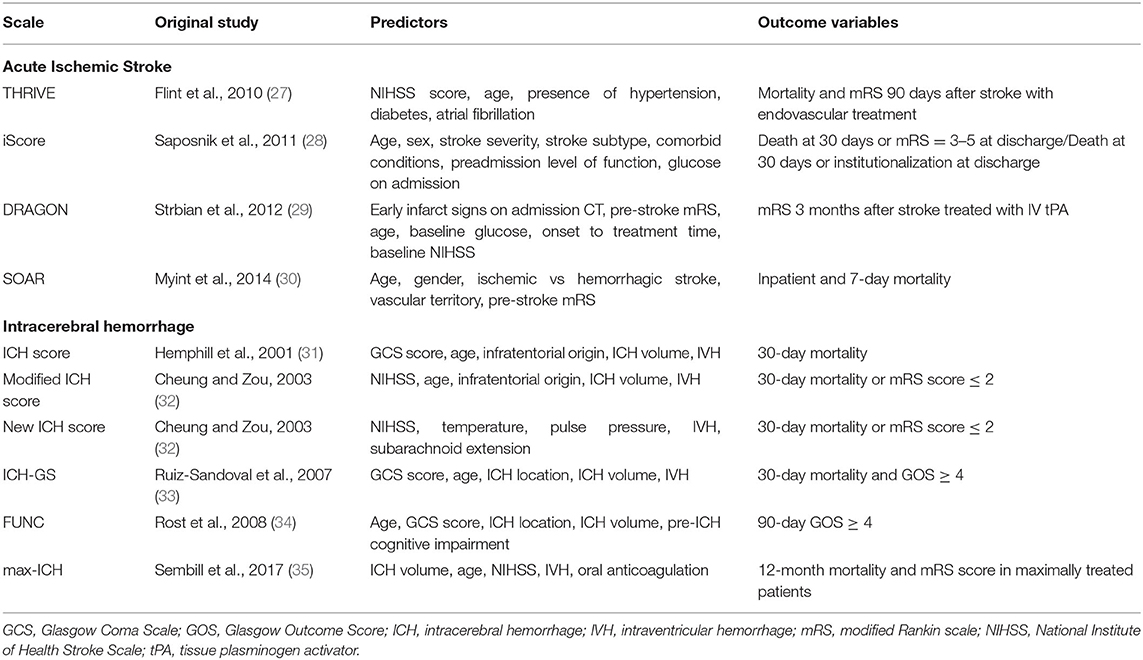
TABLE 1
www.frontiersin.org

Table 1. Selected clinical scales developed for acute ischemic stroke and intracerebral hemorrhage.

Common predictor variables in AIS scales include age, stroke severity, pre-stroke functional status, comorbidities, and stroke subtype (24), with some scales utilizing imaging characteristics (36).

For ICH, many prognostication scales are based on variations of the “original” ICH score (33, 37–40), which was initially published with 30-day mortality data utilizing age, Glasgow Coma Scale at admission, ICH location, ICH volume, and presence of intraventricular hemorrhage (31).

Some published data suggest that scales largely outperform the “subjective” opinion of clinicians at predicting mortality and functional disability (41–43). However, these studies generally involved asking clinicians to prognosticate expected outcomes from hypothetical patient vignettes, which simplify and distill information that would otherwise be available in real-world clinical practice. In a comparison of the predictions of clinicians against common prognostication scales for 3-month functional status in real-world ICH patients, clinicians outperformed scales with regards to predictive accuracy (44).

This finding points towards the first of several limitations of prognostication scales—scales generate predictions using cohort data, yet prediction for individual patients may depend on variables not captured by scales. Furthermore, few models have been assessed for calibration (45) and robust external validation (25, 46), limiting their generalizability. Most scales were developed retrospectively, and data used to generate them include local practice patterns with regards to WLST, potentially incorporating the self-fulfilling prophesy. Finally, scales may not predict outcomes that are most important to patients and families, as the same functional outcome may lead to different perceptions of QoL for different patients. Clinicians have been shown to be poor at predicting a patient's future QoL, an inherently subjective quality, after stroke (47–49).

Despite these limitations, disclosing the results of a prognostication scale for a patient to a clinician impacts that clinician's clinical impression (50). Awareness of the limitations of scales can help ensure that the clinician utilizes these tools to complement clinical judgment rather than replace it. Recent studies suggest that making predictions based on clinical data from hospital day 5 rather than at admission may improve prognostication accuracy (51). Given the lack of objective tools for accurate prognostication and the potential for clinician bias to factor into decision-making, delaying prognostication may lead to improved prediction accuracy and clinical outcomes.

Goals-of-Care Conversations: Determining Patients' Wishes

Besides accurate neuro-prognostication, the ideal timing of GOC discussions regarding acceptable QoL for hospitalized stroke patients requires several considerations. GOC discussions, once initiated, are often iterative (1). Prognostic information should be tailored by amount and timing to the preferences of patients and families (52).

The aim of GOC discussions should be to ascertain the patient's wishes, or best estimates thereof, in order to provide goal-concordant care. As a means to this end, ACPs and surrogate decision-makers represent two sources of information for clinicians.


Monday, October 29, 2018

End of life after stroke: A nationwide study of 42,502 deaths occurring within a year after stroke

Our stroke associations should be following every stroke patient to find out their end recovery or death. I don't care that this would mean following 10 million yearly stroke survivors. Only by doing this will we get objective data to analyze and make recovery better. But your fucking failures of stroke associations doesn't give a damn because they are just worried about what that next press release is going to say.  World Stroke Day here we come with awareness crapola. 

End of life after stroke: A nationwide study of 42,502 deaths occurring within a year after stroke 


First Published October 6, 2017 Research Article


In the scientific literature, there is very limited empirical information on end-of-life issues after stroke in the scientific literature. The present nationwide study describes the circumstances surrounding deaths that occur within a year after a stroke.

Datasets from three nationwide Swedish registers (on stroke, palliative care and cause of death) were linked. Basic information was available for 42,502 unselected cases of death that occurred within a year after a stroke and more detailed information was available for 16,408 deaths. Odds ratios for characteristics of end-of-life care were calculated by logistic regression.

In the late phase after stroke (three months to one year), 46% of patients died in a nursing home, whereas 37% of patients died in a hospital after readmission and 10% of patients died at home. Eleven per cent of deaths were reported as being unexpected. A next of kin was present at 49% of deaths. The frequency of unattended deaths (neither next of kin nor staff were present at the time of death) ranged from 5% at home with specialised home care to 25% in hospitals.

This is, by far, the largest study published on end-of-life issues after stroke. Major differences between countries in healthcare, community services, family structure and culture may limit direct transfer of the present results to other settings.

There is considerable discordance between presumed ‘good death’ late after stroke (dying at home surrounded by family members) and the actual circumstances at the end of life.

Tuesday, March 14, 2017

Brain patterns cannot reveal end-of-life decisions for patients with severe brain injuries

If you have locked-in-syndrome you better hope your ER doctors are using these rather than going directly to end-of-life.

New Algorithms Search for Signs of Consciousness in Brain Injury Patients


PET Scans Predict Coma Outcome

The latest here:

Brain patterns cannot reveal end-of-life decisions for patients with severe brain injuries

A growing field of research is examining the brain patterns produced by people with severe brain injuries who can no longer communicate and appear to be in a vegetative state. Some have argued that one day we may be able to unlock a code from these patterns and communicate with these patients.
Two UBC neuroethicists are studying what this might mean for Canada and other countries that have recently introduced legislation for physician-assisted death. In a JAMA Neurology article published last week, Judy Illes and Emanuel Cabral examine the ethics around end-of-life decision-making for patients with these injuries.

Are there any examples in Canada or in other countries where patients with severe brain injuries who were unable to communicate have been able to access physician-assisted death?
EC: So far in Canada, there are no known cases of patients with brain trauma who have tried to access physician-assisted death. In the United States and the
Netherlands, there have been cases where patients with brain trauma have been asked whether they wanted to prolong their life. In all of these cases, the patients suffered from a specific form of brain trauma called locked-in syndrome. Essentially, these people maintain a good awareness and understanding of their surroundings, but are unable to verbally communicate because they are practically paralyzed within their own bodies. In most cases, patients manage to communicate through eye-blinking or restricted body movements, and sometimes using an alphabet board.


In one such case, physicians in the United States were able to assess one man’s memory and thinking by communicating through small head movements. They also allowed him to make decisions on receiving life-prolonging treatments using this method. In another case in the Netherlands, another man with locked-in syndrome used blinking to communicate that he wanted physician-assisted death. After several weeks of consulting with the patient, other physicians and the family, the patient was administered life-ending drugs.
JI: These patients have used indirect “codes” to express their end-of-life preferences. Some people might logically suggest that we can use brain imaging as the “code” to communicate with people in minimally conscious states and that hypothetically, this could open legal avenues for these patients to request physician-assisted death. Our paper anticipates this question and addresses the issues around it.
How likely is it that we will be communicating with patients about end-of-life decisions by analyzing their brain patterns?
JI: The public is already asking. We need both to anticipate such questions and be prepared to be responsive to them as a professional community.
EC: The idea seems far-fetched, however, studies have shown that it might be possible to use brain imaging to communicate with patients in minimally conscious states. As it stands, this communication channel is still quite weak but as research continues, it has led to questions about whether this type of communication might be applied to end-of-life care.
Under Canadian law, verbal communication is not a requirement for physician-assisted death. However, if the person has difficulty communicating, everything must be done to provide a reliable way through which the person can understand the information that is provided to them and communicate their decision. Currently, no such system exists to do so with patients in minimally conscious states.
What are your concerns about using this form of communication?
EC: People with severe brain trauma make up a highly vulnerable and historically neglected population whose health is placed in the hands of family members or health professionals. If we consider feminist ethics and disability ethics, they both emphasize that we have to be certain that the person fully understands the information given to them and their expressed wishes are clear.
JI: There is a huge leap however between communicating directly with someone, communicating through a tool like a spelling board, and using statistical interpretation of brain signals as a sign of preference or desire. We would need to be absolutely certain that the answers interpreted through brain imaging are what patients intended to express, and that their answers reflect reproducible, intact decision-making abilities. Researchers are still working out how to interpret the different signals that injured brains produce.
Public Affairs
310 - 6251 Cecil Green Park Road
Vancouver, BC Canada V6T 1Z1
Tel 604 822 6397
Fax 604 822 2684
Email public.affairs@ubc.ca


Thursday, April 21, 2016

Physicians failing to talk to stroke patients about end-of-life treatment preferences

How would your doctor have any clue about how close you are to death with no objective information on the dead and damaged areas in stroke?
My doctor told me I had a massive stroke but that had to be pulled out of his ass, he had no concrete information to base that upon. Yeah, my left side didn't work at all but I could hold lucid conversations immediately.  I'd have to say most of my damage probably occurred during the first week as the neuronal cascade of death killed off a huge chunk of my brain. 

Physicians failing to talk to stroke patients about end-of-life treatment preferences


By Lucy Piper
US research suggests that physician-patient discussion about limitations on life-sustaining interventions following ischaemic stroke is low, poorly documented and often left too late.
Among 198 patients, aged 80 years on average, who died within 30 days of admission to hospital due to stroke, less than 40% had discussions with their physicians about limitations on life-sustaining interventions documented during the index hospitalisation.
Even among patients who died while in hospital or were discharged to hospice, only 50% had documented discussions about end-of-life treatment.
This was despite 47% of patients documenting at or within 48 hours of admission their desire to forgo at least one life-sustaining intervention.
"This suggests that there is an opportunity to improve patient-physician communication, and thus the quality of palliative care in stroke, in the early poststroke period", say lead researcher Maisha Robinson (Mayo Clinic, Jacksonville, Florida, USA) and colleagues.
Indeed, their findings showed that for most patients discussions occurred just 5 days before death and although unable to discern the reasons for this lateness, the researchers propose it could be due to worsening or lack of improvement of the patient's clinical condition or due to episodes of poor quality of care leading to clinical deterioration.
Physician communication was a significant 56% less likely to be documented for patients with mild to severe stokes than for those with very severe strokes, particularly regarding preferences for cardiopulmonary resuscitation.
"It is plausible that physicians are more comfortable initiating discussions about end-of-life care decisions in catastrophic situations or that these discussions more often lead to documented decisions to withhold life-sustaining interventions with severe strokes relative to milder ones, or both", suggests the team in Neurology.
Ying Xian (Duke University Medical Center, Durham, North Carolina, USA) and Winston Chiong (University of California, San Francisco, USA) stress in a related editorial that the highly preference-sensitive nature of decisions on life-sustaining therapy after acute ischaemic stroke and their ability to "profoundly influence consequent mortality" make them "essential" to ensure high-quality care.
They conclude: "As has been noted elsewhere, such failures to incorporate patient preferences are themselves preventable medical errors, and these errors are particularly consequential in the setting of ischemic stroke."
"Future initiatives to improve safety and reduce preventable errors in stroke care should include efforts to identify contributing factors associated with the lack of communication, develop interventions to promote healthy dialog among patients, their families, and the health care team, and ultimately improve patient-centered care at the end of life for stroke patients." (Nothing on objectively determining the damage, so guessing is involved.)