My real life tasks would have included daily bike rides, weekly whitewater canoeing, xc skiing in winter, running, sea kayaking on Lake Superior. None of which were even considered as focuses for my therapy. This is all because stroke medical professionals dumb down the goals(tyranny of low expectations) that are even offered to stroke survivors because they know that failure will occur on most of them. This requires priming the stroke survivor for low expectations. And that priming is what is wrong with all stroke therapy, no one even talks about 100% recovery.
By Tracie Hunnicutt, MS, CCC-SLP; Julie Clement, OTR; and Susan Adix, PT
Patients enter inpatient rehabilitation facilities for countless
reasons, but always share a common goal—
independence(WRONG, WRONG, WRONG! 100% RECOVERY IS THE ONLY GOAL IN STROKE! You're fired!). Each patient may
define independence differently, but the ultimate goal for all is to
recover function in the skill sets that allow them to return to their
chosen activities at home or in the community. The foundation for
successful recovery of function is task specificity. Research has shown
that physical rehabilitative therapy focused on task-specific training
produces more meaningful functional improvements than therapy based on
high-intensity repetitive exercise alone.
1 This is true
regardless of age or diagnosis, and is particularly relevant for
patients who are recovering from a neurologic event. When the
neurophysiologic goal is to impact plasticity, it is critical that the
activities chosen for therapy are the very same activities that patients
will be returning to at home or in the community. Task-specific
practice results in greater cortical representation and reorganization
in recovering neuro patients.
1 In patient populations other
than neuro, task specificity may not be necessary to impact plasticity,
but can and will incrementally improve both patient performance and
confidence.
Functional therapy begins with a skilled therapist invested in
developing an individualized care plan suited to the patient’s needs and
interests. The joint nature of the care plan should start during a
thorough patient history, where both skill and intuition are necessary
to identify what is important to the patient, and what therapy tasks can
most closely resemble the patient’s desired activities. Physical
therapists, occupational therapists, and speech language pathologists
all spend a large portion of their work day adjusting tasks or
manipulating the surrounding environment to simulate a patient’s home
and community activities. This can present a challenge during the
inpatient portion of a patient’s recovery in both acute care and
inpatient rehabilitation settings, which are hospital-based and designed
with patient safety and ease of function as priorities. The contrast
between what the environment demands from a patient in a hospital versus
the demands of home and community is vast, and can be a surprise and a
risk to patients who are not prepared.
From this clinical need arose a new treatment tool—Realistic
Environment Applied Learning, or REAL Therapy. REAL Therapy is a
community simulation environment with ready-made functional therapy
tasks available to patients and clinicians from the moment they enter
the room. Because the environment is task-specific, and does not require
modification by the therapist, the entire time spent in therapy can
address the physical and cognitive demands of real-life activities
performed by the patient. REAL Therapy is comprised of various modules
that each have a unique clinical focus. Modules were designed to address
some of the most common community-based locations patients visit upon
discharge. Available modules include a grocery store, restaurant, deli,
laundromat, and a car transfer/gas station area.
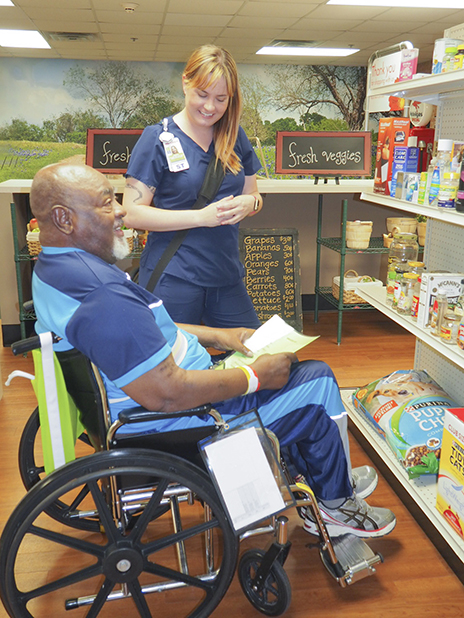
The
grocery shopping module helps patients use their OT skills when
grasping various-sized items, and PT skills when navigating the aisle
and reaching for the products at multiple levels. Items are weighted to
actual scale to closely simulate the experience of being in a real
store.
Grocery Store
The grocery store module is the most versatile and commonly used area
of REAL Therapy. Opportunities for functional therapy tasks abound, and
physical therapists, occupational therapists, and speech pathologists
alike utilize this module daily because of the variety of tasks that can
be performed. The grocery store includes standard grocery shelving with
a height of 72 inches, stocked with realistically weighted items. There
is an area with fruit and vegetables that must be hand selected and
weighed, as well as a bakery. A freezer with cold storage contains
commonly refrigerated items. There are shopping carts and baskets, a
working checkout counter, a register, and an ATM.
Some of the common physical tasks include dynamic balance activities
such as pushing a shopping cart, carrying a shopping basket, reaching
for objects on high shelves, reaching for objects on low shelves,
reaching for objects at the back of shelves, opening the glass door and
selecting items from cold storage, picking up heavy or bulky objects,
retrieving items from a shopping cart and placing them on the checkout
counter, bagging items, and carrying bags out of the store. Some of the
common cognitive tasks include creating and executing a shopping list,
locating difficult-to-find items, reading labels, calculating totals,
money management, operating a credit card machine, staying within a
budget, using memory strategies to recall short lists of items, and
identifying obstacles and safety hazards.
This module is used frequently because it represents an essential
community location that up to 84% of geriatric adults visit regularly.
2
Community-based locations specific to food and medical care are among
the most commonly visited sites for older adults. Therefore,
task-specific practice with a skilled therapist is likely to be a
precursor for greater success and safety when patients are functioning
in these locations post-discharge.
Restaurant
The restaurant is another module with a variety of applications
depending on the patient’s individual needs or preferences. There are
various settings within the restaurant, each with its own challenges to
the patient. There is indoor booth-style seating for one table and
outdoor seating/patio furniture for another, complete with a table
umbrella.
Physical tasks for this module include getting into and out of a
booth with limited space, pulling out chairs to sit down and
repositioning closer to the table once seated, raising or lowering the
table umbrella, reaching across the table to receive food from a server,
and identifying a space to place any necessary assistive devices (ie,
walkers, wheelchairs, canes, etc) while at the table. Common cognitive
or communication tasks for this module include reading a menu, making
menu choices that consider dietary restrictions or special needs,
communicating with wait staff, verbalizing an order, participating in
conversation and socialization during a meal, estimating a bill,
calculating a tip, completing and signing the check, and time
management.
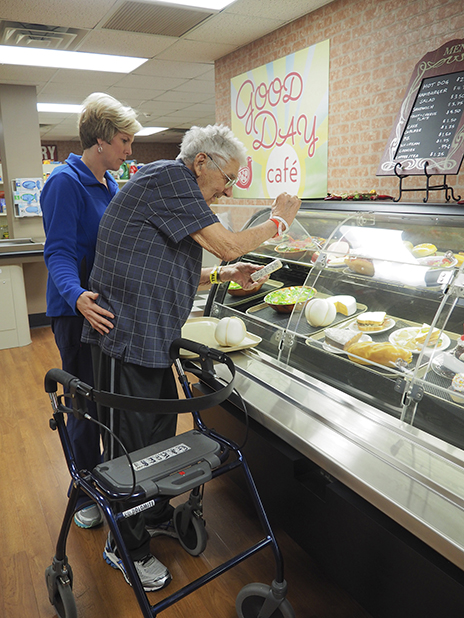
With
the café module, patients can use speech skills to call out certain
items, while using PT skills to navigate the cafeteria line, as well as
OT skills to pick up items. Cognitive skills such as math and memory may
be practiced by asking patients to select items below a certain dollar
amount.
Deli
The deli module includes a glass-faced display case from which
patients can view and select their food options. There is a metal tray
line in front of the display case followed by a drink and condiment
station. This module demands more from the patients from a mobility
standpoint, and is less flexible in terms of the ability to modify the
physical tasks that can be performed.
Common physical tasks for the deli include standing and reaching into
the display case to obtain food, placing items on the tray, pushing the
tray down the line as it gains an increasing amount of weight, moving
the tray to the drink station, obtaining the desired drink and
condiments, carrying the tray, and getting into and out of seating. The
deli has an elevated barstool-type seating area, and the restaurant
module seating may also be used. Where the deli lacks some flexibility
in physical modification of tasks, it is particularly useful in the
patient’s ability to problem-solve in a challenging, less forgiving
environment.
Cognitively, the patient must determine if he or she has the ability
to perform the necessary tasks, or if it would be safer to request help
with the physical components of this setting. Elements of the deli
environment, such as bilateral upper extremity use to open the case and
obtain the food or propelling and carrying the tray, may require the
assistance of another person, as they cannot be easily modified.
Cognitive tasks in the deli include visual scanning, sequencing food
choices (ie, salad, main dish, dessert, drink), making food choices that
are compliant with dietary needs, estimating cost, money management,
and identification of barriers or safety hazards.
Laundromat
The laundry module can represent a community-based laundromat or a
home-based laundry room. This module includes a top-loading washer, a
front-loading dryer, an ironing board, and an elevated folding table
that also has a place for hanging clothes. Common physical tasks in the
laundromat include picking up large piles of both wet and dry clothing,
picking up heavy containers of detergent or fabric softener, loading and
removing clothing from the washer, bending to load and remove clothing
from the dryer, carrying a laundry basket, folding clothes, ironing
clothes, and hanging clothes. Common cognitive tasks in this module
include sorting and organizing clothing, calculating how much detergent
or fabric softener to use, and time management. If this module is being
used to simulate an actual laundromat, there is an available change
machine to include the money management portion of the activity.
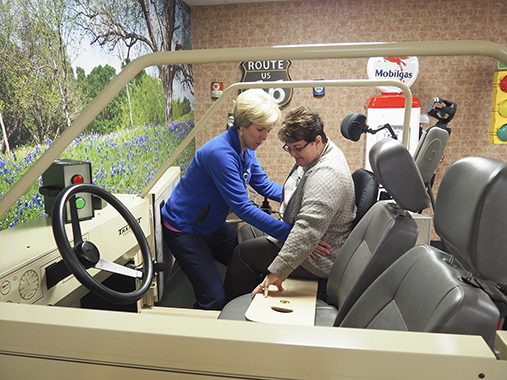
One
common goal among HealthSouth Arlington’s patients is the ability to
drive or safely get from one place to another. The car transfer
simulator is adjustable to the height of the patient’s personal vehicle,
and therapists use it to help patients learn how to safely transfer in
and out of the vehicle.
Car Transfer / Gas Station
In addition to the grocery store, the car transfer/gas station module
is one of the more frequently utilized areas of REAL Therapy. Safe and
effective car transfers are often one of the keys to a patient’s
continued community involvement, as well as access to necessities and
medical care following hospitalization. The inability to perform this
task has been linked to decreased quality of life, increased burden of
care, and the possibility of institutional living.
3 In
certain patient populations such as spinal cord injury, correct
execution of car transfers is even more critical to prevent pain and
injury that could compromise a patient’s overall independence.
4
The REAL Therapy module features a car transfer simulator. The
simulator is the front end of a car, with working doors, handles, locks,
seat belts, bench or bucket seats, gas pedal, brake, steering wheel,
and a behind-seat wheelchair loading area. The car simulator is height
adjustable, so that therapists may match the simulator to the type of
car, truck, or SUV utilized by each patient.
When utilizing the car simulator, patients must perform a variety of
physical tasks that include approaching the vehicle, opening the car
door, getting into proper position for the transfer, turning and
lowering themselves into the car seat, bringing their legs into the
vehicle, repositioning in the seat if necessary, and buckling the seat
belt. One of the more challenging aspects of car transfers is the
management of assistive devices during the transfer. Patients who are
learning to get in and out of a vehicle often need and depend upon
assistive devices, but find that there is limited space between the car
door and seat. They require instruction from a skilled therapist for
proper placement and utilization of devices such as wheelchairs, power
wheelchairs, walkers, hemi-walkers, canes, sliding boards, crutches,
etc. Another aspect of managing those assistive devices is ensuring that
the caregiver or family member is trained and able to lift and/or stow
the devices in the car. The car simulator has behind-seat space
specifically designed for practicing this skill. Caregiver training for
proper body mechanics will help prevent both injury and broken
equipment.
The simulator also has the ability to assess the driver’s brake
reaction speed with a reaction time tester. Drivers are given
instructions to attend to an illuminated light box with red and green
lights. As the green light changes to red, the timer starts and the
patient depresses the brake. Reaction speeds are generated and may be
compared to age and gender norms as a means of basic biofeedback to the
patient. Information from various studies has revealed that in some
patient populations, reaction time is a useful metric in determining
when it is appropriate to return to driving.
5 While this
decision is ultimately made jointly by the physician and patient, the
data generated by the reaction time tester can be valuable information
and a means to build insight and confidence for patients and families.
Other elements included in the car transfer/gas station module are an
ADA-compliant flooring surface that simulates asphalt, a 6-inch curb
typical of those found in parking lots, and a weighted gas pump.
While the benefit of REAL Therapy for patients is clear, the group of
people who may be the most invested in REAL Therapy are the
rehabilitation clinicians. The amount of time they spend trying to
modify the environment to suit the needs of each patient can become
direct patient care time. There are also endless possibilities of
treatment ideas, so there is less time spent planning and organizing,
and more time spent doing. REAL Therapy also removes the necessity of
explaining to the patient how the therapy tasks they are doing are
applicable to their real-life activities, as the connection is very
clear. Rather than moving weights on a shelf to simulate groceries, the
patient walks into a grocery store. Rather than move from one chair to
another, the patient gets into a car. This immediately makes sense to
the patient, increasing their buy-in and willingness to work with
therapy.
REAL Therapy is the manifestation of a treatment philosophy that
focuses on returning a patient to function. With the move to shorter
lengths of stay across all healthcare settings, it is important that
physical rehabilitation therapists immediately focus on the patient’s
desired activities and begin task-specific training as early as
possible. In addition, the evidence base supports functional,
task-specific training to achieve better patient outcomes and perceived
independence. When used in conjunction with a protocol for therapeutic
patient outings into the community, there is an even larger impact on
patient confidence and ability. As the rehabilitation industry and we as
therapy professionals move forward, REAL Therapy and functional,
task-specific treatment may be the key to efficient service delivery and
excellent patient outcomes.
RM
Tracie Hunnicutt, MS, CCC-SLP, Therapy Manager,
received her training as a speech-language pathologist at Texas Tech
University Health Sciences Center. The early part of her career was
focused on the care of traumatic brain injury (TBI) patients with an
emphasis on community re-entry. From this setting, she developed a
strong foundation in functional therapy as a tool to return patients
back to school, work, community, and home activities. Hunnicutt is
currently a medical speech language pathologist in inpatient
rehabilitation at HealthSouth Rehabilitation Hospital of Arlington.
Julie Clement, OTR, received her training in
occupational therapy at the University of Texas Medical Branch. She
specializes in helping patients increase independence with Activities of
Daily Living (ADLs), functional mobility, and Instrumental Activities
of Daily Living (IADLs). Clement is a Neuro-IFRAH certified therapist,
and has completed more than 200 hours of continuing education related to
neurological evaluation and treatment. She has been the OT Team Lead at
HealthSouth Rehabilitation Hospital of Arlington for the past 12 years.
Susan Adix, PT, received her training as a
physical therapist at the University at Buffalo. She began her career in
outpatient physical therapy at HealthSouth Arlington, working primarily
with orthopedic and neurologic patient populations. In 2006, Adix
transitioned into inpatient rehabilitation, where she focused her
professional development on the care of neurologic patients. Adix has
assisted in the development of the REAL Therapy Gym and is currently the
PT Team Lead for a staff of more than 30 physical therapists and
rehabilitation techs. For more information, contact RehabEditor@medqor.com.


