Changing stroke rehab and research worldwide now.Time is Brain! trillions and trillions of neurons that DIE each day because there are NO effective hyperacute therapies besides tPA(only 12% effective). I have 523 posts on hyperacute therapy, enough for researchers to spend decades proving them out. These are my personal ideas and blog on stroke rehabilitation and stroke research. Do not attempt any of these without checking with your medical provider. Unless you join me in agitating, when you need these therapies they won't be there.

What this blog is for:

My blog is not to help survivors recover, it is to have the 10 million yearly stroke survivors light fires underneath their doctors, stroke hospitals and stroke researchers to get stroke solved. 100% recovery. The stroke medical world is completely failing at that goal, they don't even have it as a goal. Shortly after getting out of the hospital and getting NO information on the process or protocols of stroke rehabilitation and recovery I started searching on the internet and found that no other survivor received useful information. This is an attempt to cover all stroke rehabilitation information that should be readily available to survivors so they can talk with informed knowledge to their medical staff. It lays out what needs to be done to get stroke survivors closer to 100% recovery. It's quite disgusting that this information is not available from every stroke association and doctors group.

Showing posts with label KINARM. Show all posts

Wednesday, November 22, 2023

MUN Grad Student Develops New Stroke Recovery System

Kinesiological Instrument for Normal and Altered Reaching Movements (KINARM) is a robotics research tool designed to make quantitative neurological assessments of sensorimotor, proprioception, and cognitive brain function. It consists of a wheelchair and upper extremity exoskeleton that the subject is fitted to based on their body specifications. The KINARM allows the researcher to assess coordination of limbs at multiple joints while also precisely measuring the joint-specific force applied by the subject as they perform individual tasks. The precision of the instrument removes the subjectivity that is currently inherent in most physiotherapy assessments of neurological status (e.g. muscle tone, spasticity, proprioception, etc.) 

MUN Grad Student Develops New Stroke Recovery System
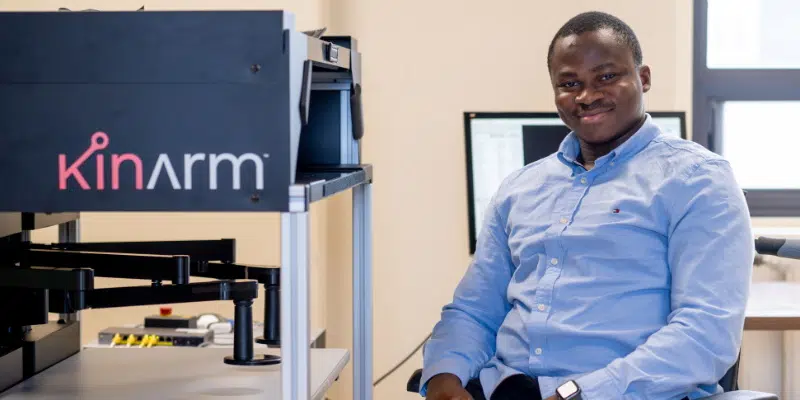
MUN Grad Student Develops New Stroke Recovery System

Submitted photo

A Memorial University grad student is hoping to make a difference in the lives of stroke patients with his new Kinarm system.

Michael Babalola of Lagos in Nigeria, says he was motivated to make the recovery process for stroke patients better and faster after watching his own grandmother recover from a stroke.

Babalola’s research uses robotics to customize patient recovery and help with their therapy. The Kinarm system uses a hybrid of virtual reality and robotics to provide clinicians with the information they need to help patients recovering from stroke.
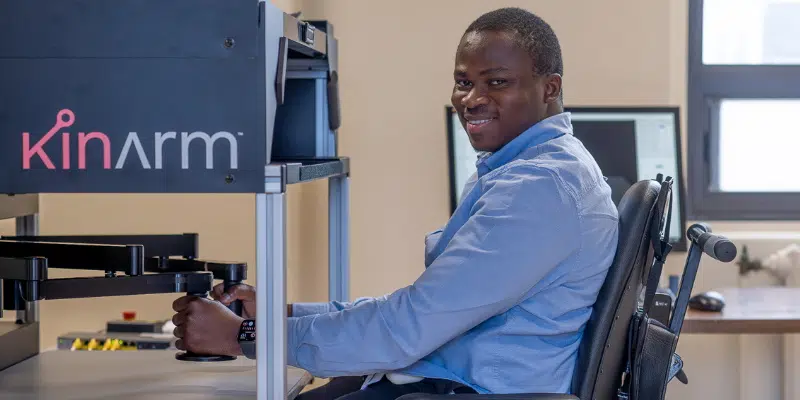
The Kinarm helps to replace typical “long” and “tiring” rehab exercises with activities that patients report are actually “fun.”

Babalola says he’s thrilled with the results and has no doubt his grandmother would be proud.

He says his desire is to touch lives and leave people smiling. He believes his grandmother is “looking down from heaven” and is very glad.

Tuesday, May 23, 2017

Inter-rater reliability of kinesthetic measurements with the KINARM robotic exoskeleton

Who gives a shit about inter-rater reliability you blithering idiots? We want to know the efficacy and results of recovering using this. My god, the stupidity out there is appalling. How well would environmental enrichment and following Margaret Yekutiel in the book, 'Sensory Re-Education of the Hand After Stroke' in 2001 lead to better recovery?

Inter-rater reliability of kinesthetic measurements with the KINARM robotic exoskeleton

  • Jennifer A. SemrauEmail author,
  • Troy M. Herter,
  • Stephen H. Scott and
  • Sean P. Dukelow
Journal of NeuroEngineering and Rehabilitation201714:42
DOI: 10.1186/s12984-017-0260-z
Received: 3 August 2016
Accepted: 16 May 2017
Published: 22 May 2017


Abstract

Background

Kinesthesia (sense of limb movement) has been extremely difficult to measure objectively, especially in individuals who have survived a stroke. The development of valid and reliable measurements for proprioception is important to developing a better understanding of proprioceptive impairments after stroke and their impact on the ability to perform daily activities. We recently developed a robotic task to evaluate kinesthetic deficits after stroke and found that the majority (~60%) of stroke survivors exhibit significant deficits in kinesthesia within the first 10 days post-stroke. Here we aim to determine the inter-rater reliability of this robotic kinesthetic matching task.

Methods

Twenty-five neurologically intact control subjects and 15 individuals with first-time stroke were evaluated on a robotic kinesthetic matching task (KIN). Subjects sat in a robotic exoskeleton with their arms supported against gravity. In the KIN task, the robot moved the subjects’ stroke-affected arm at a preset speed, direction and distance. As soon as subjects felt the robot begin to move their affected arm, they matched the robot movement with the unaffected arm. Subjects were tested in two sessions on the KIN task: initial session and then a second session (within an average of 18.2 ± 13.8 h of the initial session for stroke subjects), which were supervised by different technicians. The task was performed both with and without the use of vision in both sessions. We evaluated intra-class correlations of spatial and temporal parameters derived from the KIN task to determine the reliability of the robotic task.

Results

We evaluated 8 spatial and temporal parameters that quantify kinesthetic behavior. We found that the parameters exhibited moderate to high intra-class correlations between the initial and retest conditions (Range, r-value = [0.53–0.97]).

Conclusions

The robotic KIN task exhibited good inter-rater reliability. This validates the KIN task as a reliable, objective method for quantifying kinesthesia after stroke.

Thursday, April 7, 2016

Robotic exoskeleton maps sense-deficits in young stroke patients

No idea why this couldn't be used in adults. My proprioception is not very good.
http://www.cbc.ca/news/canada/calgary/robotic-sense-position-uofc-study-strokes-children-1.3520197?cmp=rss
Researchers at the University of Calgary are using robotics technology to try to come up with more effective treatments for children who have had strokes.
The robotic device measures a patient's position sense — what doctors call proprioception — the unconscious perception of where the body is while in motion or at rest.
robotics stroke therapy 2
The KINARM supports a patient's arms with its exoskeleton while it measures their movement as they play video games or do other tasks. (CBC)
"Someone whose position sense has been affected might have difficulty knowing where their hand or arm is in space, adding to their difficulty in using their affected, weaker limb," said one of the study's senior researchers, Dr. Kirton of the Cumming School of Medicine's departments of pediatrics and clinical neurosciences.
"We can try to make a hand stronger but, if your brain doesn't know where the hand is, this may not translate into meaningful function in daily life."
PhD candidate Andrea Kuczynski is doing ongoing research using the KINARM (Kinesiological Instrument for Normal and Altered Reaching Movements) robotic device.
During the test the children sit in the KINARM machine with their arms supported by its exoskeleton, which measured movement as they played video games and did other tasks. All the children also had MRIs, which gave researchers a detailed picture of their brain structures.

KINARM could be rehabilitation tool 

"So basically they slide me in there, position my arm, so it like maps out, so they can see it on the screen, and like how I move," said Max Challoner, a 12-year-old participant in the study.
He had a stroke shortly after he was born that left him with mild physical impairments on his right side.
Years later, testing showed that Max might have a sensory processing disorder.
But the KINARM testing has shown Max's right side moves nearly as well as his left. That's a relief for his mother, Wendy Saunders.
"That's something that we don't need to worry about," she said. "Just knowing that takes away a lot of the other anxieties we have about his future."
Max says he was just happy to take part in the study. "It feels nice actually, helping people in such a way that it could potentially help them learn how they function," he said.
Kuczynski tested 40 children who had perinatal strokes and compared the results to a healthy control group.
Perinatal stroke affects about 1,000 children in Alberta. The perinatal period lasts from the 20th week of gestation to shortly after birth.
Different types of perinatal strokes cause different brain injuries. Cerebral palsy is a common secondary outcome that affects muscle movement and motor skills.
"In the future, the KINARM could be used as a tool for rehabilitation. Once we have an understanding of how an individual's position sense has been affected, we can begin to focus and personalize rehabilitation," Kuczynski said.
The study was published in a recent edition of Neurorehabilitation and Neural Repair.