Changing stroke rehab and research worldwide now.Time is Brain! trillions and trillions of neurons that DIE each day because there are NO effective hyperacute therapies besides tPA(only 12% effective). I have 523 posts on hyperacute therapy, enough for researchers to spend decades proving them out. These are my personal ideas and blog on stroke rehabilitation and stroke research. Do not attempt any of these without checking with your medical provider. Unless you join me in agitating, when you need these therapies they won't be there.

What this blog is for:

My blog is not to help survivors recover, it is to have the 10 million yearly stroke survivors light fires underneath their doctors, stroke hospitals and stroke researchers to get stroke solved. 100% recovery. The stroke medical world is completely failing at that goal, they don't even have it as a goal. Shortly after getting out of the hospital and getting NO information on the process or protocols of stroke rehabilitation and recovery I started searching on the internet and found that no other survivor received useful information. This is an attempt to cover all stroke rehabilitation information that should be readily available to survivors so they can talk with informed knowledge to their medical staff. It lays out what needs to be done to get stroke survivors closer to 100% recovery. It's quite disgusting that this information is not available from every stroke association and doctors group.

Showing posts with label ischemia-reperfusion injury. Show all posts

Wednesday, July 8, 2026

Toward a paradigm shift in post-stroke management

 Better late than never in coming to the conclusion that blood pressure management is a complete shitshow! Wrong objective! Had you been thinking at all you would be solving the  5 causes of the neuronal cascade of death in the first week saving hundreds of million to billions of neurons!

Toward a paradigm shift in post-stroke management

 New HOPE trial explores individualized approach based on reperfusion pathophysiology. Blood pressure management after thrombectomy for acute ischemic stroke may require a change in approach. The HOPE clinical trial—short for Hemodynamic Optimization of Cerebral Perfusion after Endovascular Therapy—led by the Sant Pau Research Institute (IR Sant Pau), has shown that adapting blood pressure targets to the degree of cerebral reperfusion significantly improves patients’ functional recovery without increasing the risk of complications.  “Until now, we have applied fairly uniform strategies after thrombectomy, but probably not all patients need the same approach,” says Dr. Pol Camps-Renom, head of the Cerebrovascular Diseases Research Group at IR Sant Pau and one of the study coordinators. “Our results suggest that adjusting blood pressure according to the degree of reperfusion can have a direct impact on recovery.” The findings, presented during a plenary session at the annual European Stroke Organisation conference—the leading European scientific society dedicated to stroke—and now published in JAMA Neurology position this work among the most important recent contributions in the stroke field. They have the potential to guide new hemodynamic management strategies after thrombectomy.  Rather than applying rigid targets, the key is to better understand each patient's physiologyPol Camps-Renom

Mechanical thrombectomy has been a major advance in the treatment of large-vessel occlusion stroke because it can restore blood flow in previously blocked arteries. However, a well-known paradox remains in clinical practice: despite successful angiographic reperfusion, a substantial proportion of patients—around half—do not achieve satisfactory functional recovery in the medium term. 

This phenomenon, known as “clinically ineffective reperfusion,” reflects the fact that reopening the vessel does not always result in effective restoration of cerebral perfusion at the tissue level. Mechanisms involved include reperfusion injury, microcirculatory dysfunction, loss of cerebral autoregulation, and hemorrhagic transformation, all of which can compromise brain tissue viability even after a technically successful intervention. 

“Many times we can reopen the artery, but the brain tissue does not respond as expected,” explains Dr. Pol Camps-Renom. “The reason is that microvascular perfusion and autoregulatory mechanisms may be impaired, and this is where factors such as blood pressure become critical.” (You blithering idiots are ignoring the neuronal cascade of death in the first week and thus letting die hundreds of millions to billions of neurons! No wonder stroke recovery never gets better with this level of absolute stupidity in not knowing why artery opening doesn't solve the problem!)


As a result, blood pressure control during the hours following thrombectomy has become a key component of clinical management because it directly influences the balance between maintaining adequate perfusion and avoiding hemorrhagic complications. However, the evidence available so far has been limited and, at times, contradictory. Previous trials based on uniform intensive blood pressure reduction strategies have not demonstrated consistent benefits and have even suggested possible adverse effects. 

The HOPE trial introduces a different approach based on the concept that hemodynamic management should be adapted to each patient's physiological condition after thrombectomy. The study included 440 patients treated at 11 Spanish hospitals, who were randomly assigned either to a conventional strategy or to blood pressure management tailored to the degree of reperfusion achieved. 

Unlike previous trials, HOPE implemented a differentiated strategy according to the final angiographic result. Patients with near-complete or complete reperfusion were treated with lower blood pressure targets to reduce the risk of reperfusion injury, whereas patients with incomplete reperfusion maintained higher blood pressure levels to preserve cerebral perfusion. 

This approach recognizes that the brain may be in extremely diverse hemodynamic states, in which both excessively high blood pressure and overly aggressive reductions can be harmful. For this reason, the protocol included close monitoring during the first 72 hours, with dynamic treatment adjustments. 

This strategy resulted in a significant and consistent improvement in clinical outcomes. At 90 days, 60.0% of patients in the intervention group achieved functional independence, compared with 47.1% in the control group, representing an absolute difference of 13.3 percentage points, a clinically meaningful improvement. In addition, the overall analysis showed a favorable trend toward better levels of recovery, reinforcing the consistency of the benefit. 

In terms of safety, the strategy was associated with a lower incidence of hemorrhagic transformation, without increasing mortality or serious complications, confirming a favorable balance between efficacy and safety. “We have shown that it is possible to improve patient recovery without adding risk,” adds Dr. Joan Martí-Fàbregas, another investigator involved in the study. “This balance between efficacy and safety is probably one of the most relevant aspects of the findings.” 

The results of the HOPE trial point toward a more individualized model for blood pressure control after thrombectomy. In a setting where previous trials had produced neutral or unfavorable results, this study introduces a physiology-based approach that can optimize the balance between perfusion and hemorrhagic risk. 

Beyond its findings, HOPE provides key elements for the design of future studies, including the stratification of therapeutic targets and prolonged hemodynamic monitoring. The study also reinforces the idea that stroke treatment does not end with recanalization but continues during the hours that follow. “Rather than applying rigid targets, the key is to better understand each patient's physiology,” concludes Dr. Camps-Renom. 

Although the trial was stopped before reaching the planned sample size, its results demonstrate a clinically meaningful effect size. Nevertheless, additional studies will be required to confirm these findings before they can be broadly incorporated into routine clinical practice. 

Overall, the HOPE trial positions blood pressure control as a key component in optimizing stroke treatment after thrombectomy and opens the door to more precise strategies tailored to individual patients. 


Source: Institut de Recerca Sant Pau 

Sunday, March 1, 2026

Breaking Down the 2026 Acute Ischemic Stroke Guidelines

 What a FUCKING SHITSHOW! Guidelines; NOT PROTOCOLS! Doesn't anyone in stroke have a functioning brain?


Send me personal hate mail on this: oc1dean@gmail.com. I'll print your complete statement with your name and my response in my blog. Or are you afraid to engage with my stroke-addled mind? No excuses are allowed! You're medically trained; it should be simple to precisely state EXACTLY WHY you aren't working on 100% recovery protocols with NO EXCUSES! I've never received any communications from any stroke association. You'd think they would want to talk to their fiercest critic, but no, they are hiding under a rock someplace, probably don't even know I exist! Swearing at me is allowed, I'll return the favor. Don't even attempt to use the excuse that brain research is hard.

Breaking Down the 2026 Acute Ischemic Stroke Guidelines

Andrei Alexandrov, MD, an award-winning leader in stroke research and clinical care, discussed the clinical impact of the latest stroke guidelines and their implications for diagnosis and care.

Acute ischemic stroke (AIS) occurs when a cerebral artery becomes suddenly occluded, leading to interruption of blood flow and oxygen delivery to brain tissue. It accounts for approximately 85% of all strokes and represents a neurologic emergency in which rapid diagnosis and treatment are critical to preserving brain function and reducing long-term disability.¹

The recently published stroke guidelines, developed and maintained by the American Heart Association in collaboration with its stroke-focused division, the American Stroke Association, were written by experts in vascular neurology, emergency medicine, neurointervention, neurosurgery, neuroradiology, and rehabilitation medicine. Final documents underwent peer review and were published in the journal Stroke to support evidence-based stroke care across diverse health care settings.²

The updated stroke guidelines span the full continuum of acute ischemic stroke care, from prehospital triage and selection of intravenous thrombolytic agents to refined criteria for mechanical thrombectomy and post-procedural management. They clarify indications for tenecteplase and basilar artery thrombectomy, offer more cautious guidance for medium and distal vessel occlusions, and introduce structured recommendations for pediatric stroke and post-stroke dysphagia treatment. In addition to informing real-world clinical decision-making, the guidelines identify ongoing gaps in areas such as blood pressure management after reperfusion and device optimization, helping to shape future clinical trials and innovation in stroke systems of care.

As part of ongoing coverage, NeurologyLive® spoke with Andrei Alexandrov, MD, an award-winning leader in stroke research and clinical care, for an in-depth discussion of the updated guidelines. In this interview, Alexandrov shared key takeaways from the recommendations, examined their implications for everyday clinical practice, and highlighted remaining challenges in post-stroke blood pressure management. He also offered insight into how the revised criteria may shape future research priorities and therapeutic development in the field.


Top Takeaways From the 2026 Stoke Guidelines

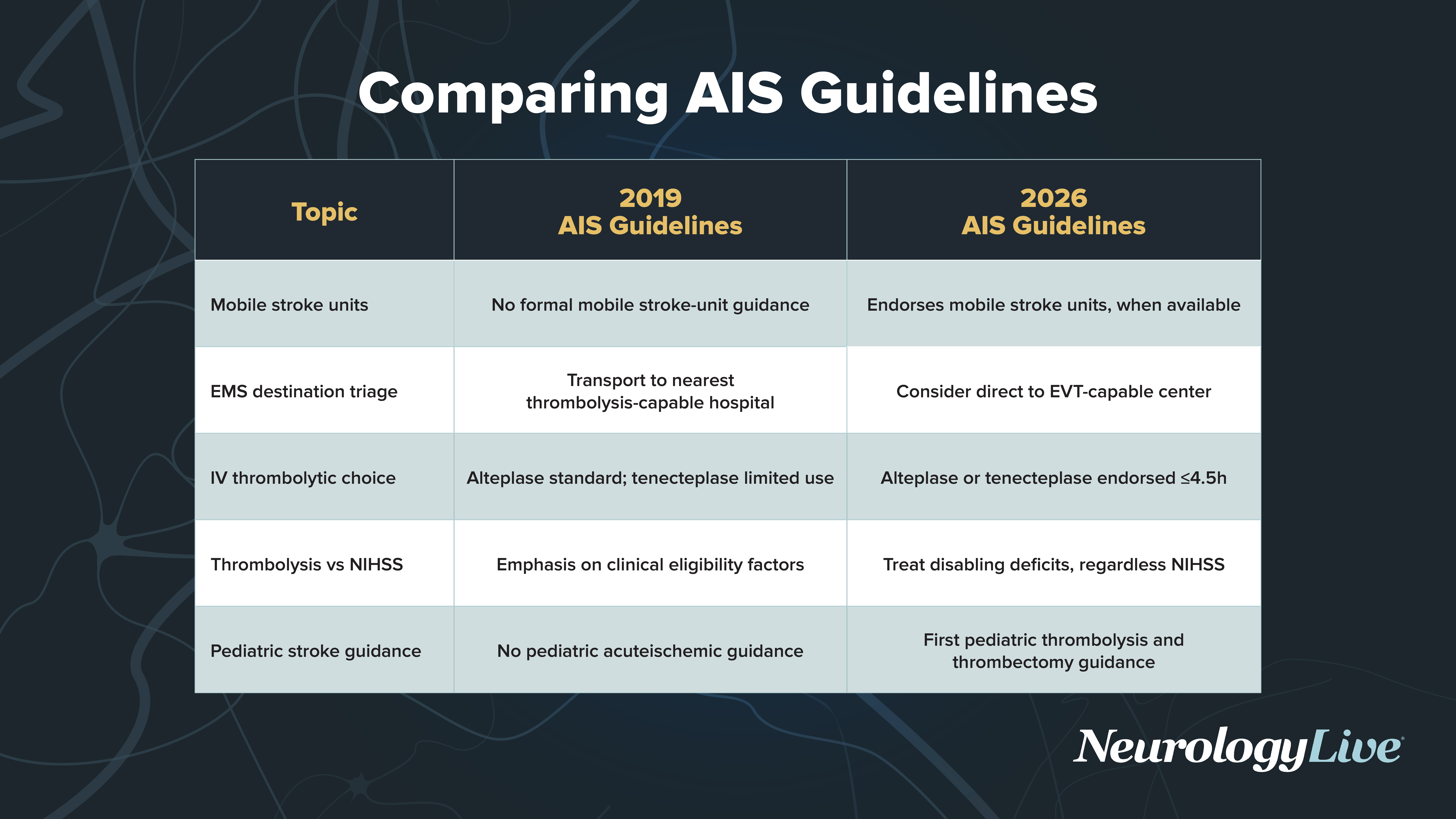
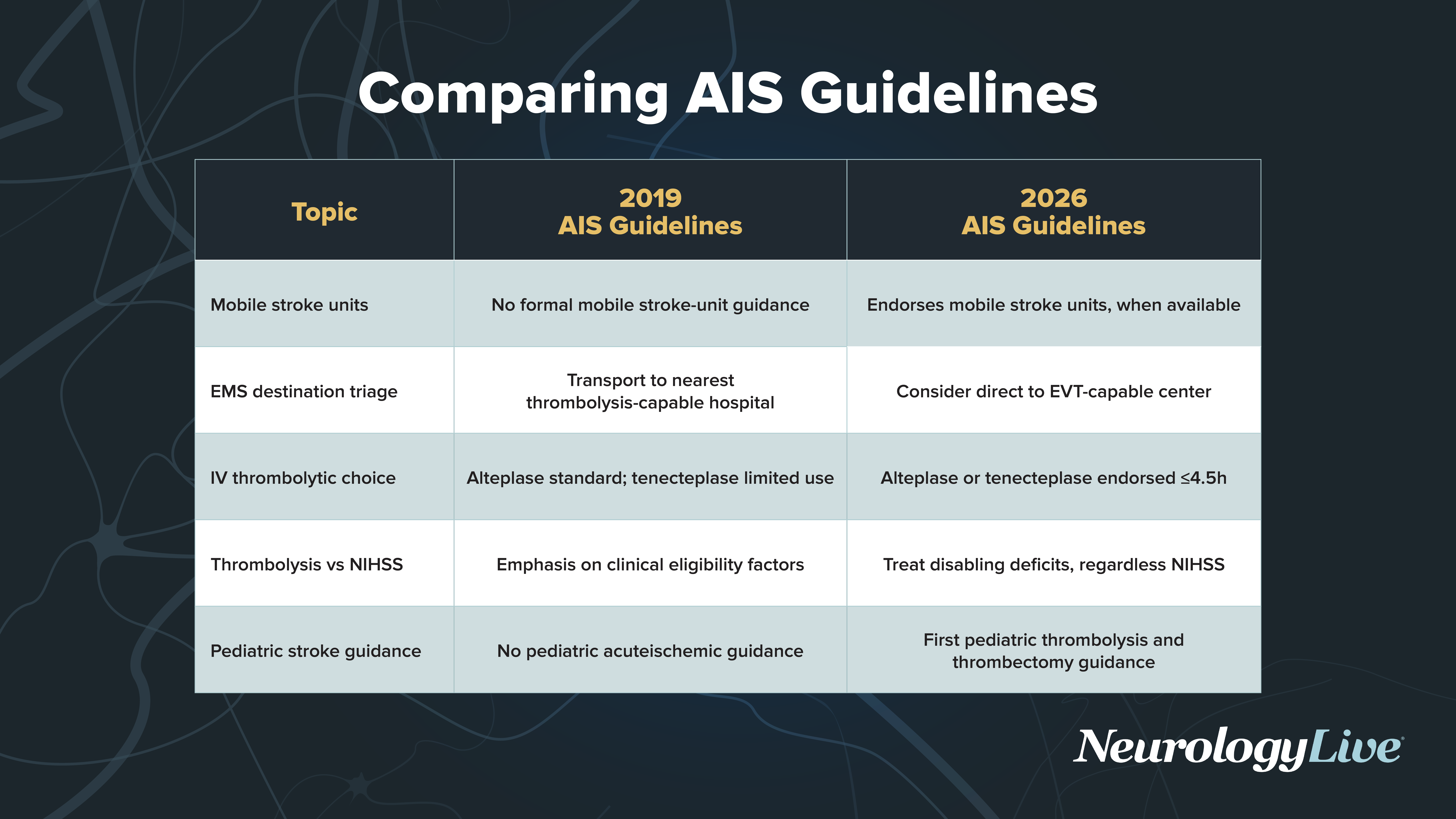
Alexandrov explained that the updated 2026 stroke guidelines align formal recommendations with evolving real-world practice. Most notably, tenecteplase (TNK) is now recommended alongside alteplase as an acceptable agent for intravenous thrombolysis, reflecting widespread adoption at advanced stroke centers. The guidelines also formally endorse mobile stroke units for rapid thrombolysis delivery and triage where available, and, for the first time, incorporate structured recommendations for pediatric stroke, including imaging, registry development, and treatment considerations.

Major Takeaways

  1. Tenecteplase is now recommended alongside alteplase as an acceptable intravenous thrombolytic agent.
  2. Mobile stroke units are endorsed for rapid thrombolysis delivery and triage where available.
  3. Pediatric stroke is formally included, with guidance on imaging, registries, and treatment considerations.
  4. The guidelines are among the most comprehensive and detailed stroke updates published to date.

Unanswered Questions: Blood Pressure management and Reperfusion injury

Alexandrov noted that optimal blood pressure management after successful reperfusion remains unsettled. Although cerebral hyperperfusion is recognized after thrombectomy, trials of intensive blood pressure lowering have not improved outcomes and may cause harm. The field now faces the challenge of determining whether more individualized and standardized approaches are needed.

Major Takeaways

  1. Cerebral hyperperfusion occurs in a substantial subset of patients after successful reperfusion.
  2. Intensive blood pressure lowering has not consistently improved outcomes in trials.(Why should it? You're reducing the blood flow and oxygen delivery to the brain when it needs it most to prevent penumbra death! Can't you think at all?)
  3. Individualized blood pressure strategies may be preferable to one-size-fits-all approaches.
  4. More rigorous and standardized trials are needed to guide post-thrombectomy management.

Expanding the Scope of Stroke Care: Dysphagia and Rehabilitation

('care' NOT RECOVERY! For that alone, you're fired!)

Alexandrov spotlighted guidelines expansion beyond acute reperfusion, highlighting pharyngeal electrical stimulation (PES) as a recommended option for post-stroke dysphagia. With FDA approval supported by European data, this therapy represents a shift toward more active treatment of neurogenic dysphagia rather than relying solely on compensatory measures.

Major Takeaways

  1. Pharyngeal electrical stimulation is now recommended for selected patients with post-stroke dysphagia.
  2. FDA approval was supported by European data demonstrating safety and efficacy.
  3. The guidelines may accelerate adoption of more active dysphagia therapies in US practice.
  4. Stroke care continues to expand beyond acute reperfusion to include rehabilitation innovation.

Looking Ahead: A Tool for Practice Change and Future Research

Alexandrov concluded by mentioning that the 2026 update serves both as a consolidation of current evidence and a roadmap for future investigation. It equips clinicians to implement updated protocols while identifying research gaps in thrombectomy expansion, device development, and post-reperfusion management.

Major Takeaways

  1. The guidelines can help clinicians advocate for updated institutional protocols.
  2. Research gaps are clearly identified, guiding future clinical trials.
  3. Mechanical thrombectomy, thrombolysis, and rehabilitation strategies continue to evolve.
  4. The 2026 update represents both consolidation of progress and a roadmap for future innovation.

Transcript edited for clarity. Click here to view more of our coverage on Stroke.

REFERENCES
1. American Heart Association / American Stroke Association. 2026 Guideline for the Early Management of Patients With Acute Ischemic Stroke. Published in Stroke. 2026.
2. American Heart Association. Guideline Development Manual. American Heart Association Scientific Statements and Clinical Practice Guidelines Methodology.

Monday, February 16, 2026

Brain-saving shot after stroke? New IV therapy shows promise

 Why is this in India Times and not the top item in the WSO or ASA? This just proves once again that all we have for stroke is fucking failures of stroke associations.

Send me personal hate mail on this: oc1dean@gmail.com. I'll print your complete statement with your name and my response in my blog. Or are you afraid to engage with my stroke-addled mind? No excuses are allowed! You're medically trained; it should be simple to precisely state EXACTLY WHY you aren't working on 100% recovery protocols with NO EXCUSES! I've never received any communications from any stroke association. You'd think they would want to talk to their fiercest critic, but no, they are hiding under a rock someplace, probably don't even know I exist! Swearing at me is allowed, I'll return the favor. Don't even attempt to use the excuse that brain research is hard.

Brain-saving shot after stroke? New IV therapy shows promise

Scientists unveil an experimental IV therapy that not only restores blood flow after stroke but may also shield fragile brain cells from further damage—offering new hope in the fight against long-term disability.

When an ischaemic stroke strikes—the most common type, caused by a clot blocking blood flow to the brain—doctors race against time to restore circulation within the “golden hour” as rapid treatment can save brain tissue and lives.

Yet the sudden return of blood flow, known as reperfusion, can paradoxically trigger a damaging cascade of inflammation and cell death, worsening long-term disability.

Researchers at Northwestern University now report an experimental injectable nanomaterial designed to protect the brain during this fragile window. The therapy, delivered intravenously immediately after blood flow is restored, aims not just to reopen blocked vessels but to shield and repair vulnerable brain cells.

The global need is urgent. According to the World Health Organization, stroke was the third leading cause of death and disability worldwide in 2021, affecting an estimated 93.8 million people.

Lifetime risk has surged by 50 percent over the past two decades, with one in four adults projected to suffer a stroke.

In India alone, stroke accounts for 1.5 to 1.8 million cases annually and ranks as the second leading cause of death after ischemic heart disease, and the third leading cause of disability.

NOVEL PROMISE

Ischemic stroke occurs when a clot blocks a brain artery, starving tissue of oxygen. Hemorrhagic stroke, by contrast, results from a ruptured blood vessel that causes bleeding in the brain. Current treatments focus almost entirely on restoring blood flow through clot-busting drugs or mechanical clot removal.

But while reopening the artery is critical, it does little to directly repair injured brain cells.

The new study, published in Neurotherapeutics, tested a single intravenous dose in mice immediately after reperfusion or restoration of circulation.

Remarkably, the therapy crossed the blood-brain barrier—a protective shield that blocks many drugs from reaching brain tissue—and promoted tissue repair.

Treated mice showed significantly less brain damage, with no detectable toxicity in major organs.

The injectable is built on supramolecular therapeutic peptides – advanced drug delivery systems and functional materials formed by the spontaneous short peptides into organised nanostructures – developed by Northwestern researcher Samuel I. Stupp in 2021.

These engineered molecules are designed to assemble into regenerative structures that support cellular recovery.

Researchers say the approach could one day complement existing stroke therapies by limiting secondary injury and enhancing functional recovery.

Reducing disability is the ultimate goal. Severe strokes often leave patients with lasting physical, cognitive, and emotional impairments, affecting their ability to work and engage with family and society.

The financial and social burden on families and healthcare systems is immense.

A therapy that minimises damage and promotes repair could have a transformative long-term impact.

LONG WAY, STILL

Yet experts urge caution. Senior neurologist Dr Sudhir Kumar of Apollo Hospital, Hyderabad notes that while the findings are scientifically exciting, they remain early-stage and limited to animal models.

Many treatments that show promise in mice fail to replicate results in humans, particularly because real-world stroke patients are typically older and have multiple medical conditions that complicate recovery, he emphasised.

Calling the therapy a breakthrough would be premature, he also pointed out, noting that only well-designed human clinical trials can determine whether this innovative peptide-based strategy will truly change the future of stroke care.

For now, the brain-saving shot remains a promising step forward—one that could, with further testing, redefine how doctors protect the brain after stroke.