Changing stroke rehab and research worldwide now.Time is Brain! trillions and trillions of neurons that DIE each day because there are NO effective hyperacute therapies besides tPA(only 12% effective). I have 523 posts on hyperacute therapy, enough for researchers to spend decades proving them out. These are my personal ideas and blog on stroke rehabilitation and stroke research. Do not attempt any of these without checking with your medical provider. Unless you join me in agitating, when you need these therapies they won't be there.

What this blog is for:

My blog is not to help survivors recover, it is to have the 10 million yearly stroke survivors light fires underneath their doctors, stroke hospitals and stroke researchers to get stroke solved. 100% recovery. The stroke medical world is completely failing at that goal, they don't even have it as a goal. Shortly after getting out of the hospital and getting NO information on the process or protocols of stroke rehabilitation and recovery I started searching on the internet and found that no other survivor received useful information. This is an attempt to cover all stroke rehabilitation information that should be readily available to survivors so they can talk with informed knowledge to their medical staff. It lays out what needs to be done to get stroke survivors closer to 100% recovery. It's quite disgusting that this information is not available from every stroke association and doctors group.

Showing posts with label microbiome. Show all posts

Monday, April 7, 2025

Stroke breakthrough takes aim at the gut

 You'll need your incompetent doctors and hospital to step up and ensure human testing gets done! But that won't occur, will it? 

Stroke breakthrough takes aim at the gut     

What does gut fermentation and stroke-induced brain inflammation have in common? Potentially a lot, according to new research looking into how the microbiome directly influences brain inflammation. It could make recovery faster, reduce cognitive impairment and protect the brain from secondary injuries following a stroke.

Scientists from The University of Texas Health Science Center at Houston (UTHealth Houston) have turned their attention to the gut – in particular, the ligands produced there. Ligands, produced in the gut as well as elsewhere in the body, are important molecules that bind to specific receptors – proteins on the surface of a cell – and play a crucial role in signaling and cell function. Some of these ligands serve as neurotransmitters and are essential for healthy neuronal activity.


The researchers were particularly interested in the gut-produced ligands that bind to the aryl hydrocarbon receptor (AhR) – AHR ligands – which impact immune response and inflammation in the body – including in the brain. Following a stroke, the gut's microbiota is compromised, resulting in an imbalance (dysbiosis) which in turn leads to a drop in gut-produced AHR ligands (dysbiosis). At the same time, there's an uptick in Kynuerine (Kyn) AHR ligands, not derived from the gut, and their overactivity results in neuroinflammation dysregulation. Ultimately, without the gut-sourced ligands binding to receptors of the microglia – the central nervous system's immune cells – in the brain, the imbalance can leave post-stroke neuroinflammation difficult to reduce, potentially leading to secondary brain injury and damage.

As such, the gut-derived ligands are essential in regulating and reducing inflammation. It's further evidence of the relationship between the gut and brain, particularly when it comes to inflammation. Late last year, research out of another Texan institute, Texas A&M University, also found that post-stroke gut health had a direct impact on the brain and recovery.
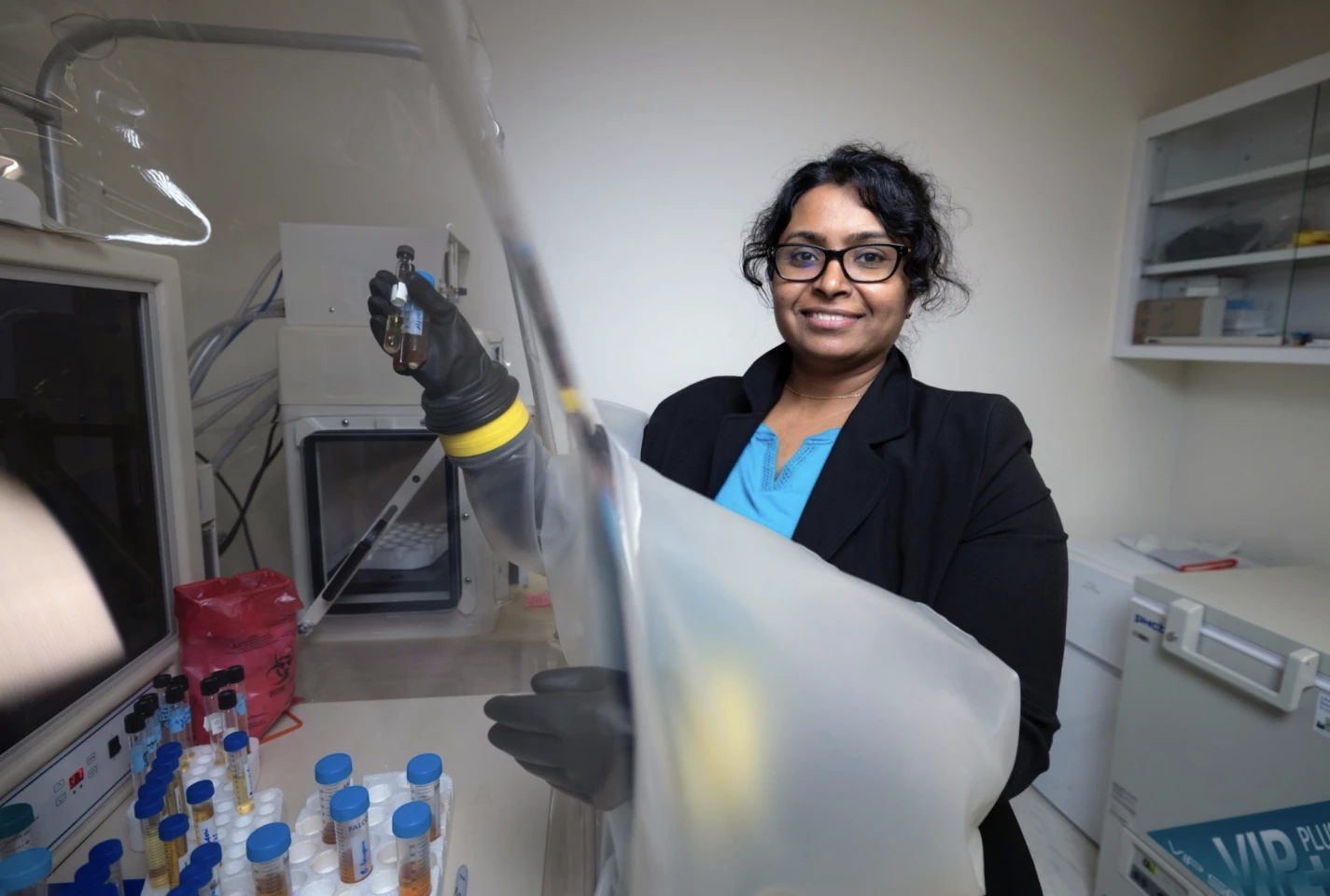
Bhanu Priya Ganesh led research revealing that changes in gut bacteria impact inflammation after stroke

“This study looked at how substances from the body and gut bacteria called AHR ligands affect post-stroke inflammation,” said senior author Bhanu Priya Ganesh, associate professor of neurology with McGovern Medical School at UTHealth Houston. “They found that after a stroke, changes in gut bacteria lead to a drop in beneficial substances and an increase in harmful ones. This suggests that restoring these beneficial substances from gut bacteria could help reduce inflammation after a stroke.”

In an earlier preclinical animal study, the researchers showed how stroke and other neurodegenerative diseases disrupt the gut microbiota, which in turn affects brain function – and that dysbiosis worsened with age. It again underpinned the critical role of the microbiota-gut-brain-axis (MGBA).

Now, once again studying aged mice, the team has demonstrated how restoring the gut's balance following a stroke, in order to provide the right fermentation environment for those important ligand metabolites to be made, can ultimately reduce neuroinflammation.

“Our recent animal-model study points to new treatment options that could focus on the gut-brain connection, offering potential ways to improve recovery after a stroke and reduce brain damage,” Ganesh said.

While the team identified some limitations, such as a sex difference in beneficial outcomes (their research focused on aged male mice, which had the strongest cognitive response), it's nonetheless an important discovery into improving brain function and recovery for stroke patients.

"Restoring a balanced pool of host- and microbiota-derived AHR ligands may be beneficial after stroke and may represent a therapeutic target," the researchers wrote.

The study was published in the journal Nature Communications.

Source: UTHealth Houston

Thursday, February 20, 2025

Milk boosts gut-friendly bacteria while cheese alters microbiome balance, study reveals

 Your competent? doctor already has told you of the benefits of dairy fat, RIGHT? 

  • dairy fat (28 posts to April 2016)
  • Milk boosts gut-friendly bacteria while cheese alters microbiome balance, study reveals

    New research reveals that milk fosters beneficial gut bacteria like Faecalibacterium and Akkermansia, while cheese reduces certain microbes—reshaping how dairy impacts digestive health.


    Study: Dairy Consumption and the Colonic Mucosa-Associated Gut Microbiota in Humans—A Preliminary Investigation. Image Credit: New Africa / Shutterstock

    In a recent study published in the journal Nutrients, researchers in the United States explored the influence of dairy consumption on colonic mucosa-associated gut microbiota. By investigating specific bacterial composition changes linked to dairy intake, they highlighted its implications for individual and public health.

    Background

    Did you know that the human gut houses trillions of bacteria that influence everything from digestion to mental health? Research increasingly points to diet as a crucial factor in shaping our gut microbiome, yet the role of dairy remains controversial. While dairy provides essential nutrients such as calcium, vitamins, and probiotics, conflicting studies raise concerns about its effects on gut health. Some research links dairy consumption to enhanced beneficial gut bacteria, while others suggest potential risks such as inflammation and metabolic disturbances. Given the global prevalence of dairy consumption, understanding its precise effects on gut microbiota is critical for shaping dietary guidelines and public health initiatives. Further research is needed to determine how specific dairy products affect different bacterial species and their long-term influence on health.

    About the study

    A cross-sectional study was conducted with 34 participants who had undergone a colonoscopy at the Michael E. DeBakey Veterans Affairs Medical Center in Houston, Texas. Participants were selected based on strict eligibility criteria, excluding individuals with inflammatory bowel disease (IBD), recent antibiotic use, or major dietary changes. Self-reported dairy intake over the past year was assessed using a validated food frequency questionnaire (FFQ). Nutrient intake was adjusted for caloric consumption.

    Colonic mucosal biopsies were collected and analyzed for microbial composition using 16S ribosomal Ribonucleic acid (rRNA) gene sequencing. Bacterial Deoxyribonucleic Acid (DNA) was extracted, and the V4 region of the 16S rRNA gene was amplified and sequenced using the Illumina MiSeq platform. Operational Taxonomic Unit (OTU) classification was performed using the Unified Platform for Automated Sequence Analysis (UPARSE) and structured Identification of Lifeforms from Various Environments databases (SILVA). Alpha-diversity (species richness and evenness) and beta-diversity (community composition differences) were calculated. Statistical analyses included negative binomial regression models adjusted for demographic and lifestyle factors such as age, body mass index (BMI), smoking status, alcohol use, and dietary quality. The study included a total of 97 mucosal biopsies from these participants. False discovery rate (FDR)-adjusted p-values were used to determine statistical significance.

    Study results

    Higher consumption of total dairy and milk was associated with increased microbial alpha-diversity, indicating greater bacterial richness and evenness. In contrast, higher cheese consumption was linked to lower microbial diversity. Beta-diversity analysis revealed significant differences in gut bacterial composition based on dairy intake levels.

    Participants who consumed more dairy and milk exhibited a higher relative abundance of Faecalibacterium, a bacterium known for its anti-inflammatory properties. Increased milk intake was also associated with greater levels of Akkermansia, a mucin-degrading bacterium linked to improved gut barrier function and metabolic health. However, the association between Akkermansia and milk intake was attenuated after adjusting for lactose intake, suggesting that lactose or other dairy components may act as prebiotics.

    Conversely, higher cheese consumption correlated with a lower relative abundance of Bacteroides and Subdoligranulum. While Bacteroides have been implicated in colorectal cancer (CRC), lower levels of Subdoligranulum have been linked to metabolic disorders. Additionally, the study found that higher total dairy intake was negatively associated with Bacteroides, suggesting a complex relationship between dairy components and microbial composition. The varying impact of milk and cheese on gut microbiota composition may be due to differences in their nutrient content and fermentation process. Milk, which contains more lactose, may promote the growth of beneficial bacteria, while cheese, which undergoes fermentation, may have distinct effects on gut microbial communities.

    The study did not find significant associations between yogurt intake and microbial composition, likely due to low yogurt consumption among participants. The findings suggest that different dairy products exert varying influences on gut microbiota, which may have implications for dietary recommendations and gut health interventions.

    Relative abundance (%) of the major bacterial phyla by total dairy (A), milk (B), cheese (C), and yogurt (D).

    Conclusions

    To summarize, dairy consumption significantly influences the composition and diversity of colonic mucosa-associated gut microbiota, with potential implications for individual and public health. A higher intake of total dairy and milk promotes beneficial bacteria such as Faecalibacterium and Akkermansia, whereas higher cheese consumption is linked to reductions in Bacteroides and Subdoligranulum. Notably, total dairy intake was inversely associated with Bacteroides, a genus linked to both colorectal cancer and inflammatory conditions. These findings underscore the broader impact of dairy consumption on gut health, which in turn affects metabolic, immune, and digestive functions.

    On a community level, dietary guidelines emphasizing balanced dairy consumption could improve public health outcomes. However, the study had limitations, including a small sample size, a predominantly older male participant pool, and reliance on self-reported dietary intake, which may affect generalizability. Globally, understanding the role of dairy in gut health could inform nutrition policies, probiotic interventions, and personalized dietary recommendations. Further research using metagenomic and metabolomic approaches is needed to explore how specific dairy components influence microbial functions and their long-term effects on health.

    Journal reference:
    • Chen E, Ajami NJ, White DL, et al. Dairy Consumption and the Colonic Mucosa-Associated Gut Microbiota in Humans—A Preliminary Investigation. Nutrients. (2025), DOI: 10.3390/nu17030567, https://www.mdpi.com/2072-6643/17/3/567

    Thursday, July 25, 2024

    Microbiome-gut-brain axis contributes to patients and Bama miniature pigs with acute large ischemic stroke

     No clue, so go ask your competent? doctor on this for your recovery needs.

    Microbiome-gut-brain axis contributes to patients and Bama miniature pigs with acute large ischemic stroke

    Dazhi Deng,Dazhi Deng1,2Hehua Lei,Hehua Lei3,4Zheng Cao,Zheng Cao3,4Cui Zhang,Cui Zhang3,4Ruichen Du,Ruichen Du3,4Xin Gao,Xin Gao3,4Junjie WeiJunjie Wei5Yibo LuYibo Lu6Xiangzhen ZhouXiangzhen Zhou7Limin Zhang,,
Limin Zhang1,3,4*
    • 1Wuhan National Laboratory for Optoelectronics, Huazhong University of Science and Technology, Wuhan, China
    • 2Department of Emergency, The People's Hospital of Guangxi Zhuang Autonomous Region and Guangxi Academy of Medical Sciences, Nanning, China
    • 3State Key Laboratory of Magnetic Resonance Spectroscopy and Imaging, National Centre for Magnetic Resonance in Wuhan, Innovation Academy for Precision Measurement Science and Technology, CAS, Wuhan, China
    • 4University of Chinese Academy of Sciences, Beijing, China
    • 5Department of Neurology, The People's Hospital of Guangxi Zhuang Autonomous Region and Guangxi Academy of Medical Sciences, Nanning, China
    • 6Department of Radiology, Nanning Fourth People's Hospital and Guangxi AIDS Clinical Treatment Center, Nanning, China
    • 7Department of Pathology, The People's Hospital of Guangxi Zhuang Autonomous Region and Guangxi Academy of Medical Sciences, Nanning, China

    Acute large hemispheric infarction (ALHI) is an overwhelming emergency with a great challenge of gastrointestinal dysfunction clinically. Here, we initially proposed delayed bowel movements as the clinical phenotype of strike to gut-brain axis (GBA) in ALHI patients by epidemiological analysis of 499 acute ischemic stroke (AIS) patients. 1H NMR-based metabolomics revealed that AIS markedly altered plasma global metabolic profiling of patients compared with healthy controls. Risk factors of strike on GBA were the National Institutes of Health Stroke Scale (NIHSS) score ≥ 5 and stroke onset time ≤ 24 h. As a result, first defecating time after admission to the hospital ≥2 days could be considered as a potential risk factor for strike on GBA. Subsequently, the ALHI Bama miniature (BM) pig model with acute symptomatic seizure was successfully established by ligation of the left ascending pharyngeal artery combined with local air injection. Clinical phenotypes of brain necrosis such as hemiplegia were examined with brain diffusion-weighted imaging (DWI) and pathological diagnosis. In addition to global brain injury and inflammation, we also found that ALHI induced marked alterations of intestinal barrier integrity, the gut microbial community, and microbiota-derived metabolites including serotonin and neurotransmitters in both plasma and multiple brain tissues of BM pigs. These findings revealed that microbiota-gut-brain axis highly contributed to the occurrence and development of ALHI.

    1 Introduction

    Stroke is a leading cause of adult disability and mortality worldwide, especially in people aged 50 years and older (WHO, 2020; Ding et al., 2022). Epidemiological studies have shown that approximately 80% of stroke patients are diagnosed with ischemic stroke (Boursin et al., 2018; Barthels and Das, 2020; Wang et al., 2022), and anterior circulation ischemic infarctions (ACIs) account for 80% of ischemic strokes cases (Sparaco et al., 2019). Acute large hemispheric infarction (ALHI) caused by the interruption of blood supply in the middle cerebral artery is a severe form of ischemic stroke and accounts for 2–8% of acute ischemic stroke (AIS) (Zha et al., 2015). More than 50% of AHLI patients experience the development of malignant cerebral edema (MCE) accompanied by blood-brain barrier (BBB) breakdown and vasogenic edema formation, which lead to mortality of up to 80% (Liebeskind et al., 2019; Lehrieder et al., 2021). Meanwhile, invasive procedures including endobronchial electrocautery (He et al., 2021), central venous catheterization (Kugiyama et al., 2018), artificial pneumothorax (Gou et al., 2019), and transbronchial needle aspiration (Van Den Plas et al., 2020) that have been widely used in clinical management for patients can induce cerebral arterial air embolism. Both kinds of strokes induce neuronal cell death, systemic inflammation, and brain regional injury and subsequent metabolic disorders. However, the pathophysiologic pathways relating to outcomes of them are still largely unknown and worth conducting further research.

    One typical consequence of ALHI is primary and secondary brain injury caused by focal and global brain inflammation. In ischemic stroke, the steep termination of blood supply in a vascular territory of the brain leads to the death of neural cells yielding an ischemic core and releasing damage-associated molecular patterns (DAMPs) such as adenosine and heat shock proteins, which trigger focal brain inflammation and immune response in the injured brain region (Schuhmann et al., 2021). Subsequently, a series of events including BBB damage, oxidative stress, and mitochondrial disruption result in secondary brain injury and global brain inflammation (Shi et al., 2019). Following an acute brain injury over stroke, peripheral leucocytes infiltrate the injured brain and release proinflammatory cytokines, thus further aggravating the BBB disruption and brain injury (Huang et al., 2022). The activated microglia by cytokines and chemokines distribute in the chronic stage of stroke forming global brain inflammation (Fifield and Vanderluit, 2020). Supportive evidence of global brain inflammation after stroke could also be found in the extensive distribution of a large number of cytokines (IL-1β, IL-6, and TNF-α) in the contralateral hemisphere of animal AIS models (Zaremba and Losy, 2001; Chen et al., 2019; Endres et al., 2022). Furthermore, previous studies also showed that global brain inflammation gradually induces global vascular inflammation in both intracerebral and subarachnoid hemorrhage mice models (Singh et al., 2018; Schuhmann et al., 2023).

    In addition to brain injury and global brain inflammation, stroke results in systemic alterations including cardiovascular and gastrointestinal systems. Increasing evidence suggests that stroke can cause disruption of the gut microbiota homeostasis and intestinal epithelial barrier integrity, and vice versa (Agirman et al., 2021). The gut and its microbiota could also increase the risk of cerebrovascular events highly contributing to the onset of stroke (Agirman et al., 2021). Patients with ALHI, in particular, face a high risk of gastrointestinal dysfunction with a potential impact on the microbiome-gut-brain axis (Coggrave and Norton, 2013; Arunachala Murthy et al., 2022). In clinical stroke, previous studies with relatively limited sample size identified overall 62 upregulated (e.g., Enterobacteriaceae, Streptococcus, Lactobacillus, and Escherichia) and 29 downregulated microbial taxa (e.g., Eubacterium and Roseburia) in the fecal microbial community (Xu et al., 2021; Peh et al., 2022). In experimental stroke, specific gut microbiome composition and their metabolites such as short-chain fatty acids closely contribute to the severity of stroke. Although clinical stroke is limited due to ethical restrictions that prevent invasive sampling of AIS patients (Coggrave and Norton, 2013; Xu et al., 2021), these experimental data suggested that modulation of an interplay between the gut and brain could be a novel therapeutic strategy for stroke prevention.

    In this study, we first conducted an epidemiological analysis of 499 AIS patients coupled with clinical magnetic resonance imaging (MRI) and computer tomography (CT) examinations. A phenomenon of delayed bowel movements was observed in LHI patients, which may be induced by a strike to the GBA. 1H NMR-based metabolomics was also employed to reveal global metabolic profiling in the plasma of AIS patients. Subsequently, a Bama miniature (BM) pig model with ALHI was successfully established and employed to investigate the alterations of intestinal barrier integrity, the gut microbial community, and microbiota-derived metabolites. These findings highlight that microbiome-gut-brain axis contributes to both clinical AIS patients and ALHI BM pigs.

    More at link.

    Wednesday, May 22, 2024

    Gut Bacteria’s Link to Alzheimer’s Explored

     Hopefully your competent? doctor will give exact amounts of probiotics and nutritional supplements and the type to buy.

    Gut Bacteria’s Link to Alzheimer’s Explored

    Summary: Researchers are investigating the connection between gut bacteria and Alzheimer’s disease. They believe harmful metabolites from bad bacteria can travel to the brain, causing inflammation and potentially triggering dementia.

    The study aims to develop drug therapies to block these metabolites and explore the use of probiotics and nutritional supplements to promote gut health and potentially prevent or slow down Alzheimer’s progression.

    Key Facts:

    • Harmful gut bacteria may trigger and accelerate Alzheimer’s disease.
    • A poor diet, aging, and lack of exercise can contribute to unhealthy gut bacteria.
    • Probiotics and nutritional supplements could help combat bad bacteria and protect the brain.

    Source: University of South Australia

    The phrase ‘you are what you eat’ was coined almost a century before Alois Alzheimer made his breakthrough in identifying brain disease, but the evidence is now clear that diet, as well as age, influences the brain.

    A growing body of research suggests a correlation between Alzheimer’s disease and an unhealthy gut, and Australian scientists are hoping to take this a step further by exploring how harmful gut bacteria access the brain and lead to dementia.

    This shows gut bacteria.
    Most types of bacteria are harmless—many are even essential for our survival—but bad bacteria create biofilms which cause gastrointestinal infections, chronic diseases, bowel cancer and brain diseases. Credit: Neuroscience News

    University of South Australia nano bio-scientist Dr. Ibrahim Javed says tiny metabolites released by bad bacteria in the gut can travel to the brain, causing inflammation and triggering Alzheimer’s disease, for which there is no cure.

    In younger people, this is less likely because the blood-brain barrier is much stronger, but this weakens as people age, allowing harmful substances to damage neurons. When the microbiome in the gut ages, it also loses the ability to fight disease.

    By identifying how metabolites released by bad bacteria damage neurons—and hopefully developing new drug therapies to block them—Dr. Javed says it should be possible to slow down or halt the progression of Alzheimer’s.

    A second aim of the three-year research project is to investigate how probiotics and nutritional supplements, both of which contain friendly bacteria, can stamp out bad bacteria and stop metabolites from escaping from the gut.

    This follows on from several international clinical research studies that have demonstrated that probiotics improve digestive and cognitive issues in people with acute and chronic COVID-19.

    Did you know that a poor diet can accelerate your chances of developing Alzheimer’s disease?

    An unhealthy gut produces bad bacteria, which releases tiny metabolites that travel to the brain, causing inflammation.

    Scientists at the University of South Australia are exploring how probiotics and nutritional supplements – both of which contain friendly bacteria – can stamp out bad bacteria and stop metabolites from escaping the gut and accessing the brain. A poor diet is just one of several factors that harms gut bacteria.

    Aging, lack of exercise, exposure to pesticides and genetics also play a role. Credit: University of South Australia

    “Our research indicates that harmful gut bacteria can trigger early onset dementia as well as accelerate dementia in patients already battling the neurodegenerative disease,” Dr. Javed says.

    “A poor diet is one of several factors that harms gut bacteria, increasing your chances of developing dementia. Aging, lack of exercise, exposure to pesticides and genetics also play a role, although the latter is responsible for a very small number of cases. In most cases, dementia is preventable.”

    Most types of bacteria are harmless—many are even essential for our survival—but bad bacteria create biofilms which cause gastrointestinal infections, chronic diseases, bowel cancer and brain diseases.

    Alzheimer’s disease affects up to 55 million people worldwide and with an aging population, this number is expected to double every 20 years, according to Alzheimer’s Disease International.

    Early onset dementia—under the age of 65—is becoming more common in the global population, attributed to preventable factors such as a poor diet and a sedentary lifestyle, smoking, excessive alcohol consumption, social isolation, exposure to pesticides and air pollution.

    Dr. Javed’s team is also collaborating with UniSA neuroscientist Associate Professor Larisa Bobrovskaya on a potential link between stress and Alzheimer’s disease, and whether women are more at risk.

    About this Alzheimer’s disease and microbiome research news

    Author: Ibrahim Javed
    Source: University of South Australia
    Contact: Ibrahim Javed – University of South Australia
    Image: The image is credited to Neuroscience News

    Friday, October 20, 2023

    Microbiome and Diet Could Mitigate PTSD Symptoms

     What is your doctor's EXACT PROTOCOL to prevent your chances of PTSD? If it's not 100% recovery protocols, WHY NOT?

    23% chance of stroke survivors getting PTSD

    The latest here:

    Microbiome and Diet Could Mitigate PTSD Symptoms

    Summary: Researchers explored the potential link between the Mediterranean diet, the gut microbiome, and PTSD symptoms. Their study, involving 191 participants, revealed that those following a Mediterranean diet exhibited fewer PTSD symptoms.

    A notable discovery was the presence of Eubacterium eligens, a bacteria positively associated with key components of the Mediterranean diet, which showed consistent negative correlation with PTSD symptoms.

    Key Facts:

    1. Adherence to a Mediterranean diet was found to reduce PTSD symptoms.
    2. The bacterium Eubacterium eligens, positively associated with Mediterranean diet components, was identified as a potential protective species against PTSD.
    3. The study suggests an intricate link between diet, gut microbiome, and mental health, with the Mediterranean diet offering potential therapeutic benefits.

    Source: Brigham and Women’s Hospital

    The human gut microbiome has a significant impact on our health. Research has shown that it can influence the development and response of emotions, but the relationship between posttraumatic stress disorder (PTSD) and the gut microbiome has been unexplored. PTSD is a fear-based mental health disorder that develops in some individuals who experience a disturbing and horrifying situation involving severe injury, actual or threat of death, or violence.

    A new study by investigators from Brigham and Women’s Hospital, a founding member of the Mass General Brigham healthcare system, and Harvard T.H. Chan School of Public Health systematically investigated the relationship between PTSD, diet, and the gut microbiome. Their study found that participants who adhered to a Mediterranean diet experienced decreased PTSD symptoms.

    Their results are published in Nature Mental Health.

    “There is a very intriguing relationship between the human gut microbiome and the brain,” said co-corresponding author Yang-Yu Liu, PhD, of the Channing Division of Network Medicine within the Department of Medicine at Brigham and Women’s Hospital.

    “Through our study, we examined how factors, like diet, are associated with PTSD symptoms. While further research is needed, we are closer to being able to provide dietary recommendations for PTSD prevention or amelioration.”

    The burden of PTSD often extends beyond the individual; family members, the healthcare industry and society are also affected by the mental health disorder. In addition, individuals with PTSD have an increased risk of developing chronic diseases such as coronary heart disease, stroke, diabetes, autoimmune diseases and premature death. Understanding the role of diet and the microbiome could improve recommendations and outcomes for patients with PTSD.     

    “Examining the gut-brain axis can provide insights on the interdependence of mental and physical health,” said co-corresponding author Karestan Koenen, PhD, of the Department of Epidemiology at Harvard T.H Chan School of Public Health. “Our findings suggest the PTSD and human gut microbiome relationship is a promising area of research that may lead to recommendations for alleviating the down-stream negative health consequences of PTSD.”

    The team collected data from 191 participants in sub-studies of the Nurses’ Health Study-II (NHS-II), which included the Mind-Body Study (MBS) and the PTSD Substudy. Participants were assigned to three groups: probable PTSD, exposed to trauma but no PTSD, and no trauma exposure.

    All the participants submitted two sets of four stool samples, once at the beginning of the study and again six months later. The samples were collected to provide microbial DNA information and to confirm that the participant’s gut microbiome was stable over six months.

    The team evaluated the associations between overall microbiome structure and host factors, including PTSD symptoms, age, body mass index (BMI) and dietary information. From this evaluation, the researchers found several host factors (BMI, depression, and antidepressants) associated with the microbiome structure.

    Next, the researchers assessed the relationship between the available dietary information and PTSD symptoms. The team found that participants who adhered to a Mediterranean diet experienced fewer PTSD symptoms. In particular, they found that the consumption of red and processed meats was positively associated with PTSD symptoms, while the consumption of plant-based foods was negatively associated with PTSD symptoms. 

    Lastly, the team employed the generalized microbe–phenotype triangulation (GMPT) method to examine the link between PTSD symptoms and the gut microbiome signatures, aiming to identify putative PTSD protective species. They identified Eubacterium eligens as the top PTSD putative protective species.  

    To test the consistency of this signature over time, the team found that the inverse association of E. eligens abundance with PTSD symptoms was highly consistent across all four time points.

    They further demonstrated that E. eligens was positively associated with the enriched components of the Mediterranean diet (such as vegetables, fruits, and fish) and that E. eligens was negatively associated with red/processed meat, which people following a Mediterranean diet limit or avoid.

    The team notes limitations to their study, including using a short screening scale for PTSD (instead of a formal clinical diagnosis of PTSD). However, the results offer insights for future studies examining other mental health disorders and dietary interventions to improve recommendations to alleviate or prevent symptoms.

    “It’s exciting that our results imply that the Mediterranean diet may provide potential relief to individuals experiencing PTSD symptoms,” said Liu. “We are eager to learn more about the relationship between PTSD, diet, and the gut microbiome. In a future study, we will attempt to validate the efficacy of probiotics as a method to prevent PTSD.”

    Disclosures:  The authors declare no competing interests.

    Funding: This work was supported by the National Institutes of Health (R01AI141529, R01HD093761, RF1AG067744, UH3OD023268, U19AI095219, and U01HL089856, R01MH101269), the Harvard T.H. Chan School of Public Health Dean’s Fund for Scientific Advancement Incubation Award, the Biology of Trauma Initiative (BTI) of Broad Institute, the Traumatic Brain Injury and Psychological Health Research Program (Focused Program Award) under Award No. (w81XWH-22-S-TBIPH2) endorsed by the Office of the Assistant Secretary of Defense for Health Affairs in the Department of Defense.

    About this PTSD, diet, and microbiome research news

    Author: Angela Christoforos
    Source: Brigham and Women’s Hospital
    Contact: Angela Christoforos – Brigham and Women’s Hospital
    Image: The image is credited to Neuroscience News

    Original Research: Closed access.
    Association of probable post-traumatic stress disorder with dietary pattern and gut microbiome in a cohort of women” by Ke, S. et al. Nature Mental Health

    Monday, July 24, 2023

    A Common Probiotic Could Boost Brain Health in Older Adults

    Hopefully your doctor is treating your constipation the correct way. But this isn't totally proven yet, so ask your doctor to followup.

    The incidence of constipation for stroke was 48%. 


    Laxative use may be linked to dementia risk, study says

    The latest here:

     A Common Probiotic Could Boost Brain Health in Older Adults

    It’s said the way to one’s heart is through the stomach, but it looks like the way to a healthy brain is by dropping a deuce regularly. According to new research presented at the Alzheimer’s Association International Conference in Amsterdam this week, chronic constipation appears to be linked to worsening cognitive abilities, likely due to an imbalance of gut bacteria causing inflammation.While the study has yet to be peer-reviewed, it emphasizes a link between cognition and the microbiome — microorganisms like bacteria, viruses, and fungi living rent-free in and on our bodies — that hasn’t gone unnoticed. There’s still a whole lot we don’t know about the microbiome, but what we do know suggests these microscopic houseguests can be manipulated to improve our own health. Mashael Aljumaah, a doctoral student at the University of North Carolina at Chapel Hill (UNC) and North Carolina State University. In findings presented Monday at the American Society for Nutrition in Boston, Aljumaah and her colleagues at UNC and Kent State University in Ohio found that for older adults, a daily probiotic containing gut-friendly Lactobacillus rhamnosus helped improve mild cognitive impairment by resetting the imbalance in gut bacteria.

    While the study has yet to be peer-reviewed, it emphasizes a link between cognition and the microbiome — microorganisms like bacteria, viruses, and fungi living rent-free in and on our bodies — that hasn’t gone unnoticed. There’s still a whole lot we don’t know about the microbiome, but what we do know suggests these microscopic houseguests can be manipulated to improve our own health.

    To offset cognitive decline, it could be as simple as a daily probiotic, says Mashael Aljumaah, a doctoral student at the University of North Carolina at Chapel Hill (UNC) and North Carolina State University. In findings presented Monday at the American Society for Nutrition in Boston, Aljumaah and her colleagues at UNC and Kent State University in Ohio found that for older adults, a daily probiotic containing gut-friendly Lactobacillus rhamnosus helped improve mild cognitive impairment by resetting the imbalance in gut bacteria.


    While further research is needed, these findings lend to new avenues of tackling cognitive decline whether due to aging or neurological conditions like dementia and Alzheimer’s disease.


    Wednesday, June 28, 2023

    Changes in Human Microbiome Precede Alzheimer’s Cognitive Declines

    So your doctor needs to test for this so EXACT DEMENTIA PREVENTION PROTOCOLS CAN BE IMPLEMENTED FOR YOU! 

    With your excellent chance of dementia post stroke you'll want your doctor and hospital to ensure  EXACT PROTOCOLS ARE CREATED to prevent this problem and prevent  dementia. And ask for specific names who will take responsibility on getting it done.

    Your risk of dementia, has your doctor told you of this?  Your doctor is responsible for preventing this!

    1. A documented 33% dementia chance post-stroke from an Australian study?   May 2012.

    2. Then this study came out and seems to have a range from 17-66%. December 2013.`    

    3. A 20% chance in this research.   July 2013.

    4. Dementia Risk Doubled in Patients Following Stroke September 2018 

    The latest here:

    Changes in Human Microbiome Precede Alzheimer’s Cognitive Declines

    Posted on by

    a field of different species of bacteria
    Caption: The human gut teems with bacteria and other microbes. They contribute to our health but also influence our susceptibility to certain diseases, including Alzheimer’s disease. Credit: Donny Bliss, NIH

    In people with Alzheimer’s disease, the underlying changes in the brain associated with dementia typically begin many years—or even decades—before a diagnosis. While pinpointing the exact causes of Alzheimer’s remains a major research challenge, they likely involve a combination of genetic, environmental, and lifestyle factors. Now an NIH-funded study elucidates the role of another likely culprit that you may not have considered: the human gut microbiome, the trillions of diverse bacteria and other microbes that live primarily in our intestines [1].

    Earlier studies had showed that the gut microbiomes of people with symptomatic Alzheimer’s disease differ from those of healthy people with normal cognition [2]. What this new work advances is that these differences arise early on in people who will develop Alzheimer’s, even before any obvious symptoms appear.

    The science still has a ways to go before we’ll know if specific dietary changes can alter the gut microbiome and modify its influence on the brain in the right ways. But what’s exciting about this finding is it raises the possibility that doctors one day could test a patient’s stool sample to determine if what’s present from their gut microbiome correlates with greater early risk for Alzheimer’s dementia. Such a test would help doctors detect Alzheimer’s earlier and intervene sooner to slow or ideally even halt its advance.

    The new findings, reported in the journal Science Translational Medicine, come from a research team led by Gautam Dantas and Beau Ances, Washington University School of Medicine, St. Louis. Ances is a clinician who treats and studies people with Alzheimer’s; Dantas is a basic researcher and expert on the gut microbiome.

    The pair struck up a conversation one day about the possible connection between the gut microbiome and Alzheimer’s. While they knew about the earlier studies suggesting a link, they were surprised that nobody had looked at the gut microbiomes of people in the earliest, so-called preclinical, stages of the disease. That’s when dementia isn’t detectable, but the brain has formed amyloid-beta plaques, which are associated with Alzheimer’s.

    To take a look, they enrolled 164 healthy volunteers, age 68 to 94, who performed normally on standard tests of cognition. They also collected stool samples from each volunteer and thoroughly analyzed them all the microbes from their gut microbiome. Study participants also kept food diaries and underwent extensive testing, including two types of brain scans, to look for signs of amyloid-beta plaques and tau protein accumulation that precede the onset of Alzheimer’s symptoms.

    Among the volunteers, about a third (49 individuals) unfortunately had signs of early Alzheimer’s disease. And, as it turned out, their microbiomes showed differences, too.

    The researchers found that those with preclinical Alzheimer’s disease had markedly different assemblages of gut bacteria. Their microbiomes differed in many of the bacterial species present. Those species-level differences also point to differences in the way their microbiomes would be expected to function at a metabolic level. These microbiome changes were observed even though the individuals didn’t seem to have any apparent differences in their diets.

    The team also found that the microbiome changes correlated with amyloid-beta and tau levels in the brain. But they did not find any relationship to degenerative changes in the brain, which tend to happen later in people with Alzheimer’s.

    The team is now conducting a five-year study that will follow volunteers to get a better handle on whether the differences observed in the gut microbiome are a cause or a consequence of the brain changes seen in Alzheimer’s. If it’s a cause, this discovery would raise the tantalizing possibility that specially formulated probiotics or fecal transplants that promote the growth of “good” bacteria over “bad” bacteria in the gut might slow the development of Alzheimer’s and its most devastating symptoms. It’s an exciting area of research and definitely one worth following in the years ahead.

    References:

    [1] Gut microbiome composition may be an indicator of preclinical Alzheimer’s disease. Ferreiro AL, Choi J, Ryou J, Newcomer EP, Thompson R, Bollinger RM, Hall-Moore C, Ndao IM, Sax L, Benzinger TLS, Stark SL, Holtzman DM, Fagan AM, Schindler SE, Cruchaga C, Butt OH, Morris JC, Tarr PI, Ances BM, Dantas G. Sci Transl Med. 2023 Jun 14;15(700):eabo2984. doi: 10.1126/scitranslmed.abo2984. Epub 2023 Jun 14. PMID: 37315112.

    [2] Gut microbiome alterations in Alzheimer’s disease. Vogt NM, Kerby RL, Dill-McFarland KA, Harding SJ, Merluzzi AP, Johnson SC, Carlsson CM, Asthana S, Zetterberg H, Blennow K, Bendlin BB, Rey FE. Sci Rep. 2017 Oct 19;7(1):13537. doi: 10.1038/s41598-017-13601-y. PMID: 29051531; PMCID: PMC5648830.

    Links:

    Alzheimer’s Disease and Related Dementias (National Institute on Aging/NIH)

    Video: How Alzheimer’s Changes the Brain (NIA)

    Dantas Lab (Washington University School of Medicine. St. Louis)

    Ances Bioimaging Laboratory (Washington University School of Medicine, St. Louis)

    NIH Support: National Institute on Aging; National Institute of Diabetes and Digestive and Kidney Diseases

    Wednesday, April 12, 2023

    Modified Mediterranean ketogenic diet may improve brain health

    You'll have to ask your doctor to get the specific protocol on this. The Mediterranean diet has nothing specific in it.

    Modified Mediterranean ketogenic diet may improve brain health 

    Key takeaways:

    • A modified Mediterranean ketogenic diet may reduce the risk for Alzheimer’s disease.
    • Researchers said that the findings offer critical insight into how diet could improve brain health.

    A modified Mediterranean ketogenic diet was associated with changes in a biological pathway linked to Alzheimer’s disease among older adults with mild cognitive impairment, according to study results published in Alzheimer’s and Dementia.

    The ketogenic diet has emerged as a potential candidate for Alzheimer’s disease treatment because of its known protective effects for seizures and metabolic dysregulation, Amanda Hazel Dilmore, a PhD student in Rob Knight's lab at the University of California, San Diego, and colleagues wrote.

    Keto diet foods
    A modified Mediterranean ketogenic diet may be beneficial for older adults with mild cognitive impairment, according to researchers. Image: Adobe Stock

    “The ketogenic diet is a candidate therapeutic for Alzheimer’s disease because of its ability to improve mitochondrial function and cerebral bioenergetics, enhance autophagy, and reduce oxidative stress,” they wrote. “It also reduces neuronal hyperexcitability and leads to improved amyloid and tau regulation, substantiating its potential use for cognitive impairment.”

    Dilmore and colleagues added that gut microbiota are critical for ketogenic diet-mediated protection against seizures and modulation of bile acids — a major factor in cholesterol metabolism. Interest in those relationships, they wrote, was the catalyst for their analysis of gut microbiota and metabolites related to cognitive status after a ketogenic diet intervention compared with a low-fat-diet intervention.

    “We hope that better understanding this complex relationship between diet, cognitive status and gut health will lead to new interventions to prevent and treat Alzheimer’s disease,” Suzanne Craft, PhD, professor of gerontology and geriatric medicine at Wake Forest University School of Medicine, said in a press release.

    The researchers randomly assigned 20 prediabetic adults with either normal cognition or mild cognitive impairment (MCI) to a high-fat modified Mediterranean ketogenic diet (MMKD) or a low-fat American Heart Association diet for 6 weeks. After a 6-week washout period, the participants then began the alternate diet. To analyze changes in gut microbiome and metabolome, the researchers collected stool samples at five timepoints throughout the interventions.

    Dilmore, Craft and colleagues found that, through modulation of GABA levels and gut-transit time, the MMKD may help older adults with MCI. (May help is not good enough! Tell us EXACTLY what will help! Do your research properly to provide answers!)

    “Broadly, our investigation demonstrated that controlled changes in diet led to widespread changes in the microbiome and metabolome over time,” they wrote.

    More specifically, the researchers found that those with MCI on the MMKD had lower levels of GABA — an inhibitory neurotransmitter — and GABA-producing microbes. They also had higher levels of GABA-regulating microbes. Notably, low levels of GABA have been linked to conditions like Alzheimer’s disease.

    “Our study is the first to show that diet modulates GABA differently in MCI,” Craft said in the release.

    The researchers also noted that those with MCI who also had curcumin in their diet had an altered bile acid pool and lower levels of bile salt hydrolase-containing microbes, which they wrote suggests reduced gut motility.

    “Gut microbiota are known to modulate the bile acid pool; given that bile acids are the primary agent of cholesterol depletion in the brain, gut microbiota-induced changes to the bile acid pool may mitigate the dysregulation of cholesterol metabolism,” they wrote.

    Dilmore, Craft and colleagues acknowledged that the study was limited because of its small sample size and “relatively brief intervention period,” but acknowledged the importance of their results.

    “These findings provide crucial insight into how diet may affect the microbiome and improve brain health,” Craft said in the release. “Larger studies are needed to assess the role diet interventions play in patients with cognitive impairment.”

    References:

    Wednesday, March 31, 2021

    Rebuilding Microbiome for Mitigating Traumatic Brain Injury: Importance of Restructuring the Gut-Microbiome-Brain Axis

     Nothing here told me anything useful in understandable actions I could take even though this was in TBI not stroke.

    Rebuilding Microbiome for Mitigating Traumatic Brain Injury: Importance of Restructuring the Gut-Microbiome-Brain Axis

    Molecular Neurobiology (2021)

    Abstract

    Traumatic brain injury (TBI) is a damage to the brain from an external force that results in temporary or permanent impairment in brain functions. Unfortunately, not many treatment options are available to TBI patients. Therefore, knowledge of the complex interplay between gut microbiome (GM) and brain health may shed novel insights as it is a rapidly expanding field of research around the world. Recent studies show that GM plays important roles in shaping neurogenerative processes such as blood-brain-barrier (BBB), myelination, neurogenesis, and microglial maturation. In addition, GM is also known to modulate many aspects of neurological behavior and cognition; however, not much is known about the role of GM in brain injuries. Since GM has been shown to improve cellular and molecular functions via mitigating TBI-induced pathologies such as BBB permeability, neuroinflammation, astroglia activation, and mitochondrial dysfunction, herein we discuss how a dysbiotic gut environment, which in fact, contributes to central nervous system (CNS) disorders during brain injury and how to potentially ward off these harmful effects. We further opine that a better understanding of GM-brain (GMB) axis could help assist in designing better treatment and management strategies in future for the patients who are faced with limited options.

    Introduction

    Traumatic brain injury (TBI) occurs due to an external force causing skull damage which could invariably affect the brain [1]. The trauma leading to brain injury can be broadly categorized as an impact or a non-impact event depending upon whether the external object had a direct contact with the head (impact) or was it a non-impact force like the blast waves or a rapid acceleration, and deceleration (non-impact) with the head [2]. In the USA, frequency of TBI occurs every 15 s (roughly about 1.7 million new TBI cases/year) and costs more than US $77 billion/year [3]. In brief, TBI events are responsible for 50,000 deaths together with 80,000 individuals that are left with permanent disabilities each year [4,5,6,7]. It is believed that the frequency of brain injury is estimated to be higher than any other type of diseases such as Parkinson’s disease, multiple sclerosis, AIDS, and breast carcinoma [3]. For example, motor-vehicle or traffic-related accidents constitute 17% cases while walking-falls are responsible for 35% of cases in USA [4,5,6,7]. As per one estimate 130,000 children in the age between 5 and 18 years suffered from sport-related concussions [8]. Besides, blast injury was the most common cause of TBI-related event that was observed among the military personnel [9]. In recent years, several experimental animal models have been developed to replicate human TBI pathophysiological aspects employing the pre-clinical settings [10] including fluid percussion, weight-drop injury, and controlled cortical impact (CCI). These animal models are routinely used in simulating TBI-related events in small animals with characteristics of mild or severe TBI. In fact, these models remain the workhorses for studying characteristic features of the primary, as well as secondary brain injuries in humans [11].

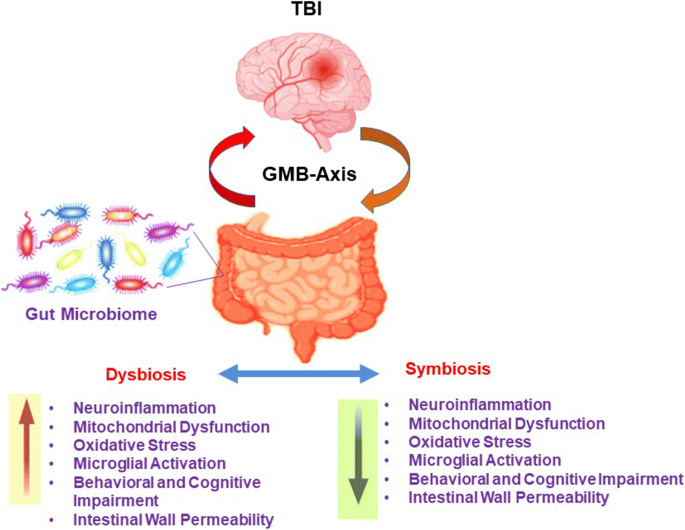
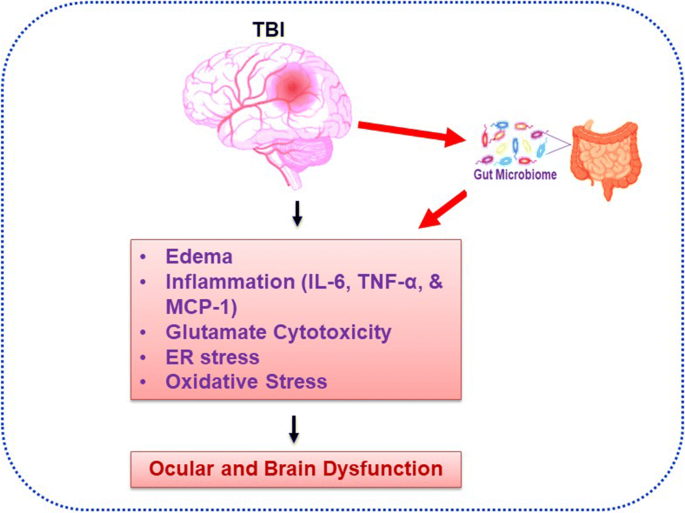
    An acquired insult during TBI could potentially change various structural components of the brain resulting in temporary or even permanent brain impairment [12, 13]. Interestingly, GM and its role(s) in various system disorders has recently been the major focus area of research worldwide. For example, previous work reveals that GM plays important roles in neurogenerative processes such as formation of BBB, myelination, neurogenesis, and microglial maturation [14]. It has been shown that microbiome also modulates many aspects of our behavior since GM is involved in the modulation of cellular and molecular processes by balancing microbial eubiosis and dysbiosis condition and also involved in the progression of TBI-induced pathologies including BBB permeability, immune response to neuroinflammation, astroglial activation, and mitochondrial dysfunction (Fig. 1) [14]. Currently, efficacious treatments for TBI patients are acutely lacking [15,16,17]. Additionally, gut dysbiosis is known to exacerbate behavioral impairment as shown in studies that employed animal models of TBI and the spinal cord injury [18,19,20,21]. Furthermore, the dysbiotic milieu negatively affects the post stroke recovery [22,23,24,25]. Treatments for TBI and related disorders are severely limited, but recent research shows that microbiome transplants could mitigate CNS damage and functional impairments in spinal cord injury and stroke in animals [18]. In addition, probiotics were shown to reduce the rate of infections and time spent in intensive care units of hospitalized patients suffering from the brain trauma [18, 26, 27]. Thus, establishment of a protective, that is, eubiotic GM, is a promising therapeutic avenue since the brain injuries induce dysbiosis (Fig. 2). Reiner and colleagues 2014 reported that Novel CB2 Inverse Agonist SMM-189 reduce motor, visual, and emotional deficits after closed-head mild traumatic brain injury mouse model via mitigation of microglial inflammatory action [28]. ER stress was found to be increased early in juvenile rats exposed to TBI and that these rats developed tau oligomers over the course of 30 days and had significant short-term and spatial memory deficits following injury [29]. Treangen and colleagues suggested that acute bacterial dysbiosis within the gut microbiome was observed after TBI post-injury in mice [30]. The overall researched layout is represented in Fig. 2. However, post-TBI associated ocular and brain dysfunction via direct regulation of altered gut microbiome homeostasis is still needed to be demonstrated. This review discusses how GM alterations during post TBI contribute to CNS dysfunction and how to potentially target GM for therapeutic benefits in patients.

    Fig. 1.
    figure1

    TBI induced dysbiosis via the gut microbiome brain (GMB) axis. The GMB-axis could potentially contribute, and further worsen the injury profile by promoting dysbiosis over eubiosis wherein harmful microbes in the gut can lead to an increase in neuroinflammation, mitochondrial dysfunction, oxidative stress, microglial activation, behavioral, and cognitive impairment, and intestinal wall permeability.

    Fig. 2.
    figure2

    Resolution of the gut dysbiotic environment. Treatment with probiotics may help break the vicious dysbiotic cycle thus reducing the impact of brain injury, and hence improve substantially the TBI-related biochemical, pathological, and behavioral markers.

    An Overview of Traumatic Brain Injury (TBI)

     More at link.