Changing stroke rehab and research worldwide now.Time is Brain! trillions and trillions of neurons that DIE each day because there are NO effective hyperacute therapies besides tPA(only 12% effective). I have 523 posts on hyperacute therapy, enough for researchers to spend decades proving them out. These are my personal ideas and blog on stroke rehabilitation and stroke research. Do not attempt any of these without checking with your medical provider. Unless you join me in agitating, when you need these therapies they won't be there.

What this blog is for:

My blog is not to help survivors recover, it is to have the 10 million yearly stroke survivors light fires underneath their doctors, stroke hospitals and stroke researchers to get stroke solved. 100% recovery. The stroke medical world is completely failing at that goal, they don't even have it as a goal. Shortly after getting out of the hospital and getting NO information on the process or protocols of stroke rehabilitation and recovery I started searching on the internet and found that no other survivor received useful information. This is an attempt to cover all stroke rehabilitation information that should be readily available to survivors so they can talk with informed knowledge to their medical staff. It lays out what needs to be done to get stroke survivors closer to 100% recovery. It's quite disgusting that this information is not available from every stroke association and doctors group.

Showing posts with label hip exoskeleton. Show all posts

Sunday, May 17, 2026

Portable hip exoskeleton improves walking economy for stroke survivors

 Nothing here would help my problems; spasticity causing left foot to angle outward, spasticity preventing lower leg swing, no pushoff.

Portable hip exoskeleton improves walking economy for stroke survivors

Abstract

Increased metabolic cost of walking after stroke limits mobility and quality of life for millions of individuals. Existing portable assistive devices, primarily targeting the ankle joint, have failed to alleviate this burden. Here, we tested a portable, lightweight hip exoskeleton providing bilateral assistance during walking for individuals with chronic post-stroke hemiparesis. The exoskeleton significantly reduced the net metabolic cost of walking by 18 ± 2% (mean ± standard error, p = 0.0002) in seven participants during treadmill walking—a reduction sufficient to potentially lessen fatigue and extend walking duration— compared to walking without the device. This improvement was associated with a 29 ± 6% reduction in positive biological hip work (p = 0.0052), indicating effective offloading of the hip joints. These results provide the first evidence that portable hip exoskeleton assistance can improve walking economy in stroke survivors, offering a promising therapeutic strategy to enhance real-world mobility and functional recovery in this large clinical population.

This might be it.


Thursday, May 14, 2026

Exoskeleton frontal and sagittal plane hip torque improves propulsion and transient stability during walking in individuals with hemiparesis

 Where the fuck is the protocol you delivered to all stroke hospitals? Oh, you DID NOTHING OF THE SORT!  You're fired for extreme incompetence! The goal is to get survivors 100% recovered; NOT TO GET YOU PUBLISHED YOU FUCKING BASTARDS! 

Your compeuppance is going to be a real bitch when you realize you could have solved stroke when still working; I'll have zero sympathy for your predicament!

Exoskeleton frontal and sagittal plane hip torque improves propulsion and transient stability during walking in individuals with hemiparesis

 We are providing an unedited version of this manuscript to give early access to its findings. Before final publication, the manuscript will undergo further editing. Please note there may be errors present which affect the content, and all legal disclaimers apply.

Abstract

Background

Millions of people around the world experience post-stroke hemiparesis, making it difficult to move one side of the body. Hemiparesis impairs an individual’s muscle strength and coordination which limits gait speed, efficiency, and endurance and contributes to reduced community participation. These limitations in strength and control also negatively impact balance, leading to a high prevalence of instability, falls, and fall-related injuries. Assistive technologies like powered exoskeletons that apply torques to the hips in the sagittal plane (hip flexion and extension) and frontal plane (hip abduction and adduction) may benefit both gait efficiency and stability in hemiparetic populations.

Methods

In this study, we investigate the impact of exoskeleton-delivered frontal and sagittal plane hip torque in eight individuals with hemiparesis. Participants completed two-minute walking bouts on an instrumented treadmill with no exoskeleton, and then with the exoskeleton applying phase-based flexion and extension assistance. They then completed a series of abduction torque trials, in which they walked with the exoskeleton-supplied sagittal-plane assistance for 10 strides, and then sagittal-plane assistance and constant abduction torque for 10 strides. The abduction torque series consisted of four levels of abduction torque, each repeated 5 times, in random order.

Results

Compared to steady-state walking without the exoskeleton, the application of sagittal plane torques significantly increased propulsive forces at push-off for the non-paretic limb by 0.83 ± 0.32% BW (p = 0.0373) and had little impact on step width or margin of stability. In the transient period following onset, hip abduction torques significantly increased step width by 0.053 ± 0.011 m (adjusted p < 0.025) and margin of stability for the paretic and non-paretic limb by 0.039 ± 0.006 m (adjusted p < 0.025) and 0.014 ± 0.004 m (adjusted p = 0.01), respectively. These outcomes are correlated with the level of abduction assistance.

Conclusion

These results provide initial evidence supporting the use of a hip exoskeleton to impact foot placement, margin of stability, and propulsion in individuals with hemiparesis, which may benefit both gait efficiency and stability.

Tuesday, May 12, 2026

Exoskeleton frontal and sagittal plane hip torque improves propulsion and transient stability during walking in individuals with hemiparesis

 My problem is spasticity preventing a free swinging lower leg and a foot that angle to the left 15 degrees preventing any pushoff at all.  Nothing here fixes that at all.

Exoskeleton frontal and sagittal plane hip torque improves propulsion and transient stability during walking in individuals with hemiparesis

    We are providing an unedited version of this manuscript to give early access to its findings. Before final publication, the manuscript will undergo further editing. Please note there may be errors present which affect the content, and all legal disclaimers apply.

    Abstract

    Background

    Millions of people around the world experience post-stroke hemiparesis, making it difficult to move one side of the body. Hemiparesis impairs an individual’s muscle strength and coordination which limits gait speed, efficiency, and endurance and contributes to reduced community participation. These limitations in strength and control also negatively impact balance, leading to a high prevalence of instability, falls, and fall-related injuries. Assistive technologies like powered exoskeletons that apply torques to the hips in the sagittal plane (hip flexion and extension) and frontal plane (hip abduction and adduction) may benefit both gait efficiency and stability in hemiparetic populations.

    Methods

    In this study, we investigate the impact of exoskeleton-delivered frontal and sagittal plane hip torque in eight individuals with hemiparesis. Participants completed two-minute walking bouts on an instrumented treadmill with no exoskeleton, and then with the exoskeleton applying phase-based flexion and extension assistance. They then completed a series of abduction torque trials, in which they walked with the exoskeleton-supplied sagittal-plane assistance for 10 strides, and then sagittal-plane assistance and constant abduction torque for 10 strides. The abduction torque series consisted of four levels of abduction torque, each repeated 5 times, in random order.

    Results

    Compared to steady-state walking without the exoskeleton, the application of sagittal plane torques significantly increased propulsive forces at push-off for the non-paretic limb by 0.83 ± 0.32% BW (p = 0.0373) and had little impact on step width or margin of stability. In the transient period following onset, hip abduction torques significantly increased step width by 0.053 ± 0.011 m (adjusted p < 0.025) and margin of stability for the paretic and non-paretic limb by 0.039 ± 0.006 m (adjusted p < 0.025) and 0.014 ± 0.004 m (adjusted p = 0.01), respectively. These outcomes are correlated with the level of abduction assistance.

    Conclusion

    These results provide initial evidence supporting the use of a hip exoskeleton to impact foot placement, margin of stability, and propulsion in individuals with hemiparesis, which may benefit both gait efficiency and stability.

    Tuesday, March 12, 2024

    Exoskeleton Could Help Stroke Victims Walk Again

     Video at link.

    Has your doctor evaluated these earlier ones? NO? I guess you don't have a functioning stroke doctor! I expect my doctor to be competent and up-to-date on all stroke rehab!

    Exoskeleton Could Help Stroke Victims Walk Again


    Researchers from the University of Massachusetts Amherst (UMass) announced a study that explored how a portable robotic hip exoskeleton could help with stroke rehabilitation. 

    Stroke victims often struggle with walking as the distances between their steps can be uneven. However, according to the research team, the exoskeleton could train people to alter this walking asymmetry. 

    The proof-of-concept study was inspired by split-belt treadmills. These machines feature a pair of belts that move at different speeds and have helped stroke patients correct uneven walking. Wouter Hoogkamer, an assistant professor at UMass and an author of the study, explained that a human’s nervous system eventually adapts to the treadmill’s different speeds, which leads to a more symmetrical walk when the belts move at the same rate.

    However, the benefits of this method are limited to the treadmill and do not fully extend to walking overground. With this in mind, the researchers designed their exoskeleton to apply resistive and assistive forces to hip joints, mimicking training on a split-belt treadmill.

    The researchers proved that their exoskeleton can modify walking asymmetry and now plan to test the device overground. The team also plans to measure neural changes related to exoskeleton use and test the new method on stroke victims. 

    The development follows an announcement last September that the National Institutes of Health awarded a four-year, $1.14 million grant to a team of UMass researchers to create a way to track body movements. The research will target rehabilitation for stroke victims, with the possibility of additional applications that cover a range of disciplines. 

    Wednesday, March 6, 2024

    Robotic hip exoskeleton could be a promising avenue for stroke rehabilitation

     Has your doctor evaluated these earlier ones? NO? I guess you don't have a functioning stroke doctor! I expect my doctor to be competent and up-to-date on all stroke rehab!

    Robotic hip exoskeleton could be a promising avenue for stroke rehabilitation

    -Reviewed

    More than 80% of stroke survivors experience walking difficulty, significantly impacting their daily lives, independence, and overall quality of life. Now, new research from the University of Massachusetts Amherst pushes forward the bounds of stroke recovery with a unique robotic hip exoskeleton, designed as a training tool to improve walking function. This invites the possibility of new therapies that are more accessible and easier to translate from practice to daily life compared to current rehabilitation methods. 

    Following stroke, people often experience walking asymmetry, where one step is shorter than the other. The study, published in IEEE Transactions on Neural Systems and Rehabilitation Engineering, reveals that the robotic hip exoskeleton has the potential to effectively train individuals to modify their walking asymmetry, presenting a promising avenue for stroke rehabilitation. 

    The approach employed by the robotic exoskeleton is inspired by split-belt treadmills, which are specialized machines with two side-by-side belts moving at different speeds. Prior research has shown that repeated training on a split-belt treadmill can reduce walking asymmetry in stroke patients. 

    Wouter Hoogkamer, assistant professor of kinesiology and author on the paper, has spent the last decade studying split-belt treadmills. "Split-belt treadmill training is designed to exaggerate a stroke patient's walking asymmetry by running the belts under each foot at different speeds. Over time, the nervous system adapts, such that when the belts are set to the same speed, they walk more symmetrically." 

    Unfortunately, there are limits to the benefits gained from treadmill-based training methods.

    What is learned on a treadmill does not completely transfer to overground contexts. This is because walking on a treadmill is not exactly the same as walking overground."

    Banu Abdikadirova, mechanical and industrial engineering doctoral candidate and lead study author 

    "The ultimate goal of gait rehabilitation is not to improve walking on a treadmill – it is to improve locomotor function overground," says Meghan Huber, assistant professor of mechanical and industrial engineering and senior author on the paper. "With this in mind, our focus is to develop methods of gait rehabilitation that translate to functional improvements in real-world contexts." 

    With this motivation, the UMass team sought a novel way to exaggerate walking asymmetry without a treadmill. 

    This proof-of-concept study showed that applying resistive forces about one hip joint and assistive forces about the other with their exoskeleton mimicked the effects of split-belt treadmill training in neurologically intact individuals. 

    Now that the research team has proven that the exoskeleton can alter gait asymmetry, they are eager to move their research into overground contexts that are more akin to the real world. 

    "Because our exoskeleton is portable, it can be used during overground walking," says Mark Price, a postdoctoral researcher in mechanical and industrial engineering and kinesiology and author on the paper. "We can build upon the successes of split-belt treadmill training with this device to enhance the accessibility of gait training and enhance the transfer of training benefits into everyday walking contexts." 

    The researchers also plan to expand their work by measuring the neural changes caused by walking with the exoskeleton and testing this new method on stroke survivors. 

    "A portable exoskeleton offers numerous clinical benefits," says Abdikadirova. "Such a device can be seamlessly integrated into the daily lives of chronic stroke survivors, offering an accessible way to increase training time, which is critical for improving walking. It can also be used during early intervention in hospitals for improved functional outcomes." 

    The robotic hip exoskeleton is just one of the innovative devices designed to study and enhance gait function developed by the collaborative team of undergraduate students, graduate students, and postdoctoral researchers from the Human Robot Systems Lab, led by Huber, and the Integrative Locomotion Lab, led by Hoogkamer. 

    "It is inspiring to witness the innovations that emerge when individuals from diverse backgrounds unite under a shared mission," says Huber. "Only through this type of cross-disciplinary research can we engineer technologies that can have a meaningful impact on people's lives."

    Source:
    Journal reference:

    Abdikadirova, A., et al. (2024) Gait Adaptation to Asymmetric Hip Stiffness Applied by a Robotic Exoskeleton. IEEE Transactions on Neural Systems and Rehabilitation Engineering. doi.org/10.1109/TNSRE.2024.3354517.

    Saturday, December 31, 2022

    Modular hip exoskeleton improves walking function and reduces sedentary time in community-dwelling older adults

     If your hospital did nothing with this research when it was done on stroke patients, YOU DON'T HAVE A FUNCTIONING STROKE HOSPITAL! So your hospital has been incompetent for at least 3 years. Why hasn't the board of directors replaced everyone? Even the board of directors is incompetent?

    Training for walking efficiency with a wearable hip-assist robot in patients with stroke: a pilot randomized controlled trial December 2019 

    The latest here:

    Modular hip exoskeleton improves walking function and reduces sedentary time in community-dwelling older adults

    Abstract

    Background

    Despite the benefits of physical activity for healthy physical and cognitive aging, 35% of adults over the age of 75 in the United States are inactive. Robotic exoskeleton-based exercise studies have shown benefits in improving walking function, but most are conducted in clinical settings with a neurologically impaired population. Emerging technology is starting to enable easy-to-use, lightweight, wearable robots, but their impact in the otherwise healthy older adult population remains mostly unknown. For the first time, this study investigates the feasibility and efficacy of using a lightweight, modular hip exoskeleton for in-community gait training in the older adult population to improve walking function.

    Methods

    Twelve adults over the age of 65 were enrolled in a gait training intervention involving twelve 30-min sessions using the Gait Enhancing and Motivating System for Hip in their own senior living community.

    Results

    Performance-based outcome measures suggest clinically significant improvements in balance, gait speed, and endurance following the exoskeleton training, and the device was safe and well tolerated. Gait speed below 1.0 m/s is an indicator of fall risk, and two out of the four participants below this threshold increased their self-selected gait speed over 1.0 m/s after intervention. Time spent in sedentary behavior also decreased significantly.

    Conclusions

    This intervention resulted in greater improvements in speed and endurance than traditional exercise programs, in significantly less time. Together, our results demonstrated that exoskeleton-based gait training is an effective intervention and novel approach to encouraging older adults to exercise and reduce sedentary time, while improving walking function. Future work will focus on whether the device can be used independently long-term by older adults as an everyday exercise and community-use personal mobility device.

    Trial registration This study was retrospectively registered with ClinicalTrials.gov (ID: NCT05197127).

    Wednesday, December 21, 2022

    Effect of a passive hip exoskeleton on walking distance in neurological patients.

    But is this better than Kickstart? Why doesn't your competent? doctor know that answer?

    The latest here:

     Effect of a passive hip exoskeleton on walking distance in neurological patients.

    Assistive Technology , Volume 34(5) , Pgs. 527-532.

    NARIC Accession Number: J90394.  What's this?
    ISSN: 1040-0435.
    Author(s): Panizzolo, F. A.; Cimino, S.; Pettenello, E.; Belfiore, A.; Petrone, N.; Marcolin, G..
    Publication Year: 2022.
    Number of Pages: 6.
    Abstract: Study investigated the effect of a passive (operating without actuators and batteries) exoskeleton assisting hip flexion on total walking distance and rate of perceived exertion during a 5-week training study in patients affected by neurological diseases. Severe neurodegenerative diseases such as Parkinson’s disease or multiple sclerosis and acute events like stroke, spinal cord injuries, or other related pathologies have been shown to negatively impact the central and peripheral nervous systems, thus causing severe impairments to mobility. The development and utilization of exoskeletons as rehabilitation devices have shown good potential for improving patients’ gait function. Ten older adults (mean age: 68.9 years) affected by neurological diseases impacting their gait function completed a 10-session gait training protocol where they walked for 10 minutes wearing a passive exoskeleton assisting hip flexion called Exoband. Results showed that participants walked a significantly longer distance in the last session of training compared to the first session (453.1 vs 392.4 meters, respectively). Findings suggest the potential of Exoband as an effective tool for gait rehabilitation in patients with neurological diseases. Wearable, lightweight, and low-cost devices such as the one involved in this study have the potential to improve walking distance in patients.
    Descriptor Terms: AMBULATION, ASSISTIVE TECHNOLOGY, NEUROLOGICAL DISORDERS, REHABILITATION TECHNOLOGY, ROBOTICS.


    Can this document be ordered through NARIC's document delivery service*?: Y.

    Citation: Panizzolo, F. A., Cimino, S., Pettenello, E., Belfiore, A., Petrone, N., Marcolin, G.. (2022). Effect of a passive hip exoskeleton on walking distance in neurological patients .  Assistive Technology , 34(5), Pgs. 527-532. Retrieved 12/21/2022, from REHABDATA database.

    Monday, June 7, 2021

    Reducing the metabolic energy of walking and running using an unpowered hip exoskeleton

    Wrong, wrong, wrong goal. Survivors want 100% recovery not this tyranny of low expectations of reducing walking energy cost. Do you EVER THINK of what survivors want?

    Reducing the metabolic energy of walking and running using an unpowered hip exoskeleton

    Abstract

    Background

    Walking and running are the most common means of locomotion in human daily life. People have made advances in developing separate exoskeletons to reduce the metabolic rate of walking or running. However, the combined requirements of overcoming the fundamental biomechanical differences between the two gaits and minimizing the metabolic penalty of the exoskeleton mass make it challenging to develop an exoskeleton that can reduce the metabolic energy during both gaits. Here we show that the metabolic energy of both walking and running can be reduced by regulating the metabolic energy of hip flexion during the common energy consumption period of the two gaits using an unpowered hip exoskeleton.

    Methods

    We analyzed the metabolic rates, muscle activities and spatiotemporal parameters of 9 healthy subjects (mean ± s.t.d; 24.9 ± 3.7 years, 66.9 ± 8.7 kg, 1.76 ± 0.05 m) walking on a treadmill at a speed of 1.5 m s−1 and running at a speed of 2.5 m s−1 with different spring stiffnesses. After obtaining the optimal spring stiffness, we recruited the participants to walk and run with the assistance from a spring with optimal stiffness at different speeds to demonstrate the generality of the proposed approach.

    Results

    We found that the common optimal exoskeleton spring stiffness for walking and running was 83 Nm Rad−1, corresponding to 7.2% ± 1.2% (mean ± s.e.m, paired t-test p < 0.01) and 6.8% ± 1.0% (p < 0.01) metabolic reductions compared to walking and running without exoskeleton. The metabolic energy within the tested speed range can be reduced with the assistance except for low-speed walking (1.0 m s−1). Participants showed different changes in muscle activities with the assistance of the proposed exoskeleton.

    Conclusions

    This paper first demonstrates that the metabolic cost of walking and running can be reduced using an unpowered hip exoskeleton to regulate the metabolic energy of hip flexion. The design method based on analyzing the common energy consumption characteristics between gaits may inspire future exoskeletons that assist multiple gaits. The results of different changes in muscle activities provide new insight into human response to the same assistive principle for different gaits (walking and running).

    Background

    Walking and running are the most common means of locomotion in human daily life. Through evolution over generations, the human anatomical bases have been well shaped to both walking and endurance running [1]. However, the efficiencies of positive work (positive mechanical power/net metabolic power) during walking and low-speed running are still not perfect, only 0.26–0.35 and 0.35–0.41 respectively [2], which is one of the direct factors that affect human locomotion performance. Therefore, people have been searching for different ways to enhance energy efficiency and thus reduce the metabolic energy of walking and running.

    Over the past six years, great progress has been made in the study of exoskeletons for reducing the metabolic rate of walking or running [3]. In studies on exoskeletons for walking assistance, both autonomous powered [4,5,6] and unpowered [7,8,9] exoskeletons were demonstrated to reduce metabolic cost. It has been found that the assistance of the net mechanical power input of the powered exoskeletons at specific phases, such as during ankle push-off [4, 5] or hip flexion/extension [6] in the stance phase, can decrease the biological positive joint power, and thus reduce the overall metabolic cost during walking. As alternatives, unpowered exoskeletons, which exploit springs to assist humans in recycling energy [7, 8] and transferring energy [9] more efficiently, reduced the metabolic rate by improving the human-exoskeleton energy efficiency as a whole. There have also been breakthroughs in unpowered [10, 11], tethered powered [12] and autonomous powered exoskeletons [13, 14] that reduce the metabolic rate of running. Unpowered exoskeletons [10, 11], which were designed based on a biomechanical analysis of running, enhance the energy efficiency during specific gait phases while simplifying the exoskeleton structure to reduce the metabolic penalty caused by mass. Lee et al. found that the metabolic cost of running can be reduced with a simulation-optimized actuation profile using a tethered soft exosuit [12]. Kim et al. proposed an online detection algorithm that enables the soft exosuit to switch seamlessly between walking and running [13]. These two studies provide a solid foundation for the soft exosuit to reduce the metabolic cost of both walking and running by 9.3% and 4.0% respectively [14]. This is also the only autonomous powered exoskeleton that can reduce the metabolic rates of both walking and running. To date, the studies on exoskeletons that can reduce the metabolic cost of both walking and running are limited.

    Several critical factors may be obstacles to enhancing the economy for both walking and running. One of the challenges is how to overcome the fundamental biomechanical differences between walking and running [14]. With the increasing speed, humans spontaneously transit from walking like an inverted pendulum [15] to the more bouncing gait of running [16], and both muscle behavior [17, 18] and joint mechanical power [2] show significant changes, which may result in different assistive approaches or different optimal assistance magnitudes and timings [10, 19]. However, unlike the hip exosuit [14], which can provide customized assistance based on differences in the natural COM fluctuation of participants, most exoskeletons have been designed based on the biomechanical analysis of walking or running, resulting in most exoskeletons providing effective assistance only for specific gaits. The unpowered ankle exoskeleton [7], which uses a spring-clutch mechanism to reduce the muscle effort of plantar flexors during the mid-stance phase, was demonstrated to reduce the metabolic rate of walking by 7.2%. On the contrary, the authors found that the energy expenditure was increased by 11.1% when this passive assistive principle was applied to running scenarios [19]. The primary reason might be the different energy consumption characteristics of ankle joint between slow walking and moderate-speed running [20]. The benefits of passive assistance may be limited by the fact that the ankle performs significantly more positive mechanical work than negative mechanical work in the late stance phase during running. Similarly, the hip unpowered exoskeleton, which exploits a torsional spring to recycle contralateral hip joint energy to assist both hip flexion and hip extension, can reduce the metabolic cost of running by 8% but was found to be ineffective in walking [10]. As the hip joint does not produce positive power during the late swing phase of walking, which is different from running, the hip extension assistance of the exoskeleton interfered with the natural biomechanics of hip muscle during passive leg swing in process of walking.

    Another challenge is how to minimize the metabolic penalty of the added exoskeleton mass while providing effective assistance for both gaits. Previous work showed that every kilogram of mass added to the lower limb segments from proximal to distal to trunk results in 1.4–4.4 times the metabolic penalty during running than the during walking (summarized in the Additional material of [14]). In the previous studies on exoskeletons, researchers reduced the metabolic penalty by using lightweight soft materials to construct the exoskeleton frame [21], concentrating the mass of motor combinations and the battery close to the trunk and transferring assistive power to the distal joint through a remote transmission mechanism [21, 22]. However, the metabolic penalty of the exoskeleton mass was still not negligible for the powered exoskeleton. Although the best-in-class hip exo-suit [14] was demonstrated to benefit both walking and running, the metabolic reduction for running was significantly lower than the for walking. One of the most likely reasons might be that the assistance effect was partly offset by the greater metabolic penalty of the same exoskeleton mass.

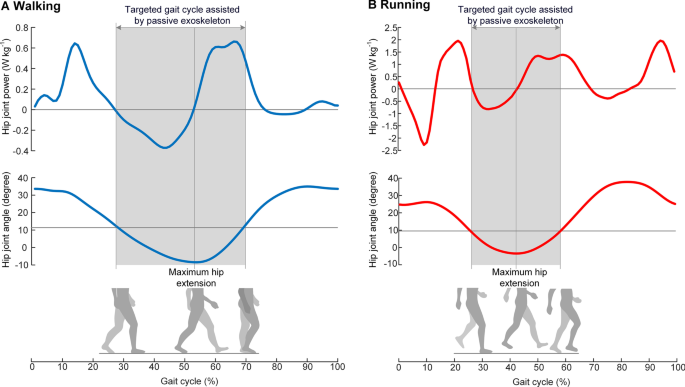
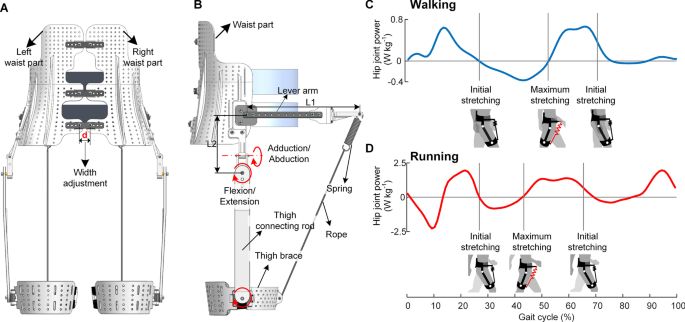
    As mentioned above, the combined requirements of overcoming fundamental biomechanical differences between the two gaits and minimizing the metabolic penalty of the exoskeleton mass make it challenging to develop an exoskeleton that can reduce the metabolic energy for both gaits. In this paper, we first analyze the common energy consumption characteristics of walking and running (Fig. 1) to find a universal assistive principle for both gaits. Then we propose a hip unpowered exoskeleton (Fig. 2A and B) to regulate metabolic energy of hip flexion during the common energy consumption period of both walking and running. The proposed exoskeleton uses exo-tendons acting in front of the hip joint to recycle the negative mechanical energy and release stored energy to assist hip flexor, which are in accordance with the biological negative mechanical power interval and positive mechanical power interval respectively (Fig. 2C). The lightweight structure, close to the human trunk, minimizes the metabolic penalty caused by the exoskeleton mass. To determine the best assistance magnitude and evaluate human response to the proposed assistive principle, the metabolic rates, muscle activities and spatiotemporal parameters of nine healthy participants are measured and statistically analyzed. We also perform speed experiments to test the influence of locomotion speed on the assistance effect. To demonstrate the generality of the proposed exoskeleton, we measure and compared the metabolic rate of walking/running with the common optimal spring stiffness to that of walking/running without the exoskeleton.

    Fig. 1
    figure1

    Hip joint power during walking and running. In the shaded interval of both walking and running, the hip joint extends from about 10 degrees of flexion position to the maximum extension position, corresponding to a period of negative power; Then, the hip joint flexes from the maximum extension position, corresponding to a period of positive work. The dataset of walking is the mean value of 7 participants (mean ± s.t.d; age, 26.9 ± 3.0 years; height,169.2 ± 7.0 cm; weight, 66.3 ± 14.2 kg), which is reported by [42]; The dataset of running is the mean value of 7 participants (mean ± s.t.d; age, 32.7 ± 5.6 years; height, 176.9 ± 6.2 cm; weight, 67.0 ± 8.9 kg), which is reported by [43]

    Fig. 2
    figure2

    Exoskeleton components and working process of the exoskeleton. A Back view of the exoskeleton. We change the length of d to adjust the width of the two waist parts for best-fit participants. B Right view of the exoskeleton. The waist part and thigh connecting rods were connected using two rotary joints with plain bearing in series, allowing the adduction/abduction and flexion/extension of the hip joint. C and D Working process of the exoskeleton. The assistance interval is in accordance with the hip joint negative and positive mechanical power during walking and running. In the walking and running condition, the assistance started at nearly 10 degrees of hip flexion position. During the negative power period of the hip joint, the spring stores energy with the hip extension to its maximum extension position. During the positive power period of the hip joint, the spring releases the stored energy to assist hip flexion to 10 degrees of hip flexion position


      More at link.