Changing stroke rehab and research worldwide now.Time is Brain! trillions and trillions of neurons that DIE each day because there are NO effective hyperacute therapies besides tPA(only 12% effective). I have 523 posts on hyperacute therapy, enough for researchers to spend decades proving them out. These are my personal ideas and blog on stroke rehabilitation and stroke research. Do not attempt any of these without checking with your medical provider. Unless you join me in agitating, when you need these therapies they won't be there.

What this blog is for:

My blog is not to help survivors recover, it is to have the 10 million yearly stroke survivors light fires underneath their doctors, stroke hospitals and stroke researchers to get stroke solved. 100% recovery. The stroke medical world is completely failing at that goal, they don't even have it as a goal. Shortly after getting out of the hospital and getting NO information on the process or protocols of stroke rehabilitation and recovery I started searching on the internet and found that no other survivor received useful information. This is an attempt to cover all stroke rehabilitation information that should be readily available to survivors so they can talk with informed knowledge to their medical staff. It lays out what needs to be done to get stroke survivors closer to 100% recovery. It's quite disgusting that this information is not available from every stroke association and doctors group.

Showing posts with label failure. Show all posts

Tuesday, March 3, 2026

Intra- and inter-day effects of novel robot-assisted hand movement training in individuals with post-stroke hemiparesis: a single-arm pilot study

So, failure to recover occurred! And no acknowledgement of that failure!

 Intra- and inter-day effects of novel robot-assisted hand movement training in individuals with post-stroke hemiparesis: a single-armpilot study 

y Kazuki Ushizawa, OTR, MS1,2, Shintaro Uehara, RPT, PhD3, Akiko Yuasa, RPT, PhD1,4, Taiki Yoshida, OTR, PhD3, Kyoichi Tomita1, Takayuki Ohtomo, PhD1, Shigeo Tanabe, RPT, PhD3, Yohei Otaka, MD, PhD1 1Department of Rehabilitation Medicine, School of Medicine, Fujita Health University, Toyoake, Aichi, Japan, 2 Graduate School of Health Sciences, Fujita Health University, Toyoake, Aichi, Japan, 3 Faculty of Rehabilitation, School of Health Sciences, Fujita Health University, Toyoake, Aichi, Japan, 4Japan Society for the Promotion of Science, Chiyoda, Tokyo, Japan 

Abstract 


Objectives: To investigate the feasibility of robot-assisted hand movement training using a novel end-effector robot in individuals after stroke. Methods: Eleven individuals with subacute stroke with hand motor impairment underwent robot-assisted repetitive finger flexion/extension for 20 min daily and repeated this training on 7 non-consecutive days. The robot was designed to allow the flexion and extension of the metacarpophalangeal and proximal interphalangeal joints of the index to the little fingers, and to provide assistive torque if the movement did not reach the target angle within a limited time. We assessed the co-contraction index (CCI) of the flexor digitorum superficialis and extensor digitorum muscles and assessed the active range of motion (AROM) of the index finger before and after training each day (intra-day effect). We performed clinical assessments of motor function and spasticity and evaluated the CCI and AROM before and immediately after the 7-day training (inter-day effect). 

Results: 
Ten participants completed the 7-day training. For the intra-day effect, the CCI was significantly decreased immediately after training, particularly during active finger flexion, and the AROM tended to improve from the middle of the training days. For the inter-day effect, there were no significant changes in the Stroke Impairment Assessment Set for Finger Function, modified Ashworth scale, CCI, or AROM after the 7-day training. 

Conclusions: 
Repetitive finger movement training with the assistance of the novel robot improves(NOT GOOD ENOUGH! Survivors want full recovery and YOU FAILED THEM!muscle activation patterns, reducing co-activation between the agonist and antagonist muscles immediately after training

Thursday, June 12, 2025

Centre for Neuro Skills Unveils New Website Design to Better Serve Brain Injury Patients and Their Families

 Does it say that everything in stroke recovery is a shitshow failure? NO? Then they are lying!

tPA full recovery? Better than 12%? That's a complete failure as survivors would describe it!

rehab full recovery? Better than 10%? That's also a complete failure as survivors would describe it!

Contact me at: oc1dean@gmail.com. We can discuss creating a strategy for 100% recovery!

Centre for Neuro Skills Unveils New Website Design to Better Serve Brain Injury Patients and Their Families

BAKERSFIELD, Calif., June 11, 2025 (GLOBE NEWSWIRE) -- Centre for Neuro Skills (CNS), a leader in traumatic brain injury and stroke rehabilitation services, today announced the launch of its completely redesigned website at www.neuroskills.com. The revamped website features an intuitive, user-friendly interface designed to better serve patients, families, healthcare professionals and caregivers seeking information and resources for brain injury rehabilitation. The redesign incorporates the visual elements and messaging from CNS' recent “ReThink Rehab” advertising campaigns, creating a cohesive brand experience across all platforms.

Reimagined Digital Experience

The new site design reflects the organization's commitment to challenging the status quo in brain injury rehabilitation with its powerful message “ReThink Rehab,” capturing the essence of CNS’ mission to reduce disability and maximize independence.

"Our new website is more than just a visual upgrade—it's a reflection of our unwavering belief in the ongoing potential for recovery in brain injury patients," said Ben Ashley, Associate Vice President of Marketing and Communications at CNS. "We've created a digital space that embodies our vision while making it easier for those we serve to access the information and support they need."

Key Features of the New Website:

  • Enhanced User Navigation: Simplified menus and intuitive pathways guide visitors to essential information about CNS’ services, patient success stories and educational resources.

  • Patient Journey Showcase: Interactive elements highlight real patient experiences, demonstrating how CNS’ approach challenges the notion of plateauing in brain injury recovery.

  • Resource Hub: Expanded educational materials for patients, families and healthcare providers that support the ongoing journey of brain injury recovery.

  • Responsive Design: Fully optimized experience across all devices, ensuring accessibility for users regardless of how they access the site. This includes the option to translate the entire site into Spanish with just a click and a fully integrated accessibility tool for those who may need specific cognitive or visual assistance.

  • A Curated User Experience: New, dynamic content added to the site now makes it easier for site visitors to find content and stories most relevant to them.

  • Integrated Campaign Elements: The site seamlessly incorporates visuals and messaging from CNS’ recent "ReThink Rehab" initiative, the first advertising campaign in the organization’s 45-year history, reinforcing the powerful narrative that recovery continues beyond conventional expectations with personalized therapies.

About the "Patients Don't Plateau" Philosophy

At the core of the website redesign is CNS’ foundational belief that brain injury recovery is not limited by arbitrary timelines. This philosophy, featured prominently throughout the new site, challenges the conventional narrative that patients will reach a "plateau" in their recovery after a certain period.

"For too long, brain injury patients have been told that their recovery has an endpoint," explained David Harrington, President and CEO of CNS. "Our new website amplifies our message that with the right approach and continued therapeutic innovation, patients can continue making meaningful progress throughout their lives and achieve independence."

CNS, now in its 45th year, was recently named one of Newsweek’s “America’s Greatest Midsize Workplaces for 2025.” Of all neurorehabilitation providers listed in the healthcare category, CNS is the only one who achieved a 5-star rating.

About Centre for Neuro Skills

Named by Newsweek as “America’s Greatest Midsize Workplaces for 2025,” Centre for Neuro Skills is an experienced and respected world leader in providing intensive rehabilitation and medical programs for those recovering from all types of brain injury. CNS covers a full spectrum of advanced care from residential and assisted living to outpatient/day treatment. Founded by Dr. Mark Ashley in 1980, CNS has seven locations in California and Texas. For more information about Centre for Neuro Skills, visit: www.neuroskills.com, Facebook, Twitter, LinkedIn, YouTube.

Media, please note: Visual assets, including photos, are available. To request an interview with CNS leadership or clinical staff, please contact Robin Carr at 415.766.0927 or CNS@landispr.com.

Media Contact:
Robin Carr
Landis Communications Inc.
415.766.0927
CNS@landispr.com

A photo accompanying this announcement is available at https://www.globenewswire.com/NewsRoom/AttachmentNg/dbb5fd55-ce73-45b2-925c-b2c66e7a56a5

Saturday, June 8, 2024

These Are The 7 Things Stroke Doctors Say You Should Never, Ever Do

This is what your stroke doctors have to do because THEY HAVE COMPLETELY FAILED TO GET STROKE SOLVED TO 100% RECOVERY!

I don't even see anyone in the stroke medical world that is working toward the only goal in stroke:100% recovery!

These Are The 7 Things Stroke Doctors Say You Should Never, Ever Do

Sunday, February 27, 2022

Mechanical blood clot removal showed positive results in half of stroke patients: Study

So a 50% failure rate is appalling. But you used your tyranny of low expectations to declare success. I'm sure the survivors this failed on didn't consider it successful.

Mechanical blood clot removal showed positive results in half of stroke patients: Study

A blood clot is a mass of blood that forms when platelets, proteins, and cells in the blood stick together. According to an international study, mechanical removal of blood clots reduced post-stroke disability in nearly half of "all-comer" real-world stroke patients.


ANI | New Orleans (Louisiana) | Updated: 14-02-2022 11:49 IST | Created: 14-02-2022 11:49 IST
Mechanical blood clot removal showed positive results in half of stroke patients: Study
Representative image. Image Credit: ANI
  • Country:
  • United States

A blood clot is a mass of blood that forms when platelets, proteins, and cells in the blood stick together. According to an international study, mechanical removal of blood clots reduced post-stroke disability in nearly half of "all-comer" real-world stroke patients. The study was a preliminary late-breaking science presented at the American Stroke Association's International Stroke Conference 2022.

The most common type of stroke, an ischemic stroke, is caused by a blood clot in a blood vessel that blocks the flow of blood to the brain. Treatment usually involves clot-busting medications to dissolve the clot. For severe stroke within a large blood vessel, the treatment also may include a procedure to remove the clot - called mechanical thrombectomy or endovascular therapy - in which a tiny tube, or catheter, equipped with a special device on the end, is threaded through the blood vessel to grasp the clot and remove it. Previous studies found that stroke patients who received mechanical clot removal had less disability after three months than those who did not. However, these studies were performed in carefully selected centres and employed strict clinical and imaging inclusion criteria, which decreases the generalizability of their findings.

To examine the effectiveness of blood-clot removal across a wide range of stroke patients seen in routine daily care (outside of a clinical trial), the Embotrap eXtraction & Clot EvaLuation & Lesion Evaluation for NeuroThrombectomy, or EXCELLENT trial, enrolled 1,000 adult ischemic stroke patients (average age 70, 52 per cent female) at 36 sites worldwide, from September 2018 to March 2021. The sites were a mix of Thrombectomy-Capable and Comprehensive Stroke Centers. Patients were treated with a specific mechanical thrombectomy device called EmboTrap in an unlimited time frame. Notably, the study was designed to collect real-world treatment and did not exclude patients based on pre-stroke independence level, the severity of the stroke, location of the occlusion, or time between the onset of stroke and treatment, researchers said (as per current guidelines mechanical thrombectomy treatment can be used within 24 hours of symptom onset in select patients). In addition, the study analyzed the characteristics of the removed blood clots and how that impacted stroke recovery.

The study found that most of the patients required only one attempt to remove the blood clot. However, it is common to require multiple attempts to completely remove the clot. In nearly half of all patients, clot removal resulted in slight/minimal disability (able to look after own affairs without assistance or no worsening from their pre-stroke condition), as gauged by a standard scale measuring level of disability 90 days after stroke. "This study shows how much stroke thrombectomy has advanced," said lead study author Raul G. Nogueira, M.D., director of the UPMC (University of Pittsburgh Medical Center) Stroke Institute and a professor of neurology and neurosurgery at the University Of Pittsburgh School Of Medicine. "We saw a wide range of cases, including patients who, not too long ago, would not be considered good candidates for thrombectomy based on older age, pre-existing disability or large size of the stroke on presentation. Our findings in this study expand thrombectomy to be considered for more stroke patients."

The study also found blood clots that were rich in red blood cells and low in platelets resulted in less disability than blood clots composed of fewer red blood cells or those rich in red blood cells and high in platelet content. Red blood cells contain the protein haemoglobin, which carries oxygen throughout the body. Fibrin is a protein, and platelets are cell fragments that help the blood to clot, to help stop bleeding, however, in a stroke, clots block blood flow to the brain. Different proportions of these elements alter the blood clot consistency and its physical properties. This may facilitate or impair the clot removal procedure.

In this study, only 10 per cent of patients whose clots had a higher composition of red blood cell count and a lower composition of platelets died within 90 days, compared to 24 per cent of patients whose clots had a lower composition of red blood cells and platelets. Among patients with higher red blood cell content, 63 per cent with lower platelet content had either slight or no disability, compared to 51 per cent with higher platelet content. "We knew that fibrin was associated with more difficult clot removal. However, this novel observation that platelets may modify clot properties is very intriguing," Nogueira said. "The results may have potential implications for technique and device selection when removing clots and the development of better blood-clot removal strategies."

Worldwide, stroke has been the second-leading cause of death and a leading cause of long-term disability. Stroke is a medical emergency requiring immediate treatment, so it is important to recognize early signs and how to respond to them: Face drooping, Arm weakness, Speech difficulty. (ANI)

(This story has not been edited by Devdiscourse staff and is auto-generated from a syndicated feed.)

>

Thursday, January 20, 2022

Failure at hanging coats

 Donated blood last week at a gymnasium at a church. Attached hangers require using your teeth to hold the hanger steady while you get one arm on and hope it stays on as you maneuver the second arm of the coat on. I skip the whole thing and just throw the coat on the rack above.


Tuesday, October 12, 2021

Efficacy of an exoskeleton-based physical therapy program for non-ambulatory patients during subacute stroke rehabilitation: a randomized controlled trial

In what multiverse do you live where stroke hospitals will buy powered exoskeletons? Your objective was to determine efficacy but you obviously failed at that task.

Efficacy of an exoskeleton-based physical therapy program for non-ambulatory patients during subacute stroke rehabilitation: a randomized controlled trial

Abstract

Background

Individuals requiring greater physical assistance to practice walking complete fewer steps in physical therapy during subacute stroke rehabilitation. Powered exoskeletons have been developed to allow repetitious overground gait training for individuals with lower limb weakness. The objective of this study was to determine the efficacy of exoskeleton-based physical therapy training during subacute rehabilitation for walking recovery in non-ambulatory patients with stroke.

Methods

An assessor-blinded randomized controlled trial was conducted at 3 inpatient rehabilitation hospitals. Patients with subacute stroke (< 3 months) who were unable to walk without substantial assistance (Functional Ambulation Category rating of 0 or 1) were randomly assigned to receive exoskeleton-based or standard physical therapy during rehabilitation, until discharge or a maximum of 8 weeks. The experimental protocol replaced 75% of standard physical therapy sessions with individualized exoskeleton-based sessions to increase standing and stepping repetition, with the possibility of weaning off the device. The primary outcome was walking ability, measured using the Functional Ambulation Category. Secondary outcomes were gait speed, distance walked on the 6-Minute Walk Test, days to achieve unassisted gait, lower extremity motor function (Fugl-Meyer Assessment), Berg Balance Scale, Patient Health Questionnaire, Montreal Cognitive Assessment, and 36-Item Short Form Survey, measured post-intervention and after 6 months.

Results

Thirty-six patients with stroke (mean 39 days post-stroke) were randomized (Exoskeleton = 19, Usual Care = 17). On intention-to-treat analysis, no significant between-group differences were found in the primary or secondary outcomes at post-intervention or after 6 months. Five participants randomized to the Exoskeleton group did not receive the protocol as planned and thus exploratory as-treated and per-protocol analyses were undertaken. The as-treated analysis found that those adhering to exoskeleton-based physical therapy regained independent walking earlier (p = 0.03) and had greater gait speed (p = 0.04) and 6MWT (p = 0.03) at 6 months; however, these differences were not significant in the per-protocol analysis. No serious adverse events were reported.

Conclusions

This study found that exoskeleton-based physical therapy does not result in greater improvements in walking independence than standard care but can be safely administered at no detriment to patient outcomes.

Clinical Trial Registration The Exoskeleton for post-Stroke Recovery of Ambulation (ExStRA) trial was registered at ClinicalTrials.gov (NCT02995265, first registered: December 16, 2016)

Background

Recovering the ability to walk is commonly cited by patients with stroke as a top priority of both rehabilitation and research efforts [1, 2]. Besides predicting long-term mobility and community reintegration after stroke [3, 4], walking outcomes are also associated with cognitive performance, post-stroke depression, and quality of life [5,6,7]. With implications for so many post-stroke outcomes, refining rehabilitation efforts to optimize the timeliness and degree of walking recovery after stroke remains a top priority.

It is recommended that early stroke rehabilitation should be goal-oriented, repetitive, progressive, and task-specific to take advantage of neuroplastic recovery and make gains in mobility and walking [8, 9]. However, dependent patients requiring substantial assistance from one or two therapists are the least likely to achieve these guidelines and take very few steps during stroke rehabilitation; studies observing inpatient stroke rehabilitation have reported as low as 8 minutes of physical activity and progression from 6 to only 16 completed steps during physical therapy [10, 11]. Even with the introduction of body weight-supported treadmill training in stroke rehabilitation and promising findings for walking recovery, the physical demand of having multiple therapists involved to assist moving the lower extremities has limited its clinical application [12, 13]. With such minimal levels of walking practice, it is unsurprising that nearly half of patients admitted for stroke are discharged from rehabilitation without the ability to walk independently [14], which in turn influences meaningful outcomes such as discharge location and return-to-work [4, 15]. Consequently, it is those patients who are more impaired and unable to walk independently who should be the target of novel interventions and research [16]. Repetition and progression should be included as key components of such efforts.

Powered exoskeletons have been commercially developed to assist and automate overground walking for individuals with lower extremity weakness. Such devices strap around the lower limbs and generate joint motion using embedded motors. They may allow patients to achieve the higher duration and repetition of stepping practice recommended for stroke rehabilitation, while offloading therapists’ physical burden. However, previous research of treadmill-based robotic devices [e.g., Lokomat (Hocoma, Zurich, Switzerland)] has found mixed results for gait recovery; several randomized trials did not did not find superior effects of robotic training on walking outcomes [17, 18], yet several reviews have found improved walking independence [19, 20]. Powered exoskeletons may offer more realistic task-specific and goal-oriented overground walking practice than treadmill-based devices, as they address the criticism that suspended robotic devices lack variability in movement and encourage passive participation [16]. Early research of powered exoskeletons in stroke rehabilitation has shown promising findings, though only a few randomized controlled studies have been conducted and none have focused explicitly on non-ambulatory patients during the subacute phase of recovery [21]. From the previous reviews of electromechanically-assisted gait training, it has been recommended that further research and therapy with robotics should only be used with patients in the early phase of stroke recovery and who require more physical assistance to walk [16, 20, 22].

Although early research of powered exoskeletons has shown they can be safely used as an adjunct therapy [21, 23], limited research has investigated their effect when integrated within the standard physical therapy component of subacute stroke rehabilitation. The primary objective of this study was to assess the effect of an exoskeleton-based physical therapy program on the recovery of walking ability during subacute stroke rehabilitation. The primary hypothesis was that non-ambulatory patients who regularly utilized an exoskeleton during their physical therapy sessions would have greater walking independence at discharge compared to patients who received standard physical therapy. The secondary objective was to evaluate the effect of exoskeleton-based physical therapy on additional walking and mobility outcomes (e.g., speed), leg motor impairment, balance, cognition, post-stroke depression, and quality of life, at discharge and after 6 months.

More at link.


Tuesday, April 6, 2021

Cath Lab Team Easily Trained to Do Stroke Intervention

 Having comparable results as neuroradiology centers is still failure because they are still only looking at reperfusion rates NOT 100% RECOVERY.  Until survivors start demanding 100% recovery the stroke medical world will continue to deliver failure. FAILURE, FAILURE, FAILURE!

Cath Lab Team Easily Trained to Do Stroke Intervention

European center reports good results from the start of its endovascular program

A computer rendering of MegaVac Mechanical Thrombectomy System

Establishing an endovascular therapy (EVT) program at a cardiology cath lab could be done with a minimal learning curve if operators had prior experience with carotid stenting, one tertiary university hospital reported.

The program, started in 2012 with the addition of an experienced interventional radiologist as lead operator, had stroke patients achieve good clinical outcomes at 90 days in 47.9% of cases.

Importantly, the distribution in modified Rankin Scale (mRS) scores stayed stable every year through 2019, according to Jakub Sulenko, MD, PhD, of Charles University and University Hospital Kralovske Vinohrady in Prague, Czech Republic, and colleagues in the PRAGUE-16 group.

"When a catheter-based thrombectomy program was initiated in an experienced cardiac cath lab in close cooperation between cardiologists, neurologists, and radiologists, outcomes were comparable to those of neuroradiology centers," Sulenko and colleagues concluded in JACC: Cardiovascular Interventions.

"These results are even more astonishing as PRAGUE-16, in contrast to the randomized trials, also included patients with ischemia in the posterior circulation in their analysis," commented Marius Hornung, MD, and Horst Sievert, MD, both of the CardioVascular Center Frankfurt.

"By caring for patients with MI, the physicians involved are comfortable working in critical situations and under mental and physical pressure. We are currently at a time when many experienced cardiologists are also trained in performing carotid artery interventions. Therefore, they are experienced in accessing the supra-aortic arteries," Hornung and Sievert said in an accompanying editorial.

The Prague cath lab operated every day and at all hours treating acute MIs before it started taking in acute ischemic stroke patients.

EVT complication rates included 5.7% symptomatic intracerebral hemorrhage and 1.8% embolization in a new vascular territory.

"These findings support the potential role of interventional cardiac cath labs in the treatment of acute stroke in regions where this therapy is not readily available due to the lack of neurointerventionalists," Sulenko's group said, citing a smaller, similar experience previously reported from a Pennsylvania center.

At the beginning of the Prague EVT program, two cardiologists with experience in carotid artery stenting (one with 42 procedures, the other with >100) were selected to perform around 30 mechanical thrombectomies under supervision of the newly arrived interventional radiologist. Subsequently, the cardiologists were able to perform thrombectomies without supervision.

A neurologist always decided which patients got stroke thrombectomy based on clinical symptoms and CT angiography.

"To be able to guarantee optimized stroke therapy as soon as possible, disputes over competence among the individual medical societies involved must be ended, and interdisciplinary teams must be created to be able to offer the best possible treatment for each patient," according to Hornung and Sievert.

"Diagnostics, patient selection, and follow-up care must remain the core competencies and tasks of neurology. Appropriately trained and experienced physicians, regardless of their specialties, should perform acute stroke interventions and endovascular thrombectomy," they urged.

The Prague experience included 333 patients with a large vessel occlusion stroke from 2012 to 2019.

Number of EVTs increased from four in 2012 to 82 in 2019. Patients were older over time, from an average of 60 to 72.

Some evidence for a learning curve was observed, as the rate of successful recanalization (TICI grade 2b/3) improved over time from a low of 60% in 2013 to a high of 84% in 2019 (P=0.047). Overall, operators achieved TICI 2b/3 in 79.3% of patients.

A study limitation was its single-center nature.

"The results of PRAGUE-16 show that experienced interventional cardiologists can perform endovascular stroke interventions and thrombectomy with a high degree of technical and clinical success after appropriate training and supervision," Hornung and Sievert maintained.

Only with a larger network of stroke interventionalists, they suggested, can clinicians stop "losing unnecessary time to patient transfer" or "continuing to offer only the second best therapy" to eligible stroke patients.

  • author['full_name']

    Nicole Lou is a reporter for MedPage Today, where she covers cardiology news and other developments in medicine. Follow

Disclosures

The study was supported by Charles University

Sulzenko and co-authors disclosed no relevant relationships with industry.

Hornung and Sievert disclosed relevant relationships (institutional) with Abbott, Access Closure, AGA, Angiomed, Arstasis, Atritech, Atrium, Avinger, Bard, Boston Scientific, Bridgepoint, Cardiac Dimensions, CardioKinetix, CardioMEMS, Coherex, Contego, Cardiovascular Systems, EndoCross, Endotext, Epitek, Evalve, ev3, FlowCardia, Gore, Guidant, Guided Delivery Systems, InSeal Medical, Lumen Biomedical, Heart Leaflet Technologies, Kensey Nash, Kyoto Medical, Lifetech, Lutonix, Medinol, Medtronic, NDC, NMT Medical, Occlutech, Osprey, Ovalis, Pathway, PendraCare, Percardia, pfm Medical, Rox Medical, Sadra, Sorin, Spectranetics, Square One, Trireme, Trivascular, Velocimed, and Veryan.


Monday, April 5, 2021

Failure at cheese plastic vacuum wrappers

 On Easter my contribution to the dinner was cheeses for hors d'oeuvres. Even with a scissors the wrapping stuck to the cheese leaving me no option but to use the dangerous paring knife to split the plastic and finally get the cheese out. Then on to the Ulu knife to actually cut the slices.  In order to safely get them there I had to insert the paper plate into a gallon ziploc bag. That took twenty minutes. It is impossible for me to open any door with my left hand and with my right hand carrying a plate door knobs don't work, so a plastic bag was used. 

Ulu rocker knife, regular knives are almost useless. I had to figure this out myself.


Wednesday, March 24, 2021

Mobile Stroke Units Improve Outcomes, Data Show

 NOT GOOD ENOUGH! Why are you accepting failure to 100% recover as a success? That to me is complete failure and survivors would agree. No excuses allowed. Don't cry to me that brain research is hard. Recovery is way harder than that.

Hope you are OK with failure to recover when you are the 1 in 4 per WHO that has a stroke.

Mobile Stroke Units Improve Outcomes, Data Show

Stroke patients treated by mobile stroke units received faster treatment and had better outcomes  (Whoopee! NOT 100% RECOVERY.)compared to patients who arrived in the standard way to emergency departments (EDs), according to results presented at the International Stroke Conference 2021.

James C. Grotta, MD, FAAN, director of stroke research at the Memorial Hermann-Texas Medical Center and the primary author of the study, said the findings demonstrate the benefits of mobile stroke units, adding to the evidence base that could lead to reimbursement to make their use more widespread.

“A mobile stroke unit is a primary stroke center, basically," Dr. Grotta told Neurology Today At the Meetings. “We get everything done that needs to be done at a primary stroke center."


Mobile units are ambulances equipped to treat patients on board with tissue plasminogen activator (tPA), with a vascular neurologist on board and the ability to do a CT scan and CT angiogram.

In the BEST-MSU study, mobile stroke units were deployed to 911 stroke calls for one week, and patients were treated on board or via telemedicine if they were deemed tPA-eligible. On alternating weeks, the units were not deployed, but staff met the EMS squad and determined whether the patient was tPA-eligible when they arrived on scene, so that the two arms included the same kinds of patients.

In the mobile stroke units, 33 percent of patients were treated during the first 60 minutes—the so-called “golden hour"—compared with just 3 percent of patients treated the standard way; in addition, 97.1 percent of those who were tPA-eligible received tPA in the mobile stroke unit group, compared to 79.1 percent of those in the standard treatment group. Most of that difference, Dr. Grotta said, was probably due to a greater inclination and willingness to use tPA by the mobile stroke unit vascular neurologist, compared to physicians in the ED.

Researchers used a utility-weighted modified Rankin score (uw-mRS), which takes into account patient perceptions about the levels of disability on the scale. For instance, an improvement from four to three—going from being unable to walk to being able to walk—is considered more significant than one to zero—non-significant symptoms versus no symptoms at all. At three months, there was a 0.07 difference in uw-mRS in favor of the mobile stroke unit group (p=0.002).

Based on these results, for every 100 patients treated with a mobile unit rather than standard management, 27 would have less final disability and 11 more will be disability-free, he said.

In the study, the units were used in fairly metropolitan areas, such as Los Angeles and Memphis, Dr. Grotta said, adding the value in rural areas remains to be seen.

Researchers will continue to assess health care utilization related to mobile stroke units for a year. But he said that if a mobile unit is active about half the time it treats 100 patients a year, resulting in 10 more patients completely recovering, that would likely more than cover the cost of the operating units.

“Even with a back-of-the-envelope calculation, I would predict that it's cost-effective to the health care system," he continued.

Commenting on the study, Robert J. Adams, MD, professor of neurology at the Medical University of South Carolina, said the data from this and other studies signal support for more frequent use of mobile stroke units.

“The data are consistent that earlier treatment leads to better outcomes, unless there are more hemorrhages," Dr. Adams told Neurology Today At the Meetings. “This study shows earlier treatment and a qualitative benefit, which is the ability for us to get experience in the 'golden hour.' We have very little data in that time domain. In my mind, these data—and I have been doing this since before there were stroke systems of care, prior to tPA and prior to the stroke certification effort—clearly provide a 'go' signal. These units should be part of the stroke treatment ecosystem."

Using the mobile stroke unit as a primary stroke center “surrogate" in an area with a high stroke rate but no hospital might be a way to increase its value, he said.

“The unit could be placed there more of the time and defer the community cost of building a facility primarily to treat stroke, for example," Dr. Adams said. “Another way to look at this would be for there to be a hefty surcharge to insurance carriers when the unit is used, to increase its ability to generate funds to defer its cost."

Dr. Grotta disclosed receiving a grant for research from Frazer Ltd and Genentech. Dr. Adams disclosed receiving consulting fees from Global Blood Products, a company that makes treatment for sickle cell disease. He has also received travel expenses from Zeriscope, Inc., a company that make mobile telemedicine platforms.

Link Up for More Information:​

ISC Abstract LB2: Grotta JC, Parker S, Bowry R, et al. Benefits of stroke treatment delivered by a mobile stroke unit compared to standard management by emergency medical services (BEST-MSU Study).

Saturday, March 20, 2021

Association Between Dispatch of Mobile Stroke Units and Functional Outcomes Among Patients With Acute Ischemic Stroke in Berlin

 You're not even measuring 100% recovery. SO YOU EXPECT STROKE SURVIVORS TO ACCEPT YOUR FUCKING TYRANNY OF LOW EXPECTATIONS?  Hope you are OK with that when you are

the 1 in 4 per WHO that has a stroke

To me this is all about accepting failure as OK, and make no mistake, not getting to 100% recovery IS FAILURE.

Association Between Dispatch of Mobile Stroke Units and Functional Outcomes Among Patients With Acute Ischemic Stroke in Berlin

JAMA. 2021;325(5):454-466. doi:10.1001/jama.2020.26345
Key Points

Question  Is the dispatch of mobile stroke units in the out-of-hospital setting before arriving at the hospital associated with better functional outcomes among patients with acute ischemic stroke eligible for thrombolysis or thrombectomy?

Findings  In this prospective nonrandomized controlled intervention study involving 1543 patients in Berlin, Germany, the dispatch of mobile stroke units in addition to conventional ambulances vs conventional ambulances alone was significantly associated with lower levels of global disability at 3 months (common odds ratio for higher modified Rankin Scale scores [ie, worse outcome], 0.71).

Meaning  Among patients with acute ischemic stroke in Berlin, Germany, dispatch of a mobile stroke unit was associated with lower global disability at 3 months; further research in diverse settings is needed.

Abstract

Importance  Effects of thrombolysis in acute ischemic stroke are time-dependent. Ambulances that can administer thrombolysis (mobile stroke units [MSUs]) before arriving at the hospital have been shown to reduce time to treatment.(But you still don't know how fast is has to be to get 100% recovered. Shouldn't that be your first step before going down this MSU route?)

Objective  To determine whether dispatch of MSUs is associated with better clinical outcomes for patients with acute ischemic stroke.

Design, Setting, and Participants  This prospective, nonrandomized, controlled intervention study was conducted in Berlin, Germany, from February 1, 2017, to October 30, 2019. If an emergency call prompted suspicion of stroke, both a conventional ambulance and an MSU, when available, were dispatched. Functional outcomes of patients with final diagnosis of acute cerebral ischemia who were eligible for thrombolysis or thrombectomy were compared based on the initial dispatch (both MSU and conventional ambulance or conventional ambulance only).

Exposure  Simultaneous dispatch of an MSU (computed tomographic scanning with or without angiography, point-of-care laboratory testing, and thrombolysis capabilities on board) and a conventional ambulance (n = 749) vs conventional ambulance alone (n = 794).

Main Outcomes and Measures  The primary outcome was the distribution of modified Rankin Scale (mRS) scores (a disability score ranging from 0, no neurological deficits, to 6, death) at 3 months. The coprimary outcome was a 3-tier disability scale at 3 months (none to moderate disability; severe disability; death) with tier assignment based on mRS scores if available or place of residence if mRS scores were not available. Common odds ratios (ORs) were used to quantify the association between exposure and outcome; values less than 1.00 indicated a favorable shift in the mRS distribution and lower odds of higher levels of disability.

Results  Of the 1543 patients (mean age, 74 years; 723 women [47%]) included in the adjusted primary analysis, 1337 (87%) had available mRS scores (primary outcome) and 1506 patients (98%) had available the 3-tier disability scale assessment (coprimary outcome). Patients with an MSU dispatched had lower median mRS scores at month 3 (1; interquartile range [IQR], 0-3) than did patients without an MSU dispatched (2; IQR, 0-3; common OR for worse mRS, 0.71; 95% CI, 0.58-0.86; P < .001). Similarly, patients with an MSU dispatched had lower 3-month coprimary disability scores: 586 patients (80.3%) had none to moderate disability; 92 (12.6%) had severe disability; and 52 (7.1%) had died vs patients without an MSU dispatched: 605 (78.0%) had none to moderate disability; 103 (13.3%) had severe disability; and 68 (8.8%) had died (common OR for worse functional outcome, 0.73, 95% CI, 0.54-0.99; P = .04).

Conclusions and Relevance  In this prospective, nonrandomized, controlled intervention study of patients with acute ischemic stroke in Berlin, Germany, the dispatch of mobile stroke units, compared with conventional ambulances alone, was significantly associated with lower global disability at 3 months. Clinical trials in other regions are warranted.


Wednesday, March 10, 2021

Dog walking failures

 When I visit a friend I am tasked with the evening walk of her niece's dog. Which is great for getting more walking done. The problem is picking up the dog's leftovers, getting the plastic bag situated just right, I have to put the leash in my teeth to hold him until I am done, my left hand would have zero ability to hold the dog even though he is only 13 pounds. My ex used to admonish me for using my teeth to accomplish ordinary tasks, I ignored her even though she was a PT.

Wednesday, January 20, 2021

wool sock failure

 Now that it is much cooler out I have to wear wool socks inside my 14 inch rain boots. But one handed putting my pants cuffs inside my wool socks is nigh impossible. Especially the outside of my left leg.


Thursday, October 22, 2020

These legs were made for propulsion: advancing the diagnosis and treatment of post-stroke propulsion deficits

Notice that the stroke medical world knows ABSOLUTELY NOTHING about gait rehab. They can get you moving but not recovered. So a complete failure by your stroke medical professionals.  I don't consider using compensatory efforts to walk a success.

These legs were made for propulsion: advancing the diagnosis and treatment of post-stroke propulsion deficits

Advances in medical diagnosis and treatment have facilitated the emergence of precision medicine. In contrast, locomotor rehabilitation for individuals with acquired neuromotor injuries remains limited by the dearth of (i) diagnostic approaches that can identify the specific neuromuscular, biomechanical, and clinical deficits underlying impaired locomotion and (ii) evidence-based, targeted treatments. In particular, impaired propulsion by the paretic limb is a major contributor to walking-related disability after stroke; however, few interventions have been able to target deficits in propulsion effectively and in a manner that reduces walking disability. Indeed, the weakness and impaired control that is characteristic of post-stroke hemiparesis leads to heterogeneous deficits that impair paretic propulsion and contribute to a slow, metabolically-expensive, and unstable gait. Current rehabilitation paradigms emphasize the rapid attainment of walking independence, not the restoration of normal propulsion function. Although walking independence is an important goal for stroke survivors, independence achieved via compensatory strategies may prevent the recovery of propulsion needed for the fast, economical, and stable gait that is characteristic of healthy bipedal locomotion. We posit that post-stroke rehabilitation should aim to promote independent walking, in part, through the acquisition of enhanced propulsion. In this expert review, we present the biomechanical and functional consequences of post-stroke propulsion deficits, review advances in our understanding of the nature of post-stroke propulsion impairment, and discuss emerging diagnostic and treatment approaches that have the potential to facilitate new rehabilitation paradigms targeting propulsion restoration.

Introduction

THE fast, economical, and stable gait that is characteristic of healthy bipedal locomotion [16] requires the coordination of three locomotor subtasks—propulsion, limb advancement, and bodyweight support. During the propulsion locomotor subtask, positive work by the trailing limb accelerates the body into the next gait cycle [7]. To walk faster, people with intact neural control symmetrically increase the positive work performed by each limb [810]. The coordinated modulation of the work performed by each limb leverages the natural oscillatory dynamics that arise from repeating foot-ground interactions to optimize stability and economy of effort while regulating walking speed [6, 10]. In contrast, the hemiparetic gait observed after stroke [1113] is slow [1417], metabolically expensive [10, 15, 1820], and unstable [2124]. In neurologically unimpaired individuals, the plantarflexor muscles are the primary generators of positive work [9]; however, post-stroke neuromotor deficits result in a distal-to-proximal redistribution of the positive work generated by the muscles of the paretic limb [10, 25, 26], and, ultimately, a markedly altered profile for the anterior ground reaction force (i.e., the propulsion force) [27].

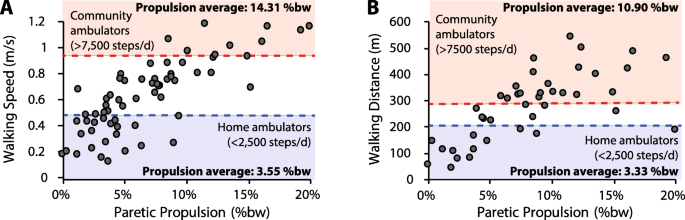
Conventional post-stroke rehabilitation efforts have had limited effectiveness in restoring the propulsion function inherent to a healthy bipedal gait, with functional improvements often being the product of compensatory mechanisms [26, 28, 30, 31]. The propulsion deficits that persist across the months and years post-stroke constrain long-term outcomes and contribute to a sedentary lifestyle, physical inactivity, and poor health [15, 3237]. Indeed, post-stroke propulsion deficits are associated with a slow walking speed [17] and reduced long distance walking ability [38]—key predictors of real-world ambulatory activity in the home and community [33, 39, 40]. Examination of data reported in previous studies [17, 28, 29] demonstrates that functional speeds and distances are rare in those with little propulsion output from their paretic limbs. Indeed, people post-stroke who walk at the speeds and distances indicative of unlimited community ambulation (i.e., more than 7500 steps/d) [39] have relatively high levels of paretic propulsion (Fig. 1). More specifically, those who walk faster than 0.93 m/s—a walking speed that identifies individuals who walk more than 7500 steps/d with a specificity of 80% [39]—walk with an average peak paretic propulsion of 14.31 ±3.70%bodyweight (%bw) (Fig. 1a). Similarly, individuals able to walk farther than 288 m during the 6-minute walk test—a distance with similar discriminative abilities as a short-distance walking speed of 0.93 m/s [39]—walked with an average peak paretic propulsion of 10.90 ±3.62%bw (Fig. 1b). In contrast, those classified as home ambulators (i.e., individuals who walk less than 2500 steps/d) presented with substantially lower paretic propulsion of 3.55 ±2.38%bw and 3.33 ±2.51%bw, respectively.

Fig. 1
figure1

Relationship between peak paretic propulsion and walking a speed and b distance. Speeds and distances indicative of unlimited community ambulation are in red. Those indicative of home ambulation are in blue. See [17, 28, 29] for primary data

In this expert review, we discuss recent advances in our understanding of post-stroke propulsion deficits, review emerging approaches to systematically diagnose and treat the underlying impairments, and highlight the substantial research and development effort that is required before these approaches can alter clinical practice. More specifically, the next section on “Propulsion diagnostics” overviews (i) the critical need for point-of-care propulsion diagnostics, (ii) the neurophysiological basis for propulsion impairments, (iii) the heterogeneous impairments underlying post-stroke propulsion deficits, and (iv) the potential for propulsion phenotyping to direct individualized therapies. The following section on “Propulsion treatments” overviews (i) the inadequacy of conventional intervention approaches and (ii) emerging propulsion-focused technologies and interventions that leverage internal and external mechanisms to target the different aspects of propulsion impairment.