Changing stroke rehab and research worldwide now.Time is Brain! trillions and trillions of neurons that DIE each day because there are NO effective hyperacute therapies besides tPA(only 12% effective). I have 523 posts on hyperacute therapy, enough for researchers to spend decades proving them out. These are my personal ideas and blog on stroke rehabilitation and stroke research. Do not attempt any of these without checking with your medical provider. Unless you join me in agitating, when you need these therapies they won't be there.

What this blog is for:

My blog is not to help survivors recover, it is to have the 10 million yearly stroke survivors light fires underneath their doctors, stroke hospitals and stroke researchers to get stroke solved. 100% recovery. The stroke medical world is completely failing at that goal, they don't even have it as a goal. Shortly after getting out of the hospital and getting NO information on the process or protocols of stroke rehabilitation and recovery I started searching on the internet and found that no other survivor received useful information. This is an attempt to cover all stroke rehabilitation information that should be readily available to survivors so they can talk with informed knowledge to their medical staff. It lays out what needs to be done to get stroke survivors closer to 100% recovery. It's quite disgusting that this information is not available from every stroke association and doctors group.

Showing posts with label railroad therapy. Show all posts

Monday, June 9, 2025

Fact Check: Can Sheesham leaves in oil cure paralysis in just 3 days?

At least safer than Train track stroke therapy? from Indonesia.

Fact Check: Can Sheesham leaves in oil cure paralysis in just 3 days?

Quick Take

A social media post claims that Sheesham leaves in oil can cure paralysis in just 3 days. After fact checking, we rated this claim as false.

false rating

The Claim

A viral Instagram video claims that any type of paralysis or ‘lakwa‘ can be completely cured at home in just 3 days. The post suggests using Sheesham leaves boiled in sesame or olive oil and applied to the affected area.
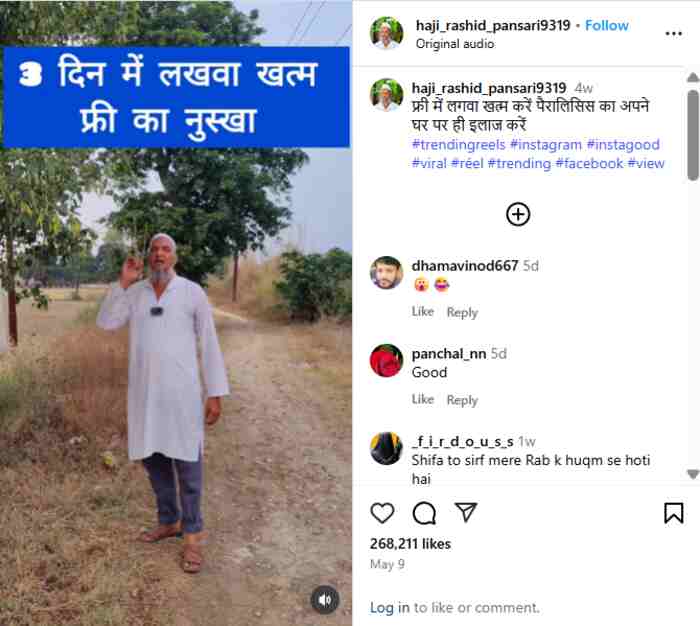
Sheesham leaves in oil can cure paralysis

Fact Check

Can paralysis be cured at home with oil?

No, paralysis cannot be cured at home using oils. Paralysis happens when communication between the brain and muscles is disrupted—this can be due to a stroke, spinal injury, nerve damage, or other medical conditions. These causes require professional medical treatment such as physiotherapy, medication, and in some cases, surgery. Oils, whether herbal or not, may help with massage and muscle stiffness, but they cannot repair nerve damage or restore movement on their own.

Dr Mohit Sandhu, Consultant Ayurvedic Practitioner

To assess the claim, we consulted Dr Mohit Sandhu, Ayurvedic Practitioner at AgniShalya Ayurvedic Hospital and Research Centre, Hamirpur. He firmly dismisses the idea to cure paralysis in just 2 or 3 minutes of oil massage, or even a few days, by applying oil, whether it contains sheesham leaves or not. “That’s not how paralysis works, not even according to Ayurveda,” he says. Dr Sandhu explains that while certain medicated oils like Mahanarayan tail or Ksheerabala tail may be used in Ayurvedic treatments, their role is to support recovery by improving circulation and easing stiffness when combined with massage (Abhyanga) and steam therapy (Swedana). In very rare and early-stage cases, such as mild Bell’s palsy or functional paralysis, some minor movement may return temporarily, but this is only short-term relief, not a cure.

He adds that Ayurveda approaches paralysis through a structured, long-term protocol involving internal and external oleation (Snehana), medicated enemas (Basti), nasal therapy (Nasya), and calming treatments like Shirodhara and Shirobasti. Therapies such as Rasayana for nerve regeneration and procedures like Marma Chikitsa or Agnikarma may also be included. “These treatments aim to manage symptoms and support nerve function over time. Claims of instant or three-day cures are misleading and have no basis in classical Ayurvedic texts or clinical practice,” Dr Sandhu concludes.

Dr Muskan Thakur, BAMS, Indore

We also spoke to Dr Muskan Thakur, Ayurvedic Practitioner from Indore, to understand if an oil massage alone can completely cure paralysis in just 3 days. She firmly denies this, stating, “Classical Ayurvedic texts and scientific evidence do not support such claims.” According to her, paralysis, or Pakshaghat in Ayurveda, is a serious condition caused by an aggravated Vata dosha, which affects the nervous system. Treatment involves a gradual, multi-step process including medicated oil massages (Abhyanga), internal herbal medicines, Panchakarma therapies like Pizhichil and Basti, and appropriate lifestyle changes. Oils such as Mahanarayana Tail and Dhanwantaram Tail can help support nerve function over time, but they cannot provide an instant cure.

Dr Thakur also stresses that the idea of one oil curing all types of paralysis contradicts the core Ayurvedic principle of personalised treatment, which considers a person’s dosha, dhatu, and roga (imbalance, tissues, and disease). “Such one-size-fits-all claims are misleading and go against the very foundation of Ayurveda. People should be cautious before trusting such advice on social media,” she concludes.

Do Sheesham leaves have any proven benefits for paralysis?

No, there is no scientific proof that sheesham leaves can cure paralysis. While Sheesham (Dalbergia sissoo) is used in Ayurveda for managing pain and inflammation, this is not the same as curing or reversing paralysis. A 2021 animal study showed that extracts from Sheesham leaves might help improve memory and reduce brain inflammation in rats with Alzheimer’s-like symptoms, but this has no connection to paralysis. So far, no clinical research supports the idea that Sheesham leaves, whether raw or boiled in oil, can heal nerve damage or restore lost muscle control. Such claims remain unverified and misleading.

Why is the “3-day cure” claim dangerous?

Because it spreads false hope and may stop people from seeking real help. Paralysis, especially after a stroke, needs urgent medical care to prevent lasting damage. Relying on home remedies like oil massages instead of going to a hospital or continuing physiotherapy can delay proper treatment. This delay could worsen the condition or make recovery much harder.

Dr Kunal Bahrani, Neurologist

Dr Kunal Bahrani, Director and HOD of Neurology at Marengo Asia Hospitals, Faridabad, explains, “Paralysis, particularly due to stroke, is a critical condition that demands immediate and structured care. It results from a sudden interruption in blood flow to the brain, which can damage the regions responsible for movement. Managing it requires timely diagnosis, medical support, and regular rehabilitation. False information about quick fixes can be harmful as it may lead patients to skip essential treatment during the most crucial recovery window.”

How are paralysis and nerve damage usually treated?

They are managed with proper medical care, not home remedies. Recovery depends on the type and cause of paralysis. Treatment may include:

  • Physiotherapy to help regain strength and movement
  • Speech or occupational therapy if muscles used in talking or daily work are affected
  • Medications to manage symptoms like pain, stiffness, or muscle spasms
  • Surgery or assistive devices in some cases Ayurveda and other traditional therapies can support recovery, but they should not replace proper medical care.

Can a massage with herbal oils be helpful in any way for paralysis?

Yes, but only as supportive care, not as a cure. Gentle massage with warm oil may improve blood flow, reduce stiffness, and offer emotional comfort. Oils like sesame or medicated Ayurvedic oils are often used in post-stroke rehabilitation, but these are part of a broader treatment plan. On their own, simple oil massages are not enough to cure paralysis.

THIP Media Take

The claim that Sheesham leaf oil can cure all types of paralysis in 3 days is false. While massage with herbal oils may provide some relief, there is no scientific or medical evidence that it can cure paralysis. People with symptoms of paralysis should seek immediate medical attention. Relying on viral remedies can be harmful and delay life-saving care.

Sunday, June 8, 2025

A pilot study for self-guided, active robotic training of proprioception of the upper limb in chronic stroke


What is your doctor's current protocol to recover proprioception? Incompetently doesn't have one, right? No protocol, YOUR DOCTOR HAS BEEN INCOMPETENT FOR OVER A DECADE!

 If your doctor writes E.T. prescriptions (Evaluate and Treat) to the OT, PT and OT like mine did, it means they KNOW NOTHING ABOUT STROKE RECOVERY! Why haven't they been fired yet? I could train a chimp to do that. If he knew anything about stroke recovery it didn't show.

 Send me hate mail on this: oc1dean@gmail.com. I'll print your complete statement with your name and my response in my blog. Or are you afraid to engage with my stroke-addled mind? Your patients need an explanation of why you don't have proprioception protocols.

Why isn't your 'professional' solving stroke?

Laziness? Incompetence? Or just don't care? NO leadership? NO strategy? Not my job? Not my Problem!

A pilot study for self-guided, active robotic training of proprioception of the upper limb in chronic stroke

Abstract

Background

Proprioceptive impairments of the upper limb are common after stroke. These impairments are not typically addressed during assessment or rehabilitation. Currently, most robotic paradigms for training of the upper limb have focused solely on improving motor function or have targeted proprioception in individuals with combined use of visual feedback. Our goal was to design a training paradigm that directly targets proprioception of the upper limb, while minimizing reliance on other sensory information to improve sensorimotor function after stroke.

Methods

In this pilot study, 5 individuals with stroke and 5 age-matched controls were tested on a single-day proprioceptive training paradigm. Here, participants used a joystick with their less-affected arm to send commands to a KINARM exoskeleton that would passively move their more-affected arm. To complete the passive reaching task, participants relied only on proprioceptive feedback from the more-affected arm and were only given knowledge of results information after each trial. Sensorimotor function of the upper limb was measured pre- and post-training via robotic measures of motor function [Visually Guided Reaching (VGR)] and position sense [Arm Position Matching (APM)]. Sensorimotor function was quantified as a Task Score, which incorporated multiple task-relevant parameters for both VGR and APM. Changes in sensorimotor performance due to training were calculated as the pre- to post-training difference for VGR and APM within the control and stroke groups.

Results

We found significant improvements from pre-training to post-training for VGR in individuals with stroke (p < 0.001, CLES = 100) that were not observed in control participants (p = 0.87, CLES = 80). We observed significant changes from pre- to post-training in both VGR (Posture Speed, Reaction Time, Initial Direction Angle, Min–Max Speed Difference, and Movement Time) and APM (Contraction/Expansion Ratiox and Shifty) parameters.

Conclusions

Our novel proprioceptive training paradigm is one of the first to implement a self-guided sensory training protocol. We observed improvements in motor function and proprioception for individuals with stroke. This pilot study demonstrates the feasibility of self-guided proprioceptive training to improve motor and sensory function in individuals with stroke. Future studies aim to examine multi-day training to examine longer-term impacts on upper limb sensorimotor function.

Background

Proprioception refers to our sense of static position (position sense) and movement (kinesthesia) in space [1]. Proprioception is critical for movement execution of the upper limb [2,3,4,5] and when proprioception is largely eliminated, as in individuals with sensory deafferentation, movement quality is significantly compromised [6, 7]. Neurological impairments, such as stroke, have also been shown to impair proprioception, with many individuals (~ 50 to 60%) after stroke exhibiting some type of proprioceptive impairment [8,9,10,11,12].

Historically, motor impairments following stroke have been studied extensively and remain a primary area for targeted improvement in neurorehabilitation [13,14,15,16,17,18]. In contrast, proprioceptive impairments are an often underexplored area of rehabilitation, as clinicians report that 1–25% of completed evaluations contain proprioceptive assessments [19]. Further, they report that use of evidence-based somatosensory training occurs in 18% or less of clinical interventions [20]. However, recent work has utilized robotic paradigms for the upper limb to examine whether proprioception can be improved [21,22,23,24,25,26]. Previous work in adults who are neurologically intact has shown efficacy for training proprioception using forced choice paradigms. Here, the participant’s arm is passively moved to the right or left of the midline. They report the perceived direction of movement and then receive feedback on response accuracy [21, 24, 26]. Other paradigms have required participants to make unseen reaches in 3D space to remembered targets [22] and actively retrace a pattern after being passively moved through the pattern [23]. A recent study implemented a forced choice paradigm in individuals with stroke and found improvements in both motor and proprioceptive behavior, providing promising evidence for targeted improvement of proprioception after stroke [25]. It is unsurprising that proprioceptive training improved reaching behavior as proprioception is critical for smooth and coordinated reaching movements [2, 4, 6, 27, 28]. Additionally, two of these studies have promoted active subject participation [22, 23] and yielded more robust improvements in proprioception compared to those studies with more passive designs [21, 24,25,26].

The goal of the current study was to design a proprioceptive training paradigm to improve proprioception in individuals with chronic stroke that would build on the insight gathered from a set of recent successful proprioceptive training studies [21, 23,24,25,26]. Here, we target the following task objectives: (1) promotion of active subject participation during task execution, (2) require and encourage participants to use real-time proprioception of the more-affected limb for task success, (3) cooperative interplay between the less-affected limb to actively guide passive movement of the more-affected limb. For evaluation of the developed paradigm, a sample of individuals post-stroke and control participants were recruited to participate in a single-session proprioceptive training protocol. We hypothesized that robotic proprioceptive training would result in a reduction of proprioceptive deficits associated with chronic stroke. Therefore, we predicted that (1) individuals with stroke would improve both their motor and proprioceptive performance after training, and (2) individuals with stroke would show more spatial and temporal errors and slower learning during proprioceptive training compared to age-matched controls [29].

More at link.

Tuesday, August 2, 2011

Train track stroke therapy?

This post is just a humorous look at odd therapies. DO NOT ATTEMPT!
http://moneywatch.bnet.com/economic-news/news/desperate-sick-indonesians-use-railroad-therapy/6270025/

In this July 26, 2011 photo, villagers lie on a railway track for an electricity therapy in Rawa Buaya, Jakarta, Indonesia. People in the outskirt of the capital have been participating in the treatment believing that the the electricity current from the track could cure various diseases. (AP Photo/Achmad Ibrahim)
JAKARTA, Indonesia — Ignoring the red-and-white danger sign, Sri Mulyati walks slowly to the train tracks outside Indonesia's bustling capital, lies down and stretches her body across the rails.

Like the nearly dozen others lined up along the track, the 50-year-old diabetes patient has all but given up on doctors and can't afford the expensive medicines they prescribe.

In her mind, she has only one option left: electric therapy.

"I'll keep doing this until I'm completely cured," said Mulyati, twitching visibly as an oncoming passenger train sends an extra rush of current racing through her body.

She leaps from tracks as it approaches and then, after the last carriage rattles slowly by, climbs back into position.

Pseudo-medical treatments are wildly popular in many parts of Asia — where rumors about those miraculously cured after touching a magic stone or eating dung from sacred cows can attract hundreds, sometimes thousands.

That may be especially true in Indonesia, where chronic funding shortages and chaotic decentralization efforts since the 1998 ouster of longtime dictator Suharto have left many disillusioned with the state-sponsored health system, said Marius Widjajarta, chairman of the Indonesian Health Consumers Empowerment Foundation.

Medical experts say there is no evidence lying on the rails does any good.

But Mulyati insists it provides more relief for her symptoms — high-blood pressure, sleeplessness and high cholesterol — than any doctor has since she was first diagnosed with diabetes 13 years ago.

She turned to train track therapy last year after hearing a rumor about an ethnic Chinese man who was partially paralyzed by a stroke going to the tracks to kill himself, but instead finding himself cured.

It's a story that's been told and retold in Indonesia.

Until recently, more than 50 people would show up at the Rawa Buaya tracks every day. But the numbers have dropped since police and the state-run railroad company erected a warning sign and threatened penalties of up to three months in prison or fines of $1,800.

No one has been arrested yet, and none of the participants in train track therapy has died.

But the dedicated dozen a day who still come say they have no plans to stop.

"They told us not to do it anymore, but what else can I do," said Hadi Winoto, a 50-year-old stroke victim who has trouble walking.

"I want to be cured, so I have to come back."