Changing stroke rehab and research worldwide now.Time is Brain! trillions and trillions of neurons that DIE each day because there are NO effective hyperacute therapies besides tPA(only 12% effective). I have 523 posts on hyperacute therapy, enough for researchers to spend decades proving them out. These are my personal ideas and blog on stroke rehabilitation and stroke research. Do not attempt any of these without checking with your medical provider. Unless you join me in agitating, when you need these therapies they won't be there.

What this blog is for:

My blog is not to help survivors recover, it is to have the 10 million yearly stroke survivors light fires underneath their doctors, stroke hospitals and stroke researchers to get stroke solved. 100% recovery. The stroke medical world is completely failing at that goal, they don't even have it as a goal. Shortly after getting out of the hospital and getting NO information on the process or protocols of stroke rehabilitation and recovery I started searching on the internet and found that no other survivor received useful information. This is an attempt to cover all stroke rehabilitation information that should be readily available to survivors so they can talk with informed knowledge to their medical staff. It lays out what needs to be done to get stroke survivors closer to 100% recovery. It's quite disgusting that this information is not available from every stroke association and doctors group.

Showing posts with label alagebrium. Show all posts

Friday, November 16, 2018

Neck scan detects dementia way before symptoms appear

So your doctor should be using this to diagnose your likely dementia post-stroke. And then give you protocols to reverse the hardening of your arteries. 

I'm doing this; don't follow me.

You can test if you have stiff arteries here and here. Or maybe you want to ask your doctors for solutions.
Stiff arteries relax like younger blood vessels after taking alagebrium
 

Watermelon juice reverses hardening of the arteries I'm doing this, no clue if it is working because there is NO protocol for it.


Neck scan detects dementia way before symptoms appear


Researchers have shown that early dementia signs could be detected by a simple short scan of the individual’s neck. The actual dementia symptoms could be seen up to 10 years after these signs are visible on the scans they add. If proven robust for all cases, this test could soon become routine for screening middle aged individuals and classifying them as high risk for dementia later in life.
The researchers at the University College London (UCL) looked at the strength of a pulse travelling to the brain via the neck from the heart. The intensity of this pulse from the heart to different parts of the body often varies. The large blood vessels are normally elastic and they absorb the major pulse intensity from the heart due to their wall elasticity. This leads to diminishing the pulse intensity that travels to the brain and thus it prevents damage to the delicate and thin blood vessels of the brain, the team explains.
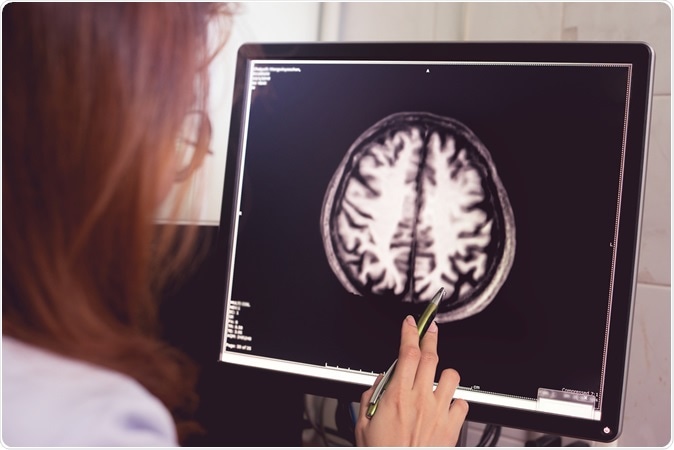
MRI brain of Dementia patient with left parietal atrophy asymmetry. Shutterstock / Atthapon Raksthaput
As a person ages, the wall elasticity of the arteries is lost and they become rigid. This means that the full intensity of the heart beat pulse reaches the brain via the stiffened arteries. This can damage the smaller and more delicate brain blood vessels which could eventually cause damage to the brain and its tissues leading to dementia. There are mini-strokes as these delicate blood vessels are damaged and they form new networks and undergo structural changes. These changes are all contributory to dementias, the authors explain.
For this study the team looked at around 3,200 middle-aged participants who were followed for an average of 15 years to see if they were at high risk of dementia. They underwent an ultrasound test of the neck in 2002 to see if their pulse intensity to the brain. In addition memory functions and problem solving tests were also conducted on these participants at baseline. Results showed that those who had the highest pulse intensity were 50 percent more likely to show an accelerated or rapidly progressing decline in cognitive abilities over the following 10 years compared to those who had a lower intensity. The team adjusted their results for other factors that may influence dementia risks such as age, blood pressure, obesity, presence of diabetes and other heart diseases.
According to the researchers, the neck scan could predict the “risk scores” for dementia later in life and increased pulse intensity was associated with a significant decline in memory, thinking, problem solving, language etc.
Dr Scott Chiesa, post-doctoral researcher at UCL in a statement said, “These findings demonstrate the first direct link between the intensity of the pulse transmitted towards the brain with every heartbeat and future impairments in cognitive function. It's therefore an easily measurable and potentially treatable cause of cognitive decline in middle-aged adults which can be spotted well in advance.”
The study was co-funded by the British Heart Foundation. Professor Metin Avkiran, the associate medical director of the BHF said that this could soon become a tool to detect dementia way before symptoms appeared. He added, “What we need now is further research, for example to understand whether lifestyle changes and medicines that reduce pulse wave intensity also delay cognitive decline.” As of now keeping blood pressure and cholesterol levels in check with appropriate medication when prescribed, in addition to a healthy diet and regular exercise can help keep dementia at bay say the experts.
The team is presenting the results of this study at the American Heart Association Scientific Sessions conference in Chicago.

Wednesday, May 28, 2014

“Virtual human” shows that stiff arteries can explain the cause of high blood pressure

Maybe you want to ask your doctor about these possible solutions to stiff arteries. Why would you listen to me? I'm a non-medical person.
You can test if you have stiff arteries here and here.
Watermelon juice reverses hardening of the arteries
Stiff arteries relax like younger blood vessels after taking alagebrium

“Virtual human” shows that stiff arteries can explain the cause of high blood pressure


High blood pressure is highly age-related and affects more than 1 billion people worldwide. But doctors can’t fully explain the cause of 90 per cent of all cases.  A computer model of a “virtual human” suggests that stiff arteries alone are enough to cause high blood pressure.
“Our results suggest that arterial stiffness represents a major therapeutic target. This is contrary to existing models, which typically explain high blood pressure in terms of defective kidney function,” says Klas Pettersen, a researcher at the Norwegian University of Life Sciences and first author of the study, recently published in PLOS Computational Biology.
High blood pressure is a major source of morbidity and mortality, because it makes individuals more prone to heart failure, stroke and kidney disease.
When blood pressure travels down the aorta from the heart, a special group of cells in the aortic wall, called baroreceptors, sense the pressure in this stretch of the aortic wall and send signals with this information to the nervous system.
If the blood pressure is too high, these cells send stronger signals and the body is able to lower blood pressure. However, if the aorta gets stiffer, as typically happens with age, this stretch of the aorta is not as sensitive as it once was in measuring blood pressure. Thus, although a person’s blood pressure may have increased, the baroreceptors do not signal as intensively as they should and the body does not get the message to lower blood pressure.
“With the stiffening of the wall that follows ageing, these sensors become less able to send signals that reflect the actual blood pressure. Our mathematical model predicts the quantitative effects of this process on blood pressure,” says Pettersen.
“If our hypothesis is proven right, arterial stiffness and baroreceptor signaling will become hotspot targets for the treatment of high blood pressure and the development of new medicines and medical devices,” says Stig W. Omholt from the Norwegian University of Science and Technology, who was the senior investigator of the research project.
With the use of existing experimental data and models of the aging human aorta, the researchers were able to show quantitatively how the stiffening of the aorta with age causes the baroreceptors to misinform the central nervous system about blood pressure, thus preventing the system from downregulating blood pressure. The model predictions were compared with data from the Nord-Trøndelag Health Study (HUNT2), which is comprised of information on the health history of 74,000 people, including blood sample collection from 65,000 people.
NTNU’s Omholt says that the study is a good example of how very complex human disease can be understood by use of mathematical models and thus allow for much better treatment strategies.
“If we are to succeed in developing  predictive, preventive and participatory medicine envisioned by so many, there is no substitute for building much stronger transdisciplinary ties between the life sciences, the mathematical sciences and engineering across the whole spectrum of basic, translational and applied research.  And mathematical models of the human physiology will be at the core of this development,” he says.
In September the Norwegian University of Science and Technology will host the biannual conference on the Virtual Physiological Human, where this research will be presented. http://www.ntnu.edu/vph2014

Thursday, May 16, 2013

Body Fat Is Associated With Reduced Aortic Stiffness Until Middle Age

I'm sure there is a correlation between stiff arteries and stroke, but I don't know about it. You can test if you have stiff arteries here and here.
You can fix them via this. Don't listen to me I have no medical training. Your doctor can tell you if fixing your stiff arteries would lead to dangerously low blood pressure and the risk of stroke from that.
Stiff arteries relax like younger blood vessels after taking alagebrium
I'm probably carrying an extra 20 pounds and I am middle-aged. So I should do something about that. Exercise, exercise, exercise. 

Body Fat Is Associated With Reduced Aortic Stiffness Until Middle Age


Abstract

Obesity is a major risk factor for cardiometabolic disease, but the effect of body composition on vascular aging and arterial stiffness remains uncertain. We investigated relationships among body composition, blood pressure, age, and aortic pulse wave velocity in healthy individuals. Pulse wave velocity in the thoracic aorta, an indicator of central arterial stiffness, was measured in 221 volunteers (range, 18–72 years; mean, 40.3±13 years) who had no history of cardiovascular disease using cardiovascular MRI. In univariate analyses, age (r=0.78; P < 0.001) and blood pressure (r=0.41; P< 0.001) showed a strong positive association with pulse wave velocity. In multivariate analysis, after adjustment for age, sex, and mean arterial blood pressure, elevated body fat% was associated with reduced aortic stiffness until the age of 50 years, thereafter adiposity had an increasingly positive association with aortic stiffness (β=0.16; P < 0.001). Body fat% was positively associated with cardiac output when age, sex, height, and absolute lean mass were adjusted for (β=0.23; P=0.002). These findings suggest that the cardiovascular system of young adults may be capable of adapting to the state of obesity and that an adverse association between body fat and aortic stiffness is only apparent in later life.

More explanation about this here: From Imperial College, London.
Body fat hardens arteries after middle age

Friday, December 2, 2011

Stiff arteries relax like younger blood vessels after taking alagebrium

Talk to your doctor on this one, I bet you'll know more about it than s/he does. It's only 6 years old. So would this be useful to take in the hyperacute phase to help with embolus extravasation
Why can't researchers be following up this, or who can I talk to about this?
http://www.medicalnewstoday.com/releases/33733.php
A compound called alagebrium, which is very similar to another used in anti-wrinkle creams, may be useful in reducing the deleterious effects of arterial aging in the majority of elderly Americans with systolic hypertension, a new study from researchers at Johns Hopkins shows.

Systolic hypertension refers to higher than normal levels of the "upper" number in a blood pressure reading, or with a lower than normal "bottom" number, in this case a pressure of 140 millimeters of mercury or greater and/or a diastolic pressure of less than 90 millimeters of mercury. Hypertension of this sort indicates stiffening of the body's arteries.

"This is the first demonstration that this class of drugs, known as collagen-crosslink breakers, can turn back the clock and make old arteries behave like young ones," says senior study investigator and geriatric cardiologist Susan Zieman, M.D., an assistant professor at The Johns Hopkins University School of Medicine and its Heart Institute. "There are many medications for routine hypertension, and coronary artery disease or atherosclerosis, which can lead to heart attack and heart failure, but none that help counteract the aging of cells inside the arterial walls that often precedes symptoms of disease."

According to the American Heart Association, more than 65 million Americans have high blood pressure, most of it of the systolic kind. In systolic hypertension, the pressure or force of blood flow through the arteries is too strong as blood is pumped by the heart's ventricles (systole) to the rest of the body. Diastolic pressure, on the other hand, is a measure of the pressure against arterial walls when the heart is resting and refilling between beats.

The Hopkins researchers found that alagebrium, formally known as ALT-711 or 4,5-dimethyl-3-(2-oxo-2-phenylethyl)-thiazolium chloride, reduced stiffening in the vessel wall in the main artery of the neck (carotid artery) by as much as 37 percent. The drug also improved endothelial function, the ability of the vessels' inner lining to relax and dilate in response to increased stress from blood flow, by 102 percent.

Chemically, alagebrium is a so-called crosslink breaker, responsible for destroying the rigid chemical bonds known as advanced glycation endproducts, or AGE for short, that form between body proteins and sugars over time. According to Zieman, both stiffening and reduced capacity of the arteries to expand in response to stress are common effects of aging that occur when the crosslinks form in the body's key structural proteins, such as collagen, or when AGEs interact directly with enzymes that regulate blood flow.

Crosslinking effectively carmelizes the collagen - found in all parts of the body, especially in the skin, eyes, blood vessels and nerves - leading to tissue "wrinkles," cataracts, as well as stiffening and increased speed and force of blood flow. These processes are accelerated in diabetics whose blood sugar content is often elevated.

As hypertension becomes chronic, aging blood vessels lose their ability to stretch and relax between heartbeats. The anti-wrinkle effects of a crosslink-breaker treatment occur on facial skin because the compound similarly lets collagen there relax, giving the skin a plumper, smoother look

The Hopkins findings, to be presented at the American Heart Association's Scientific Sessions 2005 on Nov. 15 in Dallas, Texas, also suggest that the cellular effects of aging caused by AGE are potent targets for new therapies.

In the Hopkins study, 13 elderly men and women with systolic hypertension took either daily doses of alagebrium (210 milligrams) for eight weeks or a look-alike pill (placebo), containing no active drug. AGE and collagen levels were monitored through blood tests. Stiffness was measured using a small pressure-sensor device called a tonometer.

Ultrasound readings, taken before and after drug therapy, were made as a blood pressure cuff was inflated for five minutes and deflated. This allowed researchers to calculate endothelial function based on how much the blood vessel lining relaxed as a percentage increase of how much the blood vessel could expand.

After treatment with alagebrium, neck arteries became less stiff, as shown by tonometer readings and decreased levels of collagen in the blood as AGE crosslinks were broken down. Analysis of additional pressure-wave readings also showed flatter patterns more closely resembling younger arteries than older, stiffer ones, which have wave patterns with higher peaks.

While the results did not explain why endothelial function improved, the researchers believe it has to do with the drug's effects on AGE and cell function. Their theory, Zieman says, is that one chemical reaction, the breakdown of AGE crosslinks, both reduces the structural causes of arterial stiffness in the artery wall and alleviates the detrimental effects of AGE on other enzymes or related proteins, possibly nitric oxide and other chemicals causing vessel inflammation, which are essential to regulating heart and blood vessel function.

"These results confirm that this drug does have important effects on the aging process in the arteries, but we still have to prove that there's some benefit to patients in terms of reducing cardiovascular disease," Zieman says. "Our next step will be a study, expected to begin in late 2006, of the drug's potential benefit at preventing or reversing heart failure in the elderly."

Alagebrium has been under investigational study since 1999, originally as a treatment for hypertension. While clinical studies have demonstrated the drug's ability to loosen up stiff arteries, two larger studies in older people with hypertension have not shown significant results in lowering blood pressure.

Funding for this study, which took one year to complete, was provided by the National Heart, Lung, and Blood Institute, a member of the National Institutes of Health. Medication was supplied free of charge by the drug's manufacturer, Alteon Inc., of Parsippany, N.J.