Changing stroke rehab and research worldwide now.Time is Brain! trillions and trillions of neurons that DIE each day because there are NO effective hyperacute therapies besides tPA(only 12% effective). I have 523 posts on hyperacute therapy, enough for researchers to spend decades proving them out. These are my personal ideas and blog on stroke rehabilitation and stroke research. Do not attempt any of these without checking with your medical provider. Unless you join me in agitating, when you need these therapies they won't be there.

What this blog is for:

My blog is not to help survivors recover, it is to have the 10 million yearly stroke survivors light fires underneath their doctors, stroke hospitals and stroke researchers to get stroke solved. 100% recovery. The stroke medical world is completely failing at that goal, they don't even have it as a goal. Shortly after getting out of the hospital and getting NO information on the process or protocols of stroke rehabilitation and recovery I started searching on the internet and found that no other survivor received useful information. This is an attempt to cover all stroke rehabilitation information that should be readily available to survivors so they can talk with informed knowledge to their medical staff. It lays out what needs to be done to get stroke survivors closer to 100% recovery. It's quite disgusting that this information is not available from every stroke association and doctors group.

Showing posts with label Early Supported Discharge. Show all posts

Saturday, July 18, 2020

Effectiveness of Stroke Early Supported Discharge

But you are not measuring the only goal in stroke, 100% RECOVERY.  The Rankin scale is useless, not objective except for #6, dead. The only reason I can see for ESD is to get survivors out of the hospital and not measure their failure to recover.  If you don't measure you don't have to improve anything. Of course if the board of directors was any good at all they would mandate measuring everything and insist upon constant improvements in stroke recovery. But I'm sure your board of directors is incompetent.

Effectiveness of Stroke Early Supported Discharge

Analysis From a National Stroke Registry
Originally publishedhttps://doi.org/10.1161/CIRCOUTCOMES.119.006395Circulation: Cardiovascular Quality and Outcomes. ;0

Background

Implementation of stroke early supported discharge (ESD) services has been recommended in many countries’ clinical guidelines, based on clinical trial evidence. This is the first observational study to investigate the effectiveness of ESD service models operating in real-world conditions, at scale.

Methods AND RESULTS

Using historical prospective data from the United Kingdom Sentinel Stroke National Audit Programme (January 1, 2016–December 31, 2016), measures of ESD effectiveness were “days to ESD” (number of days from hospital discharge to first ESD contact; n=6222), “rehabilitation intensity” (total number of treatment days/total days with ESD; n=5891), and stroke survivor outcome (modified Rankin scale at ESD discharge; n=6222). ESD service models (derived from Sentinel Stroke National Audit Programme postacute organizational audit data) were categorized with a 17-item score, reflecting adoption of ESD consensus core components (evidence-based criteria). Multilevel modeling analysis was undertaken as patients were clustered within ESD teams across the Midlands, East, and North of England (n=31). A variety of ESD service models had been adopted, as reflected by variability in the ESD consensus score. Controlling for patient characteristics and Sentinel Stroke National Audit Programme hospital score, a 1-unit increase in ESD consensus score was significantly associated with a more responsive ESD service (reduced odds of patient being seen after ≥1 day of 29% [95% CI, 1%–49%] and increased treatment intensity by 2% [95% CI, 0.3%–4%]). There was no association with stroke survivor outcome measured by the modified Rankin Scale.(Whatever the hell this means.)

Conclusions

This study has shown that adopting defined core components of ESD is associated with providing a more responsive and intensive ESD service. This shows that adherence to evidence-based criteria is likely to result in a more effective ESD service as defined by process measures.

REGISTRATION:

URL: http://www.isrctn.com/; Unique identifier: ISRCTN1556816

Monday, April 1, 2019

Wirral's Early Supported Discharge Service celebrates 10th birthday

In 10 years they should have been able to tell exactly how many patients fully recovered to determine if Early Supported Discharge is a success or not. Since they don't tell us that, they must not want us to know how bad this service is.  Better than when they left the hospital is not good enough. 100% recovery is the goal of all stroke patients. NOTHING LESS! How close are they to that goal?

Wirral's Early Supported Discharge Service celebrates 10th birthday


A WIRRAL hospital service that has helped thousands of stroke patients recover is celebrating the 10th anniversary of its launch this week.
The ESD (Early Supported Discharge) Service, run by Wirral University Teaching Hospital, helps stroke patients return to daily activities such as walking, shopping, reading, cooking and driving.
Among those praising it is Brian Lloyd, 81, who is back enjoying the things he loves just four months after suffering a serious stroke at his home is Eastham.
After waking one morning, Brian felt dizzy and fell down the stairs.
Despite being unable to talk, he managed to call a friend for help and was rushed to Arrowe Park Hospital by ambulance.
Medics responded quickly and after five days, Brian was well enough to leave hospital and began stroke rehabilitation in the comfort of his own home.
Since its launch a decade ago, the ESD has helped more than 3,000 people recover.
Its team of specialists provide occupational therapy, physiotherapy and speech and language therapy to eligible patients who have been discharged from the Acute Stroke Unit at Arrowe Park Hospital and Clatterbridge Hospital's Stroke Rehab Centre.
Brian explained: "I've had fantastic support from the ESD team who have made a huge difference to me, particularly with improving my speech and ability to write.
"I've had some physio and have been receiving occupational therapy and speech and language therapy at home since being discharged.
"It was important to me to avoid a lengthy hospital stay and I think it's helped me to get better sooner.
"I've been really impressed with the support I've had and it's been much easier not having to travel to the appointments."
Motoring enthusiast, Brian, has made huge progress since leaving hospital and is looking forward to driving again soon having recently passed his driving assessment.
He goes on his exercise bike every day and is continuing to do activities set by his therapists to further help his recovery.
Jenny Lawrence, ESD Clinical Lead for Occupational Therapy helped to set up the hospital's service when it was first launched ten years ago.
She said: "Our ESD team provides specialist rehabilitation in a community setting at levels comparable to that of a hospital in-patient stroke unit.
"No-one wants to be in hospital longer than necessary and evidence shows that providing this care brings real benefits to stroke patients including reducing disabilities and improving quality of life.
"We are very proud of how far the service has come in the last decade.
"Mr Lloyd has worked hard on his recovery and is a great example of the difference we can make to our patients."
To celebrate their 10th birthday, the ESD team is holding a cake sale in aid of WUTH Charity's Stroke Fund on Thursday, April 25 at Clatterbridge Hospital's rehabilitation centre from 10.30am to 12.30pm.

Sunday, July 15, 2018

Leaving hospital is ‘like falling off a cliff’ for stroke survivors

That's because there are NO protocols to be given to survivors to get rehabbed. You get fucking useless guidelines, that way your doctor can wash their hands of responsibility because 'You didn't follow the guidelines correctly'. Fucking lazy assholes. No one knows how to make neuroplasticity repeatable per exact instructions.

Leaving hospital is ‘like falling off a cliff’ for stroke survivors


Despite advances in treatments, stroke survivors can feel let down and abandoned after they are discharged from hospital


The ambition of stroke science has created a golden age of treatment where some patients, who once faced a lifetime’s disability following an attack, can walk out of hospital within days. 
Advanced techniques and streamlined medical workflow are changing outcomes and it is easy to become hypnotised by the triumphs in the operating theatre. But four out of ten of the UK’s 1.2 million stroke survivors leave hospital requiring help in their homes where daily struggles can have a corrosive and expensive impact as almost a third receive no social service visits, according to the Stroke Association. 
It is accepted that physiotherapy and support which covers speech, language and psychological help are most effective when delivered early and consistently, but a 2016 survey reported that 45 per cent of patients felt abandoned after they left hospital and only 31 per cent got the recommended six-month case review. 
“What we see from reports is that standards in hospitals are steadily improving, which is great, but stroke survivors tell us that things fall down when they are discharged from hospital,” says Juliet Bouverie, chief executive of the Stroke Association. 
“Sadly, aftercare is lagging behind and in some areas provision is shocking. It is disappointing how little support is there for them. 
“Stroke is a recovering condition unlike a lot of neurological conditions, which are degenerative, so there is a real, compelling case for investing in support therapies early which reduce the cost to the state and enable people of working age to get back to work. 
“We have people leaving hospital quite quickly after an incredibly life-changing event with very severe disabilities, who are not getting essential rehabilitation services and psychological support – in some parts of the country the waiting time for psychological help is five months when the target is 14 days. There are also huge regional variations.” 

Stroke aftercare

Reports show a disconnect between hospital and community performances, and opportunities to reduce the £9-billion annual economic burden of stroke are being lost. Informal care costs are estimated to be £2.42 billion annually, while benefit payments for stroke patients have reached more than £800 million a year. Annual productivity losses due to care, disability and death are estimated at £1.33 billion. 
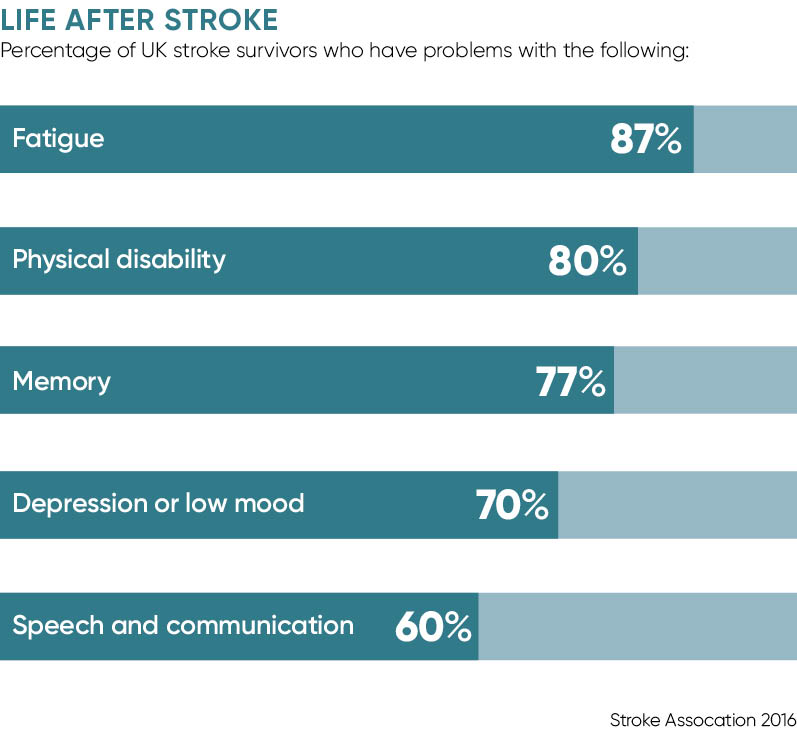
LIFE AFTER STROKE graph
None of these have protocols to address the problem
Physiotherapy, the first step on the road to recovery, is limited in some areas. Karen Middleton, chief executive of the Chartered Society of Physiotherapy, says: “Patients feel abandoned after they leave hospital and have described it as like falling off a cliff. We hear a lot about progress in hospital treatment, but what happens afterwards? Too many people are struggling and suffering at home, hidden from view, because support and care packages are not there for them. 
“It is an absolute false economy to do this because, without help early on, stroke survivors need more help long term. 
“Physiotherapy is essential to that recovery? and we talk about not just adding years to their lives, but also adding life to those years. But this part of stroke is not glamorous; it is not where you find the TV cameras.” (But physiotherapy has only a 10% chance of getting you fully recovered. You'll be better but that is faint praise for its effects and not comforting.)
It is a view echoed by Dr Martin James, consultant stroke physician at the Royal Devon and Exeter Hospital. He says: “There has been a lot of progress over the last ten years since the National Stroke Strategy was introduced and there is a lot of excitement at the acute end, but the caring for stroke survivors in the community has not really been implemented successfully. 
Too many people are struggling and suffering at home, hidden from view, because support and care packages are not there for them


“It means that a lot of people living in the community with the disabling consequences of stroke still aren’t receiving the services they need. It is quite expensive long term to look after someone with disability in the community, so it is cost effective to have interventions that reduce their reliance on services, such as the number of times they see their GP.” 
Dr James, clinical lead for the Royal College of Physician’s Sentinel Stroke National Audit Programme, adds that the repercussions are being felt across the social care budget. “One in three people who end up in a residential or nursing home are having to go there because they have had a stroke, so it is a huge contributor to long-term social costs. Social care has not had its budget protected in the way healthcare has. A lot of this burden falls on individuals and families,” he says. 
The early supported discharge scheme, which offers a full range of specialist support for six weeks, can save £1,600 on social care costs per patient, but its provision is patchy and campaigners believe too many patients slip through the net and their recovery is stalled, increasing the burden on families and the state. 

“People cherish their independence after a stroke and we should be doing everything we can to give them that,” says Dr James. 
Ms Bouverie concludes: “We are seeing a loss of momentum in stroke and long-term rehabilitation has been deprioritised when it is clear that if you intervene early the burden of disability is reduced and stroke survivors are less of a cost to the state long term.”


Tuesday, November 21, 2017

Rehabilitation of stroke: A summary of the ATTEND study(Family-led Rehabilitation after Stroke in India))

This would seem to contradict all the early supported discharge out there. Mainly being taken for cost savings in the hospital.  6 posts on early supported discharge here.
http://www.cmijournal.org/article.asp?issn=0973-4651;year=2017;volume=15;issue=4;spage=285;epage=287;aulast=Valson


Christian Medical College, Vellore, India
Date of Web Publication17-Nov-2017
Correspondence Address:
Source of Support: None, Conflict of Interest: None


DOI: 10.4103/cmi.cmi_70_17

How to cite this article:
Valson AT. Rehabilitation of stroke: A summary of the ATTEND study. Curr Med Issues 2017;15:285-7

How to cite this URL:
Valson AT. Rehabilitation of stroke: A summary of the ATTEND study. Curr Med Issues [serial online] 2017 [cited 2017 Nov 21];15:285-7. Available from: http://www.cmijournal.org/text.asp?2017/15/4/285/218641

Source: This is a summary of the study: The ATTEND collaborative Group: Family-led rehabilitation after stroke in India (ATTEND): a randomized controlled trial. Lancet. 2017 Aug 5;390. (10094):588-599. Summary prepared by Dr. Anna T. Valson, Christian Medical College, Vellore, India.

Clinical Question: Is family-led rehabilitation superior to usual care for stroke patients in a low-resource setting?

Authors' conclusions: (1) Family-led rehabilitation did not improve outcomes, but did not cause harm such as adding to caregiver burden. (2) The results of the study do not currently support the setting up of stroke rehabilitation services that shift tasks to family caregivers.


  Why this Study?Top


Stroke patients in developing countries such as India have limited the access to a multidisciplinary team of health professionals who can monitor and facilitate their rehabilitation after hospital discharge and provide much needed support to caregivers. Since the development of such multidisciplinary teams across the length and breadth of the country is not economically or logistically feasible, an attractive low-cost alternative is “Task Shifting,”[1] i.e., training caregivers to provide the needed physiotherapy to patients at home. The importance of this approach has been highlighted by the WHO in its Task Shifting Guidelines.[2] Although this is an approach that makes eminent practical sense and is scalable, there is very little evidence that it is effective in improving disease outcomes. This study [3] aimed to generate evidence regarding whether Task Shifting to family caregivers could reduce death and disability in stroke patients in India. A pilot study was carried out at Christian Medical College, Ludhiana, Punjab, to establish the trial methods,[4] and the protocol was published before data analysis of this study.[5]

Thursday, September 21, 2017

Early Discharge Services Reduce Hospital Stay, Disability After Stroke

To me this is only possible by cherry picking the survivors for the ESD program
http://www.neurologyadvisor.com/stroke/early-supported-discharge-services-for-stroke-reduce-hospital-stay-disability/article/690141/

Patients who received ESD services were more likely to be independent and living at home 6 months after stroke. Patients who received ESD services were more likely to be independent and living at home 6 months after stroke.
Early supported discharge (ESD) services, especially when managed by a coordinated multidisciplinary team of nurses, therapists, and physicians, help reduce duration of hospital stays and improve outcomes related to quality of life in patients recovering from stroke, according to a Cochrane Review on the topic.
Historically, individuals who experience stroke receive a large percentage of their rehabilitation in the hospital. ESD services, which have been designed to offer hospital patients an earlier return home and rehabilitation in a more familiar environment, are usually provided by a multidisciplinary team.
The objectives of this review were to determine whether, compared with conventional care, ESD services can accelerate patients' return home, offer equivalent or better patient and caregiver outcomes, prove to be satisfactory to both patients and caregivers, and provide justifiable implications for resource utilization.

  A total of 17 trials that recruited 2422 participants and for which outcome data were currently available were selected for review. The analysis included randomized controlled trials in hospitalized patients with stroke who received either conventional care or any service intervention known to provide rehabilitation and support in a community setting, in order to reduce length of hospital stay. The primary outcome was the composite end point of death or long-term dependency, as reported at the end of the scheduled follow-up.
Patients in the ESD group vs the conventional care group demonstrated reductions in length of hospital stay equal to approximately 6 days (95% CI, –3to –8 days; P <.0001). Overall, the odds ratio (OR) for the outcome of death or dependency at the end of the follow-up period (median, 6 months) was 0.80 (95% CI, 0.67- 0.95; P =.01), which is the equivalent of 5 fewer adverse outcomes per 100 patients with ESD. Notably, no substantial adverse effects were observed in any patients.
In addition, economic analyses found that the overall savings from hospital stays tended to be greater or equal to the cost of ESD services.

  The researchers concluded that based on moderate evidence, appropriately resourced ESD services coordinated with multidisciplinary team input can reduce hospital stay and disability in a select group of patients with stroke. The utilization of ESD services may also offer an opportunity to better control demand for hospital beds.

Reference

Langhorne P, Baylan S; Early Supported Discharge Trialists. Early supported discharge services for people with acute stroke. Cochrane Database Syst Rev. 2017;7:CD000443.

Thursday, June 29, 2017

Family-led rehabilitation ineffective for stroke patients, says Lancet study

Well shit, traditional stroke rehab with trained therapists is ineffective also since only 10% fully recover. I don't see any hue and cry about that disastrous failure.   You can read my 4 posts on early supported discharge and see if this latest research changes anything.
http://www.hindustantimes.com/health/family-led-rehabilitation-ineffective-for-stroke-patients-says-lancet-study/story-fgJvjDWbgdOCVQeStcfrVO.html
Family-led rehabilitation is ineffective for stroke patients, a recent study has found.
The study titled — ‘family-led rehabilitation after stroke in India’ — published in The Lancet is based on one of the largest stroke rehabilitation trials that was conducted at 14 centres across India, following up 1,250 stroke patients over six months.
The rehabilitation didn’t bring any improvement in the patients, compared to those who received no care.
An estimated 1.6 million people suffer a stroke in India every year, with early death rates ranging from 27% to 41%. And 5 lakh people are living with stroke disability.
The George Institute for Global Health conducted a controlled trial, which looked at whether a family-led caregiver-delivered home-based rehabilitation intervention as against usual care is an effective and affordable strategy for those with disabling stroke in the country.
The study was supported by the National Health & Medical Research Council (NMHRC) of Australia, coordinated by Christian Medical College (CMC), Ludhiana, and the quality of implementation monitored by the Indian Institute of Public Health, Hyderabad.

The results raise serious questions about the benefits of rehabilitation carried out by family members, and highlight the need for urgent investment in professional stroke facilities in low and middle-income countries.
“We had expected to see a marked improvement in recovery of people who received this extra care delivered by their own trained family members, in their own homes,” said lead author Professor Richard Lindley, The George Institute for Global Health and the University of Sydney.
“Other trials have indicated that community-based rehabilitation can play a significant role in recovery but these have been conducted largely in high resource settings. It shows effective rehabilitation may need to be provided by professionals who have undergone years of training and are specialists in their own field.”
The results are surprising and may impose major challenges to poor communities with limited financial resources that are also struggling to rehabilitate stroke patients especially in rural areas in a better way.
“Even after we save lives of stroke patients, they need a robust rehabilitation that may stretch up to months. Many more stroke units are needed in India with more trained professionals who can deliver life changing rehabilitation,” said professor Jeyaraj Pandian, neurologist, CMC, Ludhiana.
“Government will have to pitch in a big way.”

Sunday, April 9, 2017

Stroke unit care, inpatient rehabilitation and early supported discharge

Should be titled; 'Get the survivors out of our hair faster so we don't have to look at our failure to get them fully recovered'. Out of sight, out of mind.
http://www.clinmed.rcpjournal.org/content/17/2/173.short
  1. Chris Price, senior lecturer in stroke medicineB
+ Author Affiliations
  1. ANewcastle University and honorary consultant stroke physician, Northumbria Healthcare NHS Foundation Trust, Newcastle upon Tyne, UK
  2. BNewcastle University and honorary consultant stroke physician, Northumbria Healthcare NHS Foundation Trust, Newcastle upon Tyne, UK
  1. Address for correspondence: Professor Helen Rodgers, Stroke Research Group, Institute of Neuroscience, Newcastle University, 3-4 Claremont Terrace, Newcastle upon Tyne NE2 4AE, UK. Email: helen.rodgers@newcastle.ac.uk

ABSTRACT

Stroke units reduce death and disability through the provision of specialist multidisciplinary care for diagnosis, emergency treatments, normalisation of homeostasis, prevention of complications, rehabilitation and secondary prevention. All stroke patients can benefit from provision of high-quality basic medical care and some need high impact specific treatments, such as thrombolysis, that are often time dependent. A standard patient pathway should include assessment of neurological impairment, vascular risk factors, swallowing, fluid balance and nutrition, cognitive function, communication, mood disorders, continence, activities of daily living and rehabilitation goals. Good communication and shared decision making with patients and their families are key to high-quality stroke care. Patients with mild or moderate disability, who are medically stable, can continue rehabilitation at home with early supported discharge teams rather than needing a prolonged stay in hospital. National clinical guidelines and prospective audits are integral to monitoring and developing stroke services in the UK.

Friday, September 16, 2016

'Bedless' hospitals grow as industry moves toward outpatient care

This is going to become more likely even for stroke survivors with results like these:

Rehabilitation after stroke with focus on early supported discharge and post-stroke fatigue

James Paget University Hospital wins high praise for stroke rehabilitation work

 This shouldn't even be attempted for stroke survivors until  the neuronal cascade of death by these 5 causes in the first week has been solved. Otherwise you are sending patients out there even as more of their neurons continue to die in the first week. This is a gross dereliction of duty.
http://www.fiercehealthcare.com/healthcare/bedless-hospitals-telehealth-grow-as-hospitals-move-toward-outpatient-care?
The changing nature of healthcare and patients’ desire for convenience have given rise to nontraditional care formats such as stand-alone emergency rooms and “micro-hospitals,” and now “bedless hospitals” are joining the push.
Such hospitals still have standard hospital features, including infusion suites, emergency rooms, helipads and operating areas, but no overnight space, according to STAT. For example, MetroHealth System recently opened a $48 million bedless facility in the Cleveland area. CEO Akram Boutros, M.D., said staff is expecting to serve around 3,000 patients during this first year.
“It reduces cost, and it reduces the risk of infection,” Boutros told the publication. “People go home to a less-risky environment, where they tend to get better faster.”
In addition to patients’ desire for speedier, more convenient care models, the growth of such facilities is also due to growth in outpatient care within the industry. While experts say increased use of outpatient services offsets the cost of pricier inpatient care, others question whether the increase of bedless facilities mean fewer resources for patients with complex treatment needs that require beds and overnight stays, according to STAT.
Some healthcare leaders have worked to streamline complex treatments along with these developments. For example, Memorial Sloan Kettering Cancer Center designed the 16-story Josie Robertson Surgery Center, an outpatient cancer center that has 28 short-stay beds but mostly performs surgeries for which patients leave within hours.
Similarly, Mercy Hospital’s Virtual Care Center in Missouri places video calls to patients, saving time and money even for patients with complex, chronic conditions, according to CNN Money. It's especially beneficial for patients who may live far from the nearest healthcare facility. "You have to break that whole clinic kind of thinking with nursing: 'Oh my gosh, he needs to go to the ER," Dan Milner, a navigator for the care center, said. "[There's] an antiquated idea of how people think healthcare should be."

Tuesday, May 17, 2016

Rehabilitation after stroke with focus on early supported discharge and post-stroke fatigue

Patient satisfaction may be high in ESD but actual results were not communicated so ESD in my view is not proven.

James Paget University Hospital wins high praise for stroke rehabilitation work


Rehabilitation after stroke with focus on early supported discharge and post-stroke fatigue


Umeå University, Faculty of Medicine, Department of Public Health and Clinical Medicine, Medicine. Umeå University, Faculty of Medicine, Department of Community Medicine and Rehabilitation, Physiotherapy.
2016 (English)Doctoral thesis, comprehensive summary (Other academic)Alternative title
Rehabilitering efter stroke med speciellt fokus på tidig koordinerad hemgång och fortsatt rehabilitering i hemmet och post-stroke fatigue (Swedish)
Abstract [en]
Background Stroke is a major cause of disability worldwide. After treatment in a specialized stroke unit, early supported discharge (ESD) followed by home rehabilitation has shown to be an effective way(Really?) to improve patient outcome and quality of care for persons with mild to moderate stroke. ESD service is recommended in the national and international guidelines for stroke care, but has only partially been implemented in Sweden. Following stroke, fatigue is a common consequence that often becomes more evident when the patient comes home. Currently, there is insufficient evidence about how to measure, treat and handle post-stroke fatigue. The overall aim of this thesis was to evaluate and implement early supported discharge (ESD) based on stroke patients experience after discharge from the stroke unit and local conditions. The aim was also to evaluate post-stroke fatigue with a potentially valid and reliable scale and finally to prepare for a study to evaluate cardiorespiratory training as a part of ESD service for patients with post-stroke fatigue.
Methods In paper I, nine strategically chosen patients were interviewed of their experience of falling ill, the hospital stay, discharge, contact with health care after discharge and their request of support. Papers II-III describe and evaluate the development, content, implementation and effects of a locally adopted method for early supported discharge (Umeå Stroke Center ESD) in modern stroke care. Paper II included 153 consecutive patients and paper III, 30 232 patients with first-ever stroke registered in the Riksstroke registry in Sweden. Paper II evaluated number of patients/year, clinical and functional health status, satisfaction in relation to needs, accidental falls/other injuries and resources with the result summarized in a value compass. The implementation process was evaluated retrospectively by means of Consolidated Framework for Implementation (CFIR). Paper III evaluated patient reported outcome measurements (PROMs) at 3 months. The primary outcome in paper III was satisfaction with the rehabilitation after discharge. Secondary outcomes were information about stroke provided, tiredness/fatigue, pain, dysthymia/depression, general health status and dependence in activities of daily living (mobility, toilet hygiene and dressing). Multivariable logistic regression models for each PROM was used to analyze associations between PROMs and ESD/no ESD. In Paper IV, the Fatigue Assessment scale (FAS) was translated into Swedish and evaluated regarding psychometric properties when self-administered by persons with mild to moderate stroke. 72 consecutively patients selected from the stroke unit admission register received a letter including three questionnaires: the FAS, the Short Form Health Survey (SF-36) subscale for vitality and the Geriatric Depression Scale GDS-15. A second letter with FAS was sent within 2 weeks, for re-test evaluation. Paper V is a study protocol for a planned randomized controlled trial (RCT) of 50 consecutive stroke patients will who receive stroke unit care followed by ESD-service at Umeå Stroke Center, University Hospital, Umeå, Sweden. Paper V will investigate if a structured cardiorespiratory interval training program (CITP) added to the ESD-service may result in relieved post-stroke fatigue and increased oxygen uptake.
Results The interviews in Paper I revealed three main categories with subcategories: “Responsible and implicated”, “Depersonalized object for caring measures” and “The striving for repersonalization and autonomy”. The findings indicate that coming home gave the informants’ important insights and understanding of the stroke, its consequences and was also an important factor for the recovery. Paper II-III showed that it is possible to develop and implement an adapted ESD service for stroke patients based on the patients’ experiences and requests, evidence-based recommendations and local conditions. The ESD service reduced dependence of activity, increased mobility with seemingly no increased risk of accidental falls or other injuries. The patient satisfaction in relation to needs regarding the ESD was high. Paper III showed that patients that received ESD were more satisfied with rehabilitation after discharge, had less need for assistance with ADL and less dysthymia/depression compared to patients that did not receive ESD. Study IV showed that the Swedish FAS used at home as a selfadministered questionnaire is a reliable and valid questionnaire for measuring fatigue in persons with mild to moderate stroke. The internal consistency was good, the agreement between the test and retest reliability for individual items (weighted kappa) was for the majority of items good or moderate. The relative reliability for total scores was good and the absolute reliability was 9 points. The Swedish FAS had no floor nor ceiling effects and correlated both with the SF-36, subscale for vitality and the GDS-15 indicating convergent construct validity, but not divergent construct validity.
Conclusion It is possible to develop and implement ESD care for stroke patients based on patients’ experience and needs, evidence-based principles and local conditions. Early supported discharge (ESD) in the setting of modern stroke unit care appears to have positive effects on rehabilitation in the subacute phase. The Swedish FAS used at home as a self-administered questionnaire is reliable and valid for measuring fatigue in persons with mild to moderate stroke.
Place, publisher, year, edition, pages
Umeå: Umeå Universitet , 2016. , 72+2 p.
Series
Umeå University medical dissertations, ISSN 0346-6612 ; 1817
Keyword [en]
Stroke, early supported discharge, post-stroke fatigue, patient reported outcome measurement, Fatigue assessment scale, cardiorespiratory training
National Category
Other Medical Sciences
Research subject
Physiotherapy
Identifiers
URN: urn:nbn:se:umu:diva-120127ISBN: 978-91-7601-501-8OAI: oai:DiVA.org:umu-120127DiVA: diva2:926688
Public defence
2016-06-03, Sal B, byggnad 1D, Umeå universitetssjukhus, Umeå, 13:00 (Swedish)
Opponent
Supervisors
Available from: 2016-05-13 Created: 2016-05-09 Last updated: 2016-05-13Bibliographically approved
List of papers

Friday, June 28, 2013

James Paget University Hospital wins high praise for stroke rehabilitation work

But they don't give any details about recovery percentages. How many fully recovered?
http://www.edp24.co.uk/news/health/james_paget_university_hospital_wins_high_praise_for_stroke_rehabilitation_work_1_2256234
The Early Supported Discharge (ESD) team - including stroke physician Dr Hilary Wyllie and stroke therapy team leader Evie Cooper, pictured - won the East of England Stroke Forum Conference award for their poster presentation explaining how the ESD had improved patient recovery times and benefited the Gorleston hospital over the past 18 months.
While not suitable for everyone, ESD helps patients receive rehabilitation at home as an alternative to staying in hospital.
Around 50 per cent of stroke JPH patients currently benefit from ESD which started at the hospital in May 2011. Patient feedback was impressive; JPH said 100pc of its ESD patients were ‘very satisfied’, 100pc would recommend it to other patients, and nine out of ten patients (89pc) were satisfied with the level of therapy they received.
Since ESD was introduced, recovery times has improved and the average length of stay has dropped from 17.3 days before May 2011 to the current time of 13.7 days.
Lead stroke physician Dr Hilary Wyllie said: “We are delighted to have won the regional award. It’s a credit to all the staff involved that Early Supported Discharge has worked even better than we thought it would for our stroke patients. A lower length of stay has benefits for the hospital but the most important thing is that patients get home more quickly, they get better rehabilitation and we can see from the patient feedback that their satisfaction is very high.”