Changing stroke rehab and research worldwide now.Time is Brain! trillions and trillions of neurons that DIE each day because there are NO effective hyperacute therapies besides tPA(only 12% effective). I have 523 posts on hyperacute therapy, enough for researchers to spend decades proving them out. These are my personal ideas and blog on stroke rehabilitation and stroke research. Do not attempt any of these without checking with your medical provider. Unless you join me in agitating, when you need these therapies they won't be there.

What this blog is for:

My blog is not to help survivors recover, it is to have the 10 million yearly stroke survivors light fires underneath their doctors, stroke hospitals and stroke researchers to get stroke solved. 100% recovery. The stroke medical world is completely failing at that goal, they don't even have it as a goal. Shortly after getting out of the hospital and getting NO information on the process or protocols of stroke rehabilitation and recovery I started searching on the internet and found that no other survivor received useful information. This is an attempt to cover all stroke rehabilitation information that should be readily available to survivors so they can talk with informed knowledge to their medical staff. It lays out what needs to be done to get stroke survivors closer to 100% recovery. It's quite disgusting that this information is not available from every stroke association and doctors group.

Showing posts with label remote ischemic postconditioning. Show all posts

Sunday, June 28, 2026

Remote Ischemic Postconditioning in Endovascular Thrombectomy for Stroke: The EnTRIPS Randomized Clinical Trial


Is your doctor and stroke hospital so FUCKING INCOMPETENT THEY DIDN'T CREATE AND INSTALL A PROTOCOL ON THIS YEARS AGO?

Do you prefer your doctor and hospital incompetence being NOT KNOWING. Or NOT DOING?


  • remote ischemic postconditioning (5 posts to March 2021)
  • And much earlier, this might be 

    Remote Ischemic Postconditioning in Endovascular Thrombectomy for Stroke: The EnTRIPS Randomized Clinical Trial


    Abstract

    BACKGROUND:

    Although the neuroprotective potential of remote ischemic postconditioning (RIPC) has been reported, the efficacy and safety of ultra-early RIPC administered after endovascular treatment (EVT) in patients with acute ischemic stroke remain unclear. This study evaluated the efficacy and safety of ultra-early RIPC in patients with acute ischemic stroke undergoing EVT.

    METHODS:

    The EnTRIPS trial (Endovascular Treatment Combined with Remote Ischemic Postconditioning in Patients with Acute Ischemic Stroke) was a multicenter, randomized, controlled, outcome assessor-blinded, prospective clinical trial. The trial was conducted at 8 hospitals in China between April 12, 2021, and March 26, 2025. Eligible patients were adults with acute ischemic stroke due to large vessel occlusion who presented within 24 hours of symptom onset, underwent EVT, and achieved successful recanalization. A total of 270 eligible patients were randomized within 6 hours after EVT to receive either RIPC plus guideline-based therapy (n=135) or guideline-based therapy alone (n=135). RIPC was administered for 7 days using pneumatic devices consisting of 5 cycles of bilateral upper-arm cuff inflation (5 minutes at 180 mm Hg) followed by deflation (3 minutes). The primary outcome was functional independence at 90 days, defined as a modified Rankin Scale score of 0 to 2 (range, 0 [no symptoms] to 6 [death]). Safety outcomes included the incidence of RIPC-related adverse events within 7 days.

    RESULTS:

    Among 270 randomized patients, a total of 268 (99.3%) participants completed the trial, including 133 in the RIPC group and 135 in the control group (mean [SD] age, 65.5 [16.8] years; 171 [63.8%] men). At 90 days, functional independence was achieved in 81 (60.9%) patients in the RIPC group and 78 (57.8%) patients in the control group (adjusted risk ratio, 1.07 [95% CI, 0.89–1.30]; P=0.46). RIPC-related adverse events occurred in 10 of 133 (7.5%) patients, and no intervention-related adverse events occurred in the control group.

    CONCLUSIONS:

    Ultra-early RIPC is safe for patients with acute ischemic stroke treated with EVT, but it does not significantly improve the 90-day functional outcomes.

    REGISTRATION:

    URL: https://www.clinicaltrials.gov; Unique identifier: NCT04581759.

    Graphical Abstract


    Get full access to this article

    Wednesday, March 19, 2025

    Effect of RICAS (Remote Ischemic Preconditioning on Collaterals of Atherosclerosis Stroke): Rationale and Design


     Is your doctor and stroke hospital so FUCKING INCOMPETENT THEY DIDN'T CREATE AND INSTALL A PROTOCOL ON THIS YEARS AGO?

    Do you prefer your doctor and hospital incompetence being NOT KNOWING. Or NOT DOING?


  • remote ischemic postconditioning (3 posts to March 2021)
  • And much earlier, this might be 

    Effect of RICAS (Remote Ischemic Preconditioning on Collaterals of Atherosclerosis Stroke): Rationale and Design

    Journal of the American Heart Association
  • Tables
  • Abstract

    Background

    As a noninvasive, low‐cost, nonpharmacological procedure with excellent properties of safety, remote ischemic conditioning (RIC) has been demonstrated to prevent recurrence of stroke among patients with ischemic stroke of large artery atherosclerosis origin. We hypothesized that the benefit is attributed to the improvement of collaterals by chronic RIC in this population, and we aimed to explore the influence of chronic RIC on collateral status evaluated by digital subtraction angiography in this population.

    Methods

    The RICAS (Remote Ischemic Preconditioning on Collaterals of Atherosclerosis Stroke) study is a prospective, randomized, blind end point, multicenter study. Eligible patients with ischemic stroke of anterior circulation caused by large artery atherosclerosis, poor collateral compensation, and more than 1 month of symptom onset, are randomly assigned into experimental and control groups with a ratio of 1:1. The patients in the experiment group will receive treatment with RIC (bilateral upper limbs, for a total procedure time of 50 minutes, twice daily) for 1 year as an adjunct to guideline‐based treatment, while patients in the control group only receive guideline‐based treatment. A maximum of 300 patients (150 participants per group) are required to test the superiority hypothesis with 80% power (using a 2‐sided α=0.05) to detect a 15% difference. Subgroup analyses for the primary end point will be performed on 8 prespecified subgroups by age, sex, ischemic event (acute ischemic stroke ore transient ischemic stroke), tandem lesion, history of hypertension, hypercholesterolemia, diabetes, and myocardial infarction. The primary outcome is the proportion of collateral status improvement, which is defined as an increase of ≥1 point on the American Society of Interventional and Therapeutic Neuroradiology/Society of Interventional Radiology score, as assessed by digital subtraction angiography at 12 months after randomization. The safety outcomes include RIC‐related adverse events.

    Conclusions

    This study may provide the direct evidence for the potential effect of chronic RIC treatment on the improvement of collateral status.

    Registration

    URL: https://clinicaltrials.gov. Unique identifier: NCT06170944.

    Friday, March 14, 2025

    Metabolic Syndrome and Efficacy of Remote Ischemic Postconditioning in Acute Moderate Ischemic Stroke: A Post Hoc Analysis of the RICAMIS Trial

     Is your doctor and stroke hospital so FUCKING INCOMPETENT THEY DIDN'T CREATE AND INSTALL A PROTOCOL ON THIS YEARS AGO?

    Do you prefer your doctor and hospital incompetence being NOT KNOWING. Or NOT DOING?


  • remote ischemic postconditioning (3 posts to March 2021)
  • And much earlier, this might be 

    Metabolic Syndrome and Efficacy of Remote Ischemic Postconditioning in Acute Moderate Ischemic Stroke: A Post Hoc Analysis of the RICAMIS Trial

    Journal of the American Heart Association
  • Abstract

    Background

    Metabolic syndrome (METS) is associated with poor outcomes after acute ischemic stroke. This study aimed to investigate the relationship between METS and efficacy of remote ischemic postconditioning (RIPostC) in acute moderate ischemic stroke using the database of the RICAMIS (Remote Ischemic Conditioning for Acute Moderate Ischemic Stroke) trial.

    Methods and Results

    In the RICAMIS trial, eligible participants were patients with acute moderate ischemic stroke within 48 hours of onset who did not receive reperfusion treatment. A total of 1482 patients were enrolled in this secondary analysis, including the METS (602) and non‐METS (880) group according to the METS definitions of the Chinese Diabetes Society, which was further subdivided into RIPostC and control subgroups. The primary outcome was excellent functional outcome, defined as a modified Rankin Scale score of 0 to 1 at 90 days. The differences in clinical outcomes between the RIPostC subgroup and control subgroup were compared in patients with METS or non‐METS, respectively, and the interaction effects of RIPostC treatment assignment with METS status were evaluated. The baseline characteristics between RIPostC and control subgroups across patients with METS and non‐METS were well balanced, except the difference in Trial of Org 10 172 in Acute Stroke Treatment stroke mechanism in the METS group. Compared with control, RIPostC was associated with high probability of excellent functional outcome in patients with METS (68.8% versus 56.1%; odds ratio [OR], 1.751 [95% CI, 1.248–2.456]; P=0.001), but not in patients without METS (66.6% versus 64.6%; OR, 1.103 [95% CI, 0.833–1.461]; P=0.494). Notably, a significant interaction effect between treatments (RIPostC or control) by different METS status on excellent functional outcome was observed (P=0.039).

    Conclusions

    The secondary analysis suggests for the first time that RIPostC may provide greater benefit in patients with acute ischemic stroke with METS versus non‐METS.

    Nonstandard Abbreviations and Acronyms

    AIS
    acute ischemic stroke
    LAA
    large artery atherosclerosis
    METS
    metabolic syndrome
    NIHSS
    National Institutes of Health Stroke Scale
    RICAMIS
    Remote Ischemic Conditioning for Acute Moderate Ischemic Stroke
    RIPostC
    remote ischemic postconditioning
    TOAST
    Trial of Org 10172 in Acute Stroke Treatment

    Clinical Perspective

    What Is New?

    This is the first report of patients with acute moderate ischemic stroke, within 48 hours of onset, who did not receive reperfusion treatment and in whom remote ischemic postconditioning treatment produced greater probability of excellent clinical outcome in patients with metabolic syndrome compared with patients without metabolic syndrome.

    What Are the Clinical Implications?

    Patients with acute moderate ischemic stroke with metabolic syndrome may get more benefit from remote ischemic postconditioning, which needs to be validated in future trials.(Why?)
    Remote ischemic postconditioning (RIPostC), a noninvasive and nonpharmacological procedure performed by intermittently blocking the blood flow of both upper limbs, has been found to be potentially beneficial in acute ischemic stroke (AIS).1, 2 The recent RICAMIS (Remote Ischemic Conditioning for Acute Moderate Ischemic Stroke) trial has demonstrated that RIPostC can improve 3‐month functional outcomes in patients with moderate AIS,3 although this finding was not confirmed by the RESIST (Remote Ischemic Conditioning in Patients With Acute Stroke) study.4 It is an important clinical concern to identify a suitable population who can benefit from RIPostC.
    Metabolic syndrome (METS) represents a clustering of metabolic abnormalities, including 4 core components: dyslipidemia, elevated blood pressure, abnormal blood glucose, and obesity.5 Several studies have suggested that METS is associated with poor clinical outcome6, 7 and weakens the benefit of recanalization therapy in AIS.7, 8 The underlying mechanisms may involve impaired endogenous fibrinolytic capacity, endothelial dysfunction, inflammatory response, and hampered angiogenesis induced by METS.9, 10 Furthermore, neuroprotective mechanisms of RIPostC include modulation of microcirculation, endothelial function, oxidative stress, inflammation, neurogenesis, apoptosis, and autophagy.11 Given the overlap of neuroprotective effects of RIPostC with the mechanisms underlying METS‐mediated damage on stroke, we hypothesize that METS may affect the efficacy of RIPostC in AIS. Therefore, this study was designed to investigate the association of METS with the efficacy of RIPostC in the RICAMIS trial.

    More at link.

    Thursday, September 29, 2022

    Cerebral protection by remote ischemic post-conditioning in patients with ischemic stroke: A systematic review and meta-analysis of randomized controlled trials


    Remote ischemic postconditioning (RIPostC) is the application of a transient and brief ischemic stimulus to a distant site from the organ or texture that is afterward exposed to injury ischemia[8] and has been found to reduce IRI in various animal models.

    This might be 

     If so, then your hospital and doctors are extremely incompetent for not having protocols on this in place already. 

    Cerebral protection by remote ischemic post-conditioning in patients with ischemic stroke: A systematic review and meta-analysis of randomized controlled trials

    Meng Lu1, Yujiao Wang2, Xin Yin1, Yuanyuan Li1 and Hongyan Li1*
    • 1Department of Nursing, The First Bethune Hospital of Jilin University, Changchun, China
    • 2Department of Neurology, The First Bethune Hospital of Jilin University, Changchun, China

    Background: There is evidence that remote limb ischemic postconditioning (RIPostC) can reduce ischemia-reperfusion injury (IRI) and improve the prognosis of patients with ischemic stroke. However, so far, only few relevant clinical studies have been conducted. Therefore, we carried out a meta-analysis of eligible randomized controlled trials to compare the RIPostC group with a control group (no intervention or sham surgery) in patients with ischemic stroke.

    Methods: Four English-language publication databases, PubMed, Cochrane, Embase, and Web of Science, were systematically searched up to March 2022. The data were analyzed using Review Manager fixed-effects and random-effects models.

    Results: A total of 12 studies were included, and 11 of those were analyzed quantitatively. Compared to controls, The RIPostC group showed significantly reduced NIHHS scores in patients with ischemic stroke, (MD: −1.09, 95% confidence interval [CI]: −1.60, −0.57, P < 0.0001) and improved patients' Montreal Cognitive Assessment (MoCA) scores, (MD: 1.89, 95% CI: 0.78, 3.00, P = 0.0009), Our results showed that RIPostC is safe, (RR = 0.81, 95%CI: 0.61, 1.08, P = 0.15).

    Conclusion: Our meta-analysis showed that RIPostC is safe and effective and has a positive cerebral protective effect in patients with ischemic stroke, which is safe and effective, and future large-sample, multicenter trials are needed to validate the cerebral protective effect of RIPostC.

    Background

    Ischemic stroke is a highly morbid and disabling disease. About two-thirds of patients are left with sequelae including functional impairment of varying degrees (1). Early revascularization therapy such as intravenous thrombolysis and mechanical thrombectomy is an effective treatment for ischemic stroke, but this treatment has a strict time window beyond which the probability of adverse effects will increase, the salvage rate for ischemic penumbra will greatly reduce, and the risk of bleeding will outweigh the therapeutic benefit (2). In recent years, several studies have aimed to explore new neuroprotective strategies. However, few have been successfully translated from basic research to clinical application.

    The phenomenon of ischemic preconditioning was first identified in the heart. Ischemic preconditioning provides hope to the study of neuroprotective measures. In 1986, the American scholar Murry performed four ischemia-reperfusion sessions on the anterior descending branch before preparing an infarct model and found that it could lead to a reduction in infarct size (3). In several subsequent studies, it has been confirmed that ischemic preconditioning can reduce myocardial infarct size and coronary vascular injury and improve the clinical prognosis of patients with myocardial infarction (4, 5). Kitagawa et al. showed that ischemic preconditioning of the gerbil brain prior to ischemia had a protective effect on the post-ischemic brain and reduced neuronal death in the C1 region of the hippocampus (6). However, ischemic preconditioning requires intervention before the onset of an ischemic event, which is difficult to achieve in clinical practice because we may not be able to anticipate sudden events.

    In 2006, Zhao et al. (7) first found that ischemic post-conditioning attenuated ischemia-reperfusion injury (IRI) after cerebral reperfusion in a rat model of permanent middle cerebral artery occlusion and transient bilateral carotid artery occlusion. Similar to ischemic preconditioning, ischemic post-conditioning is an endogenous mechanism that stimulates endogenous protective mechanisms in the body to reduce IRI to critical vital organs through repeated, transient, non-lethal ischemic treatment of the body. Vinten-Johansen et al. found that post-treatment not only produced similar results to pretreatment, but that post-conditioning reduced infarct size, attenuated vascular dysfunction, and reduced neutrophil accumulation after prolonged reperfusion (810). Several studies have confirmed this finding (1113). Studies have shown that ischemic post-conditioning can inhibit free radical production and initiation of apoptosis during ischemic reperfusion and increase superoxide dismutase and catalase activities in brain tissue (7, 14). Reactive oxygen and nitrogen (ROS/RNS) also play an important role in the mechanism of action of ischemic post-conditioning (15). Although the protective mechanisms are not yet fully elucidated, the protective effect of ischemic post-conditioning on the brain has been confirmed in several studies.

    RIPostC is safer than local post-conditioning. RIPostC refers to ischemic post-treatment of non-life-critical organs such as skeletal muscles of the arms and legs to mediate the body's endogenous protective mechanisms, and is a complex, systemic phenomenon (16). RIPostC was first used 30 years ago in patients who suffered a heart attack (17, 18), and it can exert a protective effect on the myocardium through a complex signal transduction including neuronal and humoral (19). Similarly, RIPostC not only protects the myocardium from ischemic injury, but also has a similar protective effect on the brain (20). However, most of these studies have focused on animal models and have achieved ischemic post-conditioning by intermittent occlusion of the carotid and cerebral arteries, which is ethically not possible in humans, as it is associated with high risk. Several clinical studies have investigated the protective effect of post-treatment of RIPostC in patients with ischemic cerebrovascular disease, but the number of available studies is small and the sample size of individual studies is very limited to draw definitive conclusions. Therefore, a systematic evaluation in conjunction with published randomized controlled trials (RCTs) is needed to assess whether RIPostC improves the prognosis and reduces the degree of neurological deficits in patients with ischemic cerebrovascular disease.

    More at link.

    Thursday, June 2, 2022

    The effect of repeated remote ischemic postconditioning after an ischemic stroke (REPOST): a randomized controlled trial

    Remote ischemic postconditioning (RIPostC) is the application of a transient and brief ischemic stimulus to a distant site from the organ or texture that is afterward exposed to injury ischemia[8] and has been found to reduce IRI in various animal models.

    This might be 

     If so, then your hospital and doctors are extremely incompetent for not having protocols on this in place. 

    The effect of repeated remote ischemic postconditioning after an ischemic stroke (REPOST): a randomized controlled trial

    Abstract

    Background

    Remote ischemic postconditioning (rIPostC) refers to the observation that repeated, short periods of ischemia protect remote areas against tissue damage during and after prolonged ischemia. Based on previous observations of a potential neuroprotective effect of rIPostC, the aim of this study is to evaluate whether repeated rIPostC after an ischemic stroke can reduce infarct size, which could be translated to an improvement in clinical outcomes.

    Methods/design

    We will enroll 200 ischemic stroke patients to daily rIPostC or sham conditioning during hospitalization into a randomized single-blind placebo-controlled trial. The intervention consists of twice daily exposure to four cycles of 5-min cuff inflation around the upper arm to > 20 mmHg above systolic blood pressure (i.e., rIPostC) or 50 mmHg (i.e., control), followed by 5 minutes of deflation. The primary outcome is infarct size, measured using an MRI diffusion-weighted image at the end of hospitalization. Secondary outcomes include the Modified Rankin Scale, National Institutes of Health Stroke Scale, quality of life, and cardiovascular and cerebrovascular morbidity and mortality. To explore possible underlying mechanisms of rIPostC, venous blood will be sampled to assess biomarkers of inflammation and vascular health.

    Discussion

    Previous studies in animals and humans, using a single bout of remote ischemic conditioning, report a potential effect of rIPostC in attenuating neural damage. Although repeated rIPostC has been investigated for cardiovascular disease patients and preclinical stroke models, no previous study has explored the potential physiological and clinical effects of repeatedly applying rIPostC during the hospitalization phase after a stroke.

    Trial registration

    Netherlands Trial Register, NTR6880. Registered on 8 December 2017.

    Peer Review reports

    Background

    Ischemic stroke is the leading cause of disability in adults worldwide and has the second highest mortality of all cardiovascular diseases [1]. In particular, the intravenous and endovascular treatment of ischemic stroke has markedly improved survival and long-term functional outcomes [2,3,4]. Unfortunately, a substantial number of stroke patients still end up with a physical disability. This may in part be because the therapeutic window to attenuate the detrimental impact of ischemic injury is limited to 6 hours after the stroke. Currently, there are no subsequent treatment options available [5], although some recent studies have had promising results for intra-arterial therapy in specific subgroups of stroke patients [6, 7]. Moreover, acute revascularization might induce ischemia reperfusion injury [8] and glutamatergic excitotoxicity [9], which could lead to additional damage in the ischemic penumbra. This highlights the need for innovative additional treatment options, which preferably would extend beyond the 6 hours post-stroke. Identification of such treatment options may have a significant impact on the burden of stroke for individual patients, their caregivers, health-care professionals, and at the socioeconomic level.

    A potential approach may be the application of remote ischemic postconditioning (rIPostC). Remote ischemic conditioning (RIC) consists of several cycles of brief periods (5 min) of limb ischemia followed by reperfusion, which can be applied by inflating a simple blood pressure cuff. This intervention subsequently confers protection against severe ischemia in remote organs in humans [10,11,12]. Due to the unpredictability of stroke, applying RIC before the event is not possible. However, similar protective effects are present when RIC is applied during or even after an ischemic insult [13], which is known as rIPostC. Whilst the majority of studies have focused on the protective effects of ischemic pre- and postconditioning on cardiac tissue [10,11,12, 14, 15], recently, several studies have supported the ability of rIPostC to reduce neural damage after reperfusion [8, 16,17,18,19], validating that rIPostC may have clinical potential for stroke patients, with clinical trials showing promising results [20, 21]. Additionally, Hess et al. postulated that, in addition to the short-lasting benefits of a single bout of conditioning, chronic benefits may be induced with repeated daily conditioning [18]. This has since been supported by preclinical studies in mice and rats [22, 23] and further supported by evidence from clinical trials in humans with favorable clinical outcomes for repeated rIPostC in ischemic stroke patients [24, 25].

    We, therefore, hypothesized that rIPostC during the first few days following an ischemic stroke reduces infarct size. Since infarct size is strongly related to functional recovery [26], repeated rIPostC may be a simple and novel strategy to minimize the clinical impact of an ischemic stroke. Importantly, rIPostC is virtually cost-free, non-pharmacological, and non-invasive, and it can easily be added to the current treatment of stroke patients.

    Methods/design

    Aim

    The aim of this trial is to examine the effect of repeated (twice daily) rIPostC during hospitalization on infarct size and clinical outcomes in ischemic stroke patients. In addition, we aim to explore the potential underlying (inflammatory) mechanisms for this effect of repeated rIPostC.

    Design

    We will perform a randomized single-blind placebo-controlled clinical trial at the Radboud University Medical Centre (Radboudumc) in Nijmegen, the Netherlands. The study has been approved by the relevant ethical committee (CMO Arnhem-Nijmegen, registration number 2017–3711). This protocol has been registered with the Netherlands Trial Register (NTR6880).

    Patient population and randomization

    Patients with an ischemic stroke who are being admitted to the emergency room of the Radboudumc are eligible for this study. Other inclusion criteria are: older than 18 years and a clinical diagnosis of an ischemic stroke (established by a neurologist, based on the World Health Organization criteria for stroke) [27]. Exclusion criteria include: unstable vital signs, admitted more than 12 hours after onset of symptoms, upper extremity injury, edema contra-indicating rIPostC, bilateral mastectomy, or axillary lymph node dissection. Patients with contra-indications for magnetic resonance imaging (MRI; e.g., those with a pacemaker, vascular clips, cochlear implants, or other implanted metal objects) will also be excluded because of the impossibility of assessing our primary outcome. All patients will provide written informed consent. For those patients who are not mentally capable of signing informed consent in the acute setting, oral assent will be obtained. This will allow the intervention to start while providing an opportunity for informed consent to be given when the patients or their caregivers are capable of making a well-considered decision. Patients who receive a change in diagnosis after inclusion will be excluded from the analysis of our primary outcome (infarct size).

    After informed consent or oral assent has been given, randomization will be performed using a predefined table generated by the computer program SealedEnvelope. Patients will be randomized in a 1:1 ratio to rIPostC or sham conditioning by the coordinating investigator. Stratification will be performed for treatment received (thrombectomy, thrombolysis, or no revascularization treatment) to ensure equal allocation of these subgroups to rIPostC and sham conditioning.

    Intervention: repeated remote ischemic postconditioning

    A manual blood pressure cuff will be placed around the upper arm after the diagnosis of an ischemic stroke. All participants will receive four cycles of 5-min inflation of the blood pressure cuff, followed by 5 minutes of reperfusion. This procedure will be performed twice daily (morning and afternoon) during the hospitalization after the ischemic stroke for a maximum of 4 days. The level of cuff inflation differs between the groups. Cuff inflation in the rIPostC-group is >20 mmHg above systolic blood pressure, mediating full blockage of the arterial inflow. Subjects in the control group receive cuff inflation to 50 mmHg, which will not induce any ischemia. The intervention will be administered by a trained researcher. Blood pressure will be recorded before the intervention.

    Primary outcome measure

    The primary outcome measure will be the infarct size on day 4 after admission (or at discharge if discharge is before day 4), which will be compared between the intervention and control groups. The infarct size will be evaluated by diffusion-weighted MRI brain imaging using a 1.5-tesla MRI scanner (Siemens® Avanto). The infarct size will be annotated manually and analyzed on a dedicated work station by a trained researcher under the supervision of a neuroradiologist.

    Secondary outcome measures

    (1) The validated and frequently used Modified Rankin Scale (mRS) [2, 28, 29] will be used to assess clinical outcomes after 12 weeks. To assess clinical outcomes at the end of hospitalization, the validated National Institutes of Health Stroke Scale [30] will be used. Both scores are calculated as standard after a stroke and will be assessed by a clinical physician or nurse from the neurology department.

    After 12 months, we will also examine hospitalization, recurrent (cerebro)vascular events, and mortality. These data will be extracted from patient files at the Radboudumc.

    (2) To assess quality of life, participants will be asked to fill out two questionnaires after 12 weeks and 1 year. The first questionnaire is the Stroke-Specific Quality of Life Scale (SSQoL), which is reliable and reproducible for self-reported quality of life outcomes in stroke patients [31]. The second questionnaire is the TOPICS-SF (The Older Persons and Informal Caregivers Survey Short Form), which is used for assessing patient-reported outcome measures. The TOPICS-SF has been shown to be a valid and feasible questionnaire for older patients [32, 33].

    (3) Venous blood will be sampled during the first presentation at the emergency department and at the end of hospitalization to explore the impact of daily rIPostC on vascular, immune, and anti-inflammatory pathways. Whole blood will be spun down and serum will be stored at −80 °C for future analysis. For further analysis of possible underlying mechanisms, urine will also be sampled and stored at −80 °C at the end of hospitalization.

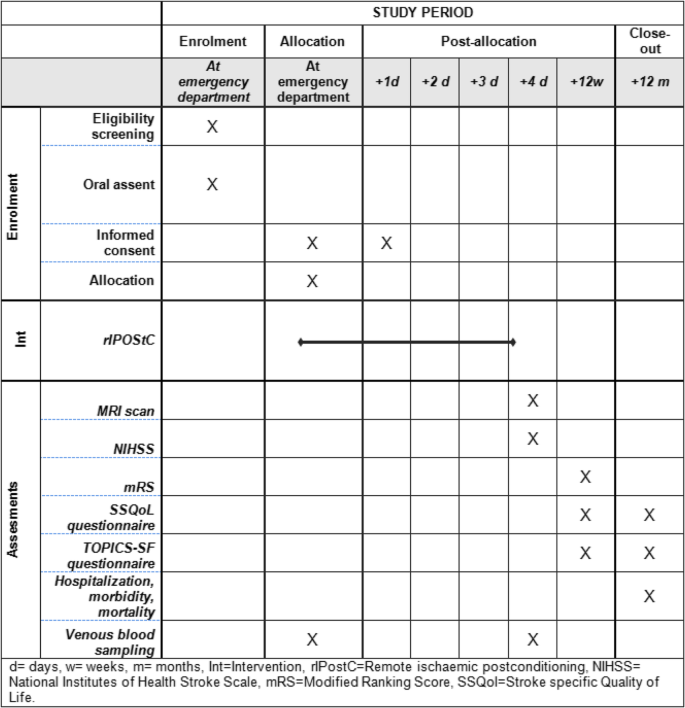
    An overview of all outcomes and corresponding measurements is presented in Fig. 1.

    figure 1

    Schedule of enrolment, interventions, and assessments according to the SPIRIT guidelines [40]. d day, w week, m month, Int intervention, MRI magnetic resonance imaging, mRS Modified Rankin Scale, NIHSS National Institutes of Health Stroke Scale, rIPostC Remote ischemic postconditioning, SSQoL Stroke-Specific Quality of Life, TOPICS-SF The Older Persons and Informal Caregivers Survey Short Form

    Fig. 1