Changing stroke rehab and research worldwide now.Time is Brain! trillions and trillions of neurons that DIE each day because there are NO effective hyperacute therapies besides tPA(only 12% effective). I have 523 posts on hyperacute therapy, enough for researchers to spend decades proving them out. These are my personal ideas and blog on stroke rehabilitation and stroke research. Do not attempt any of these without checking with your medical provider. Unless you join me in agitating, when you need these therapies they won't be there.

What this blog is for:

My blog is not to help survivors recover, it is to have the 10 million yearly stroke survivors light fires underneath their doctors, stroke hospitals and stroke researchers to get stroke solved. 100% recovery. The stroke medical world is completely failing at that goal, they don't even have it as a goal. Shortly after getting out of the hospital and getting NO information on the process or protocols of stroke rehabilitation and recovery I started searching on the internet and found that no other survivor received useful information. This is an attempt to cover all stroke rehabilitation information that should be readily available to survivors so they can talk with informed knowledge to their medical staff. It lays out what needs to be done to get stroke survivors closer to 100% recovery. It's quite disgusting that this information is not available from every stroke association and doctors group.

Showing posts with label kidney damage. Show all posts

Tuesday, May 7, 2019

Risk of Acute Kidney Injury with Consecutive, Multidose Use of Iodinated Contrast in Patients with Acute Ischemic Stroke

  Does your doctor and stroke hospital have a protocol to prevent this problem from happening? Or are they irresponsible and just hoping this won't occur?

Risk of Acute Kidney Injury with Consecutive, Multidose Use of Iodinated Contrast in Patients with Acute Ischemic Stroke

Z.Y. Jia, S.X. Wang, L.B. Zhao, Y.Z. Cao, H.B. Shi and S. Liu

    Abstract

    SUMMARY: Currently, CTA is the imaging technique most frequently used to evaluate acute ischemic stroke, and patients with intracranial large-vessel occlusion usually undergo endovascular treatment. This single-center, prospective, cohort study showed that consecutive, multidose use of contrast during CTA and DSA does not increase the incidence of acute kidney injury in patients with acute ischemic stroke, though acute kidney injury tended to have a higher incidence in the contrast multiexposure group (P = .172).

    CTA and CTP are the most frequently used noninvasive vascular imaging techniques to evaluate acute ischemic stroke (AIS).1,2 Analyses from a number of observational studies suggest that the risk of contrast-induced acute kidney injury (AKI) secondary to CTA/CTP imaging is relatively low in patients with AIS, particularly those with no history of renal impairment.13
    Apart from CTA/CTP, most patients with AIS, within the time window of recanalization, undergo intra-arterial thrombectomy, which is associated with exposure to additional iodinated contrast medium during DSA.48 Because the potential risk from iodinated contrast exposure is proportional to the dose of contrast medium administered, multiple, consecutive doses of contrast medium could imply a greater risk for AKI.9,10 Although several studies have cited data regarding the safety of the consecutive use of contrast medium in patients with AIS for CTA/CTP and DSA, the sample sizes have been small, most of the studies were retrospective, and the definition of AKI differed among the studies.1114 Hence, AKI induced by consecutive multidosing of contrast medium is still a perceived risk. We therefore performed this prospective study to determine whether consecutive, multidose use of contrast increases the incidence of AKI compared with its single use in patients with AIS.

    Materials and Methods

    Study Design and Patient Enrollment

    This study is a prospective, registered, cohort study performed from September 2016 to September 2017 at a single medical center with the approval of the institutional review board of the center. Informed consent was obtained from all patients or their legal representatives.
    Patient inclusion criteria were the following: 1) 18 years of age or older; 2) suspicion of AIS; 3) seen within 6 hours of developing anterior circulation symptoms or within 24 hours of posterior circulation symptoms; 4) no intracranial hemorrhage; and 5) underwent CTA. Exclusion criteria were lack of a baseline creatinine level or lack of a follow-up creatinine level 48 hours after CTA.

    Imaging

    All imaging was performed on a 64-section CT scanner (Optima CT660, GE Healthcare, Milwaukee, Wisconsin). For CTA, isotonic contrast material (1.5 mL/kg) (iodixanol, 320 mg I/mL, Visipaque 320; GE Healthcare, Piscataway, New Jersey) was injected at a rate of 4 mL/s, followed by a 20-mL saline bolus chaser using a dual-head injector. The upper limit volume of the contrast material was 100 mL.

    Endovascular Treatment

    Intra-arterial treatment consisted of thrombolysis, mechanical thrombectomy with a stent retriever or aspiration catheter, balloon angioplasty and stent insertion, or carotid artery stent placement. The volume of the contrast (iodixanol, 320 mg I/mL, Visipaque 320) used during the procedure was recorded.

    Definition of AKI

    AKI was defined as a >25% increase in the serum creatinine value over the baseline value 48 hours after CTA. The incidence of AKI was compared between patients given iodinated contrast medium for CTA (single exposure, CTA group) versus those given contrast medium for CTA and DSA (consecutive multiexposure, DSA group).

    Statistical Analysis

    The Student t test or the Mann-Whitney U test (for unevenly distributed categoric variables) was used to identify the difference in continuous variables. The difference in each of the categoric variables between the 2 groups was tested using a χ2 or Fisher exact test. Two-tailed P < .05 was considered statistically significant.

    Results

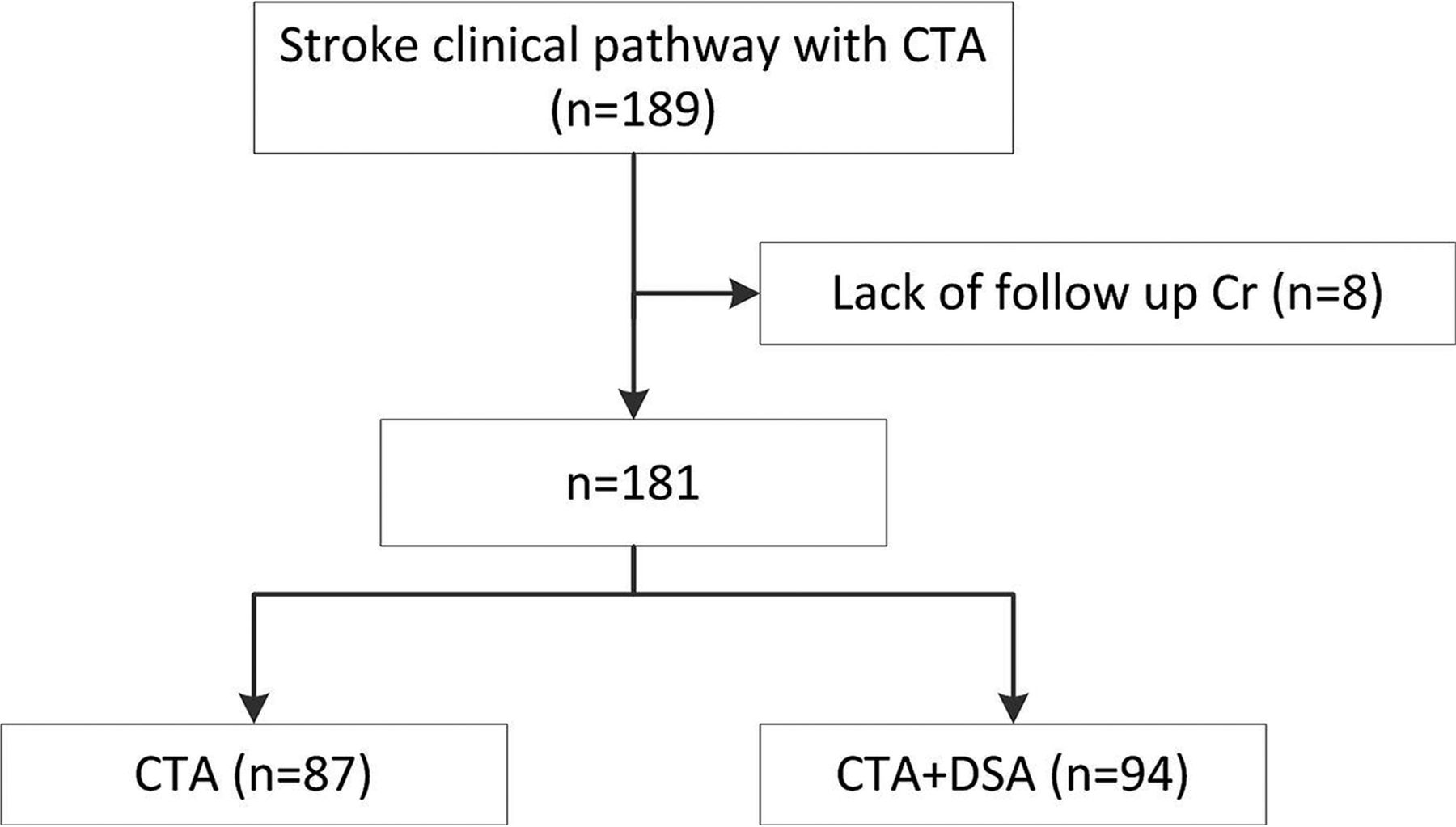
    Altogether, 181 patients with AIS were included in this study (Figure and Table 1), of whom 87 underwent CTA examinations and 94 underwent both CTA and DSA examinations. All patients were given intravenous normal saline for hydration.
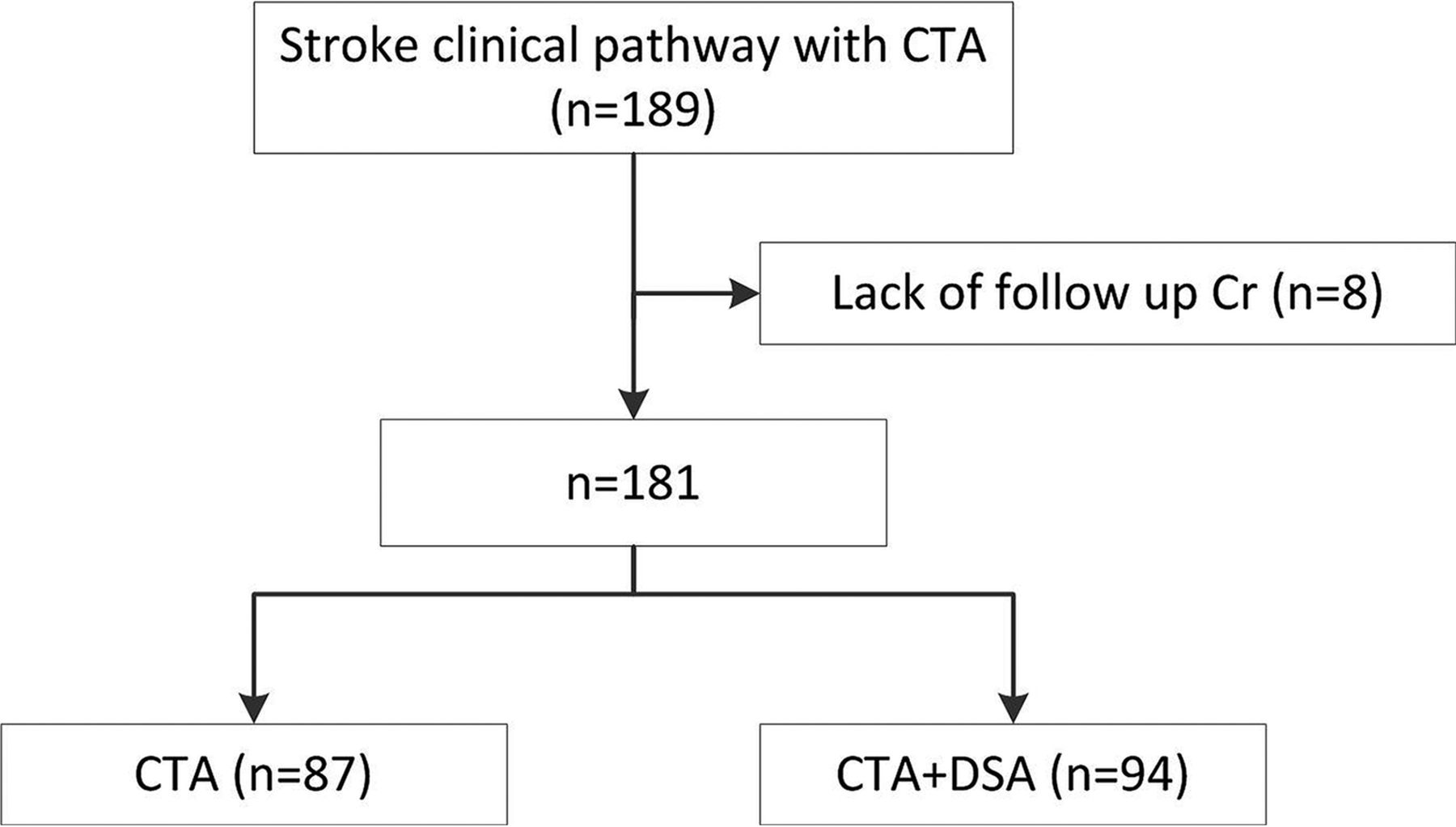
    FIGURE.
    Flow chart of the study.
    Table 1:
    Baseline demographics and characteristicsa
    The mean serum creatinine levels are shown in Table 2. Nine patients (5.0%) met the diagnostic criteria for AKI: 2 in the CTA group (2.3%) and 7 in the DSA group (7.4%) (P = .172). On average, patients with AKI had creatinine level increases: 0.24 ± 0.06 mg/dL (31.0% ± 6.9%) in the CTA group and 1.71 ± 2.42 mg/dL (131.6% ± 160.2%) in the DSA group.
    Table 2:
    Incidence of acute kidney injury in 2 study cohorts

    Discussion

    This prospective study showed that the additional use of contrast for endovascular treatment after CTA did not increase the incidence of AKI, consistent with the results of previous studies.1015
    Although the study was designed prospectively, we did not expect that the postimaging laboratory studies would be unavailable for patients with mild symptoms who left the hospital early. Loss of patients presents a potential risk of biasing the results. In addition, the prevalence of underlying medical comorbidities, such as atrial fibrillation and heart failure, was higher in the DSA group, which may predispose the patients to develop AKI.
    There was no statistically significant difference in AKI incidence between the CTA and DSA groups, though a trend toward a higher incidence of AKI was observed with consecutive, multidose use of contrast (7.4% versus 2.3%). We agree that the benefits of the endovascular treatment most likely outweigh the potential risks of AKI because these benefits were confirmed in 5 prior trials.48 We do think that controlling the total volume of contrast medium during the endovascular treatment is still necessary.
    The definition of AKI varied in previous studies, ranging from an increase in the serum creatinine level of 25%–50% from the baseline level to an absolute increase of 0.3 or 0.5 mg/dL.1015 In the current study, we chose a >25% increase in the serum creatinine level as the threshold for an AKI diagnosis, which was more sensitive than the criterion of a >50% increase or a >0.5-mg/dL increase, and it may have led to a higher incidence of AKI (7.4% in the DSA group) compared with the rate of AKI reported in previous studies (0%–9%) with varying standards.1015

    Conclusions

    This prospective study showed that consecutive, multidose use of contrast for CTA and DSA did not significantly increase the rate of AKI in patients with AIS compared with the 1-time use of contrast for CTA. The trend toward an increased AKI incidence after using more contrast should be further investigated.

    Footnotes

    • Zhen Yu Jia and Shao Xian Wang contributed equally to this work.
    • This work was supported by the Construction Program of Jiangsu Provincial Clinical Research Center Support System (BL 2014084). Clinical Trial Registration: http://www.clinicaltrials.gov; NCT03132558.
    Indicates open access to non-subscribers at www.ajnr.org

    REFERENCES

    1. 1.
    2. 2.
    3. 3.
    4. 4.
    5. 5.
    6. 6.
    7. 7.
    8. 8.
    9. 9.
    10. 10.
    11. 11.
    12. 12.
    13. 13.
    14. 14.
    15. 15.
    • Received September 17, 2018.
    • Accepted after revision November 18, 2018.
    View Abstract

    Thursday, February 9, 2017

    Kidney Function Affects Short-Term Stroke Outcomes

    My reading into this is that kidney treatment somehow takes a back seat after a stroke. With these scores is the success rate better or worse than standard patients that come in with these scores? This analysis is what should have been done rather than telling us nothing useful.
    http://dgnews.docguide.com/kidney-function-affects-short-term-stroke-outcomes?
    A routine blood test that measures kidney function can be a valuable predictor of short-term outcomes for patients who have experienced a stroke, according to a study published in the February issue of the journal Stroke.
    Nada El Husseini, MD, Wake Forest School of Medicine, Winston-Salem, North Carolina, and colleagues analysed data on more than 232,000 patients aged 65 years and older who had experienced an ischaemic stroke and were admitted to 1,581 US hospitals over a 3-year period.
    The researchers found that those patients with renal dysfunction upon admission, as indicated by the estimated glomerular filtration rate (eGFR) and basic demographic information such as age, race, and sex, were significantly more likely to die while hospitalised and far less likely to be discharged home.
    “Kidney disease is frequently a comorbidity in patients with acute ischaemic stroke,” said Dr. El Husseini. “This one test done on admission to measure kidney function can be used to better inform patients with ischaemic stroke and their families about what to expect.”
    The they study, the researchers found that in-hospital mortality was most common (29.2%) among patients with eGFR scores ≤15 without dialysis and least common (9.1%) among those with scores ≥60.
    The data also revealed that discharge home was most common (42.8%) among the patients with eGFR scores ≥60 and least common (23.5%) among those with scores of ≤15 without dialysis. The findings regarding those with eGFR scores between 16 and 59 followed similar trends in short-term outcomes, with higher scores correlating to lesser risk of in-hospital mortality and greater odds of being discharged home.
    “Any renal dysfunction was associated with increased risk of inpatient mortality and any eGFR less than 30 with lower likelihood of being discharged home,” said Dr. El Husseini. “Kidney function is clearly an important factor in stroke patients.”
    Because the study was limited to Medicare patients aged 65 years and older who were admitted to facilities participating in a voluntary nationwide quality-improvement program, the research results may not be directly applicable to other populations, noted Dr. El Husseini.
    But future research in this area might “determine if specific interventions could further influence short-term outcomes following stroke in those with kidney disease,” she said.
    SOURCE: Wake Forest Baptist Medical Center

    Sunday, December 13, 2015

    Statin Use and the Risk of Kidney Disease with Long Term Follow-up (8.4-years Study)

    Just in case you are the person that needs to keep track of side effects of your medications.
    http://www.ajconline.org/article/S0002-9149%2815%2902315-2/abstract?rss=yes

    Purchase this article (PDF Included)
    $31.50 USD (24 hour access)
    Subscribe to this title

    Abstract

    Few studies have examined long-term effects of statin therapy on kidney diseases. The objective of this study was to determine the association of statin use with incidence of acute and chronic kidney diseases after prolonged follow-up. In this retrospective cohort study, we analyzed data from the San Antonio area military health care system from October 2003 through March 2012. Statin-users were propensity score matched to non-users utilizing 82 baseline characteristics including demographics, comorbidities, medications, and health care utilization. Study outcomes were acute kidney injury (AKI), chronic kidney disease (CKD), and nephritis/nephrosis/renal sclerosis. Of the 43,438 individuals included, we propensity score-matched 6,342 statin-users with 6,342 non-users. Statin-users had higher odds of AKI (odds ratio [OR] 1.30, 95% confidence interval [95% CI] 1.14-1.48), CKD (OR 1.36, 95% CI 1.22-1.52), and nephritis/nephrosis/renal sclerosis (OR 1.35, 95% CI 1.05-1.73). In a subset of patients without co-morbidities, the association of statin use with CKD remained significant (OR 1.53, 95% CI 1.27-1.85). In a secondary analysis, adjusting for diseases/conditions that developed during follow-up weakened this association. In conclusion, statin use is associated with increased incidence of acute and chronic kidney disease. These findings are cautionary and suggest that long-term effects of statins in real-life patients may differ from shorter-term effects in selected clinical trial populations.

    Tuesday, April 17, 2012

    Coding Muddies Stats on Statin Side Effect - Rhabdomyolysis

    This was a poor article, I had to look up the definition of  Rhabdomyolysis myself. Be careful out there.
    http://www.medpagetoday.com/Cardiology/Dyslipidemia/32210
     definition first, from NIH,
    Rhabdomyolysis is the breakdown of muscle fibers that leads to the release of muscle fiber contents (myoglobin) into the bloodstream. Myoglobin is harmful to the kidney and often causes kidney damage.

    Symptoms

    • Abnormal urine color (dark, red, or cola colored)
    • Decreased urine production
    • General weakness
    • Muscle stiffness or aching (myalgia)
    • Muscle tenderness
    • Weakness of the affected muscles
    Other symptoms that may occur with this disease:
     The article:
    Relying on use of the standard diagnostic code for rhabdomyolysis, a serious but rare side effect of statin therapy, to gauge incidence of the condition may lead to both under- and overestimates, researchers said.
    Analysis of patient records maintained by the Group Health Cooperative over a 5-year period indicated that 292 charts of statin-treated patients had the ICD-9 code for rhabdomyolysis, but only 22 were validated by elevated creatine kinase levels and muscle symptoms, according to James S. Floyd, MD, of the University of Washington in Seattle.
    Another seven cases of probable rhabdomyolysis were identified for which the ICD-9 code was not used, the researchers reported in a research letter appearing in the April 18 issue of the Journal of the American Medical Association.
    In short, an ICD-9 code for the condition had a positive predictive value of just 7.5% (95% CI 5.0% to 11.1%), Floyd and colleagues wrote, while its sensitivity was 76% (95% CI 58% to 88%).
    The researchers also found that the inaccuracy was not spread evenly across different types of statin therapy. In particular, it led to an underestimate of the actual rhabdomyolysis risk associated with high-dose simvastatin (Zocor), which was the subject of an FDA warning last year.
    A higher proportion of the validated rhabdomyolysis cases were in patients taking simvastatin at 80 mg/day or more than among those with the ICD-9 code, Floyd and colleagues found.
    As a result, the incidence rate ratio for validated cases in patients on high-dose simvastatin, relative to those taking doses of 20 to 39 mg/day, was 12.2 (95% CI 3.6 to 52.3), whereas use of ICD-9 codes produced an incidence rate ratio of only 1.77 (95% CI 1.05 to 2.88).
    The researchers' analysis also showed a trend toward an increase in risk associated with more moderate simvastatin doses -- an incidence rate of 14.1 per 100,000 person-years (95% CI 6.1 to 27.8) at doses of 40 to 79 mg/day, whereas for all other statin drugs combined -- mostly lovastatin (Mevacor) or atorvastatin (Lipitor) -- the rate was 5.2 per 100,000 person-years (95% CI 1.9 to 11.2).
    "The use of administrative data alone in studies of adverse drug reactions with multiple causes may fail to detect actionable and clinically important harms," Floyd and colleagues concluded.
    To validate a case of rhabdomyolysis, the researchers looked for chart records indicating muscle symptoms with a peak creatine kinase level of 10 times the upper limit of normal or higher.
    When peak creatine kinase fell between 5 and 10 times the upper limit of normal, they classed the event as myopathy. The rate of myopathy also appeared to be elevated in patients on high-dose simvastatin versus those taking other statins or lower simvastatin doses.
    Floyd and colleagues noted that they did not adjust for potential confounding factors and also may have missed some cases of statin-associated rhabdomyolysis.
    In searching for rhabdomyolysis cases that lacked the ICD-9 code, the researchers looked for clear records of the defining symptoms and also for the words "rhabdo" and "statin" appearing near each other anywhere in the record.