Changing stroke rehab and research worldwide now.Time is Brain! trillions and trillions of neurons that DIE each day because there are NO effective hyperacute therapies besides tPA(only 12% effective). I have 523 posts on hyperacute therapy, enough for researchers to spend decades proving them out. These are my personal ideas and blog on stroke rehabilitation and stroke research. Do not attempt any of these without checking with your medical provider. Unless you join me in agitating, when you need these therapies they won't be there.

What this blog is for:

My blog is not to help survivors recover, it is to have the 10 million yearly stroke survivors light fires underneath their doctors, stroke hospitals and stroke researchers to get stroke solved. 100% recovery. The stroke medical world is completely failing at that goal, they don't even have it as a goal. Shortly after getting out of the hospital and getting NO information on the process or protocols of stroke rehabilitation and recovery I started searching on the internet and found that no other survivor received useful information. This is an attempt to cover all stroke rehabilitation information that should be readily available to survivors so they can talk with informed knowledge to their medical staff. It lays out what needs to be done to get stroke survivors closer to 100% recovery. It's quite disgusting that this information is not available from every stroke association and doctors group.

Showing posts with label robotics. Show all posts

Tuesday, June 30, 2026

Transcutaneous spinal stimulation with upper extremity robotic training in chronic stroke and spinal cord injury: individual neurophysiological and clinical responses

 How close is your competent? doctor to using this? What is your doctor doing to prevent spasticity from interfering with this intervention?

Transcutaneous spinal cord stimulation (tSCS) is a non-invasive neuromodulation technique that delivers mild electrical currents through the skin to the spinal cord. It stimulates dormant nerve pathways to help restore voluntary movement, balance, and sensation, typically when paired with physical or occupational therapy.


Transcutaneous spinal stimulation with upper extremity robotic training in chronic stroke and spinal cord injury: individual neurophysiological and clinical responses

    We are providing an unedited version of this manuscript to give early access to its findings. Before final publication, the manuscript will undergo further editing. Please note there may be errors present which affect the content, and all legal disclaimers apply.

    Abstract

    Background

    Damage to the corticospinal tract after stroke and spinal cord injury (SCI) often results in persistent upper extremity (UE) impairment. Transcutaneous spinal stimulation (TSS) and robotic technologies have been explored as approaches to facilitate motor training; however, their combined effects on UE sensorimotor recovery remain poorly understood. The purpose of this study was to examine the effects of TSS combined with UE robotic training in individuals with chronic stroke or SCI.

    Methods

    Five participants with stroke and six with SCI completed a 14-week, sham controlled, single blind crossover study consisting of four total weeks of assessments (one week each pre and post for both training phases), four weeks of UE training with sham TSS, a two-week washout period, and four weeks of UE training with active TSS. Each one-hour session (three days/week) included robotic exoskeleton-assisted UE movements and hand grip training, performed concurrently with sham or active TSS. Assessments included electrophysiological measurements and standardized rehabilitation outcomes.

    Results

    Descriptive analysis revealed meaningful individual improvements masked by group-level heterogeneity. In the stroke group, three participants showed grip strength improvement (assessed without stimulation) after the active phase (+ 9.4 Newtons [N] to + 23.9 N), with two-to-four-fold increases in forearm muscle activation. Mean Fugl-Meyer overall UE scores improved from 89 to 94.2. In the SCI group, two participants showed grip strength gains. One participant exhibited a six-fold immediate force increase (1.0 N to 6.2 N) during stimulation. Another participant achieved improved grip strength without stimulation (23.9 N to 36.8 N) and a three-fold increase in electromyography (EMG) activity from the flexor carpi radialis and first dorsal interosseous muscles, alongside partial pin-prick sensory recovery and self-reported restoration of previously affected perspiration during the active TSS phase.

    Conclusions

    Varied outcomes in participants confirm that therapeutic effects of combined TSS and robotic UE training are highly individualized. Three critical elements must be blended for the best outcomes of this combinatorial approach: residual UE function, a curated stimulation paradigm, and tailored UE training that provides appropriate challenge, intensity, and salience. The results suggest TSS with UE robotic training hold key potential when considered in the context of the physiological and functional profile of each participant.

    Highlights

    • Cervical TSS was applied during robotic upper extremity training in individuals with neurological impairment.

    • A within-subject sham-controlled crossover design compared active and sham stimulation conditions.

    • Neurophysiological responses and sensorimotor performance varied across individuals during stimulation.

    • Improvements were most frequently observed during near motor-threshold stimulation combined with active task engagement.

    Tuesday, March 3, 2026

    Intra- and inter-day effects of novel robot-assisted hand movement training in individuals with post-stroke hemiparesis: a single-arm pilot study

    So, failure to recover occurred! And no acknowledgement of that failure!

     Intra- and inter-day effects of novel robot-assisted hand movement training in individuals with post-stroke hemiparesis: a single-armpilot study 

    y Kazuki Ushizawa, OTR, MS1,2, Shintaro Uehara, RPT, PhD3, Akiko Yuasa, RPT, PhD1,4, Taiki Yoshida, OTR, PhD3, Kyoichi Tomita1, Takayuki Ohtomo, PhD1, Shigeo Tanabe, RPT, PhD3, Yohei Otaka, MD, PhD1 1Department of Rehabilitation Medicine, School of Medicine, Fujita Health University, Toyoake, Aichi, Japan, 2 Graduate School of Health Sciences, Fujita Health University, Toyoake, Aichi, Japan, 3 Faculty of Rehabilitation, School of Health Sciences, Fujita Health University, Toyoake, Aichi, Japan, 4Japan Society for the Promotion of Science, Chiyoda, Tokyo, Japan 

    Abstract 


    Objectives: To investigate the feasibility of robot-assisted hand movement training using a novel end-effector robot in individuals after stroke. Methods: Eleven individuals with subacute stroke with hand motor impairment underwent robot-assisted repetitive finger flexion/extension for 20 min daily and repeated this training on 7 non-consecutive days. The robot was designed to allow the flexion and extension of the metacarpophalangeal and proximal interphalangeal joints of the index to the little fingers, and to provide assistive torque if the movement did not reach the target angle within a limited time. We assessed the co-contraction index (CCI) of the flexor digitorum superficialis and extensor digitorum muscles and assessed the active range of motion (AROM) of the index finger before and after training each day (intra-day effect). We performed clinical assessments of motor function and spasticity and evaluated the CCI and AROM before and immediately after the 7-day training (inter-day effect). 

    Results: 
    Ten participants completed the 7-day training. For the intra-day effect, the CCI was significantly decreased immediately after training, particularly during active finger flexion, and the AROM tended to improve from the middle of the training days. For the inter-day effect, there were no significant changes in the Stroke Impairment Assessment Set for Finger Function, modified Ashworth scale, CCI, or AROM after the 7-day training. 

    Conclusions: 
    Repetitive finger movement training with the assistance of the novel robot improves(NOT GOOD ENOUGH! Survivors want full recovery and YOU FAILED THEM!muscle activation patterns, reducing co-activation between the agonist and antagonist muscles immediately after training

    Friday, December 5, 2025

    The Doctor Behind Turkey's Robotic Rehab Revolution: Dr. Mustafa Corum

     Will your competent? doctor and hospital learn and implement anything from his success? Oh no, they don't know about it and plan nothing. Perfect example of extreme incompetence of everyone involved!

    The Doctor Behind Turkey's Robotic Rehab Revolution: Dr. Mustafa Corum

    Doc. Dr. Mustafa Corum, a groundbreaking figure in Physical Medicine and Rehabilitation, has emerged as one of the leading pioneers of robot-assisted rehabilitation in Turkey and on the international stage.
    Combining advanced technology with traditional therapeutic methods--particularly in the treatment of stroke, traumatic brain injury, and spinal cord damage--Dr. Corum has become a widely recognized name in the field.

    A New Approach to Robotic Rehabilitation

    Dr. Corum's technology-driven approach goes far beyond conventional physiotherapy techniques. His practice incorporates state-of-the-art robotic systems and virtual-reality-supported rehabilitation devices.

    The systems featured in his clinic include:
    ? Lokomat Pro - robotic gait training system
    ? C-Mill VR Plus - virtual-reality-based treadmill and balance platform
    ? Armeo Spring - arm and upper-limb robotic therapy device
    ? Amadeo - robotic finger therapy system
    ? Erigo Pro - robotic tilt-table and early-mobilization platform

    These technologies provide intensive, personalized therapy programs that aid in regaining gait, mobility, and upper-limb functions following stroke. Dr. Corum emphasizes three key principles in his method: early intervention, high-intensity therapy, and individualized programming.

    Patient Stories and Remarkable Success

    The patient cases treated in Dr. Corum's clinic demonstrate the tangible outcomes of this innovative approach. One notable example includes a stroke patient who traveled from Germany to Turkey. The patient arrived with severe complications, including infection and difficulty swallowing. Following a structured robotic rehabilitation program, they progressed to the point of walking indoors with support.

    Dr. Corum's social media accounts also showcase real-time demonstrations of robotic therapy, offering a closer look at how these devices function during treatment sessions.

    Revolutionary Impact and Turkey's Role

    Dr. Corum stands at the forefront of Turkey's technological transformation in physical rehabilitation. By making robotic systems more accessible and expanding the scope of neurorehabilitation practices, he has offered renewed hope to thousands of neurological patients.

    Among the key benefits of robotic rehabilitation are:
    - faster recovery of motor functions,
    - enhanced neuroplasticity through high-repetition movements,
    - safer and more controlled therapy environments.

    According to Dr. Corum, when applied at the right time and intensity, robot-assisted therapy can produce significantly better outcomes than traditional rehabilitation alone.

    A Vision Beyond Turkey

    Dr. Corum's ambitions extend far beyond national borders. His clinic welcomes international patients and offers comprehensive inpatient robotic rehabilitation programs operated by a multidisciplinary team of physicians, physiotherapists, occupational therapists, and speech-language pathologists.

    He also contributes to the scientific community through academic publications and conference presentations. One of his recent studies focuses on a pilot randomized trial examining the effects of robot-assisted upper-extremity training.

    Friday, October 24, 2025

    Combining gamma neuromodulation and robotic rehabilitation after a stroke restores parvalbumin interneuron dynamics and improves motor recovery in mice

    Nothing here resembles a protocol, so totally useless information that can get survivors recovered!

    Combining gamma neuromodulation and robotic rehabilitation after a stroke restores parvalbumin interneuron dynamics and improves motor recovery in mice

    Abstract

    Stroke is a leading cause of long-term disability, frequently associated with persistent motor deficits. Gamma band oscillations, generated by synchronous discharge of parvalbumin-positive interneurons (PV-INs), are critically affected after stroke in humans and animals. Both gamma band and PV-INs play a key role in motor function, thus representing a promising target for poststroke neurorehabilitation. Noninvasive neuromodulatory approaches are considered a safe intervention and can be used for this purpose. Here, we present a novel, clinically relevant, noninvasive, and well-tolerated sub-acute treatment combining robotic rehabilitation with advanced neuromodulation techniques, validated in a mouse model of ischemic injury. During the sub-acute poststroke phase, we scored profound deficits in motor-related gamma band activity in the perilesional cortex. These deficits were accompanied by reduced PV-IN firing rates and increased functional connectivity, both at the perilesional and at the whole-cortex levels. Therefore, we tested the therapeutic potential of coupling robotic rehabilitation with optogenetic PV-IN-driven gamma band stimulation in a subacute poststroke phase during motor training to reinforce the efficacy of the treatment. Frequency-specific movement-related gamma band stimulation, when combined with physical training, significantly improved forelimb motor function(Where is the protocol to accomplish recovery? Since you didn't do that, all this is fucking useless!). More importantly, by pairing robotic rehabilitation with a clinical-like noninvasive 40 Hz transcranial Alternating Current Stimulation, we achieved similar motor improvements(Same question as above!) mediated by the effective restoring of movement-related gamma band power, improvement of PV-IN maladaptive network dynamics, and increased PV-IN connections in premotor cortex. Our research introduces a new understanding of the role of parvalbumin-interneurons in poststroke impairment and recovery. These results highlight the synergistic potential of combining perilesional gamma band stimulation with robotic rehabilitation as a promising and realistic therapeutic approach for stroke patients.

    Saturday, October 11, 2025

    Robotic rehabilitation and intelligent algorithms improving the performance skills of stroke patients: a scoping review

     You're published BUT NOTHING HERE get survivors recovered via EXACT PROTOCOLS! Your mentors and senior researchers need to be fired for incompetence! The only goal in stroke is 100% recovery, and this DID NOTHING TOWARDS THAT!

    You've had well over a decade to create robotic rehab protocols and ACCOMPLISHED NOTHING!

  • robotics (346 posts to August 2011)
  • Robotic rehabilitation and intelligent algorithms improving the performance skills of stroke patients: a scoping review


    Omid Rustamzadeh1,2 ∙ Seyed Ali Hosseini3 ∙ Rastegar Rahmani Tanha4 ∙ Nazila Akbarfahimi5 na.akbarfahimi@uswr.ac.ir

    Abstract

    Background

    This scoping review highlights major advances and persisting gaps in robotic and AI-driven rehabilitation for stroke, evaluating their impact on hand strength, dexterity, and ROM, and offering clinicians practical, updated guidance.
    Studies that focused on robotic-assisted technologies (RATs) in upper limb rehabilitation for stroke survivors (2014–2024) were included. Study designs unrelated to stroke, animal studies, and conference abstracts were excluded. Systematic searching in PubMed, Web of Science, Scopus, and Google Scholar employed robotic rehabilitation, AI, hand function, and stroke recovery-related terms. Data extraction encompassed intervention type, duration of treatment, dosage of therapy, outcome measures, cost-effectiveness, and patient satisfaction. Types of robotic rehabilitation: end-effector robots, exoskeletons, soft robotic gloves (SRGs), brain-computer interfaces (BCIs), and AI-enhanced virtual reality (AIVR).These devices can augment motion, grip strength, and functional independence, especially in chronic and subacute stroke patients. Therapies are made fine-grained by algorithms to balance challenge and engagement, thus lightening therapists’ burdens. Conventional energy sources may offer a more attractive option at shorter timelines and with reasonably predictable availability. Models that can be done at home enhance adherence at that higher level, though usability appears high for most models. Still, challenges with setup and independence for participants remain.

    Conclusion

    Robotic rehabilitation has a significant impact on motor function (MF) among stroke patients. Despite this, obstacles such as cost, accessibility, and long-term efficacy need even more research. Therapy dose optimization, adaptive AI integration, and cognitive-emotional outcome assessment are all areas of gaps in robotic rehabilitation that still need to be addressed.

    Saturday, September 27, 2025

    The Robotic Breakthrough That Could Help Stroke Survivors Reclaim Their Stride

     How EXACTLY is your competent? doctor getting your gait recovered until this becomes widely available?

    NOTHING! SO, YOUR DOCTOR IS COMPLETELY FUCKING INCOMPETENT? And that goes for the board of directors also!

    Oops, I'm not playing by the polite rules of Dale Carnegie,  'How to Win Friends and Influence People'. 

    Telling stroke medical persons they know nothing about stroke is a no-no even if it is true. 

    Politeness will never solve anything in stroke. Yes, I'm a bomb thrower and proud of it. Someday a stroke 'leader' will try to ream me out for making them look bad by being truthful , I look forward to that day.

    The Robotic Breakthrough That Could Help Stroke Survivors Reclaim Their Stride

    Georgia Institute of TechnologyNewswise — Crossing a room shouldn’t feel like a marathon. But for many stroke survivors, even the smallest number of steps carries enormous weight. Each movement becomes a reminder of lost coordination, muscle weakness, and physical vulnerability. A team of Georgia Tech researchers wanted to ease that struggle, and robotic exoskeletons offered a promising path. Their findings point to a simple but powerful shift: exoskeletons that adapt to people, rather than forcing people to adapt to the machine. Using artificial intelligence (AI) to learn the rhythm of patients’ strides in real time, the team showed how these devices can reduce strain and increase efficiency. They also demonstrated how the technology can help restore confidence for stroke survivors.

    The Robot Finds the Rhythm

    A robotic exoskeleton is a wearable device that helps people move with mechanical support. Traditional exoskeletons require endless manual adjustments — tu


    The Robotic Breakthrough That Could Help Stroke Survivors Reclaim Their Stride

    Georgia Institute of TechnologyNewswise — Crossin rning knobs, calibrating settings, and tweaking controls. “It can be frustrating, even nearly impossible, to get it right for each person,” said Aaron Young, associate professor in the George W. Woodruff School of Mechanical Engineering. “With AI, the exoskeleton figures out the mapping itself. It learns the timing of someone’s gait through a neural network, without an engineer needing to hand-tune everything.” The software monitors each step, instantly updates, and fine-tunes the support it provides. Over time, the exoskeleton aligns its movements with the unique gait of the person wearing it. In this study, the research team used a hip exoskeleton, which provides torque at the hip joint — in other words, adding power to help stroke survivors walk or move their legs more easily. Walking after a stroke can be tough and unpredictable. A patient’s stride can change from one day to the next, and even from one step to the next. Most exoskeletons aren’t built for that kind of variation. They are designed around the steady, even gait of healthy young adults, which can leave stroke survivors feeling more unsteady than supported. IEEE Transactions on Robotics is a neural network — a type of AI that learns patterns much like the human brain does. Sensors at the hip pick up how someone is moving, and the network translates those signals into just the right boost of power to support each step. It quickly figures out a person’s unique walking pattern. But lead clinician Kinsey Herrin said the AI’s learning doesn’t stop there. It keeps adjusting as the patient walks, so the exoskeleton can stay in sync even during stride shifts. “The speed really surprised us,” Young said. “In just one to two minutes of walking, the system had already learned a person’s gait pattern with high accuracy. That’s a big deal, to adapt that quickly and then keep adapting as they move.” Tests showed the system was far more accurate than the standard exoskeleton. It reduced errors in tracking stroke patients’ walking patterns by 70%. Young emphasized that this research is about more than metrics. “When you see someone able to walk farther without becoming exhausted, that’s when you realize this isn’t just about robotics — it’s about giving people back a measure of independence,” he said.

    Adapting Anywhere

    Every exoskeleton comes with its own set of sensors, so the data they collect can look completely different from one device to the next. A neural network trained on one machine often stumbles when it’s moved to another. To get around that, Young’s team designed software that works like a universal adapter plug — no matter what device it’s connected to, it converts the signals into a form the AI can use. After just 10 strides of calibration, the system cut error rates by more than 75%.“The goal is that someone could strap on a device, and, within a minute, it feels like it was built just for them,” Young said.

    A Step Toward the Future

    While the study centered on stroke survivors, the implications are far broader. The same adaptive approach could support older adults coping with age-related muscle weakness, people with conditions like Parkinson’s or osteoarthritis, or even children with neurological disabilities. Young and his team are now running clinical trials to measure how well the AI-powered exoskeleton supports people in a wide range of everyday activities. “There’s no such thing as an ‘average’ user,” Young said. “The real challenge is designing technology that can adapt to the full spectrum of human mobility.” If Georgia Tech’s exoskeleton can rise to that challenge, the promise goes well beyond the lab. It could mean a world where technology doesn’t just help people walk — it learns to walk with them. Inseung Kang, who holds a B.S., M.S., and Ph.D. from Georgia Tech, is the paper’s lead author and now an assistant professor of mechanical engineering at Carnegie Mellon University. He explained that the real promise is in what comes next. “We’ve developed a system that can adjust to a person’s walking style in just minutes. But the potential is even greater. Imagine an exoskeleton that keeps learning with you over your lifetime, adjusting as your body and mobility change. Think of it as a robot companion that understands how you walk and gives you the right assistance every step of the way.” Aaron Young is affiliated with Georgia Tech’s Institute for Robotics and Intelligent Machines This research was primarily funded by a grant (DP2HD111709-01) from the National Institutes of Health New Innovator Award Program. Georgia Tech researchers have created the first lung-on-a-chip with a functioning immune system, allowing it to respond to infections much like a real human lung. The breakthrough, published in Nature Biomedical Engineering, provides a more accurate way to study diseases, test therapies, and reduce reliance on animal models. With potential applications in conditions from influenza to cancer, the technology opens the door to personalized medicine that predicts how individual patients will respond to treatment. 

    Monday, July 21, 2025

    Multimodal closed-loop strategies for gait recovery after spinal cord injury and stroke via the integration of robotics and neuromodulation

    I'm sure your competent? doctor knows all this already and has EXACT PROTOCOLS FOR YOUR RECOVERY! NO? So, you DON'T have a functioning stroke doctor, do you? You're not 100% recovered! Why is your doctor getting paid at all? This is all just beating around the bush because NO PROTOCOL FOR GAIT RECOVERY EXISTS!

    And that is directly the result of our  fucking failures of stroke associations that aren't solving stroke!

     Multimodal closed-loop strategies for gait recovery after spinal cord injury and stroke via the integration of robotics and neuromodulation


    • 1CHUV, Department of Clinical Neurosciences, University Hospital Lausanne, Lausanne, Switzerland
    • 2Bertarelli Foundation Chair in Translational Neural Engineering, Neuro-X Institute, Ecole Polytechnique Federale de Lausanne, Lausanne, Switzerland
    • 3Modular Implantable Neurotechnologies (MINE) Laboratory, Università Vita Salute San Raffaele & Scuola Superiore Sant'Anna, Milan, Italy

    Restoring the ability to walk is a priority for individuals with neurological disorders or neurotraumatic injuries, given its significant impact on independence and quality of life. Multimodal closed-loop strategies that integrate robotic assistance and neuromodulation present promising avenues for personalized and physiological gait recovery. These approaches capitalize on residual motor activity, fostering neuroplasticity and motor relearning. This narrative review emphasizes the importance of mobile brain/body imaging (MoBI) for guiding the development of closed-loop systems that integrate volitional brain signals with residual motor activity in stroke and spinal cord injury patients. We explore the potential of rehabilitative and assistive interventional strategies based on robotic devices, such as exoskeletons and powered orthoses, and neuromodulation techniques like functional electrical stimulation and spinal cord stimulation. We highlight the limitations of the single interventional strategies and the potential of the synergistic combination of MoBI, robotics, and neuromodulation for gait recovery. By leveraging residual motor functions and integrating multimodal data from the different domains involved in motor recovery (i.e., brain, muscle, and biomechanics), the complementarity of these interventional strategies has the potential to enable dynamic patient-specific interventions. We outline a perspective framework on how future directions can exploit such integration to promote physiological recovery of lower limb functions and personalized therapies that are both challenging and feasible. Advancing along this path holds the promise of enhancing rehabilitative strategies, ultimately promoting functional recovery and long-term independence for individuals with neuromotor disorders.

    1 Introduction

    Neurological disorders and neurotraumatic injuries often result in severe motor impairments that significantly impact patients' independence (Oczkowski and Barreca, 1993; Catz et al., 1997; Scivoletto et al., 2013) and quality of life (King, 1996; Dijkers, 1997; Westgren and Levi, 1998). However, residual motor activity, which is preserved in many affected patients, can be harnessed to promote neuroplasticity and enhance muscle strength, ultimately resulting in significant functional improvements (Dobkin, 2004; van Hedel and Dietz, 2010; Langhorne et al., 2011; Nas et al., 2015; Stinear et al., 2020; Somers and Bender-Burnett, 2024). For instance, spinal cord injuries (SCI) are typically subdivided into complete and incomplete, with incomplete SCIs sparing at least some sensorimotor functions (Kang et al., 2018). Even in the case of complete SCIs, where no residual sensorimotor function is observable, some studies have suggested that electrical stimulation and intensive rehabilitation may lead to the restoration of voluntary movements (Angeli et al., 2014). Thus, the absence of observable residual function does not necessarily correspond to a complete lack of neural traffic through the cortico-spinal tract, which may be leveraged through rehabilitation (Wahlgren et al., 2021). Similarly, even though stroke typically causes limb paresis contralateral to the produced brain lesion, substantial functional recovery can be attained by exploiting residual motor functions and the plasticity of nearby brain regions (Virani et al., 2020).

    When SCI or stroke results in lower limb paralysis, restoring the ability to walk safely and independently becomes a primary goal for affected individuals. In particular, individuals with SCI-related paraplegia consistently rank gait restoration among their highest priorities, second only to the recovery of bladder, bowel, and sexual functions (Simpson et al., 2012). Although stroke more commonly causes unilateral motor impairments, it is estimated that approximately one-third of stroke survivors do not regain independent ambulation (Hendricks et al., 2002). Among those who do, many continue to exhibit pathological gait asymmetries and reduced walking speed (Veerbeek et al., 2014). Furthermore, even in patients who retain some degree of mobility, residual muscle weakness can contribute to balance deficits, a problem exacerbated by advanced age (Beyaert et al., 2015). While regaining the ability to walk is a central aim of rehabilitation in individuals with lower limb paralysis, even achieving upright standing can yield systemic benefits. These include improvements in cardiovascular regulation (Dunn et al., 1998; Eng et al., 2001; Edwards and Layne, 2007), as well as enhanced bowel (Dunn et al., 1998; Walter et al., 1999; Eng et al., 2001; Hoenig et al., 2001; Netz et al., 2007) and urinary function (Dunn et al., 1998; Walter et al., 1999; Eng et al., 2001).

    In recent years, a variety of technology-based interventional strategies have been explored as add-ons to traditional physical therapy for the rehabilitation of lower limb function. In this context, here we focus on two key approaches: powered orthoses and exoskeletons, robotic devices designed to provide mechanical support and passive movement to paralyzed limbs (Herr, 2009), and neuromodulation, which facilitates muscle contractions through the electrical stimulation of the neuromuscular system (Hamid and Hayek, 2008; Popović et al., 2009). Initial proof-of-concept studies have demonstrated the potential of these technologies to restore gait (Asselin et al., 2016; Wagner et al., 2018; Haufe et al., 2020; Romeni et al., 2025) and to support the execution of basic functional tasks such as standing (Hankov et al., 2025), sit-to-stand transitions (Li et al., 2023; Romeni et al., 2025), and stair climbing (Hankov et al., 2025; Romeni et al., 2025). These encouraging results have catalyzed efforts to translate such technologies into real-world applications and activities of daily living (van Dijsseldonk et al., 2020; Rowald et al., 2022), which require more sophisticated control strategies as well as improvements in portability and ease of use in unstructured environments.

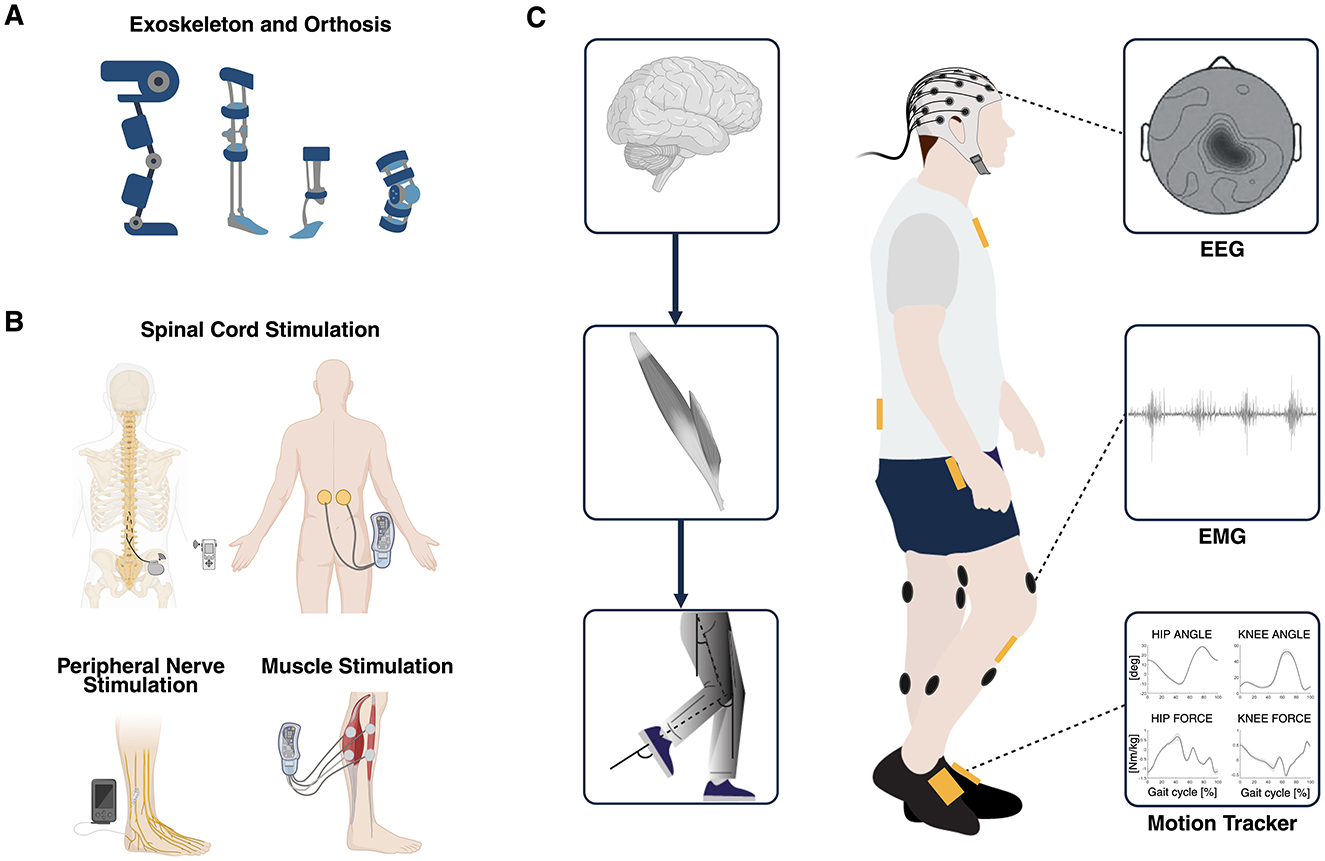
    Over time, various control strategies have been developed with the dual aim of enabling intuitive and continuous user-driven control to enhance device usability and acceptance (Semprini et al., 2022) and promoting activity-dependent plasticity in the nervous system to maximize neurological recovery (Roy et al., 2012; Mrachacz-Kersting et al., 2019). Wearable mobile brain/body imaging (MoBI) systems, capable of continuously capturing high-density brain and muscle signals along with body movement's kinematics, offer a comprehensive way to optimize and adapt the control of interventional devices (He et al., 2018b) (Figure 1).

    Figure 1
    www.frontiersin.org

    Figure 1. (A) Overview of robot-assisted devices such as exoskeletons and powered orthoses used as established interventional strategies for gait recovery. (B) Overview of electrical stimulation of the spinal cord, the nerves, and the muscles used as established interventional strategies for gait recovery. (C) Multimodal data used to simultaneously explore different domains of the hierarchical organization of the neuromusculoskeletal system: brain, muscles, and biomechanics (MoBI framework). Multimodal biomarkers of residual motor activity can be extracted from EEG, EMG, and kinematics signals and can be exploited to control in real-time different closed-loop interventions aimed at recovering walking through personalized assistance and therapy. MoBI, mobile brain/body imaging; EEG, electroencephalography; EMG, electromyography. Created with BioRender. de Seta V and Romeni S (2025). https://BioRender.com.

    In this narrative review, we aim to explore how robotic devices and neuromodulation can be controlled for assistive and rehabilitative interventions, and how different interventional strategies can be integrated to provide personalized gait rehabilitation, leveraging complementary mechanisms of action. First, we will present the state-of-the-art in robotic devices and neuromodulation for lower limb movement restoration; then, we will describe how patients' residual motor activity recorded through various approaches exploiting kinematic, muscle, and neural signals has been used in the past to control such technologies. Finally, we will provide indications and highlight potential issues in the integration of MoBI techniques with different combinations of robotic devices and neuromodulation technologies to achieve functional and physiological recovery of lower limb abilities. The main goal of this review is to provide an overview of rehabilitative interventions for the recovery of lower limb motor functions through the exploitation of residual motor functions, robotic devices, neuromodulation, and monitoring of neurophysiological correlates of movement.

    More at link.