Changing stroke rehab and research worldwide now.Time is Brain! trillions and trillions of neurons that DIE each day because there are NO effective hyperacute therapies besides tPA(only 12% effective). I have 523 posts on hyperacute therapy, enough for researchers to spend decades proving them out. These are my personal ideas and blog on stroke rehabilitation and stroke research. Do not attempt any of these without checking with your medical provider. Unless you join me in agitating, when you need these therapies they won't be there.

What this blog is for:

My blog is not to help survivors recover, it is to have the 10 million yearly stroke survivors light fires underneath their doctors, stroke hospitals and stroke researchers to get stroke solved. 100% recovery. The stroke medical world is completely failing at that goal, they don't even have it as a goal. Shortly after getting out of the hospital and getting NO information on the process or protocols of stroke rehabilitation and recovery I started searching on the internet and found that no other survivor received useful information. This is an attempt to cover all stroke rehabilitation information that should be readily available to survivors so they can talk with informed knowledge to their medical staff. It lays out what needs to be done to get stroke survivors closer to 100% recovery. It's quite disgusting that this information is not available from every stroke association and doctors group.

Showing posts with label state of the art. Show all posts

Tuesday, June 16, 2026

Guyana to build first state-of-the-art neuro-rehabilitation facility

State of the art doesn't exist in stroke rehab! NOTHING EXISTS FOR 100% RECOVERY!

Guyana to build first state-of-the-art neuro-rehabilitation facility

—Plans include advanced stroke rehabilitation, 3D-printed prosthetics and expanded autism services as healthcare transformation continues
AS Guyana continues to strengthen its healthcare system, efforts are advancing to expand rehabilitative care through the development of a state-of-the-art neuro-rehabilitation facility, the training of specialised personnel and the introduction of advanced technologies aimed at improving patient outcomes.
Speaking recently with the Guyana Chronicle, Director of Rehabilitation and Disability Services, Dr Ariane Mangar, said the Ministry of Health is pursuing a number of initiatives designed to deliver world-class rehabilitation services in keeping with the vision outlined by President Dr Irfaan Ali.
According to Dr Mangar, rehabilitative care remains one of the major areas of focus within the health sector, with significant progress already made in expanding services and increasing the number of trained professionals.
“We have grown a lot. The services have grown, definitely. We have more professionals, more physiotherapists. We did not have speech therapists, we did not have occupational therapists,” she said.
She noted that the ministry is continuing to work through training programmes and partnerships to increase the number of speech therapists and occupational therapists available within the healthcare system.
Among the most significant projects currently in development is a dedicated neuro-rehabilitation facility, which will focus primarily on stroke patients.
“We are in the process of working with the government to have a neuro-rehab facility built,” Dr Mangar said.
“This facility will focus on stroke patients, and we are hoping that it is a state-of-the-art facility, with everything that you can think about inside, so that it is first world as the President has said,” she added.
The facility is expected to significantly enhance Guyana’s ability to provide specialised rehabilitation services by increasing capacity and accommodating advanced medical equipment.
“We want to be able to meet the needs of people and showcase what Guyana can do. We have a lot of talent, but a lot of times we do not have the machines, or we are limited in what we have because of the space we have,” Dr Mangar explained.
“Now with the bigger space we can bring in more advanced machines, so that we can improve the services we offer,” she added.
In addition to infrastructural expansion, the ministry is also investing in workforce development and emerging technologies.
Dr Mangar revealed that healthcare personnel are currently being trained as orthotic and prosthetic technicians to improve the local production of prosthetic devices.
“We are upgrading some persons as orthotic and prosthetic technicians, so we can improve the making of prostheses here. We are also having training on the making of the sockets and splints using a 3D printer,” she said.
The introduction of 3D-printing technology is expected to dramatically reduce production times for prosthetic components.
“With a 3D printer, a socket can be made in three hours rather than three days. It improves the turnaround time,” Dr Mangar noted.
The ministry is also placing increased focus on autism services and early intervention programmes.
According to Dr Mangar, upcoming training initiatives will equip therapists and medical professionals with specialised skills to better support children diagnosed with autism.
“We are going to be doing some training in autism, behavioural training for our therapists, so that they can provide a more comprehensive service to the children who would have been diagnosed with autism,” she said.
The initiative will also involve training paediatricians and other healthcare professionals to improve the identification and diagnosis of autism in children.
“We will be working with some paediatricians, some doctors, to help them to better identify autism in children. We’re going to be doing that along with Mount Sinai and personnel from the University of Indiana, and that is almost immediate,” she added.
Looking ahead, Dr Mangar said the ministry’s long-term goal is to build a comprehensive rehabilitation system supported by a full complement of specialists and modern facilities.
“Ideally, we would like to have the full staff complement, physiotherapy, speech therapy, occupational therapy, more doctors involved, more physiatrists, more audiological practitioners and specialists,” she said.
“We could serve the people better, orthotic and prosthetic specialists, so we could meet the demands of the people. Once we have the staff and we have the facility, then we can definitely provide a world-class service,” Dr Mangar added.

Friday, April 4, 2025

Rehabilitation of Upper Limb Motor Impairment in Stroke: A Narrative Review on the Prevalence, Risk Factors, and Economic Statistics of Stroke and State of the Art Therapies

 This just proves stroke rehab is a shitshow; NOTHING ON 100% RECOVERY! There are NO state of the ART therapies! State of the Art means 100% recovery; there are none!

Send me hate mail on this: oc1dean@gmail.com. I'll print your complete statement with your name and my response in my blog. Or are you afraid to engage with my stroke-addled mind? Your patients need an explanation of why you aren't working on survivor requirements of 100% recovery protocols. 

Rehabilitation of Upper Limb Motor Impairment in Stroke: A Narrative Review on the Prevalence, Risk Factors, and Economic Statistics of Stroke and State of the Art Therapies

Saba Anwer 1 , Asim Waris 1 , Syed Omer Gilani 1 , Javaid Iqbal 1 , Nusratnaaz Shaikh 2 , Amit N. Pujari 3,4 and Imran Khan Niazi 2,5,6, * 1 School of Mechanical & Manufacturing Engineering, National University of Sciences and Technology (NUST), Islamabad 45200, Pakistan; sanwer.bmes19smme@student.nust.edu.pk (S.A.); asim.waris@smme.nust.edu.pk (A.W.); omer@smme.nust.edu.pk (S.O.G.); j.iqbal@ceme.nust.edu.pk (J.I.) 2 Faculty of Health & Environmental Sciences, Health & Rehabilitation Research Institute, AUT University, Auckland 0627, New Zealand; nusrat.shaikh@aut.ac.nz 3 School of Physics, Engineering and Computer Science, University of Hertfordshire, Hatfield AL10 9AB, UK; amit.pujari@ieee.org 4 School of Engineering, University of Aberdeen, Aberdeen AB24 3FX, UK 5 Center of Chiropractic Research, New Zealand College of Chiropractic, Auckland 1060, New Zealand 6 Center for Sensory-Motor Interaction, Department of Health Science & Technology, Aalborg University, 9000 Alborg, Denmark * Correspondence: imran.niazi@nzchiro.co.nz 

Abstract: 


Stroke has been one of the leading causes of disability worldwide and is still a social health issue. Keeping in view the importance of physical rehabilitation of stroke patients, an analytical review has been compiled in which different therapies have been reviewed for their effectiveness, such as functional electric stimulation (FES), noninvasive brain stimulation (NIBS) including transcranial direct current stimulation (t-DCS) and transcranial magnetic stimulation (t-MS), invasive epidural cortical stimulation, virtual reality (VR) rehabilitation, task-oriented therapy, robot-assisted training, tele rehabilitation, and cerebral plasticity for the rehabilitation of upper extremity motor impairment. New therapeutic rehabilitation techniques are also being investigated, such as VR. This literature review mainly focuses on the randomized controlled studies, reviews, and statistical meta-analyses associated with motor rehabilitation after stroke. Moreover, with the increasing prevalence rate and the adverse socio-economic consequences of stroke, a statistical analysis covering its economic factors such as treatment, medication and post-stroke care services, and risk factors (modifiable and non-modifiable) have also been discussed. This review suggests that if the prevalence rate of the disease remains persistent, a considerable increase in the stroke population is expected by 2025, causing a substantial economic burden on society, as the survival rate of stroke is high compared to other diseases. Compared to all the other therapies, VR has now emerged as the modern approach towards rehabilitation motor activity of impaired limbs. A range of randomized controlled studies and experimental trials were reviewed to analyse the effectiveness of VR as a rehabilitative treatment with considerable satisfactory results. However, more clinical controlled trials are required to establish a strong evidence base for VR to be widely accepted as a preferred rehabilitation therapy for stroke. 

Sunday, March 21, 2021

State of the art in parallel ankle rehabilitation robot: a systematic review

It can't be state of the art, nothing is mentioned on how they are dealing with spasticity. Unless they deal with it by cherry picking patients that don't have spasticity.

State of the art in parallel ankle rehabilitation robot: a systematic review

Abstract

Background

The ankle joint complex (AJC) is of fundamental importance for balance, support, and propulsion. However, it is particularly susceptible to musculoskeletal and neurological injuries, especially neurological injuries such as drop foot following stroke. An important factor in ankle dysfunction is damage to the central nervous system (CNS). Correspondingly, the fundamental goal of rehabilitation training is to stimulate the reorganization and compensation of the CNS, and to promote the recovery of the motor system’s motor perception function. Therefore, an increasing number of ankle rehabilitation robots have been developed to provide long-term accurate and uniform rehabilitation training of the AJC, among which the parallel ankle rehabilitation robot (PARR) is the most studied. The aim of this study is to provide a systematic review of the state of the art in PARR technology, with consideration of the mechanism configurations, actuator types with different trajectory tracking control techniques, and rehabilitation training methods, thus facilitating the development of new and improved PARRs as a next step towards obtaining clinical proof of their rehabilitation benefits.

Methods

A literature search was conducted on PubMed, Scopus, IEEE Xplore, and Web of Science for articles related to the design and improvement of PARRs for ankle rehabilitation from each site’s respective inception from January 1999 to September 2020 using the keywords “ parallel”, “ ankle”, and “ robot”. Appropriate syntax using Boolean operators and wildcard symbols was utilized for each database to include a wider range of articles that may have used alternate spellings or synonyms, and the references listed in relevant publications were further screened according to the inclusion criteria and exclusion criteria.

Results and discussion

Ultimately, 65 articles representing 16 unique PARRs were selected for review, all of which have developed the prototypes with experiments designed to verify their usability and feasibility. From the comparison among these PARRs, we found that there are three main considerations for the mechanical design and mechanism optimization of PARRs, the choice of two actuator types including pneumatic and electrically driven control, the covering of the AJC’s motion space, and the optimization of the kinematic design, actuation design and structural design. The trajectory tracking accuracy and interactive control performance also need to be guaranteed to improve the effect of rehabilitation training and stimulate a patient’s active participation. In addition, the parameters of the reviewed 16 PARRs are summarized in detail with their differences compared by using figures and tables in the order they appeared, showing their differences in the two main actuator types, four exercise modes, fifteen control strategies, etc., which revealed the future research trends related to the improvement of the PARRs.

Conclusion

The selected studies showed the rapid development of PARRs in terms of their mechanical designs, control strategies, and rehabilitation training methods over the last two decades. However, the existing PARRs all have their own pros and cons, and few of the developed devices have been subjected to clinical trials. Designing a PARR with three degrees of freedom (DOFs) and whereby the mechanism’s rotation center coincides with the AJC rotation center is of vital importance in the mechanism design and optimization of PARRs. In addition, the design of actuators combining the advantages of the pneumatic-driven and electrically driven ones, as well as some new other actuators, will be a research hotspot for the development of PARRs. For the control strategy, compliance control with variable parameters should be further studied, with sEMG signal included to improve the real-time performance. Multimode rehabilitation training methods with multimodal motion intention recognition, real-time online detection and evaluation system should also be further developed to meet the needs of different ankle disability and rehabilitation stages. In addition, the clinical trials are in urgent need to help the PARRs be implementable as an intervention in clinical practice.

Background

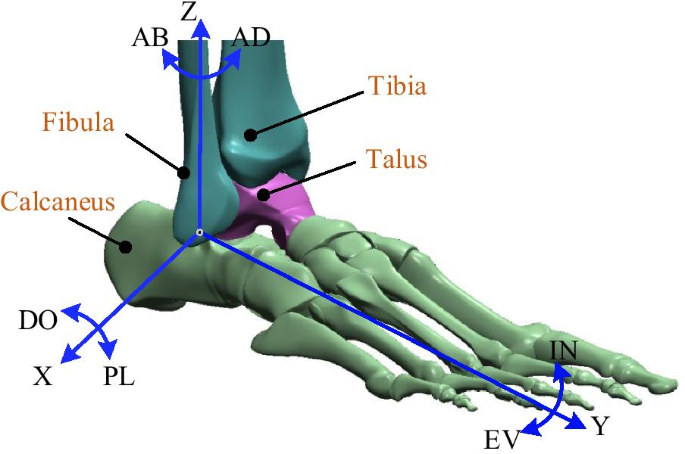
The ankle joint complex (AJC) mainly consists of the tibia, fibula, talus and calcaneus, as shown in Fig. 1 [1]. The tibia and fibula are considered one unit to simplify the motions of the AJC, and the ankle joint involves the articulation between the tibia-fibula unit and the talus [1]. The AJC is of fundamental importance for balance, support, and propulsion. However, it is particularly susceptible to musculoskeletal and neurological injuries, especially neurological injuries such as the drop foot following stroke. Based on a report from the American Heart Association, approximately 795,000 people experience stroke in the United States each year [2]; stroke has poor prognosis and is associated with a high proportion of patients with drop foot, becoming the leading cause of permanent disabilities worldwide, with over 15 million new cases each year and 50 million stroke survivors [3]. An important factor in ankle dysfunction is damage to the central nervous system (CNS), which needs to be stimulated for reorganization and compensation and to promote the recovery of the motor system’s motor perception function [4]. Therefore, physiotherapy becomes essential for patients under this circumstance [5, 6]. During treatment, patients can regain their limited range of motion (ROM), restrengthen weak muscles, recover dynamic balance, and thus gradually restore motion functions [7]. However, this necessitates a long, repetitive, and intensive rehabilitation process, leading to a large burden and workload on the traditional ankle rehabilitation training, which is performed by therapists on a one-on-one hands-on basis to gradually stimulate and repair the damaged CNS [8]. In addition, traditional ankle rehabilitation training cannot provide sufficient training frequency and intensity due to limited time and resources [6]. Moreover, the rehabilitation training plans are developed based on therapists’ subjective clinical experience, which leads to the problem where therapists cannot accurately control the changes in complex forces, rehabilitation training forms and training parameters; hence, it is difficult to ensure accurate training of the affected limbs.

Fig. 1
figure1

Anatomy of AJC and its rotational motions [1]

Therefore, it is of vital importance to replace traditional ankle rehabilitation training by developing ankle rehabilitation robots, which have the benefits of providing long-term accurate and uniform rehabilitation training as well as the ability to adaptively modify the difficulty of rehabilitation training according to real-time feedback from training [9]. In addition, the application of robot-assisted ankle rehabilitation techniques allows real-time data collection throughout the training process to further determine the accuracy of the training [10], therein allowing an assessment of the biomechanical properties of the AJC [11] and mobility [12] to customize future treatments [13]. Particularly, these techniques can effectively reduce the labor intensity of medical staff, improve the effect of ankle rehabilitation training and compensate for the shortage of rehabilitation medical resources. The parallel ankle rehabilitation robots (PARRs) and wearable devices are the most studied technologies for ankle rehabilitation, in which, the PARRs have a fixed platform and can be used for multiple degree of freedom (DOF) rehabilitation with a small size and high rigidity, while wearable devices are known as exoskeleton or powered orthoses and are often used for gait training. The advantage of a PARR compared with a wearable device is that the lower leg will not follow the swing during the process of ankle rehabilitation training, which can allow avoiding a secondary injury to the ankle joint.

Various reviews of robotic devices for ankle rehabilitation have been performed [6, 14,15,16,17]. However, references [6, 15,16,17] mainly focused on the mechanical design of ankle rehabilitation robots and covered both PARRs and wearable robots, while reference [14] focused on the effectiveness of robot-assisted therapy on ankle rehabilitation with both PARRs and wearable ones, and they concluded that wearable robots are more suitable for gait training, while PARRs are better suited for ankle exercises. Therefore, there is no systematic and comprehensive review specifically on the development of PARRs. With increasing research on PARRs, different mechanism configurations, actuator types, and rehabilitation training methods have been proposed, which may present a challenge to researchers new to this field.

The purpose of this paper is to provide a systematic review of the state of the art in PARR technology, with consideration of the mechanism configurations, actuator types, and rehabilitation training methods, thus serving as a tutorial for engineers who will design or control PARRs, making them aware of the advantages and limitations of different mechanical and control choices. From a research point of view, this paper also proposes a taxonomy expansion and a review of future research directions. The following sections review the PARRs with regard to the mechanism configurations, actuator types with different trajectory tracking control techniques, and rehabilitation training methods; we also compare, analyze and summarize them separately. Finally, the research hotspots and trends are discussed, and we present the takeaways regarding PARRs as the findings of this review.

Thursday, April 4, 2019

NYU Langone Hospital-Brooklyn Sets New Standard with State-of-the-Art Neuro-ICU

How can it be state-of-the-Art when they only describe 'care' NOT results?  Joint Commission certification doesn't measure results either so no clue how good they are .

Established in 2002 and awarded for a two-year period, The Joint Commission’s Disease-Specific Care Certification evaluates clinical programs across the continuum of care and addresses three core areas:(NOT RESULTS!)
1.  Compliance with consensus-based national standards;

2.  Effective use of evidence-based clinical practice guidelines(NOT PROTOCOLS) to manage and optimize care; and 

3.  An organized approach to performance measurement and improvement activities.(NOT RESULTS!)

NYU Langone Hospital-Brooklyn Sets New Standard with State-of-the-Art Neuro-ICU 

News provided by
NYU Langone Hospital-Brooklyn
Mar 28, 2019, 18:14 ET

BROOKLYN, N.Y., March 28, 2019 /PRNewswire/ -- A new level of neurological care is now available in Brooklyn with the opening of NYU Langone Hospital–Brooklyn's new neurointensive care unit.
The state-of-the-art 3,500-square-foot unit features four fully equipped single-bed patient rooms with a new dedicated nursing station. Each patient room has access to the latest in diagnostic equipment, including fiberoptic intracranial pressure monitoring, bedside ultrasound, therapeutic temperature management technology, and transcranial doppler to measure blood flow through the brain. The unit is an expansion of the adjacent 10-bed surgical intensive care unit on the hospital's fourth floor.
As Brooklyn's first Joint Commission-certified Comprehensive Stroke Center—and the only facility in the Northeast that additionally holds Joint Commission certification for Stroke Rehabilitation—NYU Langone Hospital–Brooklyn has built a strong stroke, neurology, and neurosurgical program that is second to none.
"This latest expansion demonstrates our commitment to delivering advanced, around-the-clock neurocritical care to our patients, our community, and our region," says Aaron S. Lord, MD, chief of neurology at NYU Langone Hospital–Brooklyn, who will oversee the new unit along with Erich G. Anderer, MD, chief of neurosurgery at NYU Langone Hospital–Brooklyn.
"Our institution includes some of the most talented brain and spine surgeons in the field, and the new unit will provide an environment that will encourage even faster recovery with a highly skilled nursing and medical staff available 24/7," says Dr. Anderer.
The new facility is an integral part of NYU Langone Health's Center for Stroke and Neurovascular Diseases, which brings leading experts in neurology, neurosurgery, neurocritical care, neurointerventional radiology, neuroradiology, and neurorehabilitation together to diagnose and treat the most complex conditions affecting the brain and spinal cord.
"Stroke is among the most interdisciplinary specialties in the medical field," said Koto Ishida, MD, medical director of the stroke program at NYU Langone Health. "Collaboration is critical to understanding and treating a patient with a neurovascular condition, whether with the emergency department nursing staff, the physicians and surgeons, or the outpatient physical, occupational, or speech therapists—everyone plays a part in delivering exceptional care during this difficult time for patients and their families."
While hospitalizations due to stroke in Brooklyn are above state and national rates, the borough has among the lowest rates of stroke death in the United States, according to federal Centers for Disease and Prevention data.
"Our outcomes in stroke treatment are a key indicator that what we have built here in Brooklyn is saving lives and serving as a model for other institutions across the country," said Dr. Rudy.
Learn more about NYU Langone Hospital–Brooklyn and the Center for Stroke and Neurovascular Diseases at https://nyulangone.org.
Media Inquiries:
Colin DeVries
colin.devries@nyulangone.org 
718-630-7414
SOURCE NYU Langone Hospital-Brooklyn

Related Links

https://nyulangone.org