Changing stroke rehab and research worldwide now.Time is Brain! trillions and trillions of neurons that DIE each day because there are NO effective hyperacute therapies besides tPA(only 12% effective). I have 523 posts on hyperacute therapy, enough for researchers to spend decades proving them out. These are my personal ideas and blog on stroke rehabilitation and stroke research. Do not attempt any of these without checking with your medical provider. Unless you join me in agitating, when you need these therapies they won't be there.

What this blog is for:

My blog is not to help survivors recover, it is to have the 10 million yearly stroke survivors light fires underneath their doctors, stroke hospitals and stroke researchers to get stroke solved. 100% recovery. The stroke medical world is completely failing at that goal, they don't even have it as a goal. Shortly after getting out of the hospital and getting NO information on the process or protocols of stroke rehabilitation and recovery I started searching on the internet and found that no other survivor received useful information. This is an attempt to cover all stroke rehabilitation information that should be readily available to survivors so they can talk with informed knowledge to their medical staff. It lays out what needs to be done to get stroke survivors closer to 100% recovery. It's quite disgusting that this information is not available from every stroke association and doctors group.

Showing posts with label arm swing. Show all posts

Friday, February 27, 2026

Saturday, October 22, 2022

Development and Feasibility Assessment of a Rotational Orthosis for Walking with Arm Swing


Useless for us, tested on healthy subjects.

16 years post stroke and my arm swing takes 30-60 minutes to occur and even then spasticity keeps my arm bent.

Development and Feasibility Assessment of a Rotational Orthosis for Walking with Arm Swing

Juan Fang1,2, Qing Xie3, Guo-Yuan Yang2 and Le Xie2,4*
  • 1Jiangsu Key Laboratory of Advanced Food Manufacturing, Equipment and Technology, Jiangnan University, Wuxi City, China
  • 2The Joint Lab of the Institute of Rehabilitation Centre and Chejing Robotics Technology (Shanghai) Co., Ltd., Med-X Research Institute, Shanghai Jiao Tong University, Shanghai, China
  • 3Department of Rehabilitation Medicine of Ruijin Hospital, School of Medicine, Shanghai Jiao Tong University, Shanghai, China
  • 4School of Material Science and Engineering, Shanghai Jiao Tong University, Shanghai, China

Interlimb neural coupling might underlie human bipedal locomotion, which is reflected in the fact that people swing their arms synchronously with leg movement in normal gait. Therefore, arm swing should be included in gait training to provide coordinated interlimb performance. The present study aimed to develop a Rotational Orthosis for Walking with Arm Swing (ROWAS), and evaluate its feasibility from the perspectives of implementation, acceptability and responsiveness. We developed the mechanical structures of the ROWAS system in SolidWorks, and implemented the concept in a prototype. Normal gait data were used as the reference performance of the shoulder, hip, knee and ankle joints of the prototype. The ROWAS prototype was tested for function assessment and further evaluated using five able-bodied subjects for user feedback. The ROWAS prototype produced coordinated performance in the upper and lower limbs, with joint profiles similar to those occurring in normal gait. The subjects reported a stronger feeling of walking with arm swing than without. The ROWAS system was deemed feasible according to the formal assessment criteria.

Introduction

People swing their arms synchronously with leg movement during walking due to interlimb neural linkage, in addition to mechanical factors. Although the arms have no direct function for propulsion (Barbeau et al., 1987), people normally swing their arms so as to improve gait stability (Behrman and Harkema, 2000; Bovonsunthonchai et al., 2012) and energy efficiency (Dietz, 2002; Collins et al., 2009). Apart from such behavioral relevance, many phenomena imply that arm swing during walking is a neural-coordinated motor output. Rhythmic muscle activity was observed in the constrained arms during walking overground (Eke-Okoro et al., 1997), which implies the existence of neural coupling between the upper and lower limbs. Furthermore, adding mass to one ankle induced adaptive changes in both arms, in addition to changes in EMG from the leg muscles (Donker et al., 2002). This resulted in a coordinated movement pattern similar to that seen in unloaded normal gait. Studies of walking on a split-belt treadmill with different speed ratios between the legs resulted in coordinated locomotion in the legs and arms (Dietz et al., 2001). Short accelerations or decelerations randomly applied to the right leg during treadmill walking produced EMG response in the bilateral arm muscles, in addition to that in the right leg (Dietz et al., 2001). Interlimb neural interaction thus appears to be an underlying neural mechanism of human bipedal locomotion.

The theory of interlimb neural coupling brings new requirements for gait rehabilitation robotics. Interlimb modulation is active during walking, but not in standing or sitting (Dietz et al., 2001; Zehr et al., 2012). The neural interaction between the upper and lower limbs is maintained in patients with injury to central nervous system (Visintin and Barbeau, 1994; Stephenson et al., 2010). The task-specific practice strategy suggests gait restoration robotic systems should provide locomotion–like movements to improve gait control and functional ability (Harkema, 2001). Judging from the implication of interlimb neural coupling and the fact of arm swing during walking, it was suggested that gait training after neurological injury should incorporate simultaneous upper limb and lower limb rhythmic exercise to take advantage of neural coupling (Ferris et al., 2006).

In spite of the existence of many types of rehabilitation robots, there is no system which activates both the upper and lower limbs in the same way as during walking. Over the last few decades many types of rehabilitation systems have emerged, including systems for gait restoration (Díaz et al., 2011) or for upper limb rehabilitation (Lum et al., 2005). Several lower-limb exoskeletons are commercially available to assist walking restoration, such as the Lokomat (Hidler et al., 2008) and the G-EO (Hesse et al., 2010) systems. They induce upright walking movement at variable speeds in the lower limbs. The arms often hold horizontal fixed bars to support the body. There are also several systems, such as the Armeo (Nef et al., 2006) and GENTLE/s (Loureiro et al., 2003), for those who have functional impairments in the upper limbs. The users often practice various arm movements in a sitting position. To the best of the authors' knowledge, there is no gait orthosis which incorporates arm swing.

Based on these limitations, a new rehabilitation system was to be developed in the present work. As the early initiation of gait rehabilitation is generally deemed important (Fang et al., 2011), the requirements of the proposed system included:

(1) to allow the users to practice walking at the early post-injury stage;

(2) to mimic the ground reaction forces on the foot which occur during walking;

(3) to activate the upper limbs synchronously with the lower limb movement.

The aim of this work was to develop and evaluate the feasibility of a Rotational Orthosis for Walking with Arm Swing (ROWAS). The formal criteria for feasibility assessment were (Bowen et al., 2009): (i) implementation—was the system technically implementable? (ii) acceptability—was the system acceptable to the users? and (iii) responsiveness—was there a measurable movement that was close to the target joint trajectories?

Friday, July 1, 2022

The workout that beats HIIT for better heart health, according to a new study

 This would require your doctor have EXACT STROKE REHAB PROTOCOLS to recover your arm and hand. I have zero arm swing to even attempt this.

The workout that beats HIIT for better heart health, according to a new study

By Melanie Radzicki McManus, CNN

Updated 4:56 AM ET, Thu June 30, 2022
Nordic walking for health and safety

Nordic walking for health and safety 01:20

"Before beginning any new exercise program, consult your doctor. Stop immediately if you experience pain."

(CNN)If you're looking for a cardiovascular activity that will get your heart pumping and improve daily life, running or interval training may immediately come to mind. To maximize your workout, however, you may want to give Nordic walking a try, new research suggests.
This low-impact, whole-body workout that originated in Finland can be performed at different intensity levels. It incorporates the use of specially designed poles that you work in opposition to your legs -- that is, your left arm and right foot work in tandem, and your right arm and left foot. The poles' planting and push-off help boost you along, and the system is especially helpful when walking up or down hills.
Wobbly on one leg? Ability to balance is linked to a longer life, study finds
Patients with coronary heart disease who participated in Nordic walking had a greater increase in their functional capacity, or the ability to carry out daily activities, compared with those who performed high-intensity interval training or continuous training at a moderate-to-vigorous level, according to a recent study in the Canadian Journal of Cardiology.

Few studies have examined the effects of Nordic walking on cardiac rehab patients, yet other forms of exercise, namely HIIT workouts, have been extensively studied, said senior author Dr. Jennifer Reed, director of exercise physiology and cardiovascular health at the University of Ottawa Heart Institute in Canada. No other study has directly compared the above three exercise regimens.

"Our research showing the superior benefits of Nordic walking on functional capacity highlights an alternative exercise option that requires minimal cost and equipment to improve physical and mental health," she said.

Total-body movement
Nordic walking exercises 80% to 90% of your muscles when done properly, according to the American Nordic Walking Association, while walking and running only recruit 40%. The additional shoulder, chest and arm muscles used are the deltoids, pectorals, upper abdominals, forearm flexors, subscapularis, triceps and external obliques. Moreover, using these additional muscles leads to a 20% increase in calorie burn compared with regular walking, according to a study published in the journal Research Quarterly for Exercise and Sport.

Track exercise intensity with the 'talk test'
During Reed's study, researchers had 130 patients in a 12-week training program performing either 60 minutes of Nordic walking on an indoor track; 60 minutes of moderate-to-vigorous continuous training (e.g., cycling or rowing); or a 45-minute HIIT workout. At the end of the training program, and again after a 14-week post-regimen observation period, the participants took two six-minute walk tests to measure functional capacity.
All of the exercise regimens helped alleviate the patients' depression and improved their quality of life, but functional capacity was greatest after Nordic walking, the researchers found. The walkers had a 19% boost in functional capacity versus 13% for those doing the HIIT workouts and 12% for those doing the moderate-to-vigorous continuous training.
Patients with coronary heart disease who did Nordic walking for 12 weeks had a greater increase in the ability to perform everyday activities than those who did interval training, a study said.
"The six-minute walk test to measure functional capacity is an evidence-based and typically reproducible test," said physician Dr. Jonathan H. Whiteson, associate professor of rehabilitation and medicine at NYU Langone Health in New York City. He was not involved in the study.
"However, as a walking test to measure improvements of different exercise regimens, it is important to recognize that training is task-specific, and so it is not such a surprise that the walking intervention, rather than the other two exercise interventions that did not focus only on walking, produced the greater increase."
Here's the way to exercise for better balance
A more objective measure of aerobic training is a cardio-pulmonary exercise test, or metabolic stress test, which can measure fitness levels through metabolic analysis, said Whiteson, who also serves as medical director of cardiac rehabilitation at NYU Langone Health. "Use of CPET testing would have enhanced the results of this study. That being said, all modalities improved functional capacity, and that is the goal of a cardiac rehab program, as it correlates well with reduced risk for future cardiac events."
The fact that Nordic walking is primarily a walking exercise and the other training programs included a variety of aerobic exercises may definitely be the reason why it came out No. 1 in the walk test, Reed acknowledged. The use of poles while walking may have improved speed and postural control, and increased walking-stride length.
Either way, Whiteson had one note of caution: To achieve an increase in functional capacity, Nordic walking must be done vigorously, and it takes coordination and balance, he said. Thus, it might not be a good choice for everyone.
Building off of the study, her team is poised to begin a clinical trial that will explore the effects of combining different exercise types on patients with cardiovascular disease, such as pairing HIIT workouts with Nordic walking.
Sign up for CNN's Fitness, But Better newsl

Tuesday, June 8, 2021

Using a simple rope-pulley system that mechanically couples the arms, legs, and treadmill reduces the metabolic cost of walking

Highly unlikely this could translate to stroke patients, it was tested on healthy people. And for me since I have no arm swing I could never assist my leg propulsion.

Using a simple rope-pulley system that mechanically couples the arms, legs, and treadmill reduces the metabolic cost of walking


Abstract

Background

Emphasizing the active use of the arms and coordinating them with the stepping motion of the legs may promote walking recovery in patients with impaired lower limb function. Yet, most approaches use seated devices to allow coupled arm and leg movements. To provide an option during treadmill walking, we designed a rope-pulley system that physically links the arms and legs. This arm-leg pulley system was grounded to the floor and made of commercially available slotted square tubing, solid strut channels, and low-friction pulleys that allowed us to use a rope to connect the subject’s wrist to the ipsilateral foot. This set-up was based on our idea that during walking the arm could generate an assistive force during arm swing retraction and, therefore, aid in leg swing.

Methods

To test this idea, we compared the mechanical, muscular, and metabolic effects between normal walking and walking with the arm-leg pulley system. We measured rope and ground reaction forces, electromyographic signals of key arm and leg muscles, and rates of metabolic energy consumption while healthy, young subjects walked at 1.25 m/s on a dual-belt instrumented treadmill (n = 8).

Results

With our arm-leg pulley system, we found that an assistive force could be generated, reaching peak values of 7% body weight on average. Contrary to our expectation, the force mainly coincided with the propulsive phase of walking and not leg swing. Our findings suggest that subjects actively used their arms to harness the energy from the moving treadmill belt, which helped to propel the whole body via the arm-leg rope linkage. This effectively decreased the muscular and mechanical demands placed on the legs, reducing the propulsive impulse by 43% (p < 0.001), which led to a 17% net reduction in the metabolic power required for walking (p = 0.001).

Conclusions

These findings provide the biomechanical and energetic basis for how we might reimagine the use of the arms in gait rehabilitation, opening the opportunity to explore if such a method could help patients regain their walking ability.

Trial registration: Study registered on 09/29/2018 in ClinicalTrials.gov (ID—NCT03689647).

Background

The mechanical and neural benefits that stem from the natural coordination of the arms and legs during walking have inspired scientists and practitioners to emphasize this natural behavior during gait rehabilitation [1,2,3,4,5,6,7,8,9]. For instance, Behrman and Harkema [2] were the first to exploit the benefit of coordinating the arms' swinging motion with the stepping motion of the legs during treadmill training with body weight support [1, 2]. In a series of case studies, physical therapists would instruct patients to intentionally swing their arms or facilitate their arm motion with hand-held poles [2]. Alternatively, a recumbent stepper or cycle ergometer can allow for an individual to actively coordinate their arm and leg movements while remaining seated. As opposed to the passive arm motion facilitated by hand-held poles, these devices have the added benefit of putting the patient in control. Through this process, individuals can use their arms to modulate the amount and timing of assistance that help drive the motion of their legs, thereby becoming actively engaged in their gait re-training. Experiments studying the training effects of actively coordinating the arms and legs with these devices have shown functional improvements in walking performance in individuals with incomplete spinal cord injury [10] or chronic stroke [11, 12]. The improvements seen in recumbent stepping and cycling may have arisen from exploiting the neural coupling that underlies the coordinated motion of the arms and legs [2,3,4].

While recumbent stepping and cycling have shown benefits, a notable concern is that this type of activity lacks some gait-related task specificity [13]. For example, the recumbent stepping and cycling kinematics of the hip, knee, elbow, and shoulder joints are fundamentally different from walking [5, 13]. Additionally, these devices do not allow the lower limbs to undergo continuous loading and unloading, as done during treadmill training with body weight support. The act of rhythmically loading and unloading the legs is recognized as a critical sensory cue for promoting walking recovery during gait rehabilitation [14, 15]. In order to promote walking recovery, the training task should have similar sensory cues as the goal task [2, 16]. Therefore, developing a strategy where an individual can simultaneously benefit from actively coordinating the arms and legs (as done in recumbent stepping and cycling) and rhythmically loading and unloading the leg during treadmill walking could further optimize task specificity and enhance walking recovery. However, an approach that allows an individual to actively use their arms to drive the motion of their legs during treadmill walking has remained elusive.

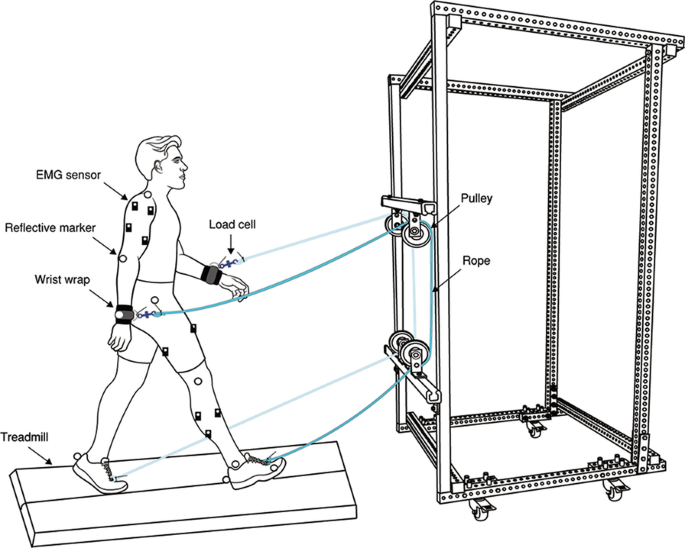
To explore this idea, we developed a rope-pulley system that physically links the ipsilateral arm and leg during treadmill walking (Fig. 1). With this approach, we imagined that individuals could use their arms to assist the legs, allowing them to be more actively engaged in their gait re-training. This approach would require a greater demand from the arms, but we suspected this would lower the demand placed on the legs. Therefore, we set out to establish proof-of-concept by first understanding how our method of linking the arms and legs would influence the mechanical, muscular, and metabolic demands of walking in a cohort of healthy, neurologically-unimpaired individuals. We presumed that a user could pull on the rope as the arm swings backward and, thus, generate a force along the rope to assist with ipsilateral leg swing. We reasoned that increasing the muscular demand of the arms would incur a metabolic cost; however, if the assistive force is transmitted effectively along the rope, we expected this assistive force to decrease the muscular and metabolic demand to swing the leg, which is estimated to comprise between 10 and 33% of the net metabolic cost of walking [17,18,19]. Given our logic, we hypothesized that (1) walking with the arm-leg pulley system would increase the arm’s muscular demand to generate an assistive force, but a trade-off would be a decrease in the leg’s muscular demand to swing the leg, and (2) any metabolic cost incurred to actively use the arms would be counterbalanced by the reduction in the cost to swing the legs, bringing about no change in the net metabolic cost of walking. A test of our first hypothesis would provide proof-of-concept that it is possible to actively use the arms to move the legs during treadmill walking. A test of our second hypothesis would give insight into whether this approach comes at the expense of an increased metabolic cost or not. Our overall goal in this study is to provide a fundamental understanding of how physically coupling the arms and legs affects the biomechanics and energetics of walking. We believe this fundamental understanding will provide insight into its potential use as a rehabilitation strategy for individuals with impaired lower limb function, such as those recovering from a spinal cord injury or stroke.

Fig. 1
figure1

Arm-leg rope pulley system. Subjects walked on a split-belt force measuring treadmill while attached to a simple device that connects the ipsilateral arm and leg using a rope. The horizontal pulley bars are height adjustable, allowing for relative changes in rope length. Furthermore, the load cell is in series with the rope and used to measure rope tension during treadmill walking. Note that the reflective markers were attached to both sides while EMG sensors were placed only on the right side of the body due to a limited number of sensors available in our lab

Methods

Participants

Eight healthy, young subjects participated in this study (3 women and 5 men; age = 23.25 ± 3.37 years, mass = 73.88 ± 18.46 kg, height = 173.84 ± 13.95 cm; mean ± SD). Prior to the experimental session, a telephone interview was conducted to ensure the participants met the inclusion criteria of a healthy participant, i.e., physically active, non-smoker, body mass index < 30.0 kg/m2, and free from musculoskeletal injuries. A health screen form was then completed, reviewed, and signed by the subject the day of the experimental session. In addition, they read and signed an informed consent document. This study was reviewed and approved by the University of Houston Institutional Review Board.


Friday, May 7, 2021

Why your arm swing is so important to running and how to improve it

 I have zero arm swing right now and this didn't tell me a damn thing.  I want to run again and it will look awful with all the spasticity I have in my left leg.  I'll have to reread 'Teaching Me to Run' by Tommye-K. Mayer.

Or maybe from here:

4 Ways To Improve Your Running Arm Swing

Fix the elbows (around) the 90 degree mark

Keep your elbows fixed somewhere between 80 and 100 degrees. Make sure you’re not constantly bending and straightening your elbows as this will use up energy. Movement should be from the shoulder joint, not the elbow joint.

Keep your hands and shoulders relaxed

There can be a tendency to elevate the shoulders whilst running. This leads to unwanted tension so try to relax and keep your shoulders down. Clenched fists are also unnecessary, so try to keep your fingers loosely curled inwards with your thumbs on top (not down into the fingers). Your palms should face each other, rather than downwards.

Don’t over-rotate the torso

It’s not uncommon to see runners driving their hands too far across the body so that their torso over rotates. This leads to unwanted demands on the core and is an extremely inefficient way of running. To ensure you don’t do this imagine there’s a vertical line that runs down the middle of your body. Swing the arms back and forth so that your hands do not cross that line.

Drive back with the elbows, not forwards with the hands

A lot of runners create an arm swing by driving their hands forwards almost in a punching like manner. This however can become very tiring, so rather than focussing on driving the hands forwards, focus on driving the elbows backwards. This will feel a lot less exhausting and will encourage good posture and forward momentum.


The latest here:

Why your arm swing is so important to running and how to improve it

You need a flexible upper body to run well. Here’s how to restore your natural arm swing to improve posture and power.
Grassland, Running, Outdoor recreation, Trail, Mountainous landforms, Recreation, Hill, Grass, Fell, Ultramarathon, Tandem

The hips may be the body’s fulcrum and its centre of balance, but things that happen above the waist can, and do, also affect balance and drive. The body is all connected and balanced on top of itself: head, shoulders, hips, knees, ankles, feet. If you throw off that balance at the top, the supporting structures need to work harder to keep your body upright before they begin the task of pushing you forward.

And here, as with the hips, our lifestyles often compromise what our arms would naturally be doing if we lived as our ancestors did – using them for lifting, carrying, pushing, pulling and throwing – as well as for daily, extensive walking and running. You don’t run on your arms, but make no mistake, arms are important to running.

Coaches have long maintained the role played by the arms in enhancing the stride. Former elite runner Grant Robison finds it is easier for runners to focus on and change their arm movements than their leg movements. ‘Your arms are right by your face,’ says Robison. ‘They are easy to focus on. It is hard to think about where your foot is landing in relation to your hips. But your arms? You can make them go.’

No arm done

‘People think running is all about the lower body,’ says therapist Laura Bergmann of Evolution Performance and Rehabilitation Center in Virginia, US. ‘But because it is all connected, tightness up there affects down here. Tight lats and pectorals, as well as rounded shoulders, all inhibit your ability to have a tall spine when you run.’

‘Many problems attributed to hips are actually upper-body mechanical problems,’ says mobility expert and coach Brad Cox. Cox says most of us have some upper body problems that stem from excessive sitting and hunching.

(Related: How strong is your upper body?)

We hunch over computers – even more now that everyone uses a laptop. We hunch over phones and video games. ‘Sitting is just horrible,’ says biomechanist and marathon runner Rebecca Shultz. ‘Tech added on top is awful.’ And it isn’t just tech; we reach forward while driving, reading, writing and eating. Everything in our lives, it seems, prompts our upper body to be forward oriented.


Thursday, March 11, 2021

Comment: difference between assessment of upper limb movement and upper limb associated reactions during walking

If this is a comment I can't figure out what it is. My arm swing is non-existant and what there is has a bent arm. So the first thing needed is to stop all my arm spasticity, including fingers.   I assume AR means associated reactions since it is not defined.

Comment: difference between assessment of upper limb movement and upper limb associated reactions during walking

Abstract

Background

While walking, people swing their arms in a specific pattern. This specific arm swing pattern during walking has shown to have a beneficial effect on gait as it reduces walking energy cost and optimizes balance. In several patient populations the arm movements can be directly affected (e.g. in patients with acquired brain injury (ABI)), which in turn has a negative effect on their gait pattern, balance and energy cost of walking.

Main text

In December 2019, Kahn et al. published a paper in JNER concerning the quantification of upper limb associated reactions (ARs) during walking in people with ABI. ARs are defined as “an effort-dependent phenomenon causing an involuntary increase in upper limb muscle tone, with awkward and uncomfortable postures”. These upper limb ARs appear often in patients with ABI and can have an important effect on their gait. The authors calculated kinematic measures using three-dimensional gait analysis relating to range of motion, variability and mean position over the gait cycle for the different upper limb joints (shoulder, elbow, wrist) during self-selected steady-state walking. Based on differences they found between an ABI cohort and healthy control cohort, the authors concluded that they were able to quantify ARs during walking in this population. This calculation, however, is not specific for upper limb ARs. In fact, the authors calculated general measures of arm posture (e.g. mean position over the gait cycle) or arm movement (e.g. range of motion and variability) during gait. Previous research has already indicated that other factors than ARs can influence the posture or movement of the arm during gait in patients with brain injury, such as voluntary compensations for gait instability and contractures or spasticity of upper arm muscles. Yet, it is not possible to disentangle the different causes of the altered arm posture during steady-state walking based on the proposed measures.

Conclusion

The kinematic arm measures proposed by Kahn et al. (J Neuroeng Rehabil 16(1):160, 2019) are not a direct measure of ARs, but provide a quantification of overall deviation of arm posture or movement during gait. Depending on the specific study design these measures may provide insights in ARs.

Background

While walking, people swing their arms. At self-selected or preferred walking speeds, this arm swing in healthy adults shows a typical pattern as it is coordinated with the leg movements; while the left leg (right) swings forward, the right (left) arm swings forward [1]. At first sight, this arm swing appears a meaningless and irrelevant by-product of movements of the trunk which are passively transferred to the arms. Previous research, however, has shown that the arm movements during gait are not entirely passive, but are partly active to achieve this specific coordination with the legs [2]. Such specific “normal” coordinated arm swing has shown to reduce walking energy cost and have a positive effect on balance [1]. The arm swing or arm posture during gait can be quantified using movement analysis, and summarized in kinematic outcome parameters. As such, these kinematic outcome parameters are a direct reflection of the arm movement pattern. In patients with central neurologic pathologies, such as stroke, cerebral palsy and Parkinson’s disease, different symptoms (e.g. spasticity) can affect or cause the altered arm movement patterns, which in turn has an effect on the coordination between the arms and legs during gait and as such influences the gait pattern, balance and energy cost of walking [1].

Main text

In December 2019, Kahn et al. published a paper in JNER concerning the quantification of upper limb associated reactions (ARs] during walking in people with acquired brain injury [3]. In their study, the authors have defined ARs as “an effort-dependent phenomenon causing an involuntary increase in upper limb muscle tone, with awkward and uncomfortable postures”. These ARs appear often and can impede the gait pattern, balance and walking energy cost in patients with acquired brain injury (ABI). This is a very relevant topic, worthy of investigation as quantification of this phenomenon allows to assess its effect on gait and can influence rehabilitation programs to address this issue to improve gait in these patients. In their paper, Kahn et al. assessed whether it was possible to quantify and assess ARs during walking from joint kinematics measured using three-dimensional motion analysis. The authors calculated measures relating to range of motion, variability (i.e. standard deviation) and mean position over the gait cycle for the different joints (shoulder, elbow, wrist) during self-selected steady-state walking and compared these to a healthy control cohort. Based on the differences between the ABI cohort and the healthy control cohort, the authors concluded that they were able to quantify ARs during walking in this population. This calculation, however, is not specific for upper limb ARs. In fact, the authors calculated kinematic measures of arm posture (e.g. mean position over the gait cycle) or arm movement (e.g. range of motion and variability) during gait, which are an overall reflection of the movement pattern. The authors, in this case, seem to assume that their kinematic arm measures in patients with ABI during gait are a direct reflection of the ARs, but the proposed kinematic measures cannot distinguish between the different causes or influencing factors of the altered movement pattern.

Previous research has already indicated that other factors (than ARs) can influence the posture or movement of the arm during gait in patients with brain injury as well. Children with cerebral palsy, for instance, have been shown to alter their arm movements during walking as a result of increased gait instability [4, 5]. In CP, the arm posture shows similarities to those described in toddlers that recently learned to walk (i.e. the elbow is more flexed and the hand is held in a high position e.g. above the pelvis), but contrary to ARs, this arm posture not necessarily unwanted or involuntary as it has been shown to be a solution to fulfill the requirements of postural stability and forward propulsion [6]. Furthermore, previous research in patients with stroke has indicated that spasticity affects the upper limb position (i.e. clinically the described with a flexed elbow, flexed wrist and closed fist) and lower limb position (i.e. usually the knee extensor muscles are involved resulting in a stiff knee, as are the ankle plantar-flexor muscles resulting in an equinovarus foot) when evaluated in isolation [7, 8]. The upper limb spasticity also affects the altered arm posture during gait, as Botulinum-toxin treatment of spastic upper arm muscles improves their arm swing movements and, consequently, their gait pattern [9, 10].

This means that an altered score on the kinematic arm measure quantified by Kahn et al. [3] is not necessarily an indication of ARs, but does show abnormal upper limb posture or movement during gait. For instance, if a patient has an elbow flexion contracture, which would already be visible when standing still, the patient will also show increased elbow flexion during walking which is not an AR. Similarly, it could be possible that a patient increases trunk and arm movements or adopts a specific arm posture to compensate for increased gait instability. These compensatory movements are then not directly related to the effort of walking, but are wanted/voluntary and, thus, do not align with the definition of ARs.

On the other hand, the phenomenon of ARs is scarcely investigated and is a relevant field of study. It may be possible to assess ARs using the proposed kinematic arm measures by Kahn et al. [3] if investigators create a study design which increases the effort of the patient without increasing his walking speed (as this may increase the velocity-dependent spasticity in these patients) and without changing the stability constraints of the walking condition (as this may influence gait stability). In this way, the proposed kinematic arm measures, which actually measure abnormal arm movement patterns, can be used to specifically assess ARs.

Conclusions

In conclusion, the kinematic arm measures proposed by Kahn et al. [3] are not a direct measure of ARs, but provide a quantification of overall deviation of arm posture or movement during gait in patients with ABI. Depending on the specific study design such measures may provide insights in ARs in different populations in future studies.


Tuesday, October 20, 2020

Development and Feasibility Assessment of a Rotational Orthosis for Walking with Arm Swing

 Useless for us, tested on healthy subjects.

14 years post stroke and my arm swing takes 30-60 minutes to occur and even then spasticity keeps my arm bent.

Development and Feasibility Assessment of a Rotational Orthosis for Walking with Arm Swing

 
Juan Fang1,2, Qing Xie3, Guo-Yuan Yang2 and Le Xie2,4*
  • 1Jiangsu Key Laboratory of Advanced Food Manufacturing, Equipment and Technology, Jiangnan University, Wuxi City, China
  • 2The Joint Lab of the Institute of Rehabilitation Centre and Chejing Robotics Technology (Shanghai) Co., Ltd., Med-X Research Institute, Shanghai Jiao Tong University, Shanghai, China
  • 3Department of Rehabilitation Medicine of Ruijin Hospital, School of Medicine, Shanghai Jiao Tong University, Shanghai, China
  • 4School of Material Science and Engineering, Shanghai Jiao Tong University, Shanghai, China

Interlimb neural coupling might underlie human bipedal locomotion, which is reflected in the fact that people swing their arms synchronously with leg movement in normal gait. Therefore, arm swing should be included in gait training to provide coordinated interlimb performance. The present study aimed to develop a Rotational Orthosis for Walking with Arm Swing (ROWAS), and evaluate its feasibility from the perspectives of implementation, acceptability and responsiveness. We developed the mechanical structures of the ROWAS system in SolidWorks, and implemented the concept in a prototype. Normal gait data were used as the reference performance of the shoulder, hip, knee and ankle joints of the prototype. The ROWAS prototype was tested for function assessment and further evaluated using five able-bodied subjects for user feedback. The ROWAS prototype produced coordinated performance in the upper and lower limbs, with joint profiles similar to those occurring in normal gait. The subjects reported a stronger feeling of walking with arm swing than without. The ROWAS system was deemed feasible according to the formal assessment criteria.

Introduction

People swing their arms synchronously with leg movement during walking due to interlimb neural linkage, in addition to mechanical factors. Although the arms have no direct function for propulsion (Barbeau et al., 1987), people normally swing their arms so as to improve gait stability (Behrman and Harkema, 2000; Bovonsunthonchai et al., 2012) and energy efficiency (Dietz, 2002; Collins et al., 2009). Apart from such behavioral relevance, many phenomena imply that arm swing during walking is a neural-coordinated motor output. Rhythmic muscle activity was observed in the constrained arms during walking overground (Eke-Okoro et al., 1997), which implies the existence of neural coupling between the upper and lower limbs. Furthermore, adding mass to one ankle induced adaptive changes in both arms, in addition to changes in EMG from the leg muscles (Donker et al., 2002). This resulted in a coordinated movement pattern similar to that seen in unloaded normal gait. Studies of walking on a split-belt treadmill with different speed ratios between the legs resulted in coordinated locomotion in the legs and arms (Dietz et al., 2001). Short accelerations or decelerations randomly applied to the right leg during treadmill walking produced EMG response in the bilateral arm muscles, in addition to that in the right leg (Dietz et al., 2001). Interlimb neural interaction thus appears to be an underlying neural mechanism of human bipedal locomotion.

The theory of interlimb neural coupling brings new requirements for gait rehabilitation robotics. Interlimb modulation is active during walking, but not in standing or sitting (Dietz et al., 2001; Zehr et al., 2012). The neural interaction between the upper and lower limbs is maintained in patients with injury to central nervous system (Visintin and Barbeau, 1994; Stephenson et al., 2010). The task-specific practice strategy suggests gait restoration robotic systems should provide locomotion–like movements to improve gait control and functional ability (Harkema, 2001). Judging from the implication of interlimb neural coupling and the fact of arm swing during walking, it was suggested that gait training after neurological injury should incorporate simultaneous upper limb and lower limb rhythmic exercise to take advantage of neural coupling (Ferris et al., 2006).

In spite of the existence of many types of rehabilitation robots, there is no system which activates both the upper and lower limbs in the same way as during walking. Over the last few decades many types of rehabilitation systems have emerged, including systems for gait restoration (Díaz et al., 2011) or for upper limb rehabilitation (Lum et al., 2005). Several lower-limb exoskeletons are commercially available to assist walking restoration, such as the Lokomat (Hidler et al., 2008) and the G-EO (Hesse et al., 2010) systems. They induce upright walking movement at variable speeds in the lower limbs. The arms often hold horizontal fixed bars to support the body. There are also several systems, such as the Armeo (Nef et al., 2006) and GENTLE/s (Loureiro et al., 2003), for those who have functional impairments in the upper limbs. The users often practice various arm movements in a sitting position. To the best of the authors' knowledge, there is no gait orthosis which incorporates arm swing.

Based on these limitations, a new rehabilitation system was to be developed in the present work. As the early initiation of gait rehabilitation is generally deemed important (Fang et al., 2011), the requirements of the proposed system included:

(1) to allow the users to practice walking at the early post-injury stage;

(2) to mimic the ground reaction forces on the foot which occur during walking;

(3) to activate the upper limbs synchronously with the lower limb movement.

The aim of this work was to develop and evaluate the feasibility of a Rotational Orthosis for Walking with Arm Swing (ROWAS). The formal criteria for feasibility assessment were (Bowen et al., 2009): (i) implementation—was the system technically implementable? (ii) acceptability—was the system acceptable to the users? and (iii) responsiveness—was there a measurable movement that was close to the target joint trajectories?

Thursday, September 10, 2020

The effect of arm movements on the lower limb during gait after a stroke

Your doctor should have analyzed this and seen what needs to be done for survivors with spasticity. I have zero natural arm swing and the sliding handles wouldn't work. 

The effect of arm movements on the lower limb during gait after a stroke

2010, Gait & Posture


Jennifer L. Stephenson
School of Physical and Occupational Therapy McGill University, Montreal Quebec, Canada August 2007
A thesis submitted to McGill University in partial fulfilment of the requirements of the degree of Master of Science in Rehabilitation Science

 ABSTRACT

This thesis introduces a new paradigm that is designed to facilitate the performance of arm movements during gait rehabilitation. The main purposes of the thesis were to assess (1) the effects of performing arm movements using this paradigm on the coordination of upper and lower limbs, and (2) the effects of arm movements on lower limb kinematic and muscle activation patterns. Ten stroke and ten healthy subjects walked on a treadmill while swinging their arms naturally, and while holding onto handles that were either fixed in place or allowed to slide along horizontal handrails. Full-body kinematics were recorded, along with bilateral surface EMG from upper and lower body muscles. Arm-leg coordination patterns were unaffected by the use of the sliding handles, and performing arm movements influenced lower limb muscle activation. Overall, results support the inclusion of arm movements in gait rehabilitation protocols and, for patients who are unable to walk without any external support, the use of sliding handles appears to be a useful surrogate to natural arm swing.

Tuesday, August 18, 2020

Development and Feasibility Assessment of a Rotational Orthosis for Walking with Arm Swing

 Your doctor and therapist have had 3.5 years to figure out what needs to be done to get coordinated arm swing with your gait. HAVE THEY DONE ONE DAMN THING? 14 years later and my arm swing takes 30-60 minutes to occur and even then spasticity keeps my arm bent.

Development and Feasibility Assessment of a Rotational Orthosis for Walking with Arm Swing


ORIGINAL RESEARCH
published: 01 February 2017doi: 10.3389/fnins.2017.00032Frontiers in Neuroscience | www.frontiersin.org
 1
 February 2017 | Volume 11 | Article 32
 Edited by:
Venketesh N. Dubey,Bournemouth University, UK
 Reviewed by:
Brent Winslow,Design Interactive, USAHans-Eckhardt Schaefer,University of Stuttgart, Germany
*Correspondence:
Le Xie lexie@sjtu.edu.cn
Specialty section:
This article was submitted toNeural Technology, a section of the journal Frontiers in Neuroscience
 Received:
 01 October 2016
 Accepted:
 16 January 2017
 Published:
 01 February 2017
Citation:
Fang J, Xie Q, Yang G-Y and Xie L(2017) Development and Feasibility  Assessment of a Rotational Orthosisfor Walking with Arm Swing.Front. Neurosci. 11:32.doi: 10.3389/fnins.2017.00032
Development and Feasibility  Assessment of a Rotational Orthosisfor Walking with Arm Swing
Juan Fang 1,2, 
Qing Xie  3 , 
Guo-Yuan Yang
 2
 and Le Xie
 2, 4
*
1
 Jiangsu Key Laboratory of Advanced Food Manufacturing, Equipment and Technology, Jiangnan University, Wuxi City,China,
 2
The Joint Lab of the Institute of Rehabilitation Centre and Chejing Robotics Technology (Shanghai) Co., Ltd., Med-X Research Institute, Shanghai Jiao Tong University, Shanghai, China,
 3
Department of Rehabilitation Medicine of RuijinHospital, School of Medicine, Shanghai Jiao Tong University, Shanghai, China,
 4
School of Material Science and Engineering,Shanghai Jiao Tong University, Shanghai, China
Interlimb neural coupling might underlie human bipedal locomotion, which is reflected in the fact that people swing their arms synchronously with leg movement in normal gait. Therefore, arm swing should be included in gait training to provide coordinated interlimb performance. The present study aimed to develop a Rotational Orthosis for Walking with Arm Swing (ROWAS), and evaluate its feasibility from the perspectives of implementation, acceptability and responsiveness. We developed the mechanical structures of the ROWAS system in SolidWorks, and implemented the concept in a prototype. Normal gait data were used as the reference performance of the shoulder, hip, knee and ankle joints of the prototype. The ROWAS prototype was tested for function assessment and further evaluated using five able-bodied subjects for user feedback. The ROWAS prototype produced coordinated performance in the upper and lower limbs,with joint profiles similar to those occurring in normal gait. The subjects reported a stronger feeling of walking with arm swing than without.  The ROWAS system was deemed feasible according to the formal assessment criteria.
Keywords: interlimb neural coupling, arm swing, normal gait, coordinated movement, rehabilitation robotics
INTRODUCTION
People swing their arms synchronously with leg movement during walking due to interlimb neural linkage, in addition to mechanical factors. Although the arms have no direct function for propulsion (Barbeau et al., 1987), people normally swing their arms so as to improve gait stability (Behrman and Harkema, 2000; Bovonsunthonchai et al., 2012) and energy efficiency (Dietz, 2002; Collins et al., 2009). Apart from such behavioral relevance, many phenomena imply that arm swingduring walking is a neural-coordinated motor output. Rhythmic muscle activity was observedin the constrained arms during walking overground (Eke-Okoro et al., 1997), which implies the existence of neural coupling between the upper and lower limbs. Furthermore, adding mass toone ankle induced adaptive changes in both arms, in addition to changes in EMG from the legmuscles (Donker et al., 2002). This resulted in a coordinated movement pattern similar to that seen in unloaded normal gait. Studies of walking on a split-belt treadmill with different speed ratiosbetween the legs resulted in coordinated locomotion in the legs and arms (Dietz et al., 2001). Short accelerations or decelerations randomly applied to the right leg during treadmill walking producedEMG response in the bilateral arm muscles, in addition to that in the right leg (Dietz et al., 2001). Interlimb neural interaction thus appears to be an underlying neural mechanism of human bipedallocomotion.
 

Wednesday, September 27, 2017

Arm swing

Had a 4 mile walk - 8000 steps - this afternoon on sidewalks. 3 miles in my left arm actually started to swing a bit. The elbow is still bent so the hand catches on the left thigh coming and going.  I never get arm swing walking in the woods. I got to do this because I had a colonoscopy this morning and since you are sedated you aren't allowed to drive yourself back. I had to use one of those handicapped vans and had them drop me off at work. It was 4 miles from work to the clinic to pick up my car.  Drove myself back to work. Will also violate one other prohibition tonight.  Do not drink alcohol. Well that won't work. I'm visiting a friend to watch Project Runway and wine will be consumed.
It was good, no polyps.

Tuesday, April 4, 2017

Arm swing while walking

I have none. It tales somewhere between 30-60 minutes of walking before my spasticity relaxes enough to have my left arm hang straight.  I should be able to go to any stroke therapist in the world and have them prescribe an EXACT exercise protocol that will bring back arm swing. That is their job and they are completely failing at that. I shouldn't have to figure out my recovery, no one is paying me for this work.  They should have protocols for each of these nine causes of deficits.
1. Penumbra damage to the motor cortex.
2. Dead brain in the motor cortex.
3. Penumbra damage in the pre-motor cortex.
4. Dead brain in the pre-motor cortex.
5. Penumbra damage in the executive control area.
6. Dead brain in the executive control area.
7. Penumbra damage in the white matter underlying any of these three.
8. Dead brain in the white matter underlying any of these three.
9. Spasticity preventing movement from occurring.