Didn't your incompetent? doctor start using this over a year ago? NO? So, totally fucking incompetent then? And you're still seeing them?
I'm this: All because my incompetent doctor didn't get me 100% recovered and didn't tell me about metabolism slowing down after 50, so I didn't change my eating habits till after I gained 30 pounds.
----------------------------------------------------------------
Percent Body Fat: 21.1%
Visceral Adipose Tissue (VAT): 3.5% or 47.8 in3 (Average)
Total VAT Mass: 1.6 lbs
Body Roundness Index: 3.2 (in the healthy zone)
Body Mass Index (BMI): 28.4 (overweight)
-----------------------------------------------------------------------------------
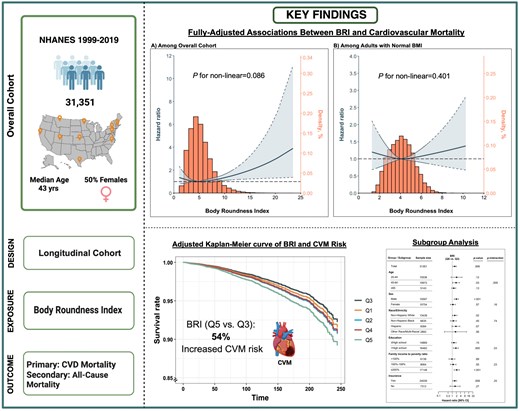
Beyond BMI: The Predictive Value of Body Roundness Index for Cardiovascular Mortality and Related Disparities: A National Cohort Study of US Adults
Abstract
Obesity, particularly visceral adiposity, is a key driver of cardiovascular mortality (CVM), yet conventional measures such as body mass index (BMI) inadequately capture fat distribution. The Body Roundness Index (BRI) is a novel anthropometric measure integrating waist circumference and height to better reflect body shape and visceral fat. This study examined the association between BRI and CVM in U.S. adults and across sociodemographic subgroups.
We analyzed data from 31,351 adults (median age 43 yrs, 50% females) aged >20 years in NHANES 1999–2018, excluding those with prior cardiovascular disease or cancer. BRI was computed using a validated equation and categorized into quintiles (Q3 as reference). The primary outcome was CVM; secondary outcomes included all-cause, heart disease, and cerebrovascular mortality. Weighted Cox proportional hazards and restricted cubic spline (RCS) models evaluated associations after adjustment for demographic, behavioral, and clinical factors. Subgroup and sensitivity analyses tested consistency and effect modification.
During a median follow up of 10.1 years (IQR: 5.3-14.9 years), 883 cardiovascular deaths occurred. In fully adjusted models, participants in the highest BRI quintile had a 54% higher risk of CVM (HR, 1.54; 95% CI, 1.13–2.08; p=0.006) versus Q3. This risk remained high even among those with normal BMI. RCS analysis indicated a modest U-shaped association. Stronger effects were observed among middle-aged adults (45–64 years) and those with higher educational attainment.
Higher BRI is independently associated with increased cardiovascular mortality, particularly among middle aged adults and those with normal BMI, underscoring its potential as a practical, noninvasive tool for cardiovascular risk stratification. Incorporating BRI into clinical and public health assessment may improve identification of individuals at elevated risk.
Lay Summary
One-sentence summary: This nationwide study shows that a simple body-shape measure that captures fat distribution and composition, called the Body Roundness Index (BRI) helps identify people at higher risk of dying from heart and blood vessel diseases, even among individuals who appear to have a healthy weight based on body mass index (BMI).
Key Findings:
Higher BRI was independently linked to a greater risk of cardiovascular and overall death in U.S. adults, including people classified as “normal weight” by BMI, suggesting that body fat distribution matters more than weight alone.
The association between BRI and cardiovascular death differed across age and socioeconomic groups, with particularly strong effects among middle-aged adults, highlighting groups who may benefit from earlier prevention and screening.


No comments:
Post a Comment