Use the labels in the right column to find what you want. Or you can go thru them one by one, there are only 34,115 posts. Searching is done in the search box in upper left corner. I blog on anything to do with stroke. DO NOT DO ANYTHING SUGGESTED HERE AS I AM NOT MEDICALLY TRAINED, YOUR DOCTOR IS, LISTEN TO THEM. BUT I BET THEY DON'T KNOW HOW TO GET YOU 100% RECOVERED. I DON'T EITHER BUT HAVE PLENTY OF QUESTIONS FOR YOUR DOCTOR TO ANSWER.
Changing stroke rehab and research worldwide now.Time is Brain!trillions and trillions of neuronsthatDIEeach day because there areNOeffective hyperacute therapies besides tPA(only 12% effective). I have 523 posts on hyperacute therapy, enough for researchers to spend decades proving them out. These are my personal ideas and blog on stroke rehabilitation and stroke research. Do not attempt any of these without checking with your medical provider. Unless you join me in agitating, when you need these therapies they won't be there.
What this blog is for:
My blog is not to help survivors recover, it is to have the 10 million yearly stroke survivors light fires underneath their doctors, stroke hospitals and stroke researchers to get stroke solved. 100% recovery. The stroke medical world is completely failing at that goal, they don't even have it as a goal. Shortly after getting out of the hospital and getting NO information on the process or protocols of stroke rehabilitation and recovery I started searching on the internet and found that no other survivor received useful information. This is an attempt to cover all stroke rehabilitation information that should be readily available to survivors so they can talk with informed knowledge to their medical staff. It lays out what needs to be done to get stroke survivors closer to 100% recovery. It's quite disgusting that this information is not available from every stroke association and doctors group.
Sunday, June 18, 2023
Special Nasal Drops Could Help The Brain Recover After A Stroke
Hell this was known and written about in January 2017.
Just proving once again how FUCKING INCOMPETENT THE STROKE MEDICAL WORLD IS!
Scientists have demonstrated how nasal drops containing a particular
molecule can help mice recover from the damaging biological consequences
of a stroke – and the hope is that the treatment could eventually be
transferred to humans.
Crucially, the treatment isn't applied straight away but is
initiated seven days after the stroke. That means those who are unable
to be assisted immediately after a stroke could still be protected
against the worst effects of the condition.
The key molecule in
the drops is the complement peptide (a chain of amino acids) C3a, which
we already know plays an important role in the body's immune system, as
well as in the development and plasticity of the brain.
"With this method, there's no need to race against the clock," says neuroimmunologist Marcela Pekna from the University of Gothenburg in Sweden.
"If
the treatment is used in clinical practice, all stroke patients could
receive it, even those who arrive at the hospital too late for
thrombolysis or thrombectomy. Those who have remaining disability after
the clot is removed could improve with this treatment too."
The delay is actually deliberate. Applied too early, the C3a
peptide can increase the number of inflammatory cells in the brain,
where they would start doing more harm than good.
Scientists
induced an artificial ischemic stroke, the most common type of stroke
there is, in mice. After a week, however, the nasal drops proved to help
mice recover motor function faster and more completely, compared to a
placebo group.
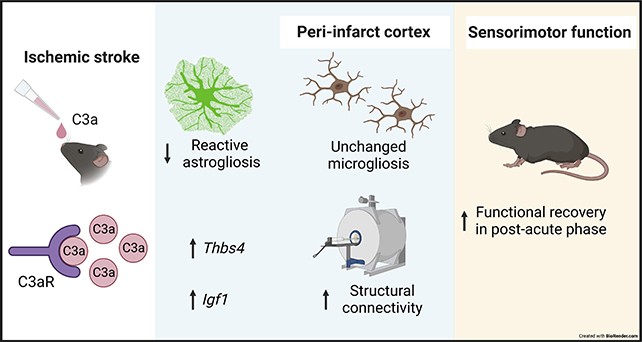
C3a was shown to help mice recover their motor function after a stroke. (Stokowska et al., Journal of Clinical Investigation, 2023)
The new study also gives us a better idea of the effect of C3a on the brain. MRI scans revealed that the peptide helped to increase the number of connections between nerve cells in the brains of the mice.
"Our results show that the C3a peptide affects the function of
astrocytes – that is, cells that control many of the nerve cells'
functions in both the healthy and the diseased brain – and which signals
astrocytes send to nerve cells," says neuroscientist Milos Pekny from the University of Gothenburg.
The study builds on previous work
by some of the same researchers into how the C3a peptide can protect
against and reverse stroke damage. That they were able to repeat their
results demonstrates the potential of this particular approach.
Some 7.6 million people
a year experience an ischemic stroke, with more than half then going on
to develop some kind of physical or mental impairment as a result: a
loss of voluntary movement in an arm or a leg, speech disturbances, or
issues with depression and anxiety.
Nosal
drops with the C3a peptide could make a massive difference in those
figures – though we're going to have to make sure that the treatment is
viable in humans as well as mice first. We can add it to the list of several possible options researchers are exploring.
"Our
ambition is to develop the method to make it usable in clinical
practice, but to get there, and especially to be able to carry out the
necessary clinical trials, we need to team up with a partner in the pharmaceutical industry," says Pekna.
 (mr.suphachai praserdumrongchai/iStock/Getty Images Plus)


No comments:
Post a Comment