Most
patients with stroke who are discharged home from inpatient poststroke
rehabilitation have residual motor impairment of the upper limb,
especially in the distal joints (i.e., the wrist and the fingers), which
greatly inhibits their ability to perform activities of daily living
(ADLs) [1, 2].
Although the traditional viewpoint on poststroke rehabilitation
suggested that significant motor recovery mainly occurs in the first
6 months after the onset of a stroke (i.e., acute and subacute periods) [3],
more recent studies have indicated that significant motor improvements
could also be achieved in the chronic period after stroke through
physical training as long as such training is as intensive as the one
provided to inpatients [4, 5]. Continuous and regular physical therapy is required to improve the wrist/hand function of outpatients with chronic stroke [6]. The restoration of limb function after stroke depends on intensive and repetitive training of the paralyzed limb [7, 8] with maximized voluntary motor effort [9, 10] and minimized compensatory motions in close-to-normal muscular coordination [10, 11].
However, the provision of effective wrist/hand rehabilitation services
for outpatients with chronic stroke is insufficient in the current
healthcare system in the world.
In most cases, outpatients have limited access to wrist/hand treatments with the necessary training intensity [12, 13] because of resource constraints due to factors such as an expanding stroke population and a lack of professionals worldwide [14, 15], as well as other difficulties such as commuting [2]
to the outpatient services in day hospitals, and the restriction of
social distancing during the COVID-19 pandemic. Home-based
telerehabilitation with minimum assistance and remote supervision by
professionals (i.e., self-help operation) is a promising approach for
sustaining of physical treatment after discharge and enhancing the
accessibility of rehabilitation resources to improve the wrist/hand
motor functions of discharged patients [16,17,18].
However,
few studies have focused on techniques for effective self-help upper
limb rehabilitation, especially for distal joints [16].
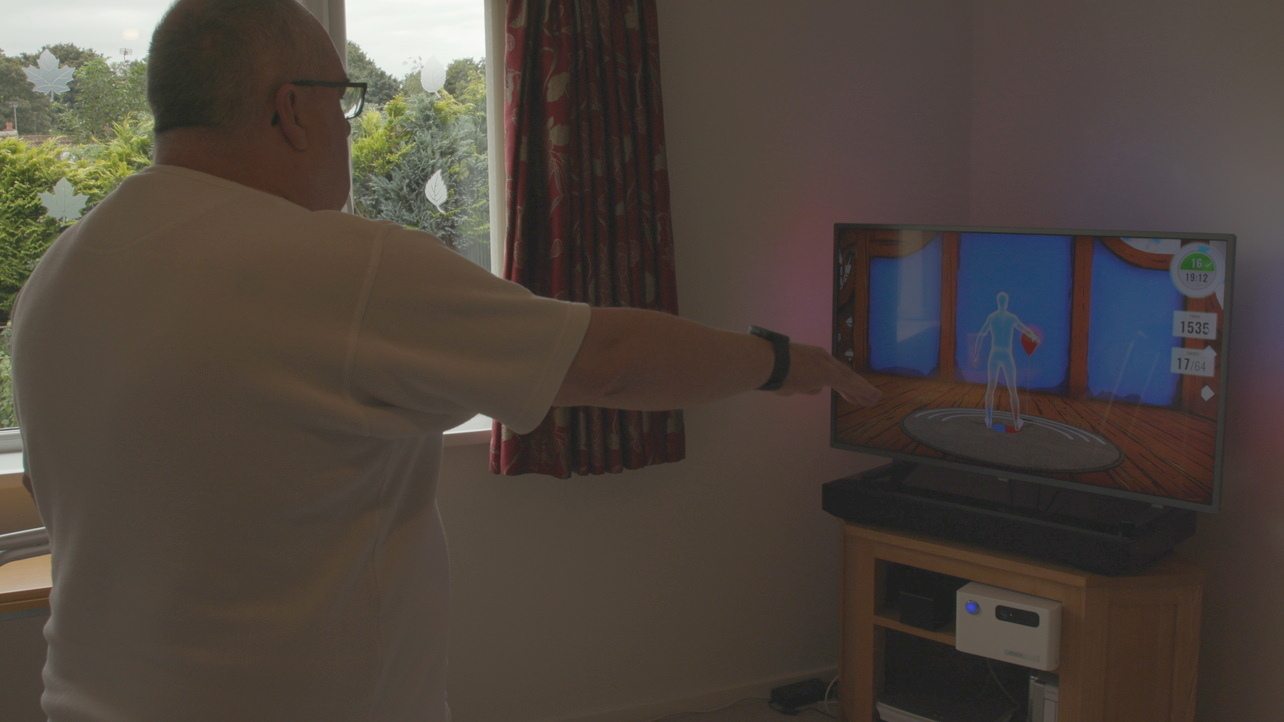
Currently, most studies on home-based telerehabilitation have been
based on virtual reality (VR) techniques because home-based VR training
is more convenient for and accessible to outpatients than conventional
therapy in a clinic or day hospital [16, 19].
Nevertheless, those systems focus on assessment or monitoring of limb
performance rather than providing the necessary physical assistance for
the patients to achieve the desired movements [16, 20,21,22,23,24].
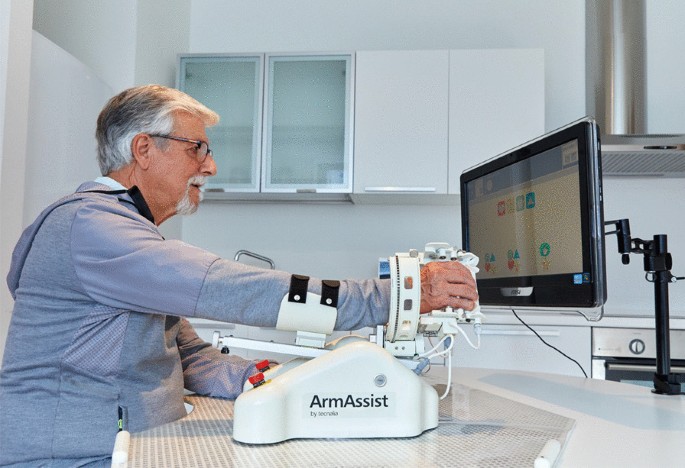
Rehabilitation robots have been developed to provide mechanical
assistance that mimics physical support from a therapist in conventional
therapy; these robots can alleviate the labor-intensive aspects of
hands-on physical therapy by performing repetitive therapeutic tasks
intensively under the supervision of a therapist [15], and these robotic therapies for distal joints have been reported to be effective for improving upper limb motor function [1, 25].
However, the majority of the existing rehabilitation robots are heavy,
have complex mechanical designs, and require large power supplies, large
physical spaces in conventional environments (e.g., clinic), and close
professional supervision, which are significant deterrents to their use
by patients independently at home [15, 26].
Furthermore,
using robot alone has a limitation in directly activating the desired
muscle groups because the target muscles of patients with stroke usually
cooperate with compensatory motions from other muscular activities [27].
Compensatory motions from the trunk and the proximal joints, i.e.,
abnormal motor synergies, are commonly observed in most persons with
chronic stroke when they attempt to reach an object or orient their hand
to grasp an object [28].
When neuromuscular electrical stimulation (NMES) combined with robotic
therapy, the robotic assistance could provide sensorimotor experiences
with precise kinematics to realize the desired movements [29], and NMES could activate the target muscles and reduce compensation from alternative muscle synergies [30].
Thus, the combined NMES-robot treatment has been suggested to
facilitate close-to-normal muscular coordination with reduced
compensation motions, and it has yielded more effective rehabilitation
outcomes than upper limb rehabilitation treatments that use only NMES or
only robots [31].
Electromyography (EMG) of the paralyzed limb to indicate voluntary
intention to integrate voluntary motor effort during practice has been
recommended for optimizing therapeutic outcomes [32].
EMG-driven training systems have yielded superior improvements in motor
functions with longer sustainability than those with passive limb
motions [33],
especially for voluntary motor control of the upper limb. Therefore,
EMG-driven NMES-robot therapy for home-based self-help training is
desirable for effective wrist/hand rehabilitation for outpatients with
chronic stroke.
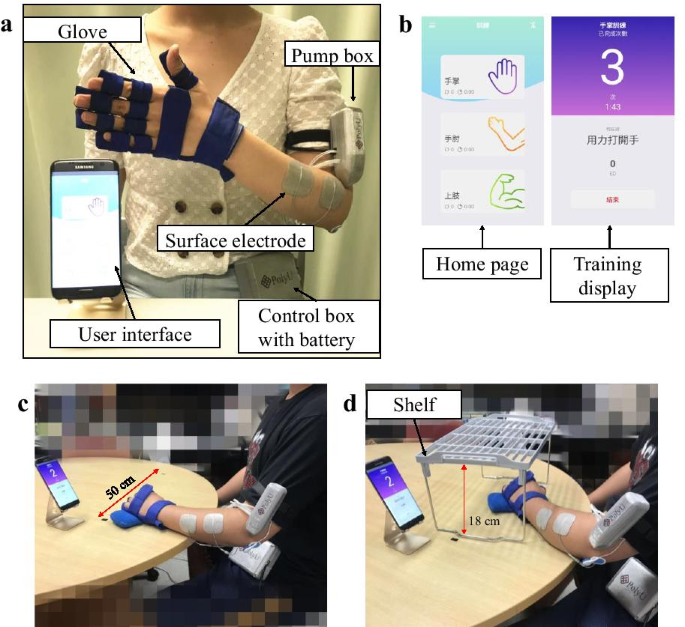
A novel EMG-driven exoneuromusculoskeleton (ENMS)
for self-help upper limb rehabilitation after stroke was developed
recently by our team [34, 35].
Taking the advantages of exoskeleton, pneumatic muscle, and NMES, the
developed system is lightweight, compact, and has low power consumption.
The system can assist the extension and flexion of the elbow, wrist,
and finger joints under voluntary effort control through EMG. The system
consists of an elbow module and a wrist/hand module that can work
collectively or separately. The wrist/hand module can work independently
as an EMG-driven wrist/hand ENMS (WH-ENMS) to assist wrist/hand
movements during training (Fig. 1). The rehabilitation effects of the EMG-driven ENMS have been investigated in 15 participants with chronic stroke [35],
followed by a 20-session training program in a neurorehabilitation
laboratory, where the participants completed the training independently
with the system after they received a tutorial session and three guided
training sessions (including practicing device operation and training
setup). The participants exhibited significant improvements in voluntary
motor control and muscle coordination of the paretic limb after the
EMG-driven ENMS-assisted upper limb training [35].
No safety problems were reported by either the experiment operators or
the participants throughout the study period. The system offers the
possibility of home-based self-help wrist/hand training for discharged
patients with chronic stroke. However, the feasibility of using the
EMG-driven WH-ENMS for self-help upper limb training and its
rehabilitation effects in a home setting had not been investigated.
Therefore,
in this study, we aimed to determine the feasibility of home-based
self-help training assisted by the EMG-driven WH-ENMS on outpatients
with chronic stroke and investigate its rehabilitation effects. Our
hypothesis was that the participants who received the home-based
self-help telerehabilitation training assisted by the EMG-driven WH-ENMS
would obtain motor improvements in the distal joints, better muscle
coordination of the paretic upper limb, and reduce compensatory
movements when performing limb tasks.