Saw an ad for this in Super Age so had to find the research behind it.
But I guess your competent? doctor told you about this last June, right?
The Essential Fat Most Diets Are Missing (And Why It Matters for Aging Well) June 2025
The latest here:
A Review of Odd-Chain Fatty Acid Metabolism and the Role of Pentadecanoic Acid (C15:0) and Heptadecanoic Acid (C17:0) in Health and Disease
,
and
MRC HNR, Elsie Widdowson Laboratory, Fulbourn Road, Cambridge CB1 9NL, UK
*
Author to whom correspondence should be addressed.
This article belongs to the Section Metabolites
Abstract
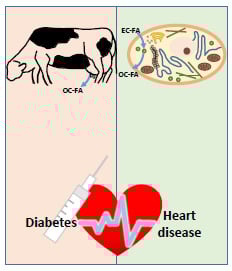
The role of C17:0 and C15:0 in human health
has recently been reinforced following a number of important biological
and nutritional observations. Historically, odd chain saturated fatty
acids (OCS-FAs) were used as internal standards in GC-MS methods of
total fatty acids and LC-MS methods of intact lipids, as it was thought
their concentrations were insignificant in humans. However, it has been
thought that increased consumption of dairy products has an association
with an increase in blood plasma OCS-FAs. However, there is currently no
direct evidence but rather a casual association through epidemiology
studies. Furthermore, a number of studies on cardiometabolic diseases
have shown that plasma concentrations of OCS-FAs are associated with
lower disease risk, although the mechanism responsible for this is
debated. One possible mechanism for the endogenous production of OCS-FAs
is α-oxidation, involving the activation, then hydroxylation of the
α-carbon, followed by the removal of the terminal carboxyl group.
Differentiation human adipocytes showed a distinct increase in the
concentration of OCS-FAs, which was possibly caused through α-oxidation.
Further evidence for an endogenous pathway, is in human plasma, where
the ratio of C15:0 to C17:0 is approximately 1:2 which is contradictory
to the expected levels of C15:0 to C17:0 roughly 2:1 as detected in
dairy fat. We review the literature on the dietary consumption of
OCS-FAs and their potential endogenous metabolism.
1. Introduction
The
development of chromatographic technologies has enabled the study of
lipid biochemistry and the role lipids play in the pathology of many
diseases. There has been an ever increasing drive to improve the
resolution and sensitivity of lipid analysis starting from thin layer
chromatography several decades ago to ultra-performance liquid
chromatography coupled to high resolution mass spectrometry. This has
led to a considerable development in the understanding of lipids and
their associations with disease, through disease etiology, biomarkers,
treatment and prevention. To the present date, there have been over 150
different diseases connected with lipids, ranging from high blood
pressure and artery plaques [1], obesity [2], type II diabetes [3], cancer [4] and neurological disorders [5].
Fatty acids are the basic building blocks of more complex lipids [6]
and their composition in different lipid species are often used as a
means for comparison within a lipid class when examining disease and
physiological perturbations in lipid metabolism. It has been shown that
saturated fatty acids [7]
are associated with increased relative risks for diseases such as
coronary heart disease, atherosclerosis, fatty liver disease,
inflammatory diseases and Alzheimer’s disease. In contrast many
unsaturated fatty acids including both mono-unsaturated and
poly-unsaturated, have been associated with a reduced risk for each of
the previously described disorders in certain studies [8].
Fatty acid chain length is also used for the diagnosis and prognosis of
disease with respect to adrenoleukodystrophy, Refsum disease and
Zellweger Syndrome where the propagation of very long chain fatty acids
(>22 Carbon length chain [9]) is indicative of these disorders [10].
The
majority of research into fatty acid metabolism has been conducted
primarily on even chain fatty acids (carbon chain length of 2–26) as
these represent >99% of the total fatty acid plasma concentration in
humans [11,12].
However there is also a detectable amount of odd-chain fatty acids in
human tissue. As a result of the low concentration there are only four
significantly measureable odd chain fatty acids, which are C15:0, C17:0,
C17:1 [13] and C23:0 [14].
C15:0 and C17:0; these have been gaining research interest within the
scientific community as they have been found to be important as: (1)
quantitative internal standards; (2) biomarkers for dietary food intake
assessment; (3) biomarkers for coronary heart disease (CHD) risk and
type II diabetes mellitus (T2D) risk (although the objective is not to
provide a meta-analysis of odd chain saturated fatty acids (OCS-FAs) and
disease risk); (4) evidence for theories of alternate endogenous
metabolic pathways, where these are discussed hereafter. The purpose of
this review is to address these points and highlight the importance of
their inclusion into routine lipidomic analyses, as well as introduce
areas that need further research.


No comments:
Post a Comment