Changing stroke rehab and research worldwide now.Time is Brain! trillions and trillions of neurons that DIE each day because there are NO effective hyperacute therapies besides tPA(only 12% effective). I have 523 posts on hyperacute therapy, enough for researchers to spend decades proving them out. These are my personal ideas and blog on stroke rehabilitation and stroke research. Do not attempt any of these without checking with your medical provider. Unless you join me in agitating, when you need these therapies they won't be there.

What this blog is for:

My blog is not to help survivors recover, it is to have the 10 million yearly stroke survivors light fires underneath their doctors, stroke hospitals and stroke researchers to get stroke solved. 100% recovery. The stroke medical world is completely failing at that goal, they don't even have it as a goal. Shortly after getting out of the hospital and getting NO information on the process or protocols of stroke rehabilitation and recovery I started searching on the internet and found that no other survivor received useful information. This is an attempt to cover all stroke rehabilitation information that should be readily available to survivors so they can talk with informed knowledge to their medical staff. It lays out what needs to be done to get stroke survivors closer to 100% recovery. It's quite disgusting that this information is not available from every stroke association and doctors group.

Showing posts with label therapist responsibility. Show all posts

Sunday, June 7, 2026

How long should you be able to hold a wall sit? Test your fitness level and see how you compare

 Ask your therapist if this would help in your balance recovery and fall prevention.

How long should you be able to hold a wall sit? Test your fitness level and see how you compare

  • Most people can hold a wall sit for 30–60 seconds, while trained athletes may sustain the position for several minutes.
  • Wall sits build lower-body endurance, stability, and isometric strength through sustained muscle contraction without movement.
  • Improving wall sit performance comes from consistent practice, proper form, and strengthening the quads, glutes, and core.

In the world of lower-body exercises, the wall sit often falls by the wayside, overlooked for other staples like deadlifts and squats. One reason may be that it looks too easy. If you really want to work your muscles, simply holding a squat position and staying still isn’t going to do much, right?


Not exactly. The wall sit is actually much harder than it looks—and it can be a great, equipment-free way to test your lower-body fitness. Here’s what you need to know.

What a Wall Sit Measures

A wall sit is an isometric exercise, meaning there’s no movement involved. Your muscles are under constant contraction—known as the concentric phase—which keeps you steady so you can hold your position.

This makes it different from other common exercises, which have both concentric and eccentric phases that produce the movement. Take a regular squat, for example: As you lower down, your muscles lengthen in the eccentric phase; then, they shorten in the concentric phase to push you back up.

That constant contraction is what makes the wall sit deceptively difficult, Evan Williams, CSCS, strength and conditioning coach for the Milwaukee Bucks, told Health. “Because it’s an isometric exercise, the muscles have little chance to relax, which leads to faster fatigue,” he said. “On top of that, the quads have to produce a significant amount of force just to maintain the position against gravity.” 

The combo of that continuous time under tension, plus the partial restriction in blood flow that can happen during sustained holds, “creates the intense burn people feel,” said Williams.

But the wall sit isn’t just about muscle fatigue. It’s also an important measure of various fitness factors. “A wall sit measures isometric strength, muscular endurance, and lower-body stability,” said Williams.

This has important carryover outside of the gym, too. “In everyday life, things like carrying objects, climbing stairs, or even standing for long periods all require a certain level of lower-body endurance and stability,” said Williams. So by boosting your performance in the wall sit, you may be able to perform daily activities more easily.

How Long Should You Be Able to Hold a Wall Sit?

There’s not a ton of standardized data on how long you should be able to hold a wall sit. One 2025 study had 739 adults complete a 12-week strength and aerobic fitness program, and measured their wall sit performance both before and after as one of their data points. On average, people held the wall sit for 47 seconds before starting the fitness program; they increased their hold duration to 65 seconds after the 12 weeks.

“This lines up well with someone moving from a beginner level into more of an intermediate range,” said Williams.

Related video: How Long You Should Be Able to Stand on One Leg, Depending on Your Age (The Hearty Soul)
lltica+How Many Push Ups should you be able to do? Amount sorted by age

  • Cassidy Thompson/Cassidy ThompsonHow to master the L-sit | Calisthenics exercises & challenge
    I Army Fitness Test?
  • 20:30
  • Additionally, the following ranges can be a useful benchmark based on Williams’s experience training individuals:

    • Beginner: 30–45 seconds 
    • Average: 45–60 seconds 
    • Above average: 60–90 seconds
    • Advanced: 90 seconds–2 minutes
    • Athlete/high fitness: 2–4+ minutes

    Still, there are lots of factors that can go into how long you can hold a wall sit, so performance should be viewed as just one piece of the puzzle rather than a strict standard, said Williams. Factors that can influence wall sit performance include bodyweight, training background, age, and sex, as well as small differences in positioning.

    How To Do a Proper Wall Sit

    Wall sits provide a glimpse into your muscular endurance, isometric strength, and lower-body stability. “More specifically, it shows how well someone can maintain proper body positioning under load over time,” Williams said.

    Here are the steps to doing a proper wall sit:

    1. Stand with your back against a wall. Walk your feet out, roughly 1–2 feet away from the wall, keeping them shoulder-width apart.
    2. Slide down the wall slowly, bending your knees, and stopping when your thighs are about parallel to the floor. Your knees should be stacked over your ankles, not pushed past your toes.
    3. Hold your position, keeping your back flat against the wall, core engaged, and weight evenly distributed through both feet. Don't forget to breathe.
    4. Stand back up by pushing through your heels and sliding up the wall.

    Wall sits seem simple, but there are a number of form mistakes Williams commonly sees with his clients. The first has to do with positioning: Your thighs should be parallel to the floor with knees bent at 90 degrees. “People are usually either too high, which makes it easier, or too low, which can add unnecessary stress,” he said.

    Many people also lose contact with the wall during the duration of the exercise, but your head, shoulders, and hips should stay against it the entire time. Your chest should stay up, ribs down, and core engaged to help maintain a strong position as well. 

    Knees collapsing inward is another big mistake. “As fatigue sets in, you’ll also often see the knees start to cave inward, which usually means the quads are getting tired and the glutes aren’t stabilizing well enough,” said Williams.

    Finally, many people forget to breathe. “A lot of people tend to hold their breath, which actually makes the exercise harder and increases fatigue,” said Williams. “It’s better to focus on slow, controlled breathing—inhale through the nose for about three to four seconds and exhale through the mouth for four to six seconds. This helps keep oxygen flowing, keeps heart rate more controlled, and allows the muscles to work longer.”

    Tips to Improve Your Wall Sit Time

    If you want to get better at wall sits, you should include them regularly in your workout routine. A good rule of thumb is two to three times per week, at two to three sets each time. If you're a beginner, see how long you can comfortably hold a wall sit the first time, and then continually try to match or beat that time.

    Wall sits “can be used either as part of a warm-up to activate the lower body or at the end of a workout to build muscular endurance,” said Williams. You can also add a challenge to the wall sit with a few progressions: Try a kickstand or single-leg variation, or add load by holding a dumbbell or a weight plate while you do the traditional version.

    But a huge part of getting better at wall sits is strengthening the muscles involved in them—mainly, your quads and glutes. “Squat and split squat variations help build quad strength, hip thrusts and band work improve glute and hip stability, and core exercises like planks and dead bugs help maintain positioning under fatigue,” Williams said. “At the end of the day, getting better at wall sits comes down to improving strength, endurance, and the ability to maintain good form as fatigue sets in.” 

    Read the original article on Health

    Monday, November 11, 2024

    The influence of a walk in nature on human resting brain activity: a randomized controlled trial

     Did your therapists get you walking in the woods? If not, they should have known of forest bathing a long time ago and figured out how to implement it for your recovery. And doing so will vastly improve your balance.

  • forest bathing (23 posts to September 2015)
  • The influence of a walk in nature on human resting brain activity: a randomized controlled trial

  • Published:
  • Abstract

    Behavioral studies suggest that immersion in nature improves affect and executive attention. However, the neural mechanisms underlying these benefits remain unclear. This randomized controlled trial (N = 92) explored differences in self-reported affect and in frontal midline theta (FMθ), a neural oscillation linked to executive attention, between a 40-min, low-intensity nature walk and an urban walk of comparable time and distance—controlling for ambient temperature, humidity, elevation change, walking pace, heart rate, calories burned, and moving time between the two groups. While affect improved for both groups, the nature walkers showed a significantly greater boost in positive affect than the urban walkers. Electroencephalography (EEG) data revealed significantly greater FMθ activity following the urban walk compared to the nature walk, suggesting that the urban walk placed higher demands on executive attention. In contrast, the nature walk allowed executive attention to rest, as indicated by the lower FMθ activity observed after the walk. This study suggests that changes in FMθ may be a potential neural mechanism underlying the attentional strain of urban environments in contrast to the attentional rest in nature.

    Wednesday, August 7, 2024

    Assessing Ankle Proprioception using a Novel Robotic Device: Generalizability, Parameter Sensitivity, and Predictive Power for Stroke Rehabilitation

     'Assessments' are completely useless unless directly used to map to EXACT PROTOCOLS that fix the deficit! I'm not going to read this, that is your doctor's and therapist's responsibility!

     Assessing Ankle Proprioception using a Novel Robotic Device: Generalizability, Parameter
    Sensitivity, and Predictive Power for Stroke Rehabilitation

    Permalink
    https://escholarship.org/uc/item/5b03k043
    Author
    Johnson, Christopher
    Publication Date
    2024
    Peer reviewed|Thesis/dissertation
    eScholarship.org Powered by the California Digital Library
    University of California
     
    154 pages at link

    Friday, August 2, 2024

    Perturbation-based estimation of within-stride cycle metabolic cost

     If your doctor and therapists can't use this to identify and correct your walking imperfections, then you need to find competent ones.

    Perturbation-based estimation of within-stride cycle metabolic cost

    Abstract

    Metabolic cost greatly impacts trade-offs within a variety of human movements. Standard respiratory measurements only obtain the mean cost of a movement cycle, preventing understanding of the contributions of different phases in, for example, walking. We present a method that estimates the within-stride cost of walking by leveraging measurements under different force perturbations. The method reproduces time series with greater consistency (r = 0.55 and 0.80 in two datasets) than previous model-based estimations (r = 0.29). This perturbation-based method reveals how the cost of push-off (10%) is much smaller than would be expected from positive mechanical work (~ 70%). This work elucidates the costliest phases during walking, offering new targets for assistive devices and rehabilitation strategies.

    Introduction

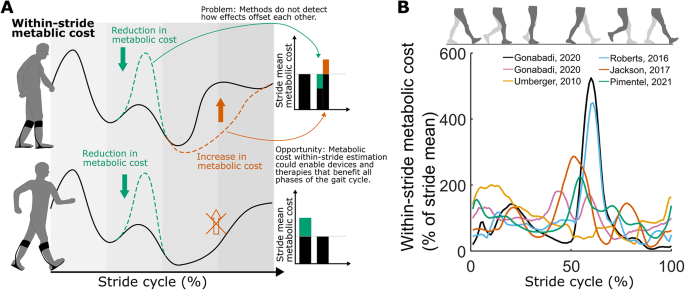
    Metabolic cost is a critical measure used to characterize movement behavior [1,2,3]. Healthy walkers naturally adopt an energetically optimal stride cycle, for example, by walking with a step length [4] and knee flexion angle [5] that minimizes metabolic cost. Pathologies like stroke and cerebral palsy alter patients’ walking stride resulting in increases to metabolic cost by 60 to 300% [6, 7]. Such increases in metabolic cost correlate to drastic reductions in people’s mobility and overall quality of life [8, 9]. If we understand how stride cycle phases contribute to metabolic cost, therapies and devices may be better optimized to improve mobility (Fig. 1A).

    Fig. 1
    figure 1

    Motivation. (A). Limitation of assessing stride-mean metabolic cost using breath-by-breath measurements. The upper figure illustrates an intervention resulting in a cost reduction (depicted in green) during push-off and a cost increase (depicted in brown) during swing. The stride-mean metabolic cost (displayed in bars) does not enable differentiation of these effects. The lower section of the figure illustrates how comprehending the costs associated with various phases could facilitate the enhancement of interventions. (B). Limited consistency between estimations of within-stride metabolic cost using model-based methods. The mean correlation between estimations is 0.29 (95% confidence interval (CI) = 0.03–0.43) [16, 19, 38, 41, 42]

    Measurements of metabolic cost are too slow to detect the contributions of different stride phases. Current methods to calculate energy from oxidative reactions include measuring respiratory CO2 production by ingesting water with a radioisotope (‘doubly labelled water method’), measuring oxidative heat production using a chamber (‘direct calorimetry’), and measuring O2 consumption from respiration (‘indirect calorimetry’) [10]. Indirect calorimetry is the fastest and most commonly used method for measuring metabolic cost during locomotion; however, it still requires averaging several minutes of breaths to be reliable [11,12,13]. A typical walking stride lasts about one second meaning current methods can only measure the mean metabolic cost following a bout of steady-state walking. Experiments that approximated the cost of the swing phase by recording cyclical leg swinging [14] and by measuring blood flow from injected microspheres in animals that are then sacrificed [15] suggest that the stride-mean metabolic cost does not necessarily represent the contributions of individual phases (‘within-stride metabolic cost’).

    Several model-based methods of estimating within-stride metabolic cost have been proposed but remain inconclusive. Umberger developed a set of equations to estimate metabolic cost from muscle parameters and used this to produce the first estimation of within-stride metabolic cost from a forward simulation of walking [16]. Other groups used EMG-driven simulations [17] or equations based on joint kinetics instead of muscle parameters [18]. However, when comparing those methods to each other, their estimations of within-stride metabolic cost are relatively inconsistent (Pearson correlation: r = 0.29, n = 6 estimations, Fig. 1B) [19]. Currently, there is no way to validate these model-based estimations for within-stride metabolic cost since measurements from indirect calorimetry only obtain a stride mean. This motivates the development of an alternative method to estimate within-stride metabolic cost that is supported by indirect validation approaches.

    We hypothesized that applying a set of perturbations creates a set of instances of the behavior where the differences in the time series between each perturbed instance can be attributed to the different magnitudes and timings of the applied perturbation. By applying perturbations repeatedly to a specific part of the gait cycle for several minutes, we can induce changes in the stride-mean metabolic cost as well as in the biomechanical time series (e.g., kinematics, kinetics, and muscle activations) [19,20,21]. We postulated the variation across the set of perturbed walking strides would be representative of the fluctuations in metabolic cost within the stride cycle so long as the set contained a large number of different perturbations. If true, this would enable a method to extract key features of within-stride metabolic cost. Our approach is inspired by prior studies that utilized ankle perturbations to assess time series of joint impedance during the stance phase [22, 23] as well as studies that used elastic bands and added mass to estimate the cost of stance and swing phases [24, 25]. To the best of our knowledge, using of a perturbation-based approach for estimating within-stride metabolic cost time series is novel.

    Using this concept, extraction of within-stride behaviour from a collection of perturbed instances, we developed an alternative method to estimate within-stride metabolic cost that we refer to as our ‘perturbation-based method’. Our method estimates within-stride metabolic cost using measurements from a set of perturbed walking strides. We then evaluated our method’s ability to consistently reproduce model-based estimates of within-stride metabolic cost.

    More at link.

    Friday, April 19, 2024

    Upper limb motor recovery post-stroke seminar: Embracing complexity to deliver optimal outcomes.

    When your doctors and therapists go to this event; DEMAND THEY COME BACK WITH 100% RECOVERY PROTOCOLS! Anything less is a waste of time.

     Upper limb motor recovery post-stroke seminar: Embracing complexity to deliver optimal outcomes.

    Event Location

    33 Queen Square Basement Lecture Theatre
    Location
    33 Queen Square Basement Lecture Theatre
    Venue Details

    Basement Lecture Theatre

    33 Queen Square

    London

    WC1N 3BG

    More Information

    How to get to Queen Square 

    Arriving by national rail :

    Buses leave from the following mainline train stations to Russell Square:

    Euston - 68, 168, 59, 91

    King's Cross - 35, 91

    Waterloo - 59, 168, 188

    Charing Cross - 91

    Paddington - 7 

    Arriving by car:

    Parking is available at the NCP Brunswick Square car park on Marchmont Street, LondonWC1N 1AF, which is a five minute walk to Guildford Street.

    MAP


    Arriving by tube: 

    The nearest tube stations are Russell Square, Euston and King’s Cross.

    Please click on the link below for a map of the area:

    TUBE

     
    Date of Event
    13th May 2024
    Last Booking Date for this Event
    13th May 2024

    Description

    Upper limb motor recovery post-stroke: Embracing complexity to deliver optimal outcomes.

    Dr Kate Hayward, University of Melbourne


    Dr Kate Hayward is an Associate Professor of Stroke Recovery and Rehabilitation at the University of Melbourne. Kate is an NHMRC Emerging Leader, Heart Foundation Future Leader, and Dame Kate Campbell Fellow. She leads the REPAIR Research Group which applies early phase clinical trial designs to study when the ideal time is to start therapy after stroke, how much therapy should be provided, and who stands to benefit most from therapy. Kate also co-Chaired the recent third international Stroke Recovery and Rehabilitation Roundtable.


    The seminar will take place in person with no online attendance option. Please join us after the event for wine, soft drinks, crisps, and networking. 

    Attendee CategoryCostPlace(s) Available  

    Free.£0.0052[Read More]


    Friday, December 1, 2023

    The 5 Longevity Exercises a Physical Therapist Recommends To Stay Strong and Pain-Free As You Age—No Equipment Required

    If you can't do these post stroke; you can blame your doctors and therapists for not having decent enough EXACT RECOVERY PROTOCOLS! They will try to blame you for your lack of recovery; DO NOT ALLOW THAT DIVERSION OF RESPONSIBILITY!

    The 5 Longevity Exercises a Physical Therapist Recommends To Stay Strong and Pain-Free As You Age—No Equipment Required

    Newton was on to something (beyond just sheer physics) with the whole “a body in motion stays in motion” thing. Longevity experts are clear: If you hope to limit aches and pains as you age, remaining active now is key.But that doesn’t necessarily mean putting your body through grueling workout after grueling workout—in fact, it’s much simpler and less brutal than that.How to exercise for healthy aging When thinking holistically about exercise for longevity, there are some common themes to keep in mind.

    Think about function first

    Different workouts can address different facets of aging, like how high-impact workouts benefit bone strength, for instance. But nothing is quite as useful to healthy aging as functional fitness. This fitness buzzword essentially means training in a way that offers strength you can use in the movements you do in everyday life. And it doesn’t matter whether that’s cardio or lifting weights. “If an exercise yields an adaptation that helps someone become better able to do what they need to do, then it’s functional,” explains Ryan Chow, DPT, founder of Reload, a physical therapy and fitness practice, where he frequently works with aging and elderly populations. “Function is defined as ‘useful, ‘purposeful’—stuff like bending, twisting, lifting, loading, pushing, pulling, squatting, and hauling,” adds Ingrid Clay, CPT, a trainer on Centr, a personalized coaching app. Functional fitness often works on flexibility and balance, which are key components of healthy aging, as they help prevent falls and injuries, adds Clay. Functional exercises are designed to help you, say, get up out of a car, or safely walk down stairs—real-life movements we need to do to stay independent as we age.
    Do it often enough It’s not just about how you move, but how much time you spend moving. Dr. Chow recommends following the physical activity guidelines set by the World Health Organization or American Heart Association
    : 150 to 300 minutes of moderate to vigorous aerobic exercise throughout the week and progressive resistance training (aka strength training) targeting all major muscle groups twice a week. “The mounting evidence suggests that this can reduce all causes of mortality by 40 percent,” says Dr. Chow. “Maybe more importantly, reaching these guidelines is also giving you [greater] quality of life.”

    Vary your workouts

    For best results as you age, avoid doing the same type of exercise again and again. Instead, mix things up. Even if what you love most is walking, push yourself to try a yoga class or hop on a bicycle every so often. This ensures you’re moving your body in all planes of motion and maintaining a strong heart, lungs, and muscles. “Doing both resistance training and cardiovascular training can keep your metabolic and cardiovascular systems healthy, while maintaining the health and function of your muscles and joints so that you can be able-bodied as you get older,” says Dr. Chow.

    Five strength exercises you can do at home for healthy aging

    Whether you’re 25 or 75, these functional exercises recommended by Dr. Chow will help set you up for safe, comfortable movement for life. Add them to your weekly routine, along with regular bouts of aerobic exercise for a longevity-focused regimen.

    Isometric split squat


    “This exercise is related to balance, and getting up and down from the ground,” says Dr. Chow.With one foot in front and the other behind you, bend both knees coming into a 90-degree bend with both legs. Hold for as long as you can, with the goal of working up to two minutes.Modification: If 90-degrees is too deep to bend and hold comfortability, hold the position a bit higher or use a sturdy object to touch lightly for support.

    Supported deep squat


    “This exercise trains both strength and mobility in the hips and knees,” says Dr. Chow. Clay adds that the lower body strength you build with squats “is important for maintaining balance and mobility as we age.”Stand in front of a closed door that does not swing toward you. Feet should be slightly wider than hip-distance apart and toes slightly turned out.Grab the door handle for leverage to pull against as you bend both knees to slowly come into a squat, taking five seconds to get there.Pause at the bottom for one second.Slowly push through soles of the feet to return to standing, taking five seconds to get there. Form note: Keep tension on the door handle to engage the upper body, which helps maintain a straight back throughout the movement.

    Wall sit with heel raise


    “This exercise trains the soleus and the Achilles tendon to maintain the ability to be springy and absorb impact in the hips, knees, and ankles,” says Dr. Chow.tand with your back toward a wall. Press your head, upper back, and butt against the wall, as you walk your feet away from it and begin to slide into a sitting position, with knees and hips bent at 90 degrees. Raise your heels up without moving anything else. Aim to hold for 60 seconds.Progression: Once you’re able to hold the heel-elevated wall sit for a minute, try holding for as long as possible on one leg, then the next. “This exercise trains the muscles of the upper back to maintain the ability to stay upright,” says Dr. Chow. “These are your antigravity muscles to Begin standing with hands behind your ears, palms facing forward, and elbows out wide. Engage your lats (the large muscles on the sides and upper back) to pull your elbows down and in toward your sides, squeezing your shoulder blades together.Squeeze and hold for five seconds. Form tip: Don’t crunch inward when bringing elbows down to sides. Keep your chest lifted. Arms will mimic the letter W.

    Beast crawl

    “This move trains your shoulders, trunk, thighs, and most importantly, the toes,” says Dr. Chow. “It’s important to maintain the ability to land on the toes to allow for push-off during quick activities like running or walking fast, plus it controls stress to the big toe joint, which can prevent bunion development.” Start in a tabletop position on hands and knees, with your toes tucked under. Engage the core to lift knees off the ground in a hover.From here, crawl slowly forward, back, and side to side with the goal of staying moving and knees elevated for 30 seconds.Form tip: Try to keep your back flat and hips parallel to the ground.Newton was on to something (beyond just sheer physics) with the whole “a body in motion stays in motion” thing. Longevity experts are clear: If you hope to limit aches and pains as you age, remaining active now is key.But that doesn’t necessarily mean putting your body through grueling workout after grueling workout—in fact, it’s much simpler and less brutal than that.How to exercise for healthy aging When thinking holistically about exercise for longevity, there are some common themes to keep in mind.

    Think about function first

    Different workouts can address different facets of aging, like how high-impact workouts benefit bone strength, for instance. But nothing is quite as useful to healthy aging as functional fitness. This fitness buzzword essentially means training in a way that offers strength you can use in the movements you do in everyday life. And it doesn’t matter whether that’s cardio or lifting weights.“If an exercise yields an adaptation that helps someone become better able to do what they need to do, then it’s functional,” explains Ryan Chow, DPT, founder of Reload, a physical therapy and fitness practice, where he frequently works with aging and elderly populations.“Function is defined as ‘useful, ‘purposeful’—stuff like bending, twisting, lifting, loading, pushing, pulling, squatting, and hauling,” adds Ingrid Clay, CPT, a trainer on Centr, a personalized coaching app. Functional fitness often works on flexibility and balance, which are key components of healthy aging, as they help prevent falls and injuries, adds Clay. Functional exercises are designed to help you, say, get up out of a car, or safely walk down stairs—real-life movements we need to do to stay independent as we age.It’s not just about how you move, but how much time you spend moving. Dr. Chow recommends following the physical activity guidelines set by the World Health Organization or American Heart Association: 150 to 300 minutes of moderate to vigorous aerobic exercise throughout the week and progressive resistance training (aka strength training) targeting all major muscle groups twice a week.“The mounting evidence suggests that this can reduce all causes of mortality by 40 percent,” says Dr. Chow. “Maybe more importantly, reaching these guidelines is also giving you [greater] quality of life.”

    Vary your workouts

    For best results as you age, avoid doing the same type of exercise again and again. Instead, mix things up. Even if what you love most is walking, push yourself to try a yoga class or hop on a bicycle every so often. This ensures you’re moving your body in all planes of motion and maintaining a strong heart, lungs, and muscles. “Doing both resistance training and cardiovascular training can keep your metabolic and cardiovascular systems healthy, while maintaining the health and function of your muscles and joints so that you can be able-bodied as you get older,” says Dr. Chow.

    Five strength exercises you can do at home for healthy aging

    Whether you’re 25 or 75, these functional exercises recommended by Dr. Chow will help set you up for safe, comfortable movement for life. Add them to your weekly routine, along with regular bouts of aerobic exercise for a longevity-focused regimen.

    Isometric split squat

    “This exercise is related to balance, and getting up and down from the ground,” says Dr. Chow.With one foot in front and the other behind you, bend both knees coming into a 90-degree bend with both legs.Hold for as long as you can, with the goal of working up to two minutes.>Modification: If 90-degrees is too deep to bend and hold comfortability, hold the position a bit higher or use a sturdy object to touch lightly for support.Supported deep squat “This exercise trains both strength and mobility in the hips and knees,” says Dr. Chow. Clay adds that the lower body strength you build with squats “is important for maintaining balance and mobility as we age.”Stand in front of a closed door that does not swing toward you. Feet should be slightly wider than hip-distance apart and toes slightly turned out.Grab the door handle for leverage to pull against as you bend both knees to slowly come into a squat, taking five seconds to get there.Pause at the bottom for one second.Slowly push through soles of the feet to return to standing, taking five seconds to get there.

    Wall sit with heel raise

    “This exercise trains the soleusand the Achilles tendon to maintain the ability to be springy and absorb impact in the hips, knees, and ankles,” says Dr. Chow.Stand with your back toward a wall. Press your head, upper back, and butt against the wall, as you walk your feet away from it and begin to slide into a sitting position, with knees and hips bent at 90 degrees.

    Bat wing


    “This exercise trains the muscles of the upper back to maintain the ability to stay upright,” says Dr. Chow. “These are your antigravity muscles to .”Begin standing with hands behind your ears, palms facing forward, and elbows out wide.Engage your lats (the large muscles on the sides and upper back) to pull your elbows down and in toward your sides, squeezing your shoulder blades together.Squeeze and hold for five seconds.

    Beast crawl

    Absolutely impossible for me to do; can't get hand into position, elbow and wrist collapse.

    “This move trains your shoulders, trunk, thighs, and most importantly, the toes,” says Dr. Chow. “It’s important to maintain the ability to land on the toes to allow for push-off during quick activities like running or walking fast, plus it controls stress to the big toe joint, which can prevent bunion development.”Start in a tabletop position on hands and knees, with your toes tucked under.From here, crawl slowly forward, back, and side to side with the goal of staying moving and knees elevated for 30 seconds.Form tip: Try to keep your back flat and hips parallel to the ground.Newton was on to something (beyond just sheer physics) with the whole “a body in motion stays in motion” thing. Longevity experts are clear: If you hope to limit aches and pains as you age, remaining active now is key.

    How to exercise for healthy aging

    When thinking holistically about exercise for longevity, there are some common themes to keep in mind.

    Think about function first

    Different workouts can address different facets of aging, like how high-impact workouts benefit bone strength, for instance. But nothing is quite as useful to healthy aging as functional fitness. This fitness buzzword essentially means training in a way that offers strength you can use in the movements you do in everyday life. And it doesn’t matter whether that’s cardio or lifting weights.“If an exercise yields an adaptation that helps someone become better able to do what they need to do, then it’s functional,” explains Reload, a physical therapy and fitness practice, where he frequently works with aging and elderly populations.“Function is defined as ‘useful, ‘purposeful’—stuff like bending, twisting, lifting, loading, pushing, pulling, squatting, and hauling,” adds Centr, a personalized coaching app. Functional fitness often works on flexibility and balance, which are key components of healthy aging, as they help prevent falls and injuries, adds Clay. Functional exercises are designed to help you, say, get up out of a car, or safely walk down stairs—real-life movements we need to do to stay independent as we age.

    Do it often enough

    It’s not just about how you move, but how much time you spend moving. Dr. Chow recommends following the physical activity guidelines set by the American Heart Association: 150 to 300 minutes of moderate to vigorous aerobic exercise throughout the week and progressive resistance training (aka strength training) targeting all major muscle groups twice a week.“The mounting evidence suggests that this can reduce all causes of mortality by 40 percent,” says Dr. Chow. “Maybe more importantly, reaching these guidelines is also giving you [greater] quality of life.”

    Vary your workouts

    For best results as you age, avoid doing the same type of exercise again and again. Instead, mix things up. Even if what you love most is walking, push yourself to try a yoga class or hop on a bicycle every so often. This ensures you’re moving your body in all planes of motion and maintaining a strong heart, lungs, and muscles. “Doing both resistance training and cardiovascular training can keep your metabolic and cardiovascular systems healthy, while maintaining the health and function of your muscles and joints so that you can be able-bodied as you get older,” says Dr. Chow.Five strength exercises you can do at home for healthy agingWhether you’re 25 or 75, these functional exercises recommended by Dr. Chow will help set you up for safe, comfortable movement for life. Add them to your weekly routine, along with regular bouts of aerobic exercise for a longevity-focused regimen.

    Isometric split squat

    “This exercise is related to balance, and getting up and down from the ground,” says Dr. Chow. With one foot in front and the other behind you, bend both knees coming into a 90-degree bend with both legs.
    Hold for as long as you can, with the goal of working up to two minutes.Stand in front of a closed door that does not swing toward you. Feet should be slightly wider than hip-distance apart and toes slightly turned out. Pause at the bottom for one second.Slowly push through soles of the feet to return to standing, taking five seconds to get there.Form note: Keep tension on the door handle to engage the upper body, which helps maintain a straight back throughout the movement.“This exercise trains the soleusand the Achilles tendon to maintain the ability to be springy and absorb impact in the hips, knees, and ankles,” says Dr. Chow.Stand with your back toward a wall. Press your head, upper back, and butt against the wall, as you walk your feet away from it and begin to slide into a sitting position, with knees and hips bent at 90 degrees.Raise your heels up without moving anything else. Aim to hold for 60 seconds.Progression: Once you’re able to hold the heel-elevated wall sit for a minute, try holding for as long as possible on one leg, then the next.Bat wing“This exercise trains the muscles of the upper back to maintain the ability to stay upright,” says Dr. Chow. “These are your antigravity muscles to limit the negative effects of slouching and slumping.”Begin standing with hands behind your ears, palms facing forward, and elbows out wide.Engage your lats (the large muscles on the sides and upper back) to pull your elbows down and in toward your sides, squeezing your shoulder blades together.Squeeze and hold for five seconds.Form tip: Don’t crunch inward when bringing elbows down to sides. Keep your chest lifted. Arms will mimic the letter W.

    Beast crawl

    “This move trains your shoulders, trunk, thighs, and most importantly, the toes,” says Dr. Chow. “It’s important to maintain the ability to land on the toes to allow for push-off during quick activities like running or walking fast, plus it controls stress to the big toe joint, which can prevent bunion development.”
  • Start in a tabletop position on hands and knees, with your toes tucked under.
  • Engage the core to lift knees off the ground in a hover.From here, crawl slowly forward, back, and side to side with the goal of staying moving and knees elevated for 30 seconds.