Changing stroke rehab and research worldwide now.Time is Brain! trillions and trillions of neurons that DIE each day because there are NO effective hyperacute therapies besides tPA(only 12% effective). I have 523 posts on hyperacute therapy, enough for researchers to spend decades proving them out. These are my personal ideas and blog on stroke rehabilitation and stroke research. Do not attempt any of these without checking with your medical provider. Unless you join me in agitating, when you need these therapies they won't be there.

What this blog is for:

My blog is not to help survivors recover, it is to have the 10 million yearly stroke survivors light fires underneath their doctors, stroke hospitals and stroke researchers to get stroke solved. 100% recovery. The stroke medical world is completely failing at that goal, they don't even have it as a goal. Shortly after getting out of the hospital and getting NO information on the process or protocols of stroke rehabilitation and recovery I started searching on the internet and found that no other survivor received useful information. This is an attempt to cover all stroke rehabilitation information that should be readily available to survivors so they can talk with informed knowledge to their medical staff. It lays out what needs to be done to get stroke survivors closer to 100% recovery. It's quite disgusting that this information is not available from every stroke association and doctors group.

Showing posts with label thumb. Show all posts

Tuesday, August 26, 2025

Study Links Thumb Length to Brain Size and Cognition

 Disappointed that nothing was mentioned of exact length that shows higher cognition.

Study Links Thumb Length to Brain Size and Cognition

Summary: New research reveals that primates with longer thumbs tend to have larger brains, suggesting that manual dexterity and brain evolution developed together. The study analyzed 94 living and extinct primate species and found a consistent link between thumb length and brain size.

Surprisingly, the growth was tied to the neocortex — the region linked to higher thinking — rather than the cerebellum, which controls movement. This provides the first direct evidence that the evolution of precise gripping and cognition were tightly intertwined.

Key Facts:

  • Thumb-Brain Link: Longer thumbs correlate with larger brains across primates.
  • Neocortex Connection: Growth was tied to cognition and sensory processing, not movement control.
  • Evolutionary Insight: Dexterity and intelligence evolved together, shaping human uniqueness.

Source: University of Reading

Longer thumbs mean bigger brains, scientists have found – revealing how human hands and minds evolved together. 

Researchers studied 94 different primate species, including fossils and living animals, to understand how our ancestors developed their abilities.

They found that species with relatively longer thumbs, which help with gripping small objects precisely, consistently had larger brains. 

This shows a hand reaching to grab a brain. Under the brain are primates, referencing the evolutionary benefit of longer thumbs.
Instead, longer thumbs were connected to the neocortex (a complex layered region comprising approximately half the volume of the human brain), which processes sensory information and handles cognition and consciousness. Credit: Neuroscience News

The research, published today in Communications Biology, provides the first direct evidence that manual dexterity and brain evolution are connected across the entire primate lineage, from lemurs to humans.  

Humans and our extinct relatives boast both extraordinarily long thumbs and exceptionally large brains. However, the link remains strong across all primates: when scientists removed human data from their analysis, the connection between thumb length and brain size remained. 

Dr Joanna Baker, lead author from the University of Reading, said: “We’ve always known that our big brains and nimble fingers set us apart, but now we can see they didn’t evolve separately.

“As our ancestors got better at picking up and manipulating objects, their brains had to grow to handle these new skills. These abilities have been fine-tuned through millions of years of brain evolution.” 

Thumbs linked to thinking, not movement 

The scientists made a surprising discovery about which part of the brain grows alongside longer thumbs. They expected longer thumbs to be linked to the cerebellum because it is the region of the brain that controls movement and coordination.

Instead, longer thumbs were connected to the neocortex (a complex layered region comprising approximately half the volume of the human brain), which processes sensory information and handles cognition and consciousness.

It was a surprise that only one of the two major brain regions they thought would be involved actually was.

The findings suggest that as primates developed better manual skills for handling objects, their brains had to grow to process and use these new abilities effectively – but further work is needed to establish exactly how the neocortex supports manipulative abilities.

About this neuroscience and evolution research news

Author: Ollie Sirrell
Source: University of Reading
Contact: Ollie Sirrell – University of Reading
Image: The image is credited to Neuroscience News

Original Research: Open access.
Human dexterity and brains evolved hand in hand” by Joanna Baker et al. Communications Biology


Tuesday, February 13, 2024

Doctor and therapist failure on walker opening/closing

 My Mom at 94 now needs a walker so I get to fold and unfold it all the time for car travel. It is made for two functional hands/thumbs to press the release buttons and open it or close it.  My doctor and therapist did nothing to get my left hand and thumb recovered!


Monday, December 11, 2023

Three-Dimensional Magnetic Rehabilitation, Robot-Enhanced Hand-Motor Recovery after Subacute Stroke: A Randomized Controlled Trial

Interesting, but the thumb does not seem to be part of the therapy. That's a mistake that the mentor should have caught. The rest of the paper has 3 references to the thumb so maybe the pictures chosen were incorrect.

Three-Dimensional Magnetic Rehabilitation, Robot-Enhanced Hand-Motor Recovery after Subacute Stroke: A Randomized Controlled Trial 

1
Department of Electronics & Information Engineering, Korea University, Sejong 30019, Republic of Korea
2
Department of Electronics Convergence Engineering, Wonkwang University, Iksan 54538, Republic of Korea
3
Department of Rehabilitation Medicine, Soonchunhyang University Cheonan Hospital, Cheonan 31151, Republic of Korea
4
Department of Regenerative Medicine, College of Medicine, Soonchunhyang University, Cheonan 31151, Republic of Korea
*
Author to whom correspondence should be addressed.
Brain Sci. 2023, 13(12), 1685; https://doi.org/10.3390/brainsci13121685
Original submission received: 10 November 2023 / Revised: 2 December 2023 / Accepted: 6 December 2023 / Published: 7 December 2023
(This article belongs to the Special Issue Stroke and Acute Stroke Care: Looking Ahead)

Abstract

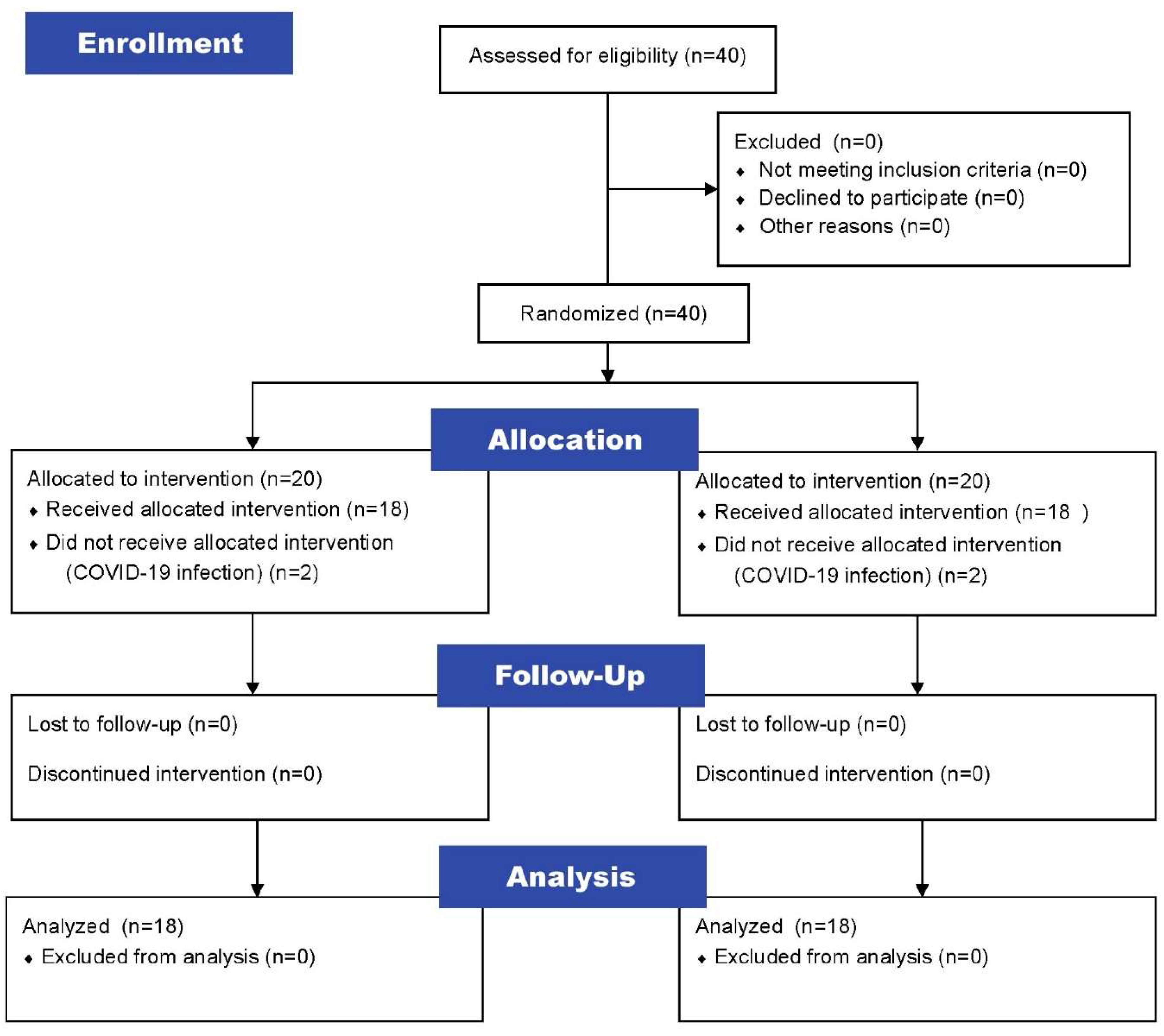
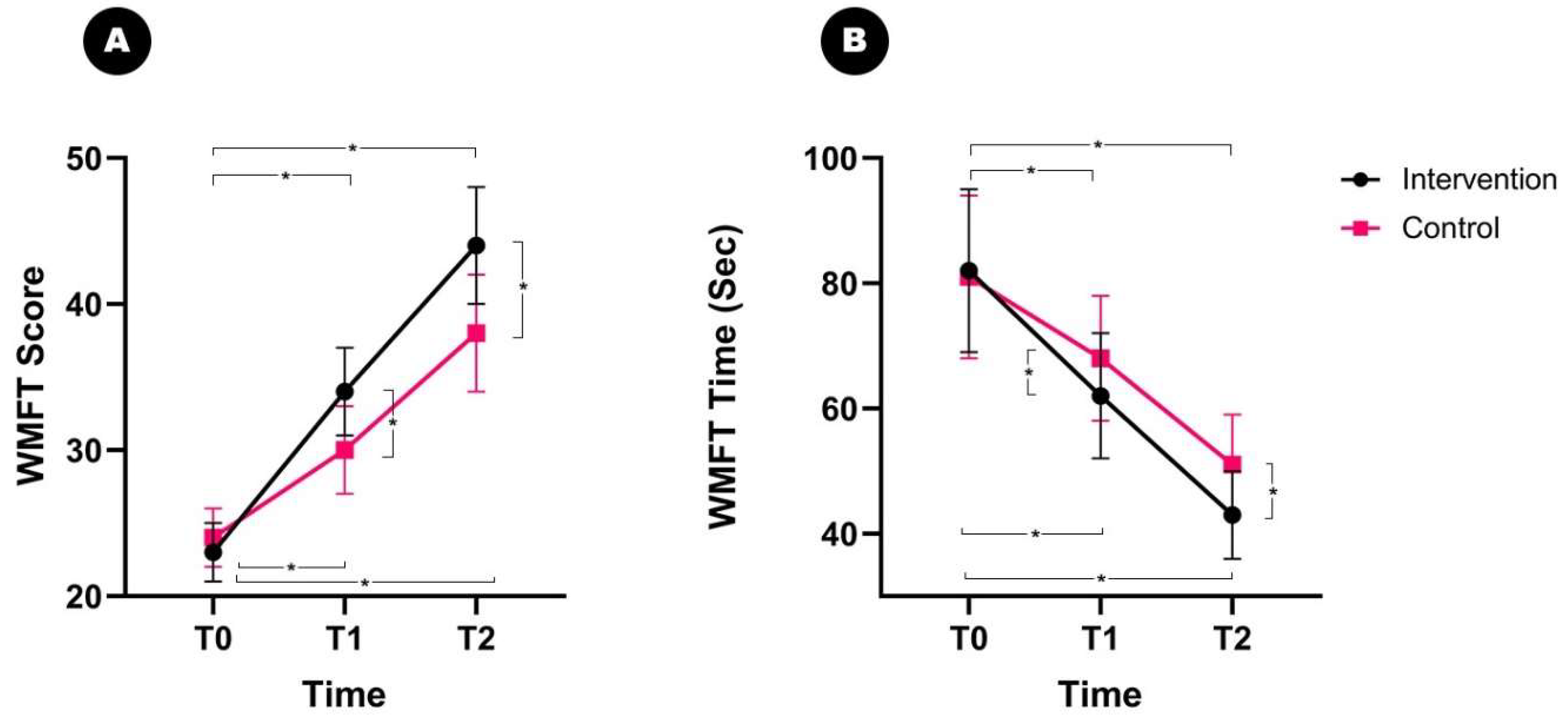
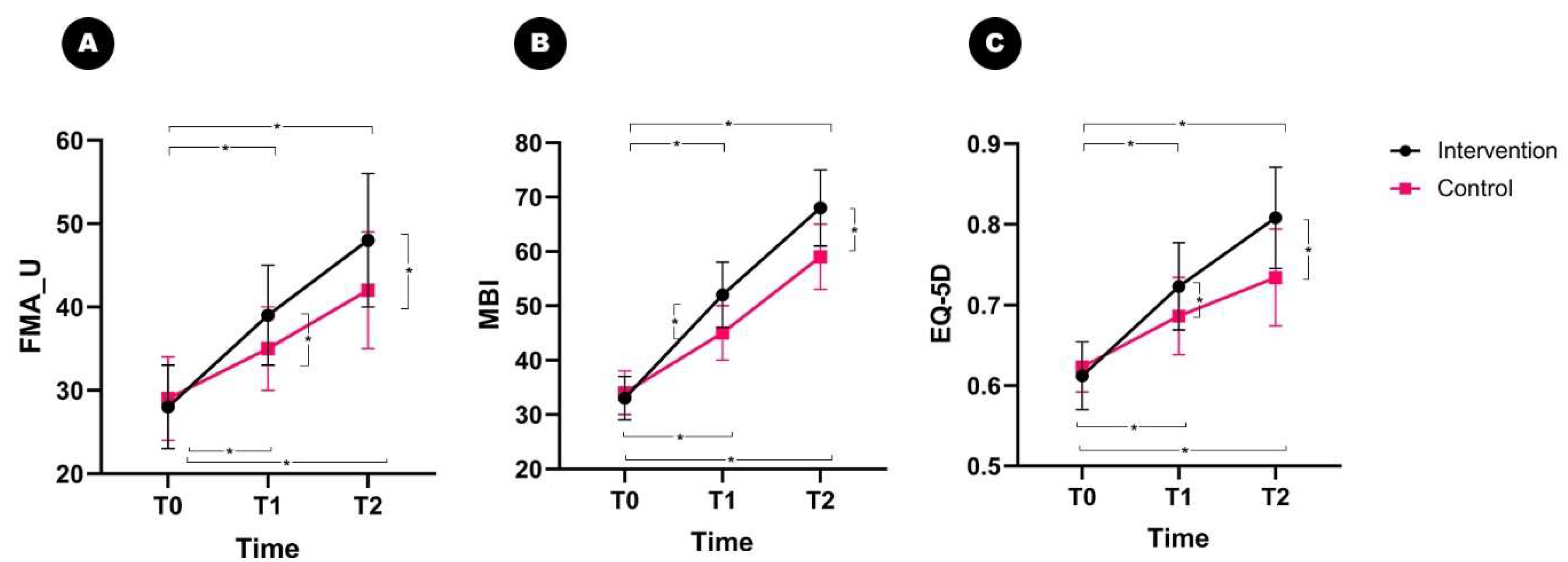
We developed an end-effector-type rehabilitation robot that can uses electro- and permanent magnets to generate a three-way magnetic field to assist hand movements and perform rehabilitation therapy. This study aimed to investigate the therapeutic effect of a rehabilitation program using a three-dimensional (3D) magnetic force-based hand rehabilitation robot on the motor function recovery of the paralyzed hands of patients with stroke. This was a double-blind randomized controlled trial in which 36 patients with subacute stroke were assigned to intervention and control groups of 18 patients each. The intervention group received 30 min of rehabilitation therapy per day for a month using a 3D magnetic force-driven hand rehabilitation robot, whereas the control group received 30 min of conventional occupational therapy to restore upper-limb function. The patients underwent three behavioral assessments at three time points: before starting treatment (T0), after 1 month of treatment (T1), and at the follow-up 1-month after treatment completion (T2). The primary outcome measure was the Wolf Motor Function Test (WMFT), and secondary outcome measures included the Fugl–Meyer Assessment of the Upper Limb (FMA_U), Modified Barthel Index (MBI), and European Quality of Life Five Dimensions (EQ-5D) questionnaire. No participant safety issues were reported during the intervention. Analysis using repeated measures analysis of variance showed significant interaction effects between time and group for both the WMFT score (p = 0.012) and time (p = 0.010). In post hoc analysis, the WMFT scores and time improved significantly more in the patients who received robotic rehabilitation at T1 than in the controls (p = 0.018 and p = 0.012). At T2, we also consistently found improvements in both the WMFT scores and times for the intervention group that were superior to those in the control group (p = 0.024 and p = 0.018, respectively). Similar results were observed for FMA_U, MBI, and EQ-5D. Rehabilitation using the 3D hand-rehabilitation robot effectively restored hand function in the patients with subacute stroke, contributing to improvement in daily independence and quality of life.

1. Introduction

The human hand is one of the most fascinating and sophisticated biological motor systems, and its complex biomechanics and neural architecture enable it to grasp objects of various shapes and sizes through the coordinated motions of multiple fingers that can engage in creative and practical activities, such as writing, drawing, and playing musical instruments [1]. Hand function also has huge implications for performing tasks in a person’s occupation. Greater difficulties in hand function correspond to increased impairment in the use of assistive technology enabling participation in academic and social activities [2]. Upper-extremity motor function impairment reportedly occurs in ≤80% of patients with stroke [3], and the extent of a patient’s upper-extremity dysfunction is determined by the degree of functional hand impairment [4]. Several rehabilitation techniques have been developed to restore impaired hand function after stroke, including constraint-induced movement therapy [5], repetitive transcranial magnetic stimulation [6], and traditional occupational therapy. Although these therapies have partially contributed to the recovery of hand function after stroke, the complexity and versatility of the human hand pose a major challenge in stroke rehabilitation [7].
In light of these challenges, clinicians and researchers have begun to actively apply robotic therapeutic techniques to patients undergoing stroke rehabilitation. Robots used to restore motor function in the upper limb are broadly categorized into end-effector-type robots and exoskeletal-type robots [8]. The end-effector-type hand-rehabilitation robot is connected to the distal part of the patient’s upper limb and can apply free-exercise programs according to the patient’s hand-function level [8]. Exoskeletal-type hand-rehabilitation robots have the joint axes of the robot aligned with the joint axes of the patient’s hand, and can train specific muscles by controlling joint movements with calculated torques [9]. Robotic-assisted hand rehabilitation is often used to improve motor function in stroke-related paralyzed hands and has shown significant therapeutic benefits compared with conventional treatment [10,11]. Wearable robots have gained attention as they can embody motor functions tailored to various hand movements by collecting motion data or physiological signal data on the user’s hand movements through device-mounted sensors [12]. These robots also reportedly have a positive effect on hand motor function recovery in patients with stroke [13]. Virtual-reality programs are additionally applied to improve patient compliance with the robot [14], and hand-rehabilitation robots are being developed with artificial intelligence technology to provide a variety of patient-specific protocols [15].
We have noted that magnetic forces can be efficiently used to assist the strength of hands paralyzed by stroke and to perform exercise therapy. Magnetic forces are invisible and can give patients the sensation that their fingers are actually moving, which can reduce resistance to treatment [16]. Moreover, the advantage of magnetic forces is that they can implement a variety of finger movements in different directions based on the magnetic force direction, regardless of the position of the hand [7]. We previously developed a three-dimensional (3D) hand-rehabilitation robot that can perform finger-rehabilitation training with constant force and orientation regardless of hand position and confirmed the short-term therapeutic effect in an earlier study [17]. However, we were still uncertain if the 3D hand-rehabilitation robot could contribute to the long-term recovery of hand function in patients with stroke. Therefore, this study aimed to investigate the long-term effects of a 3D hand-rehabilitation robot on the recovery of hand function in patients with stroke-related hand paralysis.

2. Materials and Methods

2.1. Magnetic Force-Driven Hand-Rehabilitation Robot

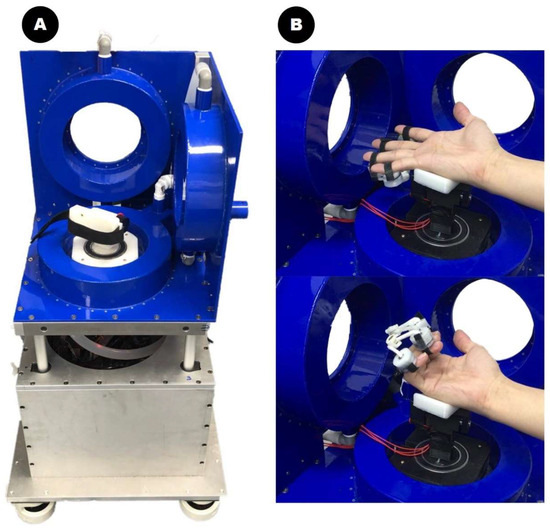
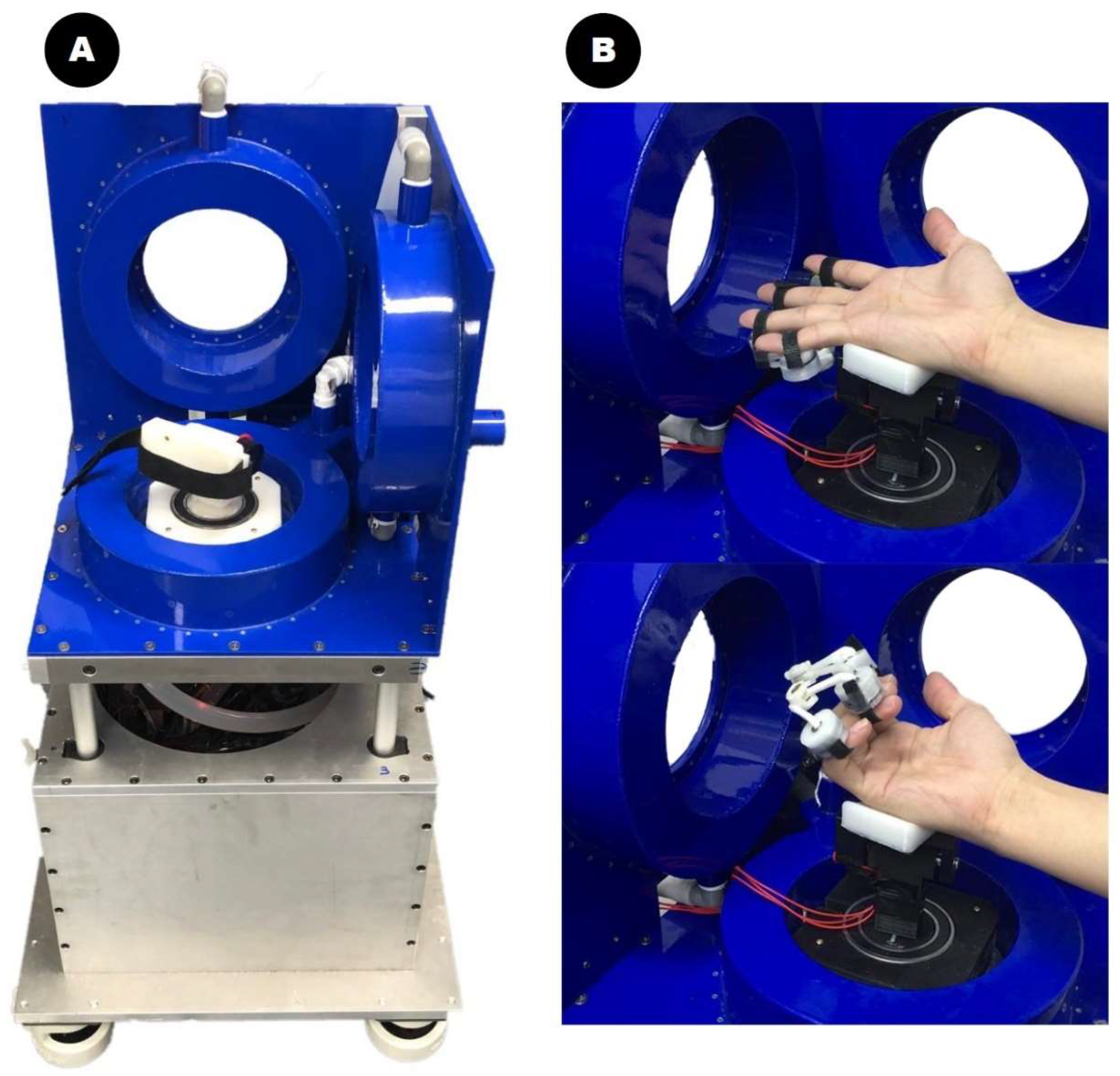
A developed electromagnetic rehabilitation system with multilink magnetic devices on the fingers can create and induce flexion and extension movements of the fingers because the applied alternating current (AC) magnetic field generates magnetic forces (attraction and repulsion) [16]. These forces create a bending or extending motion of the fingers. The magnetic force required to move the finger the desired amount is controlled by the amount of current flowing through the coils [18]. The 3D hand-rehabilitation systems with magnetic multilink devices have the advantage of being able to detect finger positions in real time, enabling active flexing and extending regardless of the hand position (Figure 1).
Figure 1. The three-dimensional magnetic force-driven finger-rehabilitation robot is shown. (A) The developed magnetic array device. (B) The extension and flexion movements of the hand aided by magnetic forces in the device. The magnetic array placed on the patient’s finger generates attraction and repulsive forces driven by the magnetic field of the three-dimensional coil system. These magnetic forces are used to move the paralyzed fingers of patients with stroke.
Because patients with stroke cannot remain immobilized for long periods of time, their finger positions are constantly changing. Therefore, the change in angle is fed back to the coil’s current controller, and the direction of the magnetic field is automatically changed by the control algorithm to match the hand position. The robot can effectively perform finger-rehabilitation exercises by applying a constant external force to the patients fingers at all times, regardless of the patient’s hand position. More details about the magnetic force-based hand-rehabilitation robot’s mechanism are presented in a previous paper [17].

2.2. Study Design

The study included patients with ≥grade 2 finger motor grade by manual muscle test on the paralyzed side after stroke. The patients’ ages ranged from ≤20–80 years. Stroke onset had occurred ≤3 months before study inclusion for all patients. The patients with spasticity or severe muscle shortening of a modified Tardieu Scale grade ≥3, patients with severe cognitive impairment who were unable to understand the physiotherapist’s instructions, maintain a sitting position, and receive appropriate rehabilitation due to serious medical conditions, such as pneumonia, were excluded from the study.
This was a parallel-group, single-blind, randomized controlled trial (Unique identifier: KCT0007970) with participants randomly assigned in a 1:1 ratio between the treatment and placebo groups. A block randomization process to ensure equal numbers in each treatment group was used by a statistician to achieve randomization before starting the trial. The participants were randomly assigned to the intervention and control groups.
The intervention was designed so that the control and experimental groups received the same amount of rehabilitation time. Patients of intervention and control groups equally received occupational therapy to restore upper limb function for 1 h a day. Specifically, the patients in the control group received conventional occupational therapy, including the upper-extremity range of motion exercises, finger stretching, sensory stimulation, and strengthening exercises for one hour once a day. The patients in the intervention group received conventional occupational therapy for 30 min, followed by magnetic force-driven robotic hand rehabilitation therapy for the remaining 30 min a day.
Physical therapy programs such as neurodevelopmental therapy, muscle strengthening exercises, and gait training, which are generally administered to stroke patients, were performed equally for both groups for an hour per day.

Thursday, July 27, 2023

Comparative Analysis of Custom-Designed Soft Pneumatic Actuators for Human Thumb Movement in Post-Stroke Rehabilitation

Ask your doctor if this is good enough to recover thumb movement. You shouldn't have to ask because your doctor, if competent, would already have analyzed this before you asked about it.

 Comparative Analysis of Custom-Designed Soft Pneumatic Actuators for Human Thumb Movement in Post-Stroke Rehabilitation

Syahirul Alim Ritonga a,1,*, Herianto a,2
a Universitas Gadjah Mada, Jl. Graphica, Sleman and 55281, Indonesia)
1 syahirul.alim.r@ugm.ac.id*; 2 herianto@ugm.ac.id.
A B S T R A C T
Article history:
Accepted
One of the most potential applications of soft actuator is as wearable
medical devices for post-stroke rehabilitation as a field that requires
high levels of safety and adaptability. Incorporating SPAs into such
devices can provide a safer and more secure solution, ensuring
controlled movements that do not pose a risk to patients. However,
there is a research gap regarding the design considerations for soft
actuators specifically targeting the human thumb, which exhibits
distinct motion patterns compared to the other fingers. This paper
addresses this gap by developing and evaluating custom-designed
SPAs for the movement of the human thumb, with a focus on post-
stroke rehabilitation. Three SPA models (M1, M2, and M3) were
proposed, and their performance in replicating the twisting motion of
the thumb was assessed. The SPAs were fabricated using 3D
printing, and image processing software was utilized for
measurement and analysis. The results showed that the M3 model,
with two sections of chambers in different axes, exhibited the best
performance in generating the desired twisting angle. Integration of
the M3 model with four finger-shaped SPAs enabled successful
grasping and picking-like movements. This research contributes to
the advancement of soft actuators in wearable medical devices,
particularly in post-stroke rehabilitation, and holds promise for
enhancing patient recovery and quality of life.

Saturday, June 25, 2022

Thumb Stabilization and Assistance in a Robotic Hand Orthosis for Post-Stroke Hemiparesis

When I was using the Saebo-flex, the thumb was the problem with only one cable.

Thumb Stabilization and Assistance in a Robotic Hand Orthosis for Post-Stroke Hemiparesis

Publisher: IEEE

Abstract:

We propose a dual-cable method of stabilizing the thumb in the context of a hand orthosis designed for individuals with upper extremity hemiparesis after stroke. This cable network adds opposition/reposition capabilities to the thumb, and increases the likelihood of forming a hand pose that can successfully manipulate objects. In addition to a passive-thumb version (where both cables are of fixed length), our approach also allows for a single-actuator active-thumb version (where the extension cable is actuated while the abductor remains passive), which allows a range of motion intended to facilitate creating and maintaining grasps. We performed experiments with five chronic stroke survivors consisting of unimanual resistive-pull tasks and bimanual twisting tasks with simulated real-world objects; these explored the effects of thumb assistance on grasp stability and functional range of motion. Our results show that both active- and passive-thumb versions achieved similar performance in terms of improving grasp force generation over a no-device baseline, but active thumb stabilization enabled users to maintain grasps for longer durations.
Published in: IEEE Robotics and Automation Letters ( Early Access )
Page(s): 1 - 7
Date of Publication: 22 June 2022
ISSN Information:
Publisher: IEEE

Friday, August 31, 2018

Achy breaky stroke hand

On one of my long driving trips I managed to get my affected hand open and spread on top of my left leg. Normally the thumb loses its position soon and the whole arm falls into the abyss between the seat and the door. Then I have to hope like hell I never get T-boned on that side because I can't lift the arm out without using my right hand. This particular time it stayed there for about an hour. By which time the thumb muscles were very painful. It is completely disgusting that 12 years after my stroke spasticity still prevents my recovery.  Don't suggest botox or muscle relaxants, they don't do anything for recovery.

Thursday, June 2, 2016

Thumb Thing Book Page Holder and Bookmark

I had high hopes for being able to incorporate my left hand into reading, but no. It makes the assumption that you can straighten your thumb at will and split two fingers on the left side of the spine and two fingers on the right side of the spine. Well my spasticity in my fingers doesn't allow any of them to remain straight. And the spasticity in the arm doesn't even get the hand into the correct position.
Thumb Thing Book Page Holder and Bookmark, Large (TPG-TT3) colors may vary

Thursday, February 25, 2016

Columbia professors develop robotic glove to help stroke survivors recover


I really do have to wonder if this was tested on any stroke survivors at all. That glove would be almost impossible for any survivor with finger spasticity to get on without at least 3 therapists and popsicle sticks. No help for the thumb.

http://columbiaspectator.com/news/2016/02/25/columbia-professors-develop-robotic-glove-help-stroke-victims-recover
Article Image
Nearly 800,000 people suffer from strokes every year, making it the leading cause of long-term disability in the United States.
Strokes can often lead to impaired hand function due to loss of blood flow to areas of the brain.
ADVERTISEMENT
To help address this, rehabilitation and regenerative medicine professor Joel Stein and mechanical engineering professor Matei Ciocarlie are combining their respective expertise in medicine and robotics to create MyHand, a glovelike device that aims to rehabilitate stroke survivors who have lost function in their hands.
The glove, currently in its prototype stage, is being funded by a Columbia-Coulter research partnership and a National Science Foundation award. Ciocarlie was also recently a recipient of the Sloan Research Fellowship, an award that commends early-career scientists and provides grant money to further their research.
Traditionally, stroke survivors with impaired hand function have turned to physical therapists to help them regain hand function. However, limited therapy resources and failure to exercise enough often pose major challenges to full recovery.
MyHand seeks to overcome those challenges by assisting stroke survivors with their rehabilitation exercises and overall hand motion. Stein and Ciocarlie's device is a portable, lightweight glove that uses artificial tendons to assist the user’s hand movement by helping them make grasping motions and other hand movements that would otherwise be difficult or impossible(Sorry, this looks like it might help grasp in the lower picture but the upper picture doesn't look like it helps grasping at all).
The hope is that MyHand would speed up recovery time by allowing people to do more exercises on their own, in their own time.
“If the task is to pick up objects … and you can’t actually pick them up quickly, you’ll get frustrated and call it a day,” Stein said. “But a device that can help you complete the task then gives you reason to keep at it and keep practicing—and hopefully, ultimately, not need the device.”
To successfully aid stroke survivors in these everyday tasks, MyHand must be both versatile and wearable. From an engineering perspective, the device has to be able to assist the many joints and digits of the hand while using very few motors to reduce weight and clunkiness.
“You don’t want a big, massive device that, you know, somebody sits down next to and then gets hooked up to,” Ciocarlie said. “You want something that the person can use in their kitchen, or in their living room.”
Currently, Stein and Ciocarlie are testing their prototypes on patients at the Columbia University Medical Center. There, the researchers are troubleshooting potential issues, such as correctly positioning the glove on the wrist and making sure the patient can take the glove on and off.
Stein and Ciocarlie are also working on finding the target population that would best benefit from the device. Those with hand impairment often exhibit different levels of impediment brought upon by their stroke, ranging from slightly slowed movements to complete immobility.
“There’s a sweet spot in terms of this type of technology. Some people don’t need it, some people can’t benefit from it, and some people can’t really tolerate it, or it’s too difficult for them to use,” Stein said. “To try to find the best population, the most targeted, the most likely to benefit population, is part of what we’ve been working on.” 
Though MyHand is still in its prototype stage, both Stein and Ciocarlie discussed the untapped potential that such collaborations between engineering and medicine stand to offer.
“It’s interesting—it’s a good, deep problem to work on,” Ciocarlie said. “We won’t run out of scientific challenges anytime soon.”

Thursday, October 10, 2013

Control of thumb force using surface functional electrical stimulation and muscle load sharing

My OT never worked on FES for my thumb, so I don't know if this is new knowledge or not. I can see how my fingers will recover but the thumb with its damnable spasticity doesn't even rest in the correct starting location.
http://www.jneuroengrehab.com/content/10/1/104/abstract
Ard J Westerveld, Alfred C Schouten, Peter H Veltink and Herman van der Kooij
For all author emails, please log on.
Journal of NeuroEngineering and Rehabilitation 2013, 10:104 doi:10.1186/1743-0003-10-104
Published: 9 October 2013

Abstract (provisional)

Background

Stroke survivors often have difficulties in manipulating objects with their affected hand. Thumb control plays an important role in object manipulation. Surface functional electrical stimulation (FES) can assist movement. We aim to control the 2D thumb force by predicting the sum of individual muscle forces, described by a sigmoidal muscle recruitment curve and a single force direction.

Methods

Five able bodied subjects and five stroke subjects were strapped in a custom built setup. The forces perpendicular to the thumb in response to FES applied to three thumb muscles were measured. We evaluated the feasibility of using recruitment curve based force vector maps in predicting output forces. In addition, we developed a closed loop force controller. Load sharing between the three muscles was used to solve the redundancy problem having three actuators to control forces in two dimensions. The thumb force was controlled towards target forces of 0.5 N and 1.0 N in multiple directions within the individual's thumb work space. Hereby, the possibilities to use these force vector maps and the load sharing approach in feed forward and feedback force control were explored.

Results

The force vector prediction of the obtained model had small RMS errors with respect to the actual measured force vectors (0.22?0.17 N for the healthy subjects; 0.17?0.13 N for the stroke subjects). The stroke subjects showed a limited work range due to limited force production of the individual muscles. Performance of feed forward control without feedback, was better in healthy subjects than in stroke subjects. However, when feedback control was added performances were similar between the two groups. Feedback force control lead, especially for the stroke subjects, to a reduction in stationary errors, which improved performance.

Conclusions

Thumb muscle responses to FES can be described by a single force direction and a sigmoidal recruitment curve. Force in desired direction can be generated through load sharing among redundant muscles. The force vector maps are subject specific and also suitable in feedforward and feedback control taking the individual's available workspace into account. With feedback, more accurate control of muscle force can be achieved.

The complete article is available as a provisional PDF. The fully formatted PDF and HTML versions are in production.

Friday, August 2, 2013

‘Thumbells’: Network provider develops dumbbells for your thumb

Your hand therapist should be able to create an exercise protocol for you to bring back your thumb movements.
The Fox news report here;
http://www.foxnews.com/health/2013/08/02/thumbells-network-provider-develops-dumbbells-for-your-thumb/
This would first require my therapist to cure the spasticity in my thumb so it can actually straighten out.  This is great, killing two birds with one stone, fixing spasticity and getting my thumb to move correctly again. Where is the research that proves it can be done?


This may be tongue-in-cheek
for this company but very serious for us. Ask your therapist exactly how to recover your thumb for texting.  Do not accept, 'I don't know' for an answer.  Because previous survivors never put their therapists on the spot as exactly how to recover we are in the current situation that only 10% fully recover.