Changing stroke rehab and research worldwide now.Time is Brain! trillions and trillions of neurons that DIE each day because there are NO effective hyperacute therapies besides tPA(only 12% effective). I have 523 posts on hyperacute therapy, enough for researchers to spend decades proving them out. These are my personal ideas and blog on stroke rehabilitation and stroke research. Do not attempt any of these without checking with your medical provider. Unless you join me in agitating, when you need these therapies they won't be there.

What this blog is for:

My blog is not to help survivors recover, it is to have the 10 million yearly stroke survivors light fires underneath their doctors, stroke hospitals and stroke researchers to get stroke solved. 100% recovery. The stroke medical world is completely failing at that goal, they don't even have it as a goal. Shortly after getting out of the hospital and getting NO information on the process or protocols of stroke rehabilitation and recovery I started searching on the internet and found that no other survivor received useful information. This is an attempt to cover all stroke rehabilitation information that should be readily available to survivors so they can talk with informed knowledge to their medical staff. It lays out what needs to be done to get stroke survivors closer to 100% recovery. It's quite disgusting that this information is not available from every stroke association and doctors group.

Showing posts with label Thrombosis. Show all posts

Thursday, June 19, 2025

Smart Thrombosis Care: The Rise of Closed-Loop Diagnosis-to-Treatment Nano Systems

 There is much earlier research on nano stuff for recovery. HAS YOUR INCOMPETENT? DOCTOR DONE NOTHING WITH THIS? So, you DON'T have a functioning stroke doctor, do you? And complete incompetence(for over a decade!) in the stroke medical world which seems to have NO idea on how to solve stroke! They are all blithering idiots straight from the pages of Monty Python. Like this:

Monty Python's Flying Circus - Upper Class Twit of the Year (1971)
  • nanoparticles (83 posts to June 2012)
  • nanomissiles (1 post to June 2022)
  • nanoneedles (2 post to March 2015)
  • nanopatch (1 post to August 2024)
  • nanopeptide (1 post to October 2017)
  • nanophytomedicine (1 post to May 2021)
  • nanopropellers (1 post to May 2020)
  • nanoRobots (14 posts to March 2012)
  • nanorockets (1 post to December 2016)
  • nanorods (1 post to January 2016)
  • nanosensors (3 posts to November 2017)
  • nanospear (1 post to June 2018)
  • nanospheres (1 post to June 2025)
  • nanostructures (1 post to November 2019)
  • nanosubmarine (1 post to November 2015)
  • nanotechnology (9 posts to December 2014)
  • nanotherapeutic (5 posts to April 2015)
  • nanotubes(5 posts to February 2012)
  • Nanovesicles (2 posts to November 2021)
  • nanowires (23 posts to January 2012)
  • Nanozymes (2 posts to June 2024)
  • Smart Thrombosis Care: The Rise of Closed-Loop Diagnosis-to-Treatment Nano Systems

    Authors Wu JZhang YChen WHao TRan CZhou YShen YYou WWang T

    Received 27 March 2025

    Accepted for publication 10 June 2025

    Published 19 June 2025 Volume 2025:20 Pages 7851—7868

    DOI https://doi.org/10.2147/IJN.S530884

    Checked for plagiarism Yes

    Review by Single anonymous peer review

    Peer reviewer comments 2

    Editor who approved publication: Prof. Dr. RDK Misra


    Jiong Wu,1,* Yuanyuan Zhang,2,* Wu Chen,1,* Tianjiao Hao,1 Chuanjiang Ran,1 Yuanyuan Zhou,1 Yan Shen,1 Wei You,3 Tao Wang4

    1Department of Pharmaceutics, School of Pharmacy, China Pharmaceutical University, Nanjing, Jiangsu Province, 210009, People’s Republic of China; 2Department of Pharmacy, Jiangsu Cancer Hospital, Jiangsu Institute of Cancer Research, Nanjing Medical University Affiliated Cancer Hospital, Nanjing, People’s Republic of China; 3Department of Cardiology, Nanjing First Hospital, Nanjing Medical University, Nanjing, People’s Republic of China; 4Department of Clinical Laboratory, Second People’s Hospital of Taixing City, Taixing, Jiangsu Province, 225400, People’s Republic of China

    *These authors contributed equally to this work

    Correspondence: Wei You, Email youwei@njmu.edu.cn Tao Wang, Email 13775743588@163.com

    Abstract: Thrombosis continues to be a leading cause of morbidity and mortality worldwide, presenting complex pathophysiological challenges that complicate effective diagnosis and treatment. A holistic approach to thrombosis management, incorporating integrated diagnostic and therapeutic systems, is essential for improving patient outcomes. This review explores the emerging concept of closed-loop diagnosis-to-treatment nanosystems in thrombosis care, with a focus on integrating advanced technologies. Specifically, we examine the targeting of critical components involved in thrombosis, including platelets, coagulation factors, endothelial cells, the fibrinolytic system, and the immune system. Techniques such as platelet aggregation assays, coagulation function tests, biomarker detection, and nanotechnology-based therapies are discussed. Moreover, the application of these integrated systems is reviewed in both the acute and chronic phases of thrombosis, covering conditions such as acute coronary syndrome, acute pulmonary embolism, chronic deep vein thrombosis, and post-surgical thrombosis prevention. Finally, the review highlights potential future developments in integrated thrombosis care, with an emphasis on personalized treatment strategies and the role of emerging technologies in enhancing clinical outcomes. These insights underscore the transformative potential of closed-loop nano-systems in achieving more precise, timely, and effective thrombosis management.

    Keywords: thrombosis, nanotechnology, integrated management

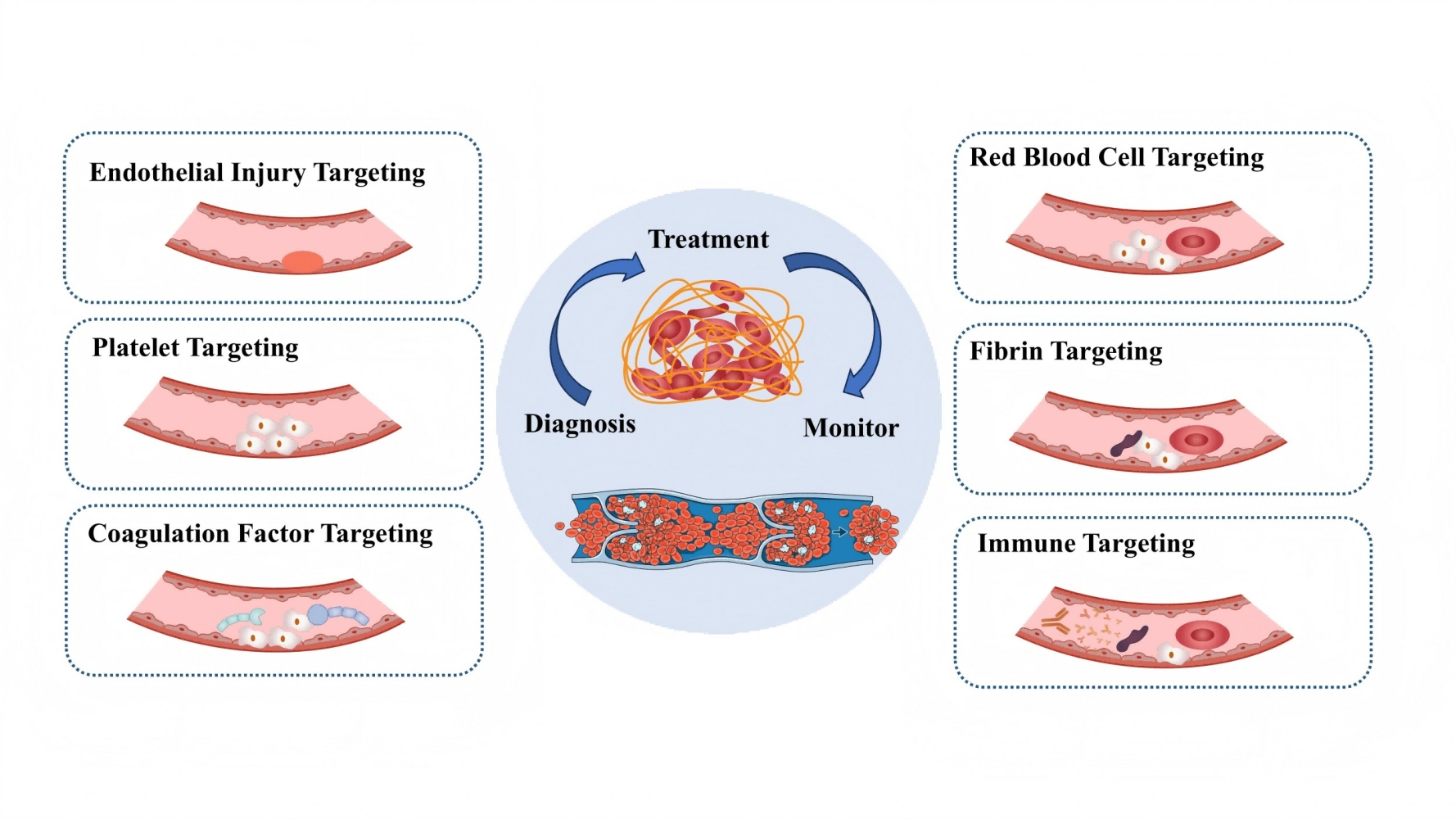
    Graphical Abstract:
    Introduction

    Thrombosis-related diseases, including deep vein thrombosis (DVT), pulmonary embolism (PE), and coronary artery thrombosis, impose a substantial global health burden. These conditions contribute to high morbidity and mortality rates, with venous thromboembolism (VTE) alone affecting millions of individuals annually.1 In the United States and Europe, VTE accounts for an estimated 300,000 to 600,000 deaths per year, often due to complications such as PE. The economic burden is equally significant, as healthcare systems allocate substantial resources to hospitalization, long-term anticoagulation therapy, and the management of recurrent thrombotic events.2 Development of diagnosis and treatment of thrombosis is shown in Figure 1. Despite advancements in thrombosis management, major challenges persist in early diagnosis, risk stratification, and individualized treatment, underscoring the urgent need for more effective and integrated approaches.3

    Saturday, June 13, 2020

    Stent thrombosis may be more common in COVID-19 patients

    Be careful out there. While this suggests waiting for further study on antiplatelet regimens, I'm going to demand immediate use of them, even though I have no stents to be concerned about. But I'm not medically trained so don't listen to me. 

    Stent thrombosis may be more common in COVID-19 patients

    Reuters Health Medical News|June 11, 2020
    Stent thrombosis appears to be more common in patients with COVID-19, according to a case series.
    "We don't want to create alarm," Dr. Juan G. Cordoba-Soriano of Complejo Hospitalario Universitario de Albacete, in Albacete, Spain, told Reuters Health by email. "In general, the risk is low, we think. In our center we had nearly 2,000 COVID-19 patients and only 4 stent thromboses (ST), but it is certain that it is a higher incidence than expected among percutaneous coronary intervention (PCI) procedures."
    "During the peak of the pandemic at our center, we had the subjective feeling that presentation of patients with ST was higher than expected compared with our experience in normal conditions," he said. "Some other interventional cardiologists in Spain had the same feeling."
    Dr. Cordoba-Soriano and colleagues describe four cases of coronary stent thrombosis between March 15 and April 5 at their center in a paper in JACC Case Reports.

    The patients included a 49-year-old man who underwent primary angioplasty for a lateral ST-elevation myocardial infarction (STEMI), a 71-year-old man whose stent was placed following an inferior STEMI in 2007, an 86-year-old man whose stent was placed following a non-ST-elevation MI in 2018, and an 85-year-old man whose stent was placed in 2005.
    Two patients had a cough and chest x-ray findings compatible with COVID-19, but confirmatory tests were not performed at the early stage of the pandemic. One of these patients later tested positive for IgG to SARS-CoV-2; the other was not tested. The third patient tested positive for SARS-CoV-2 RNA, and the fourth patient tested positive for IgM to SARS-CoV-2.
    These four incidents represented 13% of PCIs performed during this period, compared with an overall incidence of ST of 1.2% during 2019.
    "This virus is highly thrombogenic," Dr. Cordoba-Soriano said. "As we have learnt that anticoagulation is key in the management of these patients, it is important to treat them with the currently available support of the guidelines and according to their recommendations when they present with an acute coronary syndrome."
    He endorsed the careful use of antiplatelet regimens in these patients, pending further study.
    "We decided to perform a multicenter registry, which we hope will be published soon by another colleague," Dr. Cordoba-Soriano added.
    —Will Boggs MD
    To read more, click here

    Wednesday, January 27, 2016

    A Nuclear Attack on Thrombosis and Inflammation

    What is your doctor doing with this to stop your arterial inflammation? ANYTHING AT ALL?
    http://atvb.ahajournals.org/content/36/2/221.extract?etoc 
    1. Edward M. Conway
    + Author Affiliations
    1. From the Department of Medicine, Centre for Blood Research, University of British Columbia, Vancouver, Canada.
    1. Correspondence to Edward M. Conway, MD, PhD, Department of Medicine, Centre for Blood Research, 4306-2350 Health Sciences Mall, University of British Columbia, Vancouver BC V6T 1Z3, Canada. E-mail ed.conway@ubc.ca  
    Email for your doctor if they have questions on the procedures. There are no excuses for your doctor not applying this for you.
    Key Words:
    Thrombomodulin is a transmembrane glycoprotein expressed on the lumenal surface of endothelial cells, where it maintains vascular homeostasis via its anti-inflammatory, anticoagulant, and anti-fibrinolytic properties. These effects of thrombomodulin are achieved through dynamic interactions primarily with thrombin, protein C, thrombin activatable fibrinolysis inhibitor, complement components, and the proinflammatory danger signal high mobility group box 1 (HMGB1).1 When bound to thrombomodulin, thrombin loses its procoagulant/proinflammatory properties, while efficiently generating activated protein C and activated thrombin activatable fibrinolysis inhibitor. Activated protein C is a potent anticoagulant, anti-inflammatory and cytoprotective protease. Activated thrombin activatable fibrinolysis inhibitor inhibits fibrinolysis, and inactivates proinflammatory mediators and anaphylatoxins. The lectin-like domain of thrombomodulin also dampens inflammation by blocking HMGB1 and suppressing complement activation. Diminished expression of thrombomodulin is a feature of endothelial cell dysfunction, and it is a driver in the pathogenesis of several disorders, including venous thromboembolic disease, sepsis, disseminated intravascular coagulation (DIC), atherosclerosis, stroke, inflammatory arthritis and colitis, thrombotic microangiopathies, and diabetic nephropathy. To offset the imbalance associated with reduced thrombomodulin, and with the aim of preventing organ damage, systemic administration of recombinant forms of thrombomodulin has shown efficacy in several preclinical models of thrombosis and inflammation, and in humans with DIC and sepsis.2
    See accompanying article on page 361
    Yang et al3 have taken a different approach to augment endothelial thrombomodulin and limit disease, particularly focusing on thrombosis. Going nuclear, they examined the role of 2 transcription factors, Nur77 and Nor1, members of the family of nuclear orphan NR4A receptors. These …