I tried this once, never worked. Body weight support was useless; I needed the weight over my legs to counteract my spasticity. The only thing that did that was the Lokomat which my doctor thought was worthless. Shows you how incompetent doctors are!
Immediate Effects of Walker-Assisted Gait Training at Higher Training Speeds Comparing Conditions With and Without Body Weight Support After Stroke: A Pilot Crossover Study
Abstract
Background: Body weight-supported treadmill training (BWSTT) permits patients with stroke to practice walking at higher speeds under safe conditions but is limited by cost and accessibility. A suspended body weight-supported (BWS) walker has been developed as a practical alternative, enabling higher training speeds during walker-assisted gait training. However, it is unclear whether high-speed BWS walker-assisted gait training leads to immediate improvements in gait performance and how training speed and body weight support contribute to these effects. Methods: Twenty patients with chronic stroke participated in a crossover study. Each participant underwent two gait training sessions using the same walker device: one without BWS and one with BWS activated. Gait performance was assessed before and after each session using the 10 m walk test. Training speed during each session was recorded to evaluate its relationship with pre-to-post changes in gait performance.Results: Training with BWS enabled higher training speeds and resulted in significant improvements in gait speed and affected side step time, with a significantly greater increase in gait speed than that during training without BWS. Of the participants, 70% demonstrated increased training speed accompanied by immediate improvements in gait speed during BWS walker-assisted training. Improvements in gait speed were associated with increased stride length and reduced affected side step time.
Conclusion: Walker-assisted gait training that enables higher training speeds, particularly when combined with BWS, may contribute to immediate improvements in gait speed in patients with stroke. Reductions in affected side step time may represent one mechanism underlying this training speed-related effect.
Introduction
Stroke patients often experience reduced gait speed due to functional impairments such as hemiplegia [1]. Improving gait speed is a critical rehabilitation goal, as it is directly associated with activities of daily living [2]. The efficacy of suspended body weight-supported (BWS) treadmill training (BWSTT) in enhancing gait speed in stroke patients has been well documented [3-5]. One of the major advantages of BWSTT is that the use of a safety harness allows precise control of walking speed while minimizing the risk of falls. This enables patients to practice walking at speeds higher than their self-selected walking speed under safe conditions. Gait training performed at higher walking speeds is associated with improvements in gait speed and spatiotemporal gait parameters in patients with stroke [6,7]. These speed-dependent training effects are considered an important mechanism underlying gait improvement. However, suspension-based BWS devices such as those used for BWSTT have notable limitations, including high cost, lack of portability, and restricted availability to specialized facilities. To address these drawbacks, a suspended BWS walker has been developed [8].
To prevent falls and make weight unloading during gait training easier, the BWS walker uses a harness fastened to the walker to support body weight. Recent studies on BWS walkers have shown that the use of a suspension system reduces the fear of falling and enables patients with stroke to walk at higher training speeds than those during usual walking [9]. Importantly, both walker-assisted walking without body weight support and walking with body weight support allowed patients to achieve faster walking speeds, suggesting that the presence of a safety suspension itself plays a key role in facilitating higher training speeds by enhancing postural confidence.
Although it has become clear that walker-assisted gait training enables patients to walk at higher training speeds under safe conditions, it remains unclear whether such high-speed gait training translates into improvements in actual walking performance. In addition, the relative contributions of training speed and body weight support to immediate gait improvements have not been fully elucidated.
In this study, we aimed to investigate the immediate effects of walker-assisted gait training at higher training speeds by comparing conditions with and without body weight support in patients with stroke.
Materials & Methods
Study design and experimental protocol
The immediate effects of gait training were assessed by comparing gait performance using the same suspended walker device with BWS activated (BWS walker condition) or without BWS (walker condition). The study design employed an open-label crossover design (Figure 1).
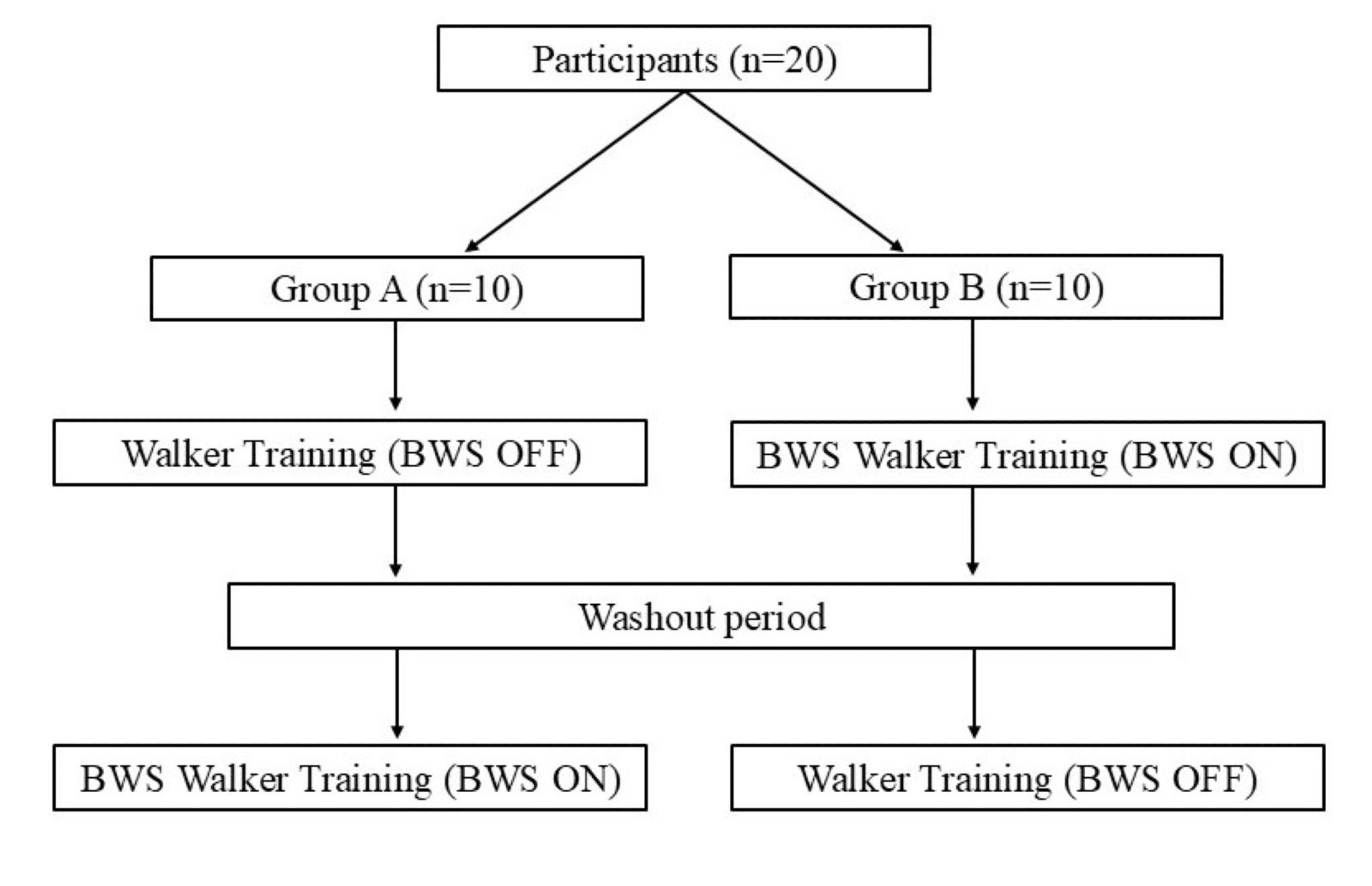
Participants were randomly assigned to one of two groups: group A first underwent walker gait training, followed by a one-week washout period, and then BWS walker gait training. Group B first underwent BWS walker gait training, followed by a one-week washout period, and then walker gait training. Walker gait training was performed without body weight support, whereas BWS walker gait training included 25% body weight support. Each training session lasted 10 minutes, including rest periods. The intervention was conducted under therapist supervision, and no falls, accidents, or other adverse events occurred during the study period. Pre- and post-training gait performance was assessed using a 10-meter walk test. The differences in gait parameters before and after each training session were analyzed, and the magnitude of change was compared between walker and BWS walker gait training. Additionally, gait speed during each training session was calculated for both conditions.


No comments:
Post a Comment