Changing stroke rehab and research worldwide now.Time is Brain! trillions and trillions of neurons that DIE each day because there are NO effective hyperacute therapies besides tPA(only 12% effective). I have 523 posts on hyperacute therapy, enough for researchers to spend decades proving them out. These are my personal ideas and blog on stroke rehabilitation and stroke research. Do not attempt any of these without checking with your medical provider. Unless you join me in agitating, when you need these therapies they won't be there.

What this blog is for:

My blog is not to help survivors recover, it is to have the 10 million yearly stroke survivors light fires underneath their doctors, stroke hospitals and stroke researchers to get stroke solved. 100% recovery. The stroke medical world is completely failing at that goal, they don't even have it as a goal. Shortly after getting out of the hospital and getting NO information on the process or protocols of stroke rehabilitation and recovery I started searching on the internet and found that no other survivor received useful information. This is an attempt to cover all stroke rehabilitation information that should be readily available to survivors so they can talk with informed knowledge to their medical staff. It lays out what needs to be done to get stroke survivors closer to 100% recovery. It's quite disgusting that this information is not available from every stroke association and doctors group.

Showing posts with label DMTF1. Show all posts

Wednesday, May 6, 2026

Scientists Have Discovered a Protein That Reverses Brain Aging in The Lab

 Your competent? doctor followed up this earlier research, right? To solve for your 5 lost years of brain cognition due to your stroke?

Do you have ANY CONFIDENCE AT ALL that your stroke medical 'professionals' will get human testing going with an EXACT PROTOCOL DELIVERED?


Scientists Have Discovered a Protein That Reverses Brain Aging in The Lab

Our brains age along with the rest of our bodies, and as they do, they produce fewer new brain cells. Now, researchers have found a key mechanism through which the typical age-related decline in neuron production might be slowed.

In later life, the neural stem cells (NSCs) that turn into fully fledged neurons become more dormant – almost as if they're going into retirement after a long lifetime of service. As that happens, cognitive decline creeps in.

A major reason why NSC activity fades with age is the wear and tear on telomeres, the protective caps on the ends of DNA. Telomeres fray a little more each time a cell divides, and over time, this impairs cells' ability to grow and divide, leading to increasing cell death.

This latest study, led by a team from the National University of Singapore (NUS), took a closer look at the mechanisms involved to see if they could find a way to restore weary NSCs."Impaired neural stem cell regeneration has long been associated with neurological aging," says chemical biologist Derrick Sek Tong Ong, from NUS.

"Inadequate neural stem cell regeneration inhibits the formation of new cells needed to support learning and memory functions."

"While studies have found that defective neural stem cell regeneration can be partially restored, its underlying mechanisms remain poorly understood."

Through a combination of human NSC analysis in the lab and mouse model experiments, the researchers singled out a protein called cyclin D-binding myb-like transcription factor 1 (DMTF1). Transcription factors such as DMTF1 bind to DNA, to switch genes on or off.
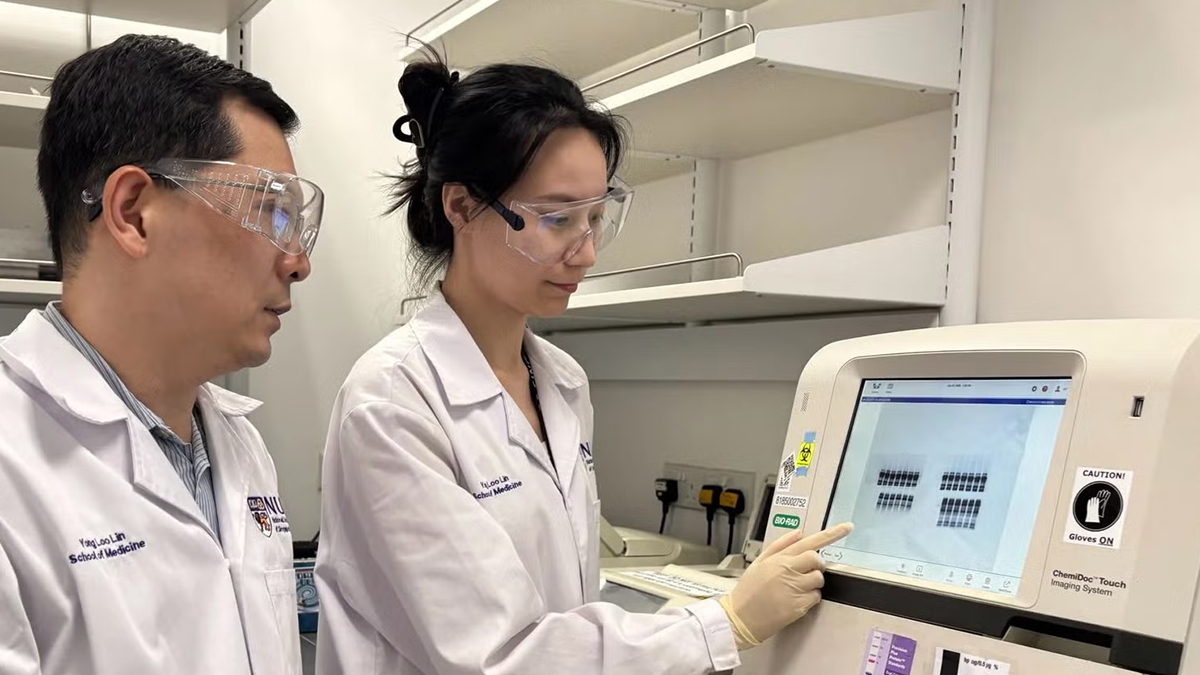
Study researchers
Scientists looked at gene expression related to DMTF1. (NUS)

DMTF1 isn't new, but its role in influencing NSCs is. The team found that it's more abundant in younger and healthier brains, and that adding more DMTF1 encouraged NSCs to grow and divide – potentially restoring the natural neuron production associated with a younger brain.While shorter telomeres seemed to contribute to a reduction in DMTF1 levels, when the amount of DMTF1 was artificially boosted in cells, telomere length remained unchanged – so the transcription factor seemed to find a workaround.

Specifically, DMTF1 activates two 'helper' genes called Arid2 and Ss18, which promote cell growth by switching on other genes that restore the biological cycle through which neurons are created.Understanding this process at such a fundamental level means we might eventually be able to control it – perhaps through treatments that encourage neuron growth in spite of age.

"Our findings suggest that DMTF1 can contribute to neural stem cell multiplication in neurological aging," says neuroscientist Liang Yajing, from NUS.

It's a significant discovery of a crucial process, but we shouldn't get ahead of ourselves: This study is based on lab experiments and mouse models, and any suggestion that neuron production could be boosted still needs to be proven.Now that this mechanism has been identified, however, future studies can build on this research. It's possible that manipulating DMTF1 could potentially reverse some of the aging that normally grips the brain, but that remains to be seen.

Next steps could include a more comprehensive analysis of how DMTF1 might be used to restore NSC activity and whether that could possibly lead to improvements in learning and memory. This would need to be carefully done, firstly in animal studies; DMTF1 is linked to cell growth, so too much duplication could lead to cancer tumors.

We can add this latest study to a growing body of research looking at how the brain ages, and how some of that aging might be slowed, stopped, or reversed.

Diet and exercise appear to help, yet the allure of therapies to rejuvenate aging brain cells remains strong, though a distant prospect.

Related: Stress-Sensitive Neurons May Have a Powerful Effect on Our Entire Brain

An older brain is one that's more susceptible to cognition problems, disease, and dementia. While this research didn't look at those issues specifically, it may go some way in helping us understand normal brain aging.

"Understanding the mechanisms for neural stem cell regeneration provides a stronger foundation for studying age-related cognitive decline," says Ong.

The research has been published in Science Advances.

Thursday, February 26, 2026

Scientists Found a Protein That Could Keep Your Brain From Growing Old

 Ask your competent? doctor EXACTLY HOW TO ACQUIRE THIS! No excuses allowed! Oh sorry, you DON'T have a functioning stroke doctor, do you?

Scientists Found a Protein That Could Keep Your Brain From Growing Old

Here’s what you’ll learn when you read this story:

  • As the human brain ages, the regeneration of neuronal stem cells declines.

  • A new study analyzed DMTF1—a specialized protein that regulates gene expression—and found that it was repressed in “aged” neural stem cells.

  • This could be the key to promoting regeneration in an aging brain, and to avoid the worst cognitive outcomes in the future.


Aging has always been an inevitable part of life, but now scientists hope that one of its cellular mechanisms could help reverse its effects. The mechanism in question is the seemingly unavoidable decline of neural stem cells. That decline is a pretty big piece of biological bad news, as a dip in neuronal regeneration can have profound impacts on learning and memory. Recently, a team of scientists from the National University of Singapore (NUS) wondered if investigating the underlying mechanism of decline could help them find the key to halting the process.

This search led them to a transcription factor (a specialized protein that regulates gene expression) whose name is a bit of a mouthful—cyclin D-binding myb-like transcription factor 1, or DMTF1. In their experiments, they found that DMTF1 appears repressed in “aged” neural stem cells, and conversely, that restoring DMTF1’s expression helped stem cells get their mojo back. The results of the study were published in the journal Science Advances.

“While [previous] studies have found that defective neural stem cell regeneration can be partially restored, its underlying mechanisms remain poorly understood,” Derrick Sek Tong Ong, the senior author of the study from NUS, said in a press statement. “Understanding the mechanisms for neural stem cell regeneration provides a stronger foundation for studying age-related cognitive decline.”

The NUS research team used human stem cell systems and mouse models to simulate aging, and then analyzed how DMTF1 influenced neural stem cell function through transcriptome analyses and genome binding. Telomeres are repetitive DNA sequences capping the ends of chromosomes to prevent them from fraying or tangling, and they naturally get shorter over time as cells divide inside an aging organism. Thus, reduced telomere length is a telltale sign of aging. Indeed, short telomeres can trigger cellular senescence, which in turn leads to decreased cell division and a rise in inflammation.

What the researchers discovered is that DMTF1 can control the expression of helper genes that activate other, growth-related genes through chromatin remodeling. Crucially, this mechanism rescued the proliferation of neural stem cells impaired by telomere shortening, even without restoring telomere length itself. This discovery suggests that in the future, therapies targeting DMTF1 can reverse age-related decline in brain stem cells by reactivating the molecular machinery that drives cell division.

“Our findings suggest that DMTF1 can contribute to neural stem cell multiplication in neurological aging,” Liang Yajing, a co-author of the study from NUS, said in a press statement. “While our study is in its infancy, the findings provide a framework for understanding how aging-associated molecular changes affect neural stem cell behavior, and may ultimately guide the development of successful therapeutics.”

While these experiments were all performed outside of a human body, the researchers are still hopeful that future studies on DMTF1 could, at the very least, improve neuronal stem cell regeneration—even as telomeres shorten and aging takes hold. Such future treatments wouldn’t be a rewind button on aging, but they could help ensure that those golden years stay golden.

Wednesday, February 18, 2026

Scientists discover protein that rejuvenates aging brain cells


Do you have ANY CONFIDENCE AT ALL that your stroke medical 'professionals' will get human testing going with an EXACT PROTOCOL DELIVERED?

Do you prefer your doctor, hospital and board of director's incompetence NOT KNOWING? OR NOT DOING? Your choice; let them be incompetent or demand action!

Scientists discover protein that rejuvenates aging brain cells

Date:
February 12, 2026
Source:
National University of Singapore, Yong Loo Lin School of Medicine
Summary:
A newly identified protein may hold the key to rejuvenating aging brain cells. Researchers found that boosting DMTF1 can restore the ability of neural stem cells to regenerate, even when age-related damage has set in. Without it, these cells struggle to renew and support memory and learning. The findings raise hopes for treatments that could slow or even reverse aspects of brain aging.

Scientists at the Yong Loo Lin School of Medicine at the National University of Singapore have identified a protein that may help restore the brain's ability to produce new cells as it ages. Their findings, published in Science Advances, point to a transcription factor called cyclin D-binding myb-like transcription factor 1 (DMTF1) as a central regulator of neural stem cell activity in older brains. Transcription factors are proteins that control how genes are turned on or off in specific cells.

Neural stem cells are responsible for generating new neurons, which play an essential role in learning and memory. As people age, these stem cells gradually lose their ability to renew themselves, contributing to cognitive decline.

Investigating DMTF1 in Aging Brain Cells

The study was led by Assistant Professor Ong Sek Tong Derrick, with Dr. Liang Yajing as first author, from the Department of Physiology and the Healthy Longevity Translational Research Programme at NUS Medicine. The team set out to uncover the biological changes that cause neural stem cells to weaken over time, with the goal of identifying targets for future therapies aimed at slowing neurological aging.

To understand how DMTF1 functions, the researchers examined neural stem cells derived from humans and from laboratory models designed to mimic premature aging. They used genome binding and transcriptome analyses to map how DMTF1 influences gene activity. A key focus was how this protein interacts with stem cells affected by telomere dysfunction. Telomeres are the protective ends of chromosomes that gradually shorten each time a cell divides. This shortening is widely recognized as a marker of aging.

Restoring Regeneration in Aged Stem Cells

The team found that levels of DMTF1 were significantly reduced in "aged" neural stem cells. When they restored DMTF1 expression, the cells regained their ability to regenerate. This suggests that DMTF1 could serve as a promising therapeutic target for restoring stem cell function in the aging brain.

Further analysis revealed how DMTF1 exerts its effects. The protein regulates helper genes (Arid2 and Ss18) that loosen tightly packed DNA, allowing growth-related genes to become active. Without these helper genes, neural stem cells cannot effectively renew themselves.

"Impaired neural stem cell regeneration has long been associated with neurological aging. Inadequate neural stem cell regeneration inhibits the formation of new cells needed to support learning and memory functions. While studies have found that defective neural stem cell regeneration can be partially restored, its underlying mechanisms remain poorly understood," said Asst Prof Ong. "Understanding the mechanisms for neural stem cell regeneration provides a stronger foundation for studying age-related cognitive decline."

Potential Therapies to Slow Brain Aging

The findings indicate that strategies designed to increase DMTF1 levels or enhance its activity could potentially reverse or delay the decline in neural stem cell function linked to aging.

Although the current results are based largely on in vitro experiments, the researchers plan to investigate whether boosting DMTF1 can increase neural stem cell numbers and improve learning and memory in conditions involving telomere shortening and natural aging, without raising the risk of brain tumours. Over the long term, the team hopes to identify small molecules capable of safely stimulating DMTF1 activity to rejuvenate aging neural stem cells.

"Our findings suggest that DMTF1 can contribute to neural stem cell multiplication in neurological aging," Dr. Liang said. "While our study is in its infancy, the findings provide a framework for understanding how aging-associated molecular changes affect neural stem cell behavior, and may ultimately guide the development of successful therapeutics."


Story Source:

Materials provided by National University of Singapore, Yong Loo Lin School of MedicineNote: Content may be edited for style and length.