Changing stroke rehab and research worldwide now.Time is Brain! trillions and trillions of neurons that DIE each day because there are NO effective hyperacute therapies besides tPA(only 12% effective). I have 523 posts on hyperacute therapy, enough for researchers to spend decades proving them out. These are my personal ideas and blog on stroke rehabilitation and stroke research. Do not attempt any of these without checking with your medical provider. Unless you join me in agitating, when you need these therapies they won't be there.

What this blog is for:

My blog is not to help survivors recover, it is to have the 10 million yearly stroke survivors light fires underneath their doctors, stroke hospitals and stroke researchers to get stroke solved. 100% recovery. The stroke medical world is completely failing at that goal, they don't even have it as a goal. Shortly after getting out of the hospital and getting NO information on the process or protocols of stroke rehabilitation and recovery I started searching on the internet and found that no other survivor received useful information. This is an attempt to cover all stroke rehabilitation information that should be readily available to survivors so they can talk with informed knowledge to their medical staff. It lays out what needs to be done to get stroke survivors closer to 100% recovery. It's quite disgusting that this information is not available from every stroke association and doctors group.

Showing posts with label thermal stimulation. Show all posts

Sunday, June 30, 2024

Effects of Thermal Stimulation and Transcutaneous Electrical Nerve Stimulation on Sensory and Motor Function of Upper Extremity in Acute Stroke Survivors: A Randomized Controlled Pilot Study

Didn't your competent doctor start using thermal stimulation on you a long time ago? I guess not! So you don't have a functioning stroke doctor? Why are you seeing them?

Effects of Thermal Stimulation and Transcutaneous Electrical Nerve Stimulation on Sensory and Motor Function of Upper Extremity in Acute Stroke Survivors: A Randomized Controlled Pilot Study 

Hong-Chi Wang • Willy Chou • Yu-Lin You • Yu-Lin Wang • Min Hsu • Chia-Chi Yang • Chen-Wen Yen • Lan-Yuen Gou

Published: June 28, 2024DOI: 10.7759/cureus.6337 


Cite this article as: Wang H, Chou W, You Y, et al. (June 28, 2024) Effects of Thermal Stimulation and Transcutaneous Electrical Nerve Stimulation on Sensory and Motor Function of Upper Extremity in Acute Stroke Survivors: A Randomized Controlled Pilot Study. Cureus 16(6): e63375. doi:10.7759/cureus.63375

Abstract

Objective

Upper-limb coordination is crucial for daily activities, especially among stroke survivors who may encounter obstacles during upper-limb rehabilitation. This study aimed to investigate the effects of thermal stimulation (TS) and transcutaneous electrical nerve stimulation (TENS) on sensory and motor function during recovery in acute stroke patients.

Design

This is a parallel study with a randomized controlled design. The experiment was conducted in the E-Da Hospital Rehabilitation Department, Kaohsiung, Taiwan.

Intervention

Thirty participants were in-patients with acute stroke at the E-Da Hospital. Participants were randomly assigned to three groups for a one-week intervention: exercise combined with TS, exercise combined with TENS, or conventional physical therapy with exercise alone. The Fugl-Meyer upper extremity scale, Brunnstrom stage, minimal current perception (MCP), and modified Ashworth scale were collected for the assessment.

Results

The outcomes demonstrated considerable improvement in MCP in all the groups after treatment. Specifically, the groups receiving TS and TENS showed significant improvements in the Brunnstrom stage, suggesting that both treatments improved distal motor recovery.

Conclusion

The results, following a one-week intervention period, suggested that both TS and TENS contributed to the improvement of motor and sensory function, with a significant impact on the Brunnstrom stage in the upper extremity, particularly in the distal region. The inclusion of TS or TENS in rehabilitation protocols improved distal motor function compared to baseline measures, suggesting these treatments as effective components in acute stroke rehabilitation.

Introduction

More than 85% of post-stroke patients experience impaired upper limb functionality on the hemiplegic side [1]. In general, 55%-75% of the sequelae remain even three to six months later [2]. Furthermore, coordination of both sides of the upper extremity is needed to accomplish most daily activities such as face washing, tooth brushing, eating, and getting dressed [1]. Therefore, assisting individuals with stroke in recovering the use of their affected upper limbs was a crucial goal for rehabilitation.

Recently, sensory stimulation has often been applied simultaneously with motor stimulation in stroke-affected limbs. Sensory stimulation techniques, such as transcutaneous electrical nerve stimulation (TENS) [3-8] and thermal stimulation (TS) [9-11] have demonstrated more favorable effects on motor recovery or pain relief than motor training alone for post-stroke survivors. TENS intervention on the lower extremity demonstrated significant positive effects on the decrease in the hyperactivity stretch reflex, maximal voluntary contraction of the ankle dorsiflexor [12], and walking speed [13] in individuals with chronic stroke. Furthermore, the effects of combining TENS with task-oriented interventions showed significantly greater improvement in motor function and spasticity compared to task-oriented interventions alone for individuals with chronic stroke [5]. Hence, TENS interventions for chronic stroke may positively affect motor recovery or spasticity. On the other hand, TS, which is a sensory stimulation intervention, is usually used with hot and cold packs wrapped in the target region, and TS intervention demonstrated a significant increase in motor function and Brunnstrom stage for individuals with acute stroke [11], subacute stroke [14], and chronic stroke [15].

A possible explanation for the effectiveness of TS on sensory and motor function improvements might be that, during the acute phase of stroke, the cerebral cortex undergoes regrouping [16,17]. This constitutes a timely opportunity for the application of high levels of sensory stimulation to the affected limbs for the activation of specific cortical areas, thereby improving sensory and motor functions and alleviating secondary injuries caused by the loss of those functions [18]. Hence, the application of sensory stimulation to improve motor function in patients with stroke should be addressed in the rehabilitation protocol. Clinically, both TENS and TS are easily used and applied as rehabilitation approaches, and both interventions facilitate motor function restoration owing to the stimulation of peripheral sensory receptors and further cause excitation of the cortex [15]. Thus, investigations on the effects of TS, TENS, and conventional therapy on motor recovery of the upper extremities are essential to provide evidence for therapists to choose rehabilitation approaches and protocols. However, few studies have used sensory stimulation accompanied by motor training in stroke patients during the acute phase to determine their effects. Thus, the present study aimed to investigate the effects of TENS and TS combined with motor training on sensory and motor recovery in the upper extremities of patients with acute stroke. This study hypothesized that sensory stimulation might improve sensory and motor functions in individuals with acute stroke.

Materials & Methods

Trial design

This is a parallel study design; patients with acute stroke were assigned to the TS group, TENS group, or control group using a random number drawing method by the investigator. Assessment of sensory and motor recovery of the upper limb was performed the day before and the day after the intervention. The assessments were performed by the investigator, while the intervention was performed by two physiotherapists familiar with the research procedures. The study protocol was approved by the institutional review board of E-Da Hospital (approval number EMRP-103-113) and was registered on the ISRCTN registry (no. ISRCTN62945682). This study is a non-blinding design. One experienced physical therapist performed the intervention and the evaluation for all participants. The experiment was conducted in E-Da Hospital, Kaohsiung, Taiwan.

Participants

The sample size of this study was evaluated by power analysis using G*Power Ver.3.1.9.2 (Heinrich-Heine-Universität Düsseldorf, Düsseldorf, Germany). The power analysis results revealed that a minimum sample size of 25 participants was required in this study with a significance level of 0.05, and statistical power of 0.8 for an analysis of covariance (ANCOVA) design.

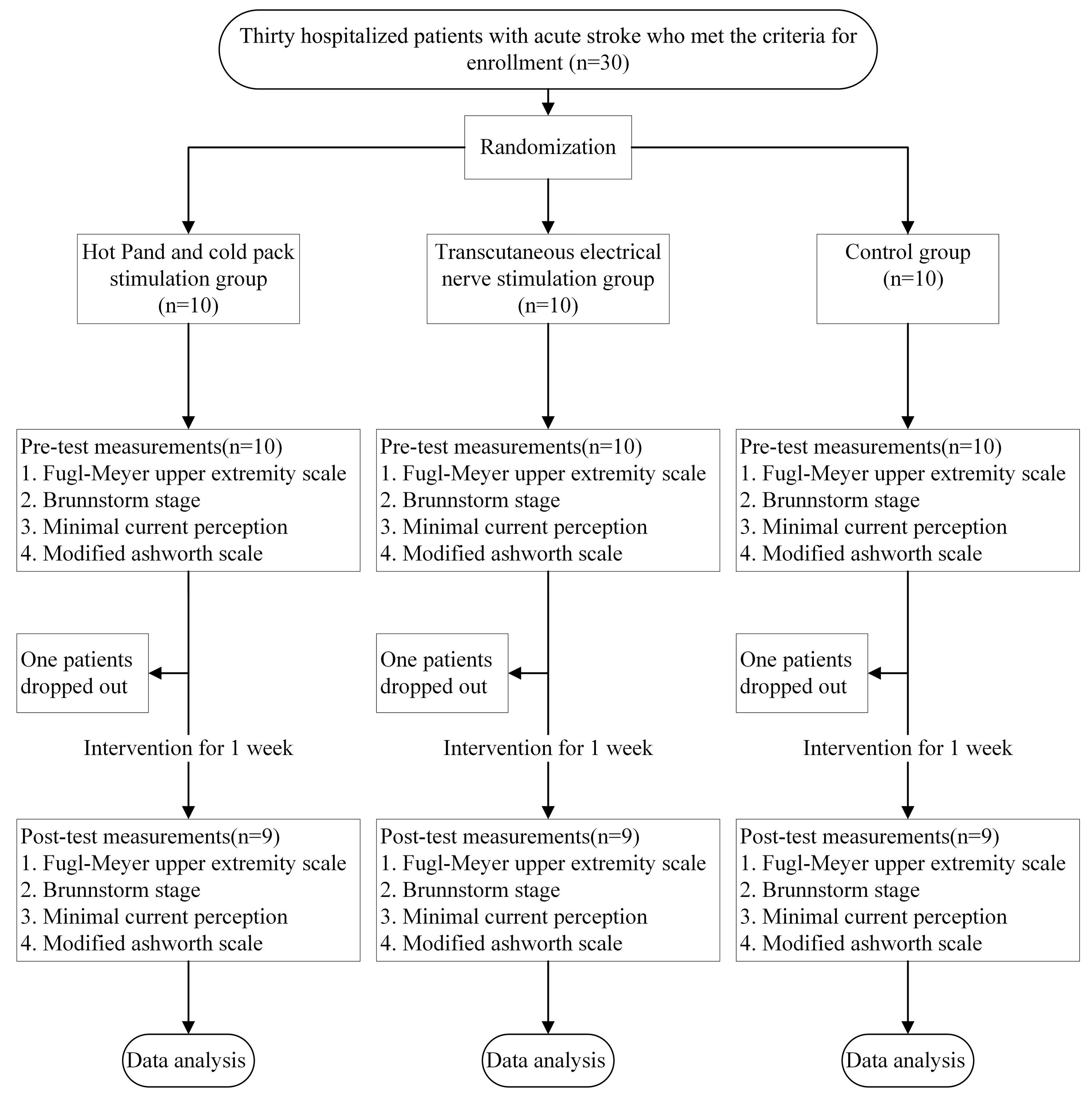
Thirty participants were randomly assigned to one of three groups (n = 10 each): the TS, TENS, and control groups. The participants were inpatients with stroke at the E-Da Hospital. Patients who (1) were aged 20 years or older; (2) had a stroke for the first time and exhibited hemiparesis; (3) were hospitalized during the acute phase; (4) did not have obvious cognitive impairments; (5) could independently maintain a sitting posture for at least 30 min; and (6) had provided written informed consent for participation in this study were included. Patients were excluded if they (1) had skin conditions or injuries (e.g., wounds) on their upper limbs or had other contraindications for electrotherapy or TS (e.g., a malignant tumor); (2) had a language disorder (e.g., aphasia) and were therefore unable to communicate or comply with instructions; (3) had other orthopedic conditions (e.g., severe arthritis) or nerve damage (e.g., peripheral nerve injury) affecting movement in their upper limbs; (4) had diabetes or complete sensory impairment not caused by stroke (e.g., peripheral vascular disease or neuropathy); (5) had developed neurological disorders during the experimental period or other conditions that may have affected the study results; (6) had uncontrolled hypertension, unstable angina, a history of myocardial infarction, epilepsy (except for febrile seizures) in the past three months, or a pacemaker; or (7) had participated in other rehabilitation or drug trials. One participant from both the TS and TENS groups withdrew from the study after discharge from the hospital, and one participant in the control group withdrew due to poor attendance. Thus, nine participants remained in each of the three groups (total, n=27). The experimental flowchart is shown in Figure 1.
Treatment sessions

TS Group

In the TS group, the following equipment and intervention protocol were used. The hot and cold stimulation devices used were a Firstek heating circulator water bath (B300, Firstek Corp, Taiwan) and a Firstek cooling circulator water bath (B401L, Firstek Corp, Taiwan), respectively. Each was connected to a temperature therapy pad (TP22E, Gaymer Corp, USA). For the hot and cold stimulation, the temperatures were set at 51°C and 4°C, respectively. The participants received hot and cold stimulation in 30-minute sessions administered twice daily (once in the morning and afternoon, respectively) over five days, totaling 10 sessions. In accordance with the procedure used in one study [10], participants receiving TS were instructed to sit with both hands flat on the table. Heat stimulation was applied to their healthy arm for no more than 15 minutes. A thermometer was placed on the stimulated body part to prevent frostbite or burns. The therapy pad was wrapped around the palm and wrist of the affected limb. During the session, the therapist encouraged the participants to pull their limbs from the therapy pad through active movements. They were instructed to remove their healthy hand when they began feeling discomfort or when a score of seven had been reached on a standard 10-point visual analog scale (administered by the therapist), and the time from the beginning of the session to this point was recorded. The same procedure was repeated with the participants’ affected forearm. If no adverse skin reactions occurred, heat was applied on their affected arm 10 consecutive times, separated by three minutes of rest. Cold therapy involved the same procedure and was applied alternately with heat therapy. With both heat and cold therapy, TS was applied for 15 seconds, followed by at least 30 seconds of rest. Heat and cold were applied 20 times in each session. During each session, the therapist constantly measured the skin surface temperature on the tested limb to prevent frostbite or burns.

TENS Group

Portable TENS (TRIO-310, ITO, Japan) was used for the intervention in the TENS group. The patches were adhered to the forearm. The skin was cleaned with alcohol before and after each disinfection session to reduce the possibility of increased electrical resistance. Wounds were avoided during the study. The TENS settings were as follows: pulse width, 200 µs; output frequency, 100 Hz; output time, 30 minutes. The output frequency was selected mainly for stimulating the Aβ fibers, which produce sensations of light touch and pressure [19]. The current strength was adjusted to the maximum that participants could withstand. As with TS, TENS was applied in 30-minute session administered twice daily (once in the morning and afternoon) over five days, totaling 10 sessions. Moreover, the therapist monitored the participants during each session and measured their blood pressure, heart rate, and breathing before and after the intervention, adjusting the rest periods as necessary and taking care to prevent electrical burns.

Control Group

Participants in the control group received regularly scheduled rehabilitation therapy (one hour each of physical and occupational therapy). Physical therapy includes therapeutic exercise, facilitation training, and functional training. Occupational therapy involves hand function training for activities of daily living.

Outcome measurements

Outcome measures were conducted before and after a one-week intervention. The Fugl-Meyer Upper Extremity (FMUE) scale, Brunnstrom stage classification-proximal and distal ends of the upper limb, minimal current perception (MCP), and modified Ashworth scale (MAS) for the elbow flexor and wrist flexor were used to evaluate the intervention effects.

FMUE Scale Assessment

FMUE measurements were used to evaluate motor function, sensory function, joint range of motion, and balance. An ordinal level of measurement was used. The FMUE has high reliability (intraclass correlation coefficient, ICC=0.99) for evaluating motor function after post-stroke [20].

Brunnstrom Stage Assessment

Brunnstrom stage was used to evaluate motor recovery after brain injury. There were six evaluation stages. Stage 1 is flaccid, which means that the limb does not have movement or muscle tone, while stage 6 is near normal, which means that the motor performance of the limb is near normal. The Brunnstrom stage classification had high intra- and inter-rater reliability (ICC for inter-rater=0.94, ICC for intra-rater=0.97) [21].

Minimal Current Perception

Pain vision PS-2100 (Nipro Co., Osaka, Japan) was used to evaluate sensory deficits in individuals with stroke. The electrical stimulation frequency was set at 50 Hz. Participants held a switch on the device to activate and stop the device. The weak current increased gradually when the participant switched on the device. The participant was then asked to switch off the device when they felt the current [22].

MAS Assessment

This study evaluated the spasticity of the elbow and wrist flexors using MAS. MAS is a reliable assessment tool for evaluating limb spasticity (ICC=0.86) [23]. First, the joint range of motion was measured, and the therapist manually stretched the participants to observe limb resistance.

Statistical analysis

Analyses were conducted using IBM SPSS Statistics for Windows, version 20.0 (IBM Corp., Armonk, NY, USA). Chi-square tests were performed on categorical variables to determine the presence of between-group differences based on sex, affected side, and stroke type. Continuous demographic data and baseline measurements were evaluated using a one-way analysis of variance (ANOVA).

One-way analysis of covariance (ANCOVA) and paired t-tests were performed to determine between-group differences and significant differences between the pre-test and post-test in each group. The significance level was set at p<0.05. The Bonferroni correction was used for post-hoc comparisons.

Results

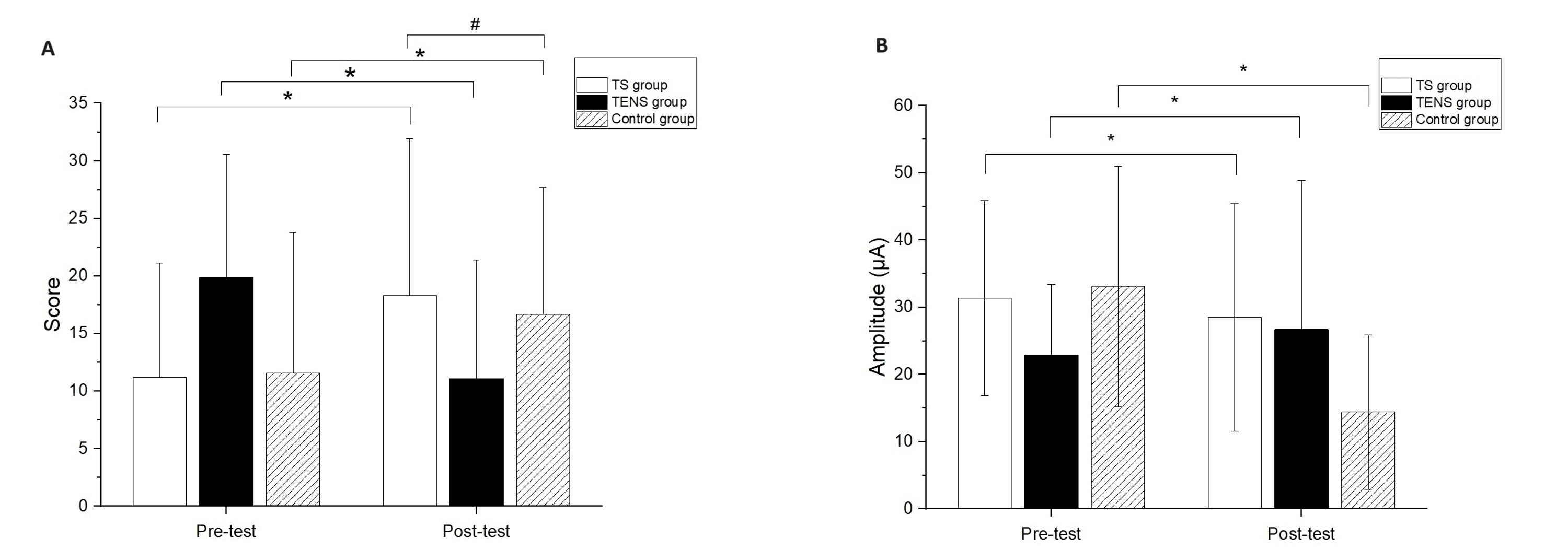
The three groups showed no significant differences in the demographic data and baseline outcome measurements (Table 1). Significant differences after the intervention compared to baseline measurements were found in the FMUE for all groups (TS group, 95% CI: -10.00, -7.34, p<0.01; TENS group, 95% CI: -8.15 and -5.40, p<0.01; control group, 95%CI: -7.77 and -3.34, p<0.01) (Figure 2A). In addition, a significant difference between the TS and control groups was observed in the FMUE (p=0.02) (Figure 2A). The comparisons of the differences of pre- and post-test were significant in MCP for all groups (TS group, 95%CI:2.48 and 14.92, p=0.02; TENS group, 95% CI:1.37 and 7.81, p=0.01; control group, 95% CI:1.15 and 7.78, p=0.01) (Figure 2B). However, there were no significant differences among the groups at the post-test in the MCP test.
  TS group (n=9) TENS group (n=9) Control group (n=9) P-value
Age (years) 65 (9.2) 64.9 (7.3) 67.7(5.7) 0.68b
Number of Gender (Male / Female) 6/3 6/3 4/5 0.54a
Number of affected side (Left/Right) 5/4 5/4 4/5 0.86a
Number of types of stroke (Ischemia/Hemorrhagic) 7/2 8/1 8/1 0.75a
Fugl-Meyer Upper Extremity Scale (Scores) 11.2(9.9) 11.6(12.2) 11.1(13) 0.89b
Minimal current perception (μA) 31.6(14.5) 33.1(17.9) 26.7(14) 0.65b
Modified Ashworth scale_Elbow flexor (scores) 0.1(0.3) 0.2(0.4) 0.1(0.3) 0.75b
Modified Ashworth scale_Wrist flexor (scores) 0.1(0.3) 0.4(0.5) 0.2(0.4) 0.27b
Brunnstorm stage Proximal end of upper limb (Scores) 2.3(0.7) 2.3(1.0) 2.4(1.0) 0.94b
Brunnstrom stage_Distal end of upper limb (Scores) 2.3(1.0) 2.3(0.9) 2.6(1.1) 0.74b

Significant differences were found in the FMUE for all groups compared to baseline measurements (TS group, 95% CI: -10.00, -7.34, p<0.01; TENS group, 95% CI: -8.15 and -5.40, p<0.01; control group, 95%CI: -7.77 and -3.34, p<0.01), with a significant difference observed between the TS and control groups (p=0.02). Additionally, significant differences in MCP were found in all groups comparing pre- and post-test values (TS group, 95%CI: 2.48 and 14.92, p=0.02; TENS group, 95% CI: 1.37 and 7.81, p=0.01; control group, 95% CI: 1.15 and 7.78, p=0.01) (Figures 2A, 2B). However, no significant differences among the groups were observed in the post-test in the MCP test.

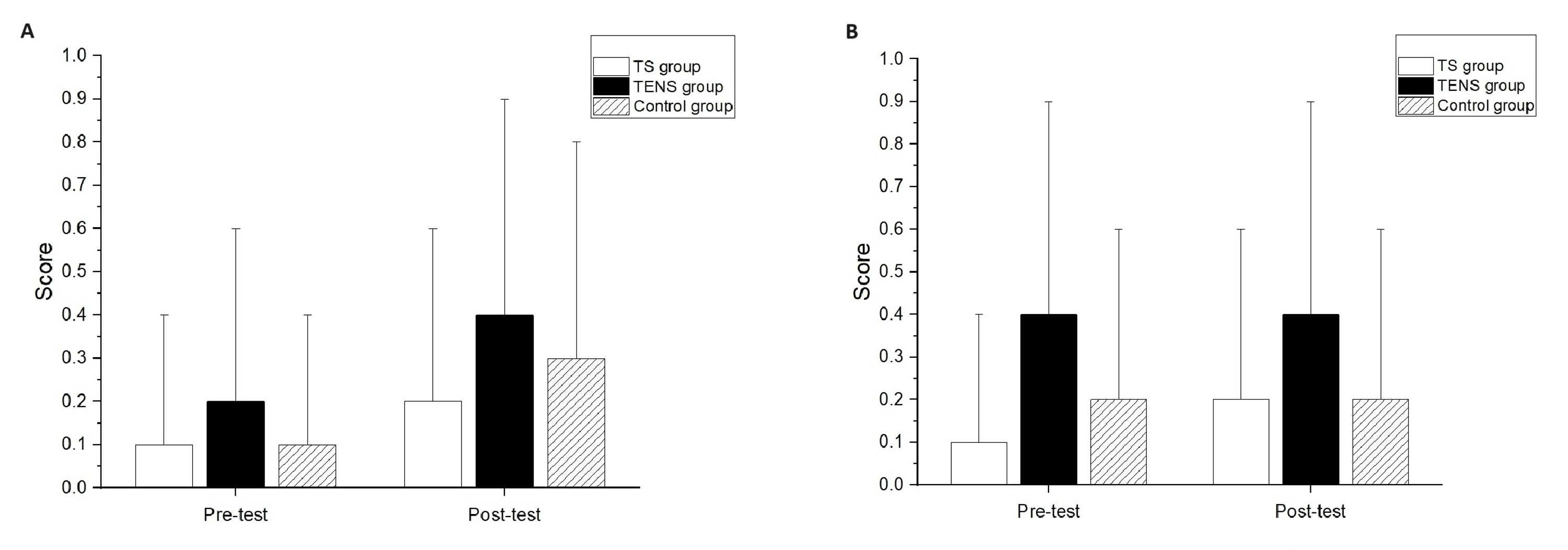
Significant differences after the intervention compared to the baseline measurements were not found in the MAS of the elbow flexors for all groups (Figure 3A) or the wrist flexors for all groups (Figure 3B). There were no significant differences among the groups at post-test in the MAS scores of the elbow flexors and wrist flexors (Figures 3A, 3B).
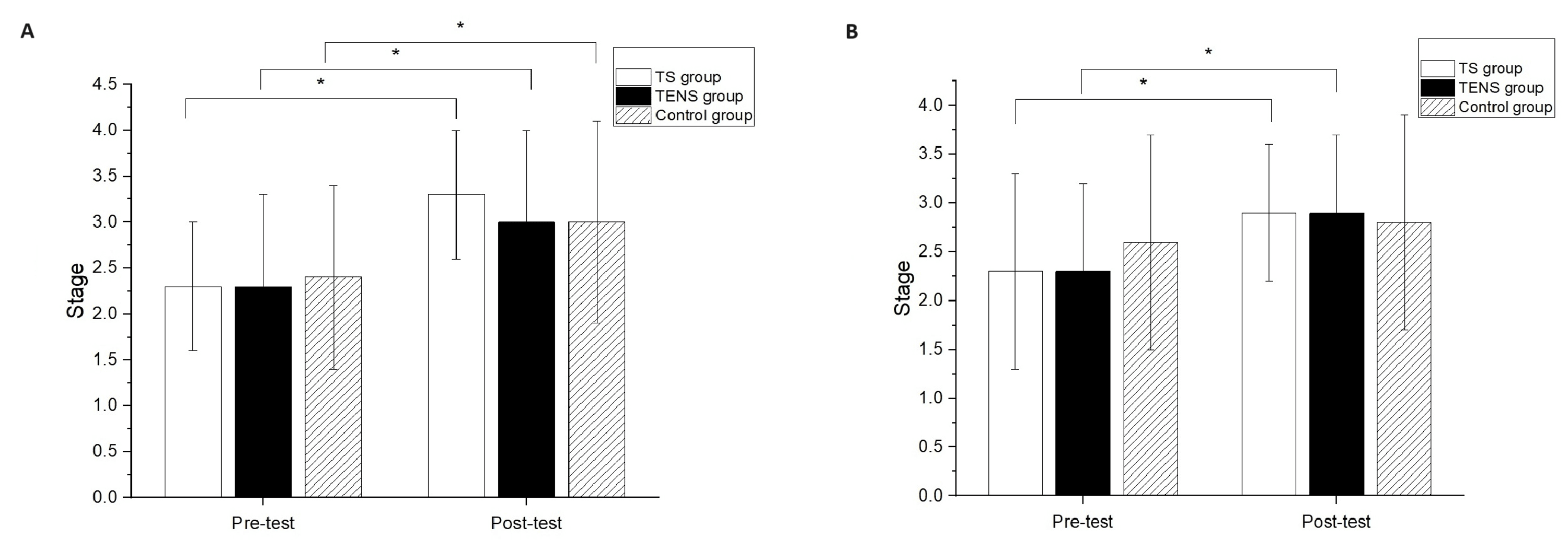
Significant differences after the intervention compared to baseline measurements were found in the Brunnstrom stage classification of the proximal end for all groups (TS group, p<0.01; TENS group, p<0.01; control group, p=0.02) (Figure 4A). However, there was no significant difference among the groups in the Brunnstrom stage classification of the proximal end at the post-test (Figure 4A). Significant differences after the intervention compared to the baseline measurements were found in the Brunnstrom stage classification of the distal end for the TS group (p=0.02) and the TENS group (p=0.04) (Figure 4B); however, there was no significant difference between the pre-test and post-test in the Brunnstrom stage classification of the distal end for the control group. There was no significant difference among the groups in the Brunnstrom stage classification of the distal end at the post-test (Figure 4B).
Discussion

In the current study, TS and TENS interventions were applied for one week to evaluate their effects on the recovery of motor and sensory functions in the upper limbs of acute stroke patients. Significant improvements in FMUE scores were observed in all three groups after the intervention, with the TS group showing superior performance compared to the control group. Short-term improvements in motor function, with no differences in spasticity in the elbow and wrist flexors, were seen in all groups according to MCP results. The proximal end of the Brunnstrom stage showed significant short-term improvements in all groups, while the distal end showed immediate improvement only in the experimental group after one week. These results suggest the efficacy of TS and TENS in improving short-term motor recovery in acute stroke patients. Additionally, the study highlighted the significant effects of the TS intervention on FMUE, supporting its role as a sensory stimulation tool in restoring motor function during stroke recovery. Previous research has further supported the positive effects of TS on motor recovery in acute and subacute stroke patients, as observed on the Action Research Arm Test and the upper extremity subscale of the Stroke Rehabilitation Assessment of Movement [9,11]. TS and TENS have shown promise in managing acute stroke patients. Previous research has shown that repetitive sensory stimulation and mass motor practice could promote neuroplasticity and cortical reorganization in stroke patients, which might contribute to improved motor function [6]. There was also evidence indicating that TENS had demonstrated positive outcomes in alleviating brain damage following ischemic stroke by reducing oxidative stress, inhibiting neuronal pyroptosis, and activating mitophagy pathways [24]. Therefore, both TS and TENS, either individually or in combination, could be valuable adjuncts to conventional therapy in enhancing motor recovery and functional outcomes in acute stroke patients.

With our understanding, this study was the first to compare the recovery of motor and sensory functions in the upper limbs of individuals with acute stroke by simultaneously applying TS and TENS, common modalities in clinical rehabilitation [6,24]. Several studies have suggested the benefits of both TS and TENS for motor recovery in acute stroke patients. However, most of these studies had focused on either one modality or a combination with other interventions, such as TENS with taping [25]. Nevertheless, there has been little research comparing the efficacy of TS and TENS concurrently for upper limb motor recovery in individuals with acute stroke.

Between-group comparisons revealed that the TS group demonstrated more substantial post-intervention improvements in terms of the FMUE scores than the control group. In contrast, the TENS group did not significantly outperform the control group. Notably, all three groups exhibited significant improvements in the FMUE scores in the post-test, with the TS group outperforming the control group. The higher performance of the TS group on the FMUE scores compared to the other groups might be due to several factors. First, many of the items assessed in the FMUE were related to distal hand and wrist control, which correlated with improvements in the distal Brunnstrom stage. Another possible reason might have been the active participation in the thermal and cold stimulation procedure, which involved moving the hand back and forth, which was believed to enhance proprioceptive input, leading to improved motor control in the affected upper limb movements [26]. This suggests that motor learning potentially boosts proprioception and body movements by influencing the relationship between somatosensory and motor systems through neural pathways. This active participation likely contributed to the improvement in FMUE scores. In contrast, the TENS group largely maintained a static posture during the intervention, resulting in no significant difference in FMUE improvement compared to the control group.

The TENS group also exhibited significant improvements after the intervention, but these changes were not significant compared with the control group. This result does not support the premise that the motor improvements observed in the TENS group were attributable to the intervention. The previous study involved individuals in the chronic phase of stroke who received a combination of upper extremity TENS and task-related training (30 minutes per day, five days per week, four weeks). This intervention resulted in significant improvements in a variety of assessments, including the FMUE, the Manual Functional Test, the Box and Block Test, and the MAS. Specifically, the group that received TENS in addition to task-oriented training showed significant improvement, particularly in reducing spasticity according to the MAS. In contrast, the control group, which received placebo TENS and task-oriented training, did not show similar improvement. The researchers concluded that the improved motor function was primarily due to motor training effects and highlighted the effectiveness of TENS in reducing spasticity [27]. In the present study, the spasticity scores on the MAS of 0.2±0.4 indicated low tension, which is understandable given that the participants were all in the acute phase. This also explains why the effects of TENS were less apparent.

Overall, all three groups demonstrated improvements in motor function after the intervention. This may be associated with the fact that the participants were in the acute phase when brain reorganization was the most active. Although this result was only observed in the FMUE group, significant post-intervention differences were only present between the TS and control groups. Less substantial differences were noted between the TENS and control groups; however, based on the mean value, the TENS group improved more than the control group. Moreover, the proximal and distal parts of the Brunnstrom stage indicated that both TS and TENS resulted in greater improvement. Therefore, it could be suggested that additional interventions using TS or TENS could potentially aid in the recovery of upper limb motor function in individuals with acute stroke. This research was in line with findings from previous studies, which suggested that TS and TENS activated the cortical areas responsible for motor function [5,28].

Regarding the assessment of sensory function, the present study used devices that allowed for the quantification of perception and pain with regard to the MCP of each participant. In all three groups, the postintervention MCP differed significantly from the preintervention MCP; however, no significant between-group differences were observed. A study reported that individuals with stroke (three months after stroke occurrence) who received intermittent pneumatic compression (30-min sessions, five days a week, four weeks) with conventional rehabilitation treatments outperformed the control group, who only received conventional rehabilitation treatments on the Nottingham Sensory Assessment Scale, two-point discrimination test, and tactile and joint kinesthesia assessments, despite both groups demonstrating significant post-intervention improvements [29]. In a similar study, the experimental and control groups underwent TS (sessions of 20-30 min, five days a week, six weeks) and conventional rehabilitation, respectively. Both groups had significant post-intervention improvements in the Semmes-Weinstein monofilament test, with the experimental group outperforming the control group [11]. These collective results suggest that interventions during the acute phase of stroke can lead to considerable improvements in the recovery of sensory function regardless of the use of additional sensory inputs. Moreover, sensory stimulation appears to exert more substantial benefits on sensory recovery than conventional rehabilitation. Furthermore, although significant improvements were observed among all three groups after the intervention, no significant between-group differences were detected. This might be because the intervention lasted only one week, which was considerably shorter than that in previous studies (at least four weeks).

In the present study, the MAS measurements of the elbow and wrist flexors did not change significantly after the intervention in any group. A previous study applied TENS to the upper limbs of individuals with stroke (on average, 12 months post-stroke). The intervention comprised 30-min sessions administered five times a week over four weeks, and similarly, the stroke individuals exhibited a significant reduction in muscle tension after the intervention [5]. The following arguments regarding the mechanism by which TENS reduces post-stroke spasticity have been proposed. First, TENS can promote the release of the inhibitory neurotransmitter gamma-aminobutyric acid in the posterior gray column [30]. Second, spasticity is caused by hyperexcitability of the central nervous system. The application of TENS to the surrounding nerves can lower spasticity through reciprocal inhibition [5]. In the present study, no changes in spasticity or significant differences were observed among the three groups after the intervention. This may be because the intervention period of five days was not sufficient to induce a significant reduction in spasticity.

Study limitations

There were some limitations in interpreting the results of this study. First, the intervention period of this study was only five days; hence, it may not be sufficient to improve spasticity. Second, the sample size was relatively small; there were only nine participants with acute stroke in each group. Finally, this study had a non-blinded design, which may have influenced the results. Second, this study had a non-blinded design; one experienced physical therapist carried out the evaluation and intervention, while the study did not include the placebo group; hence, the participants were not blinded.

Conclusions

The use of TS in individuals with acute stroke demonstrated a significant improvement in pain perception compared to conventional physical therapy. Both TS and TENS had positive effects on motor function recovery at the distal end of the upper limb compared with baseline measurements. This study suggested that incorporating TS or TENS in the rehabilitation protocol potentially improved motor function in individuals with acute stroke, compared to those who received conventional physical therapy alone.


Wednesday, November 22, 2023

Thermal Grill Illusion in Post-Stroke Patients: Analysis of Clinical Features and Lesion Areas

Seems similar to Margaret Yekutiel wrote a whole book about this in 2001, 'Sensory Re-Education of the Hand After Stroke'.

Of course, your competent? doctor put together somatosensory protocols from this earlier research a long time ago, right? Oh no, you DON'T have a functioning stroke doctor, do you? Too bad, it's your problem to solve since your stroke hospital board of directors is fucking incompetent in running their hospital! 24 years of incompetence! WOW, that's got to be a record for staying incompetent!

Thermal Grill Illusion in Post-Stroke Patients: Analysis of Clinical Features and Lesion Areas

Authors Matsuda S , Igawa Y, Uchisawa H, Iki S, Osumi M

Received 3 August 2023

Accepted for publication 8 November 2023

Published 14 November 2023 Volume 2023:16 Pages 3895—3904

DOI https://doi.org/10.2147/JPR.S433309

Checked for plagiarism Yes

Review by Single anonymous peer review


Soichiro Matsuda,1 Yuki Igawa,1,2 Hidekazu Uchisawa,1,2 Shinya Iki,3 Michihiro Osumi1,4

1Graduate School of Health Sciences, Kio University, Nara, Japan; 2Department of Rehabilitation, Nishiyamato Rehabilitation Hospital, Nara, Japan; 3Department of Rehabilitation, Kawaguchi Neurosurgery Rehabilitation Clinic, Osaka, Japan; 4Neurorehabilitation Research Center, Kio University, Nara, Japan

Correspondence: Soichiro Matsuda, Graduate School of Health Sciences, Kio University, 4-2-2 Umaminaka, Kitakatsuragigun, Nara, 635-0832, Japan, Tel +745-54-1601, Fax +745-54-1600, Email f1996957@kio.ac.jp

Purpose: In the thermal grill illusion, participants experience a feeling similar to burning pain. The illusion is induced by simultaneously touching warm and cool stimuli in alternating positions. In post-stroke pain, central sensitization is caused by a variety of factors, including damage to the spinothalamic tract and shoulder pain. Because the thermal grill illusion depends on central mechanisms, it has recently been suggested that it may be a useful indicator of central sensitization. Therefore, we hypothesized that post-stroke patients who are more likely to experience central sensitization may also be more likely to experience a thermal grill sensation of pain and discomfort than the likelihood among those who are less likely to experience central sensitization. However, the effects of the thermal grill illusion in post-stroke patients have not yet been reported. In this pilot study, we conducted the thermal grill illusion procedure in post-stroke patients and analyzed the relationship between clinical somatosensory functions and thermal grill sensations. We also conducted brain imaging analysis to identify brain lesion areas that were associated with thermal grill sensations.
Patients and Methods: Twenty patients (65.7 ± 11.9 years old) with post-stroke patients participated in this study. The thermal grill illusion procedure was performed as follows: patients simultaneously touched eight water-filled copper bars, with the water temperature adjusted to provide alternate warm (40°C) and cold (20°C) stimuli.
Results: Thermal grill sensation of pain and discomfort tended to be associated with the wind-up phenomenon in bedside quantitative sensory testing and thermal grill sensation of discomfort was also related to damage to the thalamic lateral nucleus.
Conclusion: These findings suggest that the thermal grill illusion might measure central sensitization, and that secondary brain hyperactivity might lead to increased thermal grill sensations.

Sunday, January 27, 2019

Breaking Up Sitting Time After Stroke Study - Australia

BUST-BP-Dose Study

Researchers at the Hunter Medical Research Institute (HMRI) are looking at the effects of reducing long periods of sitting, with regular activity breaks, to improve blood pressure in those who have had a stroke.
The BUST-BP-Dose study will monitor blood pressure and blood sugar levels in people who have had a stroke between 3 months and 10 years ago. The study will look at the amount of short activity breaks needed to improve blood pressure in stroke survivors and reduce their risk of having another stroke.
The study is being supported by a Heart Foundation Vanguard Grant, Hunter Medical Research Institute research support grant and Priority Research Centre for Stroke and Brain Injury research support grant.

Register your interest

To find out more or to register your interest please contact Dr Gary Crowfoot on 02 40420759 (Gary.Crowfoot@newcastle.edu.au) or Mr Paul Mackie on 0420881472 (Paul.I.Mackie@uon.edu.au).

Tuesday, November 20, 2018

Extra sensation for stroke motor recovery

Two parts: I just started doing this, no clue about efficacy but then nothing is known about efficacy for any stroke rehab. That point is just one of the proofs about the complete fucking failure of everything in stroke.

1.) From the Margaret Yekutiel book about this from 2001, 'Sensory Re-Education of the Hand After Stroke'. In the 17 intervening years I have not been able to find ANY PROTOCOL on this. I have no clue what exactly to do and if my 12 years post stroke means this won't work at all. But since I'm now retired I have a bit of extra time I can use this brush in the shower to try to get my hand working. I use both sides all along the arm and hand


2.) Thermal therapy speeds limb recovery after stroke

November 2005

In the article you can actually find a protocol for this. I'm totally guessing on the temperatures I use. I'm setting two buckets next to my chair and since my arm movement is so poor I have to use my good hand to move from one to another. I'd be willing to bet your doctors and stroke hospital aren't doing anything like this for their stroke patients


Researchers found that cycles of heat and cold significantly enhanced the

sensory and motor function in the arms and hands of stroke survivors after a few weeks of therapy.


Monday, August 8, 2016

UK Stroke Forum - Monday 28 - Wednesday 30 November 2016 ACC, Liverpool

Looking at the schedule, it seems to be a complete waste, nothing on any of the problems in stroke and the session 'How to achieve 45 minutes of therapy a day?' has got to be a joke. The goal should be 10-12 hours of therapy a day, including action observation, PROM, lucid dreaming, mirror box therapy, thermal stimulation, positive side effects of eating spicy foods.  This is a perfect example of the incompetence in stroke.
https://www.stroke.org.uk/sites/default/files/uk_stroke_forum_preliminary_programme_as_of_08.08.16.pdf

Friday, February 20, 2015

Hot tub stroke rehabilitation

Last night was our monthly potluck and wine party based upon this wine school article;
Your Next Lesson: Langhe Nebbiolo
Between the 9 of us we polished off 5 bottles. Reasons here;

Red Wine Prevents Memory Loss

After most people left 4 of us entered the hot tub. This became a never ending rehab exercise. In order not to slip off the bench I had to force my spastic left leg to stay connected to the floor, while still holding the wine glass above the water. It was not a good idea to let my leg start wandering into other peoples spaces. The thermal stimulation was great for sensation. Even after two hours in the tub my bicep refused to relax and straighten out. Spasticity sucks big time.

Tuesday, January 28, 2014

What Dr. Richard Harvey of RIC should have said to Julia

I put this together since this is all readily available for anyone with a modicum of stroke knowledge and smarts.  If the RIC were anything close to the #1 stroke rehabilitation hospital out there, this would be the minimum I would expect from them.  With a team of 5 people and a couple of years Dr. Harvey could have accomplished this, or just me in a couple of hours. Why didn't he?

The RIC episode fiasco as explained in a letter to them here;
http://mycerebellarstrokerecovery.com/2014/01/26/julia/
RIC failed miserably in point #2 from here. My opinion only since I'm not seeing any facts proving their competency.

How to tell you have an incompetent stroke doctor or hospital

-----------------------------------------------------------------------------

Pedro Bach-y-Rita had a stroke in 1958, it destroyed a large portion of his brain stem and yet over the last 7 years of his life he recovered most of his faculties. We have the methods he used, we should be able to modify them to help you.
http://oc1dean.blogspot.com/2011/05/brainstem-stroke-recovery.html

 If you have spasticity in your hand the only way I think its possible to stop spasticity is to exercise the spastic muscles, thus telling the brain that it has control and stop listening to those contract messages from the spinal cord. As Peter Levine talks about here;
http://physical-therapy.advanceweb.com/Article/The-Magic-Cure-for-Spasticity-Reduction.aspx
That does require the ability to grasp and close your hand

Since your control area for your fingers is probably dead, the next step is to find a new location for that control area, this is where the Good, the Bad and the Ugly come in. We really have no idea on how to accomplish that yet.

The Good, the Bad and the Ugly - neurons

The area that controlled your hand is probably dead, this means none of the standard therapies will work, but since we are #1 we have studied possibilities that show promise in bringing back those functions.
1. Mirror therapy
Mirror Therapy for Improving Motor Function After Stroke
Systematic Review on the Effectiveness of Mirror Therapy in Training Upper Limb Hemiparesis after Stroke
Regardless we have come up with some protocols to follow.

2. Action observation
From action representation to action execution: exploring the links between cognitive and biomechanical levels of motor control

Modulating the motor system by action observation: Implications for stroke rehabilitation

We have thousands of animated gifs and videos of hundreds of muscle movements.


3. Mental imagery
Motor Imagery As A Tool For Stroke Rehabilitation Improvement
 We believe this works even though some research suggests it doesn't.
4. Passive movement
Exoskeleton hand gives you robo-powered fingers
We are working on getting a prototype of this in RIC.

5. Thermal stimulation
Facilitation of Sensory and Motor Recovery by Thermal Intervention for the Hemiplegic Upper Limb in Acute Stroke Patients
Basically 15 seconds warm 30 seconds cool.

6. Lucid dreaming
Lucidity Research, Past And Future - dreaming

7. Extra sensation
According to Margaret Yekutiel  in the book, Sensory Re-Education of the Hand After Stroke in 2001 sensation is a great precursor to movement.


You have to hope that your executive control areas are strong enough to resist being taken over.


We have been studying the hundreds of neurogenesis research papers and while there is no defined standard of care for this yet we have some ideas worth trying. This is fairly far out there so we don't even have any reported successes yet.

Stem cells are not even close to any brain application.
We have the ability to get you closer to where you want to be.


Contact me RIC if you want even more innovative ideas to keep your #1 ranking.  Its obvious Dr. Harvey is not.

Sunday, December 23, 2012

Effectiveness of thermal stimulation for the moderately to severely paretic leg after stroke: serial changes at one-year follow-up

So ask your therapist exactly what the protocol for thermal stimulation is. Don't take  - I don't know for an answer.
http://feedproxy.google.com/~r/nih/bxxu/~3/EGesXl_nnzY/display.cgi
Effectiveness of thermal stimulation for the moderately to severely paretic leg after stroke: serial changes at one-year follow-up.To evaluate the serial changes of long-term effects of thermal stimulation (TS) on acute stroke patients.A prospective study with follow-up at 3, 6, and 12 months after TS to assess motor and balance function of the paretic leg of acute stroke patients.A general hospital rehabilitation department.  Poststroke patients (N=30) with moderate to severe impairment of leg function.In addition to receiving standard rehabilitation, eligible patients were randomly assigned to a TS group (5 thermal stimulations per week for 6wk) or a control group (3 consultations per week for 6wk).Fugl-Meyer lower extremity score, Medical Research Council Scale for the Lower Extremity, Berg Balance Scale, Modified Motor Assessment Scale, Functional Ambulation Classification, and Barthel Index were administered at baseline, after 4 and 6 weeks of treatment, and at the 3-, 6-, and 12-month follow-up.No significant differences were found between the 2 groups at baseline. After TS, the Fugl-Meyer lower extremity score, Medical Research Council Scale for the Lower Extremity, Modified Motor Assessment Scale, and Functional Ambulation Classification were significantly better in the TS group, and the effects persisted for 3 months (P.05).The long-term benefits of TS for patients with acute stroke may be sustained for 3 months but disappear by the 6-month and 1-year follow-up.

Sunday, October 21, 2012

Facilitation of Sensory and Motor Recovery by Thermal Intervention for the Hemiplegic Upper Limb in Acute Stroke Patients

I had mentioned this in a number of my posts but the link is gone and it needed its own post because it is so important that all your therapists should have told you about this already.  Didn't they?
They've had 7 years to get up-to-date.
http://stroke.ahajournals.org/content/36/12/2665.full
The pertinent paragraph here:

Intervention

Patients comfortably sat in a quiet room with their hands placed on a table. Temperatures of room and subjects’ hands were noted before experiment. Thermal agent was made by general hot (≈75°C) or cold (0°C) pack wrapped with 2 towels, which buffered the thermal conduction. The thermal agent was placed over the region of the hand and wrist. A thermal couple was placed in between the hand and thermal agent to measure the skin temperature. Changes of the skin temperature induced by thermal agents were nonlinear. In our pilot study (n=30), uncomfortable signs to heating and cooling agents occurred at 10.1±1.0 seconds (44.3±0.2°C) and 15.1±1.2 seconds (18.8±0.3°C), respectively. To avoid tissue damage, ceiling durations of heating and cooling stimulation on the paretic hand were limited by 15 seconds (48.8±0.3°C) and 30 seconds (14.0±0.2°C), respectively. During the development of uncomfortable sensation, patients were encouraged to actively move their paretic hands away from the stimuli or generated a reflex. Thus, the thermal agent could produce thermal sensation followed by voluntary/reflexive behavior. 


This is obviously very dangerous so no self-prescription or self-therapy without your doctors approval.

Thursday, September 30, 2010

24 hour-a-day stroke rehab therapy

My therapy seems to continue 24 hours a day.  There is nothing here that is clinically proven but I believe that even minimal tries every day will eventually produce neuroplastic change.
This knowledge came from reading lots of books, mostly Stronger After Stroke by Peter Levine. Everything I do has to be looked at in terms if it will help my recovery. I'm left side affected with at least half of my motor cortex dead and all of my pre-motor cortex dead, no real damage to my sensory cortex. This diagnosis did not come from my doctor since he never even showed me my MRI, I figured this out myself by joining a research study that did an fMRI scan on my brain. My sensory cortex supposedly was not affected but is less than before so I am assuming that it was routed thru the motor cortex across the central sulcus to get to the correct nerve endings. And since the motor cortex is mostly dead I have to find a new pathway to those nerves. This is rather depressing that I have to do all this self-diagnosis myself.
Since I am 4 years out I am way past the normal spontaneous recovery of the penumbra of the stroke. This means that all the work I am doing is to neuroplastically move control of dead areas to another location in the brain. The concept I am working on is to at least get some movement by passively moving body parts that don't work. Passive movement does have some research backing it up. http://www.ncbi.nlm.nih.gov/pubmed/15003755

Normal day, going to work.
Breakfast is pretty much a one-handed affair. I don't have finger extension yet to be able to hold my bowl of cereal with my left hand.  I can't keep my arm on the table due to spasticity constantly pulling it off, My OT tried to use opening the refrigerator door with my left hand as a therapy goal but since the fingers still haven't opened that one is still a failure. Zipping up a coat is still a challenge with the limited pinch grasp I have. I walk 2 blocks to the bus stop with my cane. I use a cane to get to work because the Messenger bag I carry pulls me off balance. At the corner waiting for the bus I lift my left foot up to the top of an 18 inch high rock. this mimics the stair stepping my PT always had me doing.After that I stand on my right leg and pull my left leg back until it rests on my left toes, this is trying to get my hamstring to fire. Then comes standing on my left leg and stepping back and forth with the right leg, good for all the little muscles that fire in your legs to keep you balanced, if necessary I use the cane in my right hand for balance. This came from a Tai Chi class I took. I add using my cane for PROM movements of my shoulder. On the bus ride itself I have to decide if I should work on keeping my arm straight, trying to stop the spasticity in my bicep, or flex my fingers open and closed with my good hand.
At work, I use my good hand to guide me bad hand with a single finger pointing down to type. Sitting in my work chair I pull my left leg under me, trying to fire my hamstring muscles.I try to dangle my arm over the side of the chair to let it know that it can relax and hang straight. Washing my hands at the sink I have to open and close the single lever faucet with my bad arm/hand. Then I go to the stairwell and do a set of 50 toe raises.
Waiting at the bus stop at night I raise and lower my lower arm 50 times. Next is knee bends on the left side, just going down enough to unlock the knee and then straightening it out again. On the way home I stop at one of our apple trees in our yard and put the affected hand around a limb that is at shoulder height, push and pull with the biceps/triceps. Sitting on a couch reading requires either sitting on my flattened hand or keeping the whole arm straight next to my leg.
While sitting I rotate my arm outward from my leg, even if it is only 3 inches at a time.
Eating at the table I just put my left hand flat on the table next to my plate, just trying to keep it in one place is a workout quieting down my spastic pectoralis and bicep muscles. I sneezed once at the table and swept all my dishes to the floor, so now I grab my affected hand as soon I notice a sneeze coming. In the shower at night I put my affected hand Linkdirectly under the shower head trying to stimulate the sensations. This idea came from Sensory Re-education of the Hand After Stroke by Yekeutiel, Margaret. I also have a small fingernail brush that I use on my affected hand. The other trial I work on is hot and cold water on the hand from http://myweb.ncku.edu.tw/~fzshaw/ ASA.pdf
Researchers found that cycles of heat and cold significantly enhanced the
sensory and motor function in the arms and hands of stroke survivors after a few weeks of therapy.
At night I have to decide if I want to sleep on my back which requires putting my affected fist under my butt, or sleep on my side with my affected hand flattened out under my pillow.
Other therapies during a regular day. Riding in a car means either flexing my fingers of my affected hand or straightening my left arm and just holding it straight.
Every time I stop walking I have to consciously tell my left arm to relax and hang straight by my side. This is rather embarassing for a guy walking around to have his bent arm constantly banging into his crotch. As much as possible I try to come up with exercises that engage my triceps to keep my arm straight. I also work on exercising my biceps because exercising spastic muscles does not increase spasticity as your therapist probably told you.
None of this is intended to be medical advice, Just my opinion that if you are going to recover you need to consider it a constant job, either with exercises or mental imagery of those exercises.
My suggestion is that you take whatever movement you do have and work at the outer limits of that movement.
What I have to do is think every single moment of the day if there is some movement I should practise or should I be thinking about that movement. What this means is that I have to do everything the hard way to get to recovery rather than compensatory movements.
This book, The survivors club : the secrets and science that could save your life / Ben Sherwood, was interesting in that it broke down survivors of disasters into 3 groups. 10% would actively become leaders, 80% would follow the leaders, 10% would do nothing. I try to apply this to my stroke survivorship and am working on being in the top 10%.
In further posts I will detail the work I do for rehab.

No rest for the wicked.

Thursday, August 12, 2010

What my doctor should have told me about stroke recovery

After four years this is what I expected during my hospital stay, with my therapists working on pieces to meet those needs.
I received no information on stroke rehabilitation or even what the damage from stroke consisted of from my physiatrists. This is what I believe I should have received. If the medical profession is not willing to critique their own information delivery then we will have to do it for them. Some of these references probably didn't exist 4 years ago but if the same stroke happened today this is what a good doctor should be able to give you.
If your doctor doesn't give something like this to you, Point blank ask him/her 'Who can I go to that will give me hope/answers?'     Remember the detriment of the nocebo effect.


You had a massive stroke affecting your right cerebral cortex, a clot plugged your middle cerebral artery at this location - shows me a three dimensional map of a brain and points out the location. This area here is the epicenter of the stroke, it includes the motor cortex, the part that controls your muscles on the left upper half side of your body. The pre-motor cortex was also destroyed, this does the planning for complicated muscle movements. The sensory cortex does not seem to have died. Your cognitive abilities were spared.
Because you had an ischemic stroke(clot) you will be started on warfarin, a blood thinner, eventually we will get you down to just using aspirin.
There are two types of damage to the brain, First is the epicenter, this area is dead, the second is called the penumbra, which is the area surrounding the epicenter that was partially damaged during your stroke. Recovery of the penumbra area usually spontaneously recovers in 6-12 months. This does not mean you can sit back and just wait for recovery to happen. The ability to move muscles in this area is fairly limited, in order to recover them to something close to pre-stroke levels, you will need to try very hard to move them even if they barely work. This may require thousands to millions of repetitions. The statement you will sometimes hear in regard to this is, 'Use it or lose it'. Any minimal movement you have will need to be diligently worked at. This is what can be called the easy neuroplasticity
The recovery of functions that were controlled by the areas that are now dead is much harder and will require you to neuroplastically move control to another location in your brain. Call this hard neuroplasticity. You do not have unused areas of your brain, the 10% brain use is a myth.
Neuroplasticity is the most important term for you to understand, read about and believe in.
These books give a good explanation of this concept:
The mind and the Brain : neuroplasticity and the power of mental
force / Jeffrey M. Schwartz and Sharon Begley.
Train Your Mind, Change
Your Brain: How a New Science Reveals Our Extraordinary Potential to
Transform Ourselves by Sharon Begley
The brain that changes itself : stories of personal triumph from the frontiers of brain science / Norman Doidge.
Stronger After Stroke by Peter Levine, This one is worth buying.
CIMT (Constraint Induced Movement Therapy) is a way to get movement back. The concept is your working side, usually your arm/hand is prevented from moving you will retrain your non-working side to be able to do the movement needed. This is quite useful for areas that are in the penumbra on the stroke.
If you find that your sense of touch is not up to pre-stroke levels this document will give you a good idea of what needs to be done.

Thermal therapy speeds limb recovery after stroke

November 2005

researchers found that cycles of heat and cold significantly enhanced the
sensory and motor function in the arms and hands of stroke survivors after a few weeks of therapy.
For recovering the functions that were in the dead area there are a number of possibilities. Here are printouts of research studies. None of these are far enough along to have therapy protocols but this is the best we can do right now
1. Passive Movement, moving the affected limb with the good limb.
http://www.ncbi.nlm.nih.gov/pubmed/15003755
The effects of repetitive proprioceptive stimulation on corticomotor representation in intact and hemiplegic individuals.
2. Mental imagery, Imagining doing something like playing the piano or whatever you used to be able to do with the affected side but can't now.
Efficacy of motor imagery in post-stroke rehabilitation: a systematic
review
Andrea Zimmermann-Schlatter*1,2, Corina Schuster2,3, Milo A Puhan4,
Ewa Siekierka5 and Johann Steurer4
http://www.jneuroengrehab.com/content/pdf/1743-0003-5-8.pdf
Using Motor Imagery in the Rehabilitation of Hemiparesis , .
Archives of Physical Medicine and Rehabilitation , Volume 84 , Issue 7 , Pages 1090 - 1092
J . Stevens
Mental imagery for promoting relearning for people after stroke: A randomized controlled trial1 , *1 .
Archives of Physical Medicine and Rehabilitation , Volume 85 , Issue 9 , Pages 1403 - 1408
K . Liu , C . Chan , T . Lee , C . Hui-Ch
Mental practice and imagery: a potential role in stroke rehabilitation. Author's reply
R VAN LEEUWEN, JT INGLIS, J RAVEY - Physical therapy reviews, 1998 - cat.inist.fr
3. Mirror-box therapy, This is watching your good hand/arm arm in a mirror. The reflected image looks like the affected hand/arm is moving. This tricks the mind into believing the affected arm is being used.
Rehabilitation of hemiparesis after stroke with a mirror
Altschuler EL, Wisdom SB, Stone L, Foster C, Galasko D, Llewellyn DME, Ramachandran V
The Lancet - Vol. 353, Issue 9169, 12 June 1999, Pages 2035-2036
4. Music therapy, music has been proven to help initial recovery, So while you are in the hospital you will have a selection of music to listen to.
http://www.msnbc.msn.com/id/35502970/ns/technology_and_science-science/
http://www.epsychology.us/rhythm-of-life-music-shows-potential-in-stroke-rehabilitation/
http://hubpages.com/hub/Music-Therapy-Healing

One of the main deficits that survivors complain about is the fatigue that seems constant. We do not have any solutions for this but to suggest that you try to increase your cardiovascular capacity.

The second major deficit survivors complain about is spasticity, abnormal stiffness of your affected side. You will need to stretch those muscles. Stretching does not cure the spasticity but it does prevent contractures, which is the permanent shortening of tendons and muscles.
Some of the recommended interventions for spasticity are stretching, general muscles relaxants, ITB(Intra Thecal Baclofen Therapy), botox, phenol, serial casting, tendon rearrangement, tendon snipping. None of these are cures, they tackle the side effects of spasticity. The cure is to get brain control of those muscles again. The best way to do that is to exercise the muscles that are spastic.

Recovery is a long drawn out processs, brains do not recover like other parts of your body. You will need to work at this for years. The only way you will not get better is if you decide that you are satisfied with where you are at and stop working at your recovery therapies.

Changes will barely be able to be noticed after one year so you will need to stay persistent and positive about your recovery work.

Your Physical, occupational and speech therapists will give you rehabilitation exercises to follow both here and at home. Doing them will not easily bring back your lost functions but they will bring back more than you have today.
If you get depressed, come back we can provide some medications that can help.
Good luck and keep in touch.