Ask your competent? doctor if this will cure spastic fingers.
You're fired for incompetence! You couldn't look up previous research on this and at least propose a protocol?
At-Home Stroke Rehab Device Improves Upper Limb Function
A brain-computer interface has shown encouraging results in stroke rehabilitation, helping patients with chronic stroke regain partial upper limb function through regular, device-assisted exercises performed at home.
The technology links activity in the unaffected hemisphere to a hand device that facilitates movement of the paretic limb, promoting the formation of new neural pathways to support motor recovery.
Results of a clinical trial showed patients using the new device, known as IpsiHand, showed clinically meaningful improvement in hand/arm function compared with control individuals assigned to standard at-home exercise programs.
“This study shows that chronic stroke recovery is not biologically closed. This noninvasive brain computer interface therapy produced meaningful clinical recovery where standard therapy did not, and the effect size and response rate starts to approach accepted stroke interventions, despite occurring years after injury,” said lead study investigator, Eric Leuthardt, MD, professor with the Department of Neurological Surgery and the Department of Biomedical Engineering at Washington University, St Louis.
He added that it was particularly notable that recovery was achieved at home and noted that the therapy does not require surgery, inpatient rehabilitation, or ongoing therapist supervision because patients can perform the exercises independently at home.The results were presented at International Stroke Conference (ISC) 2026.
Harnessing Activity in the Unaffected Hemisphere
The IpsiHand device is designed to harness activity in the unaffected cerebral hemisphere during motor intention, using those signals to retrain alternative neural networks to restore control of the disabled arm.
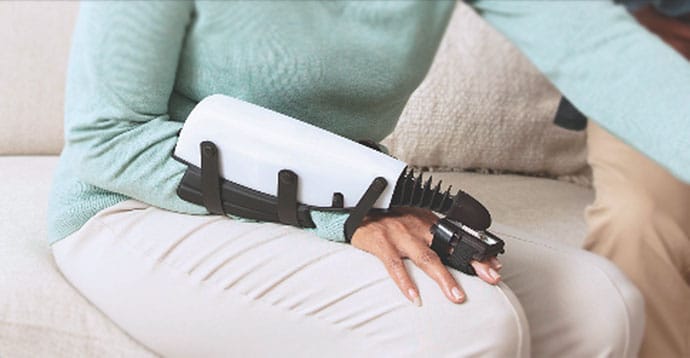
The system includes three components: a wireless handpiece that assists with opening and closing of the affected hand, a noninvasive EEG headset that detects activity in the unaffected hemisphere and identifies neural signals associated with the intention to move the paretic hand, and a tablet interface that guides patients through daily therapy sessions and provides performance feedback.
Leuthardt said the technology is based on understanding the process of how the brain encodes information and transforms that to motor movements.
“Classically, we understand that the primary motor cortex encodes that information that is transmitted to the muscles on the opposite side of the body. But in the setting of stroke, the unaffected hemisphere still maintains some of those motor intentions, and by tapping into those signals, that provides a signal source for a brain-computer interface to work to enable neuro restoration and neuro remodeling,” he noted.
The sensors in the EEG headset detect signals from the healthy hemisphere of the brain, and computation is used to convert those signals into an output that reflects the intentions of the user — in this case movement of a robotic handpiece fitted to the disabled arm.
The IpsiHand system is FDA approved and has been available in the US since 2023.
Previous studies in which patients served as their own controls have suggested clinical benefit with this technology. In addition, electrophysiologic and connectivity changes in the brain which correspond to the magnitude of functional improvement have also been observed.
At-Home Setting
The current study evaluated the brain-computer interface system against standard exercise therapy to assess the potential for meaningful motor improvement in a home environment.
Patients performed an EEG assessment to determine if they could generate an ipsilateral motor signal from the unaffected side of the brain associated with motor imagery from the affected hand. If this was successful, they were randomly assigned to therapy with the brain-computer interface intervention or a standardized home exercise program.
Baseline evaluations were performed, both in motor and nonmotor assessments. Patients were asked to perform the exercises at home for 5 out of 7 days each week and were seen again at 12 weeks.
Patients had to be more than 6 months out from their stroke and to have upper extremity hemiparesis or hemiplegia.
The primary outcome measure was improvement of motor function as measured on the Fugl-Meyer scale.
Compliance was defined as a greater than 80% adherence to the prescribed intervention, which was monitored through use of the system. For the control group, adherence to the home exercise program was self-reported.
Of 109 patients initially assessed, 24 were excluded of these individuals, 10 were excluded because they were unable to generate a brain-computer interface signal. Leuthardt noted that the vast majority of patients are able to produce an ipsilateral motor signal sufficient for device control.
A Chronic Patient Population
Ultimately, 85 patients were randomized, but 17 participants assigned to the control group withdrew, largely because of dissatisfaction with being in the control group. The final study population comprised 62 patients — 37 in the intervention group and 25 in the control group.
At baseline, the mean age was 56.6 years. The average upper extremity Fugl-Meyer score was 26.5, indicating moderate-to-severe impairment, and the mean time since stroke was 5.5 years.
“These were pretty chronic stroke patients,” Leuthardt noted.
Results showed that patients receiving brain-computer interface therapy achieved greater improvement than those assigned to the home exercise program.
Leuthardt noted that although differences in Fugl-Meyer Section A, which assesses gross motor function, were modest, more substantial improvements were observed in section B (wrist), section C (hand), and section D (coordination).
On average, patients in the brain-computer interface group gained 6 points in the Fugl Meyer score compared with 1.5 points for those in the home exercise therapy group, a difference of 4.5 (P < .001).
In addition, 55.5% of those in the intervention group did better than the minimally clinically important change of 5.25 points on the Fugl-Meyer scale vs 9.6% of those in the control group.
Leuthardt noted that this represented a 5.8-fold higher response rate in the intervention group, corresponding to a number needed to treat of 2.2 to achieve a clinically meaningful benefit.
He noted that chronic stroke remains an area of substantial unmet need, with approximately 40% of patients experiencing persistent upper extremity deficits and few effective options to improve function. Access to rehabilitation services is also limited, particularly for patients in rural and underserved communities.
“These results suggest that brain computer interface technology could help bridge that gap,” he added.
An Exciting Innovation
Commenting on the findings for Medscape Medical News, Raul Nogueira, MD, director of the stroke unit at the University of Pittsburgh Medical Center, Pittsburgh, described the technology as compelling. He said it could make the rehabilitation process more accessible and manageable for patients and families and represents an important advance for those left with persistent upper extremity deficits after stroke.
Nogueira was particularly impressed that the device could be used at home. “This technology brings rehabilitation to the home, and on top of that, it seems to produce better results than regular rehab. So there are two victories here.”
He added that although the device may initially be costly, its ability to be used independently at home without daily therapist supervision could ultimately reduce overall rehabilitation expenses. He described the technology as an exciting innovation with the potential to open a new frontier in stroke rehabilitation.
This study was funded by Neurolutions, the company commercializing the IpsiHand device. Leuthardt reported being the inventor of the technology and holding the intellectual property that was licensed Neurolutions. He also reported holding equity in the company. Nogueira reported having no relevant disclosures.


No comments:
Post a Comment