Use the labels in the right column to find what you want. Or you can go thru them one by one, there are only 33,991 posts. Searching is done in the search box in upper left corner. I blog on anything to do with stroke. DO NOT DO ANYTHING SUGGESTED HERE AS I AM NOT MEDICALLY TRAINED, YOUR DOCTOR IS, LISTEN TO THEM. BUT I BET THEY DON'T KNOW HOW TO GET YOU 100% RECOVERED. I DON'T EITHER BUT HAVE PLENTY OF QUESTIONS FOR YOUR DOCTOR TO ANSWER.
Changing stroke rehab and research worldwide now.Time is Brain!trillions and trillions of neuronsthatDIEeach day because there areNOeffective hyperacute therapies besides tPA(only 12% effective). I have 523 posts on hyperacute therapy, enough for researchers to spend decades proving them out. These are my personal ideas and blog on stroke rehabilitation and stroke research. Do not attempt any of these without checking with your medical provider. Unless you join me in agitating, when you need these therapies they won't be there.
What this blog is for:
My blog is not to help survivors recover, it is to have the 10 million yearly stroke survivors light fires underneath their doctors, stroke hospitals and stroke researchers to get stroke solved. 100% recovery. The stroke medical world is completely failing at that goal, they don't even have it as a goal. Shortly after getting out of the hospital and getting NO information on the process or protocols of stroke rehabilitation and recovery I started searching on the internet and found that no other survivor received useful information. This is an attempt to cover all stroke rehabilitation information that should be readily available to survivors so they can talk with informed knowledge to their medical staff. It lays out what needs to be done to get stroke survivors closer to 100% recovery. It's quite disgusting that this information is not available from every stroke association and doctors group.
Until we get the correct research objective for all stroke research, we will never solve stroke. The major obstacle is we have NO strategy to solve stroke and NO leadership to drive that strategy to completion. It is that fucking simple.
1. All stroke research leads to 100% recovery.
2. All stroke research creates rehab protocols usable and understandable by survivors.
The
record-breaking pace of COVID-19 vaccine development and implementation
depended heavily on collaboration among academic, government, and
commercial stakeholders, especially through data-sharing and robust
multicenter trials. Collaborative efforts have not been as fruitful in
fields such as neurorehabilitation, where non-pharmacological
interventions play a much larger role. Barriers to translating
scientific advancements into clinical practice in neurorehabilitation
include pervasively small study sizes, exacerbated by limited funding
for non-pharmacological multicenter clinical trials; difficulty
standardizing—and adequately describing—non-pharmacological
interventions; and a lack of incentives for individual patient-level
data-sharing. These barriers prevent reliable meta-analysis of
non-pharmacological clinical studies in neurorehabilitation. This
point-of-view will highlight these challenges as well as suggest
practical steps that may be taken to improve the neurorehabilitation
pipeline between evidence and implementation.
Stroke is chronic and has totally been overtaken by dementia/Alzheimers. Stroke needs to get to the tipping point where every piece of research is breathlessly reported on. But that won't occur with current stroke leadership who in some la-la land think nothing needs to be done for stroke, it's already solved.
The whole problem is the stroke world
thinks nothing needs to be done as proven by this meme on World Stroke
Day a few years ago. Whomever approved that is a complete blithering
idiot.
The newspaper, social media, dinner time conversation, the
principal’s office, sportscasters, the weather, the boardroom–the
conversation is almost always about the emergency of the moment. The
thing that’s happening all at once.
We have a volunteer fire department in town, but we don’t often have a
volunteer corps dedicated to long-term culture change. Even typing that
out seems odd.
But the chronic problems define our future, and the persistent
changes over time brought us to where we are. Evolution of species is a
chronic process. And most of us die from chronic illnesses.
What would it take for us to spend even a fraction of our time and
energy and attention on the chronic instead of the urgent? Drip by drip.
You can try to understand this or just turn it over to your doctor to explain. You need to know how close you are to a 'tipping point' after your stroke damage and how to prevent that.
Enlarge/
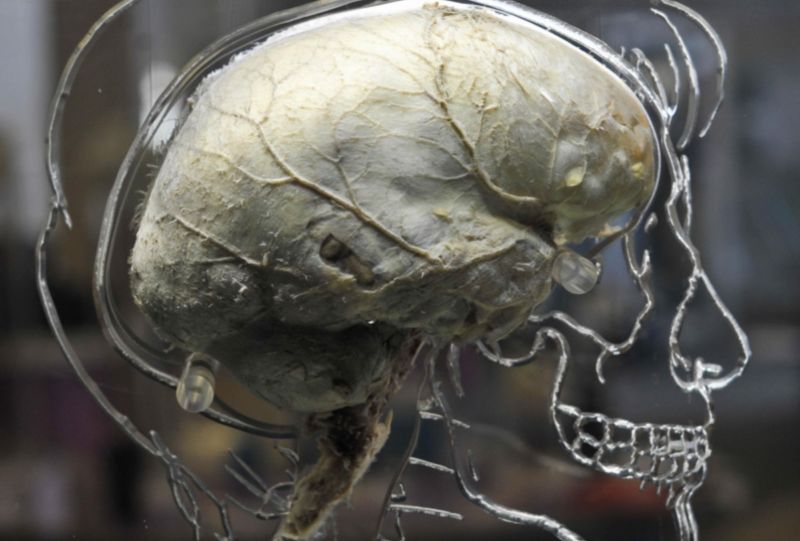
A real human brain suspended in liquid within a human silhouette carved
into acrylic, on display at the Bristol Science Centre in England. New
research finds more evidence that the brain operates near a critical
point.
Ben Birchall/PA Images/Getty Images
The human brain doesn't seem like it would have much in common with
how water freezes into ice or heats up into a gas. But over the last
decade, evidence has been mounting that the brain as a system functions
much like water approaching the critical point of a phase transition.
Now a team of Brazilian scientists has found additional evidence in rat
brains that this might indeed be the case. The team described its
findings in a recent paper in Physical Review Letters.
The notion of so-called "self-organized criticality" dates back to a landmark paper in 1987, when the late Danish physicist Per Bak
concluded that nature's exquisite order was the result of a kind of
phase transition. That precise moment of transition is colloquially
known as the "tipping point" or "critical point."
A brain's the thing
Typically, a classical phase transition only occurs when the
temperature and pressure are just right for a given system.
Self-organized criticality emerges spontaneously as the result of many
local interactions between the many elements of a system, like millions
of grains of sand running from the top to the bottom of an hourglass.
The pile grows, grain by grain, until it becomes sufficiently unstable
that the next grain to drop makes the pile collapse in an avalanche. The
base of the pile widens, restoring stability, and the pile-up begins
anew, until the sand pile hits the critical point again. Those
avalanches follow a so-called "power law," meaning smaller ones happen more often than larger ones.
Bak extended his ideas in a 1996 book, How Nature Works,
applying the notion of self-organized criticality to earthquakes,
financial markets, traffic jams, biological evolution, how galaxies are
distributed in the universe, and the brain. In fact, he annoyed a group
of neuroscientists in 1999 when he blithely informed them that he had
figured out the fundamental principles behind how the brain works. Much
like the pile of sand in an hourglass, he proposed that the brain
teeters at that same critical point, a balance achieved by avalanches of
electrical activity between neurons at all size scales. In other words,
he proposed that electrical activity should follow a power law. The
idea is that this critical state is a kind of "Goldilocks zone" that
optimizes the transfer and processing of information in the brain while
still maintaining stability.
Enlarge/
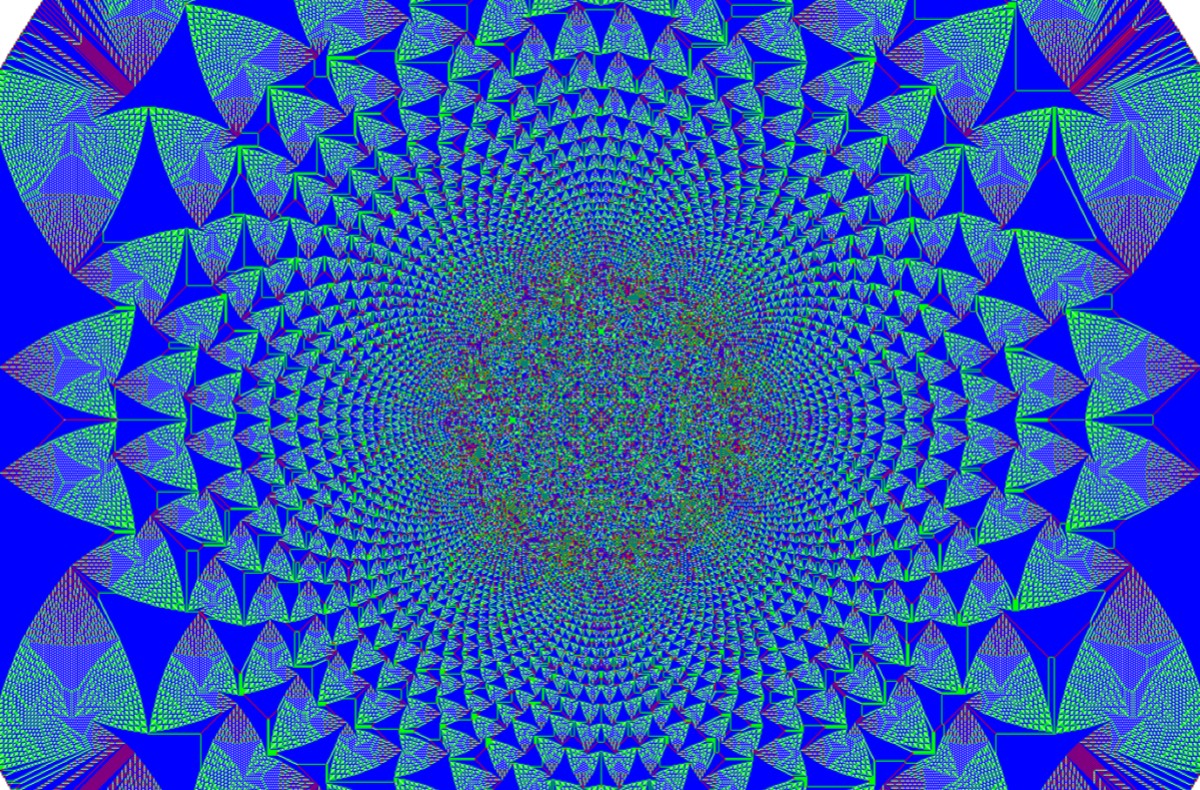
The Bak–Tang–Wiesenfeld (Abelian) sandpile, here composed of 28 million
grains, is a famous model for self-organized criticality.
Granted, the brain is not a highly idealized model sandpile, but the
concept makes a certain degree of sense. The brain is a complex system
that must adapt to constantly changing circumstances, so why shouldn't
it have evolved mechanisms to maintain an ideal balance between order
and disorder, so to speak? "A brain that is not critical is a brain that
does exactly the same thing every minute, or, in the other extreme, is
so chaotic that it does a completely random thing, no matter what the
circumstances," Dante Chialvo, a neurophysiologist with UCLA and the
National Scientific and Technical Research Council in Argentina, memorably told Quanta in 2014. "That is the brain of an idiot."
Signifying nothing?
All this was purely theoretical—and quite controversial—until 1992, when Swedish scientists conducted experiments
with grains of rice pressed between glass plates, adding grains one by
one and recording the eventual avalanches on camera. As Bak had
predicted, there were more smaller avalanches than larger ones,
following the telltale power law. In 2003, Indiana University
biophysicist John Beggs and several colleagues were the first to demonstrate that slices of a brain's cortex showed evidence of an exponent relation. Add in evidence gleaned from other studies using magnetoencephalography, electroencephalography (EEG) recordings of the interactions between individual neurons, and computer simulations
with fMRI imaging data of the brain's resting state, and it starts to
look like proponents of the "brains at the tipping point" hypothesis
might just have a case.
The biggest issue is what one might call a "fine-tuning" problem:
critical states in nature are generally fragile, in that a slight
perturbation will move it away from the exact critical point. And the
brain is an especially noisy system, so there would be many such
perturbations. That's why Beggs and his Indiana University colleague
Gerardo Ortiz have since argued that perhaps the brain hovers near, rather than precisely at, the critical point—think of it as more of a "quasi critical" phase space than a traditional tipping point. Similarly, Viola Priesemann of the Max Planck Institute for Dynamics and Self-Organization in Gottingen has argued that the brain operates in a slightly subcritical zone.
Not everyone is convinced. Among the most vocal critics of the brain operating in a critical state is Alain Destexhe,
a theoretical neuroscientist at the National Center for Scientific
Research (CNRS) in France. Among other concerns, power law distribution
isn't sufficient evidence for criticality, since other processes in
nature can mimic that signature. In a 2017 paper, he and co-author Jonathan Touboul proposed that the real sign of criticality would be the critical exponent relation.
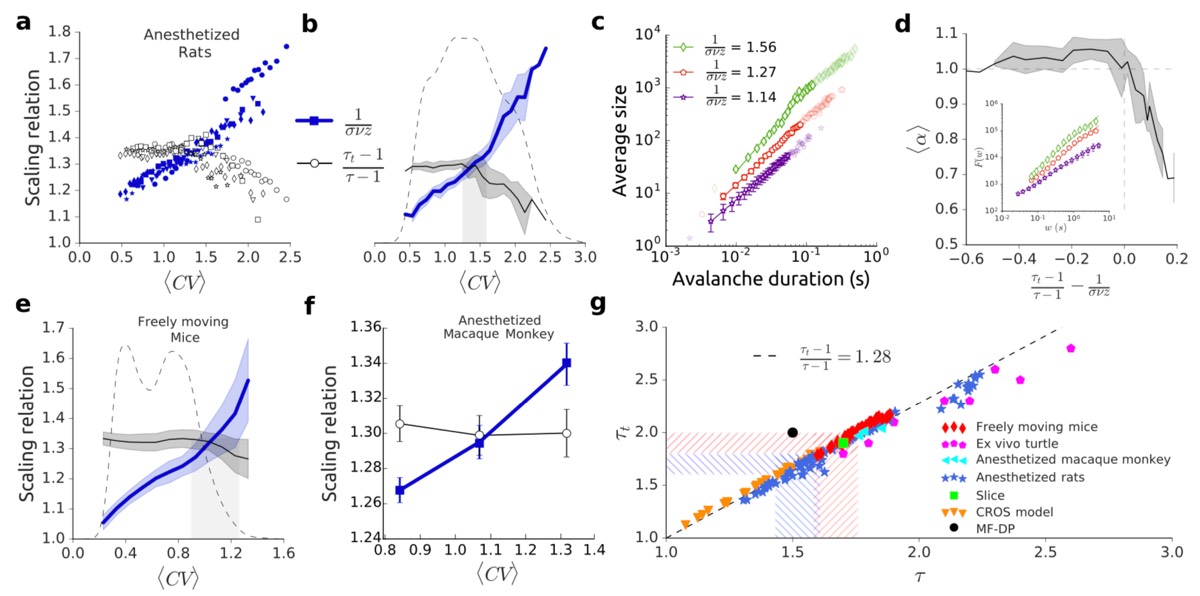
Enlarge/ Signatures of criticality as a function of cortical spiking variability across several different species.
A.J. Fontenele et al./PRL
"This is mind-blowing"
Furthermore, if the brain operates near criticality, what kind of
phase transition might be taking place? That's the question Antonio
Fontenele and Mauro Copelli—both of the Universidade Federal de
Pernambuco in Brazil—and various colleagues sought to answer
with their experiments. They monitored the brains of lab rats as the
rats moved from being asleep (thanks to a bit of anesthesia) and
awake—technically, synchronized and unsynchronized states,
respectively—and concluded that the rodent brains showed all the
hallmarks of moving through a critical state as they cycled between
sleep and wakefulness. Specifically, researchers saw spiking avalanches
following a power distribution.
In other words, "The transition is between unsynchronized and
synchronized firing, this transition point is indeed critical, and the
brain hovers around it," said Beggs, who was not involved with the
experiments. "They had avalanches, too, and they satisfied the exponent
relation. To me, this is mind-blowing."
Beggs was especially impressed with the second figure in this latest
paper, which showed every data point following the exponent
relation—stronger evidence for criticality than a power law distribution
alone. That figure includes data from multiple experiments
involving anesthetized rats, freely moving mice, anesthetized macaque
monkeys, and even turtle brains. That's in keeping with a paper last year reporting
on the recording neuronal activity in the brains of zebrafish, which
showed similar evidence of hovering near criticality.
"This shows that a variety of quite different species, under
different conditions, all line up near the critical point," said Beggs.
"Usually with biological data you expect a cloud of points that may show
some rough correlation. Here you get something noticeably different:
there is order. This suggests that different brains are hovering around
criticality, independent of many biological details." This should
delight physicists, who love universality—that is, when an equation can
capture the large-scale behavior of a complicated system like the
brain—and irritate biologists. However, "It is very difficult to dismiss
the idea of criticality in the cortex, given the data points lining up
pretty nicely across species," said Beggs.
DOI: Physical Review Letters, 2019. 10.1103/PhysRevLett.122.208101 (About DOIs).
You can read and weep about this at the link. But I'm focusing on the complete failure of our stroke associations to reach this same tipping point on stroke. Now 1 in 4 will have a stroke and nothing exists for effective stroke rehab protocols to 100% recover. So 10 million yearly stroke survivors are fucked but the meme from World Stroke day is keep your head firmly buried up your ass so you can't see all the problems in stroke.
At 800,000 strokes a year in the US by 2060 that means we will have 33.6
million stroke cases, and that is a low estimate as our country ages. If our fucking failures of stroke associations can't figure out how to get stroke to the tipping point where tons of research is directed to stroke and every research is reported by all media they need to be dissolved and run by survivors. But never mind, stroke is treatable per the meme from World Stroke Day a couple of years ago. That has got to be the biggest lying piece of shit stroke associations have ever put out.
Nearly 14 million Americans may have Alzheimer's disease by then
by Judy George, Contributing Writer, MedPage Today
Over 3%
of the population -- nearly 14 million Americans -- may have
Alzheimer's disease or related dementias by 2060, according to a new CDC
report.
The burden of Alzheimer's disease and related dementias, which was
1.6% of the U.S. population in 2014, is projected to double to 3.3% by
2060, reported the CDC's Kevin Matthews, PhD, and and colleagues in Alzheimer's & Dementia.
That translates to a jump from 5 million to 13.9 million Americans affected by the disease.
Hispanic Americans are expected to have the biggest increase due to
population growth, but non-Hispanic whites still will have the most
Alzheimer's cases, based on population numbers.
The study is the first to forecast Alzheimer's disease by race and
ethnicity. It shows "that as the U.S. population increases, the number
of people affected by Alzheimer's disease and related dementias will
rise, especially among minority populations," CDC Director Robert
Redfield, MD, said in a statement.
Currently, Alzheimer's disease is the fifth leading cause of death of
Americans age 65 and older, the CDC said. Of people in that age group,
African Americans have the highest prevalence of Alzheimer's disease and
related dementias at 13.8%, followed by Hispanics at 12.2%,
non-Hispanic whites at 10.3%, American Indian and Alaska Natives at
9.1%, and Asian and Pacific Islanders at 8.4%.
By 2060, 3.2 million Hispanics and 2.2 million African Americans are
expected to have Alzheimer's disease and related dementias, due in part
to longer life spans.
The
report also addressed the need to support caregivers of Alzheimer's and
dementia patients and the importance of early diagnosis. "Early
diagnosis is key to helping people and their families cope with loss of
memory, navigate the health care system, and plan for their care in the
future," Redfield said.
CDC researchers used population projections from the U.S. Census
Bureau and percentages of Medicare fee-for-service beneficiaries 65 and
older with Alzheimer's disease and related dementias from the Centers
for Medicare & Medicaid Services to estimate the number of people
with Alzheimer's by age, sex, race, and ethnicity in 2014 and 2060.
The findings
and conclusions in the study do not necessarily represent the official
positions of the Centers for Disease Control and Prevention or the
Centers for Medicare and Medicaid Services.
What should be occurring with stroke if it had hit the tipping point where all news about stroke is breathlessly reported. Failure on a massive scale from our stroke associations. Someone in the United States has a stroke every 40 seconds, more often than Alzheimers yet no reporting is done on that because our fucking failures of stroke associations seem to only put out 'happy talk'. https://danablog.org/2017/01/24/alzheimers-every-minute-counts/
In the United States, someone is diagnosed with Alzheimer’s disease
every minute; around the world, it’s every four seconds. “It is the
biggest epidemic we have in this country,” says Harvard University’s Rudolph Tanzi, “I’m shocked that people aren’t panicked about what this disease is going to do to the country or to their families.”
This Wednesday (January 25) at 10 pm ET, PBS is premiering “Alzheimer’s: Every Minute Counts,”
an urgent wake-up call about the national threat posed by the disease.
The documentary includes interviews with doctors, caregivers, and
longtime researchers of the disease, such as Dana Alliance member Tanzi.
With the number of people finding they have Alzheimer’s rapidly
escalating as the baby boom generation reaches 65 and older, researchers
estimate that by 2050, the rate of diagnosis won’t be every minute but
every 33 seconds. Scientists and drug-makers have yet to find a cure;
they cite a dire need of federal funding for further research. No
lifestyle activity is guaranteed to prevent the disease, Tanzi says, but
there are measures we can take, based on various epidemiology studies
and trials, that can reduce risk.
Among those things, he recommends:
Stay active. Exercise, which can help remove the pathology and stop inflammation (considered by many a key part of Alzheimer’s disease).
Get enough sleep. Scientists have found that during
the deepest part of sleep (slow-wave sleep) is the only time the brain
doesn’t make the amyloid proteins responsible for creating the plaques
associated with the disease. Tanzi recommends a minimum of seven to
eight hours a night to ensure the brain has time to “clean itself.”
Adopt a healthy diet. The Mediterranean diet has
shown to be most effective in reducing risk; it includes more fiber,
olive oil, fruits, nuts, more fish, vegetables, and less red meat.
“Keep moving” physically, socially, and intellectually.
Every time you learn something new, your brain creates new connections
between synapses and strengthens the ones already there. In Alzheimer’s,
what correlates most with the degree of dementia is loss of synapses.
To watch the full, four-minute video of Tanzi’s tips on keeping our brains as healthy as possible, click here.
We have selected
these articles based on stories that received the most views from our
readers, as well as the most shares and likes from Reddit, Facebook,
Twitter, Google+ and our other social networks.
This list is based on popularity among Neuroscience News audiences and is not based on importance of research directly.
Thanks to all of our readers and social media fans for reading and sharing our news throughout 2016.
In no particular order, here are some of the most popular Neuroscience News articles of 2016.
Happy New Year!
Depression Is Not Just a Mental Illness, It Affects the Whole Organism
13 – Rhythm of Breathing Affects Memory and Fear
Perhaps our top story of the year was published in early December and
comes from a team of researchers from Northwestern University.
Researchers have been able to link breathing rhythm to emotional judgement and enhanced memory recall.
There is a ‘dramatic difference’ in neural activity in both the
hippocampus and amygdala depending on whether you are inhaling or
exhaling, the researchers report. This can affect how you perceive
stimuli and your ability to recall memories. Read the full article.
How LSD Affects Language
14 – How LSD Affects Language
During 2016, we seemed to report fairly often on the neurobiological
effects of LSD. Back in August, a new study was released that looked at
the effect LSD had on language processing and skills.
Researchers reported that, when people under the influence of LSD
were asked to name specific objects, their reaction times did not
change, but they were more likely to mistakenly call objects by
different names. For example, when presented with an image of a car,
people who had taken LSD would instead name the stimuli as a ‘bus’ or
other vehicle.
Based on their findings, the researchers believe that LSD could allow
‘quicker access to far away concepts stored in the brain’ (Neiloufar
Family) and could help in the treatment of psychiatric illnesses. Read the full article.
Broca and Wernicke Are Dead – It’s Time to Rewrite the Neurobiology of Language
15 – Broca and Wernicke Are Dead – It’s Time to Rewrite the Neurobiology of Language
One of the most influential news stories of the year was released in
early November and could have implications for the way researchers
consider the neurological basis of language function.
A new paper published by the BPS argued that the ‘Classic Model’ of
language function in the brain is obsolete and the continued use could
be hampering progress when it comes to researching language production.
The researchers call for a new approach that considers how much of
language function is overlaid on the cognitive system. Read the full article.
Brain Structure That Tracks Negative Events Backfires in Depression
16 – Brain Structure That Tracks Negative Events Backfires in Depression
Back in May, we reported on a significant new finding which relates to the neurobiology of depression.
Researchers from University College London discovered people with
depression had hyperactive habenula function. Surprisingly, when faced
with an adverse event, habenula activity decreased in depressed people.
The findings suggest that this brain area functions in a much different
way in people with this psychiatric condition. Read the full article.
How Neurons Talk to Each Other
17 – How Neurons Talk to Each Other
While not so much of a breaking news story, one of our most popular
articles of the year provided a comprehensive breakdown of the process
of neurotransmission. The article received a great deal of attention via
our social network accounts and became quite a hit with educational
communities and groups online. Read the full article.
Our Brains Have a Basic Algorithm That Enables Our Intelligence
18 – Our Brains Have a Basic Algorithm That Enables Our Intelligence
Back in November, we reported on a groundbreaking piece of research
that demonstrated our complex brain computations and intelligence are
reliant upon a fairly basic algorithm. However, the researcher noted
exceptions to the math rule in areas such as the reward system. Read the full article.
Religious Beliefs Activate Neural Reward Circuits in Same Way As Sex and Drugs
19 – Religious Beliefs Activate Neural Reward Circuits in Same Way As Sex and Drugs
One of our favorite stories of the year was published back in late
November and came to us from researchers at the University Of Utah
School Of Medicine.
A new neurotheology study looked at the neural networks that are involved in feelings of spirituality.
Through neuroimaging technology, researchers identified activation in
the nucleus accumbens, an area of the brain associated with reward,
when powerful spiritual feelings are encountered. Interestingly, similar
brain activation occurs when people are exposed to pleasurable stimuli
such as sex, drugs, music and gambling. Read the full article.
But you as the National Stroke Association are doing fucking nothing to solve that problem. Lazy AWARENESS press releases. You haven't figured out how to get stroke to the tipping point where every research paper on stroke is held in breathless anticipation. You don't deserve any money for your useless work.
Women are almost twice as likely to die from a stroke as from breast cancer
Stroke is the fifth leading cause of death in the U.S.
800,000 people will experience a stroke this year and live to join the 7 million stroke survivors in the U.S.
Stroke is a leading cause of serious, long-term disability
Strokes in children, teens, and young adults are increasing at an alarming rate
For 32 years, we’ve been committed to raising stroke awareness. Stroke
is a sudden and shocking loss for millions of families. But, with your help,
we know we can do more to empower our community to understand their risk for
stroke and make lifesaving changes.
No reference in here to tackling anything about stroke which affects 15 million persons a year, 5 million die. The ASA, NSA and WSO can congratulate themselves that they have convinced the whole world that stroke is being treated so well that nothing needs to be done to improve stroke treatment. Stroke has not hit the tipping point where everyone in the world knows about all the fucking problems in stroke and waits breathlessly for advances in stroke results. So the presidents of the ASA, NSA and WSO are not concerned about having a stroke since they will be treated F.A.S.T. and fully recover. Excuse me while I scrape myself off the floor for telling such a whopper of a lie. http://www.thelancet.com/journals/lancet/article/PIIS0140-6736%2816%2931847-5/fulltext
But higher rates reported for younger adults, blacks
By Steven Reinberg HealthDay Reporter
WEDNESDAY, May 11, 2016 (HealthDay News) -- While
Americans suffered fewer strokes overall from 2000 to 2010, stroke rates
climbed substantially among younger adults and blacks, a new study
found.
Hospitalizations for strokes caused by artery blockages dropped 18.4
percent overall during the decade, with greater decreases among the
elderly, University of Southern California researchers found.
Within the overall decrease, however, some groups saw an increase in
hospitalizations as the burden of stroke shifted to younger adults. For
example, although stroke hospitalizations dropped 50 percent for people
65 and older, they increased nearly 49 percent among 25- to 64
year-olds.
Stroke hospitalizations also varied by race -- up almost 14 percent among blacks.
Dr. Paul Wright, chair of neurology at North Shore University
Hospital, in Manhasset, N.Y., said, "There are things we can do to help
prevent strokes." Topping the list: living a healthier lifestyle, which
can prevent as many as 80 percent of strokes, said Wright, who was not
involved with the study.
The study authors said better control of blood pressure, blood sugar
and cholesterol probably accounted for the steep decline in strokes
among the elderly.
Exactly why strokes are up among younger adults isn't clear, but more
awareness of stroke symptoms is the most likely reason, Wright said.
"People are more aware of the risk factors for stroke and seek help
when something happens, as opposed to saying, 'I'm getting a little
numbness and tingling and weakness, but it will go away,' " he said. "So
people are more likely to get help sooner."
Wright believes the higher stroke rate among blacks is largely due to
lack of access to care. He also cited a need for more stroke education
targeted to this population.
Dr. Amytis Towfighi, senior researcher on the study, emphasized the protective role of lifestyle behaviors in stroke prevention.
"The majority of cardiovascular events including heart attacks and
stroke can be prevented through changing seven modifiable risk factors,
namely: smoking, obesity, physical inactivity, poor diet, cholesterol,
blood pressure and blood sugar," she said.
If you've had a stroke, "it's not too late to change your lifestyle.
By making immediate changes one is on the road to a longer, healthier
life," said Towfighi, an assistant professor of neurology at USC's Keck
School of Medicine.
Healthier lifestyle habits probably accounted for the hefty decline
in strokes for seniors -- down 28 percent for those 65 to 84, and more
than 22 percent for those 85 and older, Towfighi said.
For the study, Towfighi and her colleagues analyzed data from a
national database that collects information on about 8 million hospital
stays each year.
They looked at the most common type of stroke, called ischemic
stroke. This occurs when a clot in a blood vessel in the brain cuts off
the blood supply to that area. Symptoms usually include weakness or
numbness and tingling on one side of the body.
The researchers found that stroke hospitalization for whites declined
about 12 percent and for Hispanics nearly 22 percent. But it rose 13.7
percent among blacks.
Overall, women saw a steeper decline in stroke than men -- more than 22 percent versus roughly 18 percent.
The study findings were published online May 11 in the Journal of the American Heart Association. More information
For more about stroke, visit the American Stroke Association.
SOURCES: Amytis Towfighi, M.D. assistant professor, neurology,
Keck School of Medicine, University of Southern California, Los Angeles;
Paul Wright, M.D., chair, neurology, North Shore University Hospital,
Manhasset, N.Y.; May 11, 2016, Journal of the American Heart Association, online
This in a nutshell points out the whole problem with our stroke associations. Awareness NOT finding solutions to all the problems in stroke. This is so simple to solve; 1. Create and follow a stroke strategy to solve stroke problems. BHAGs (Big Hairy Audacious Goals)
Like repeatable neuroplasticity, repeatable neurogenesis, fatigue,
spasticity, aphasia. And since we have no National Stroke Plan or
strategy nothing will get done in stroke from the NSA that actually helps survivors. 2. Put out RFPs(Request for Proposals) to researchers to solve those problems. 3. Apply for grant money to fund those research projects. 4. Broadcast the success stories to generate enthusiasm and more foundations that want to get on a successful stroke strategy train. Hit the tipping point for stroke so each stroke success is met with breathless anticipation and media stories. http://www.stroke.org/
Why can't our fucking failures of stroke associations find a popular actor/actress who had a stroke and use that to show what still needs to be done to solve all the problems in stroke? We don't need another awareness campaign. We could finally get stroke to the tipping point where every research breakthrough is announced with breathless anticipation. This is so simple that any decent marketer should have thought of this years ago.
Cardiovascular disease is the leading cause of death in the US, a new report revealed.
One in every three deaths in the US occurs because of heart disease, stroke and other cardiovascular diseases.
And across the globe, heart disease and stroke are the leading causes of death, according to the American Heart Association.
The
AHA’s 2016 Heart Disease and Stroke Statistics Update showed
cardiovascular diseases claimed 801,000 lives in the US in 2013 – the
last available data.
Of that group, heart disease killed more than 370,000 people.
Stroke took the lives of nearly 129,000 people.
A report from the American Heart
Association revealed that cardiovascular disease is the top killer in
the US. Heart disease and stroke were also found to be the top two
killers worldwide
Dr
Mark Creager, president of the AHA, said: ‘Statistics about
cardiovascular disease and stroke, and particularly the metrics about
death and the factors that contribute to cardiovascular disease are
incredibly important.’
The report has been produced annually since 1958.
It
uses the most-recent data available from the AHA, the National
Institutes of Health, the Centers for Disease Control and Prevention and
other government sources.
The statistics help the AHA track the effectiveness of its efforts.
But
despite the progress in reducing the number of deaths from heart
disease and stroke, Dr Creager said the data is still too high.
Stroke has vastly more people affected by it than Parkinsons yet our stroke associations are so fucking incompetent they can't get any visibility. I'd say that is because they keep saying everything is coming up roses because of F.A.S.T. and tPA. When the truth is that everything in stroke is a failure and they refuse to acknowledge that. https://www.michaeljfox.org/foundation/news-detail.php?today-we-re-in-the-future& Approximately 60,000 Americans are diagnosed with Parkinson's each year. 800,000 Americans have a stroke each year. 13.3 times more stroke patients each year than Parkinsons. Yet our stroke associations have no clue how to get stroke to the tipping point.
While there is an ever-increasing amount of academic research around
the practice and its effects, scientists are still figuring out what
precisely is happening when people meditate, and what effects that
behaviour has on the brain.
Harvard neuroscientist Sara Lazar, a leading researcher in the field,
is one of the first to show that meditation practice produces
structural changes in the brain.
In 2005,
her team was the first to show how long-term meditation practice
correlates with cortical thickening in brain areas associated
with attention, sensory processing, and interoception (the awareness
someone has about the physiological state of their body).
In a 2011 paper,
she found that people who learned meditation for the first time in an
eight-week course had increases in grey matter concentration in areas of
the brain associated with “learning and memory processes, emotion
regulation, self-referential processing, and perspective taking.”
The research suggests that “changes in brain structure may underlie
some of these reported improvements and that people are not just feeling
better because they are spending time relaxing,” Lazar says.
Those changes to brain structure come with big changes in mental activity.
Lazar revealed a few of them to Tech Insider:
• Understanding yourself (and other people too).
Meditation increases your awareness of “minimally conscious thoughts and
emotions,” or quieter emotions that otherwise go unnoticed. “You have
probably experienced many emotions that you’re not even aware of,” Lazar
says. “If you understand them in yourself, you’ll understand them
better in other people.” • Emotional strength. When you have a higher
resolution image of your emotional landscape, then you’re less to be
swayed by each individual feeling. “If you have a better handle of all
the different emotions, you realise, ‘OK, this emotion isn’t useful,'”
Lazar says. “It gives you more information, and information is power.”
• Getting less freaked out by stress. “You’re less
likely to make a rash decision,” Lazar says. “You’re less stressed,
you’re less caught up in the hullabaloo around you. I think that’s
important regardless of what you do. it plays into quality of life. I
still get stressed, but it takes more to make me stressed out.”
Lazar is careful to note that your brain changes when you learn
anything, be it a second language or juggling. Same with meditation:
though it can be an intimidatingly abstract activity when you first
encounter it, mindfulness meditation is an exercise that you can learn
to get better at, just like swinging at a baseball.
It works like this.
“You pick one object,” Lazar says. “For many people, it’s breathing
sensations. It doesn’t have to be that, but it’s the most common thing
to start with. You notice that, and your mind is going to get bored, and
it’s going to start wandering, and then you realise, oh, my mind is
starting to wander, and bring it back to breath.”
Instead of manipulating a bat to hit a ball, Lazar says that you’re
using two of the mind’s go-to instruments: attention and metacognition,
or your awareness of your own thoughts.
“Attention helps you stay focused, and metacognition helps you to see
all the minimally conscious content,” Lazar says. “You think, this is boring,
but what else is happening? You start to notice little thoughts and
feeling happening in the back. They’re happening all the time, and we
miss them 80% or 90% of the time. You notice there’s a lot more going on
that you never saw before.”
Lazar has had a personal practice for nearly two decades, but she
fell into meditation unexpectedly. When she and a friend over-trained
for the Boston Marathon and ended up hurting themselves, Lazar started
going to yoga to help recover.
Then she got into mindfulness meditation. “It was really clear that
something in my brain had changed,” she tells Tech Insider. “I was
noticing things I hadn’t noticed before, and I was less reactive to
things that would piss me off.”
“It’s not you start meditation and you become a Buddhist monk,” Lazar
says. “It will help promote attention and metacognition. The benefits
are real and beneficial, but it’s not like you become a super person
because of this.”
Watch Lazar’s 2011 TedX talk on meditation’s effects on the brain below.
Because our stroke associations have totally failed us we have no positive articles like this. Stroke has not hit the tipping point because we always are bombarded with this 'happy talk' that all you have to do is get to a stroke hospital(F.A.S.T.) in 3 hours and you'll be made all better. What a FUCKING LIE!!! If you don't acknowledge that there are problems to be solved no one will be willing to help you.
Like all these f*cking problems in stroke that no one wants to talk about.
Or the fact that if you have a stroke right now you are screwed.
Or the fact that your doctor doesn't tell you anything about how to recover from a stroke. http://www.alz.org/news_and_events_101507.asp?WT.mc_id=enews2015_06_17&
The House Labor, Health and Human Services (Labor-HHS) Appropriations
Subcommittee today approved a historic $300 million increase for
Alzheimer’s disease research as requested by Alzheimer’s Association
advocates. If this increase becomes law, it will be the largest annual
increase in federal Alzheimer’s research funding to date. The
Alzheimer’s Association applauds this exemplary bipartisan effort to
address this devastating and costly disease before Alzheimer’s
prevalence triples and costs quadruple in just over a generation.
“In an act of true leadership, Chairman Cole and the bipartisan
members of the subcommittee reached across the aisle today to change the
trajectory of the Alzheimer’s epidemic,” said Harry Johns, president
and CEO of the Alzheimer’s Association. “This bipartisan effort
reflecting a more than a 50 percent increase in Alzheimer’s research
funding shows that leaders on Capitol Hill are in agreement that the
burden Alzheimer’s places on families and the nation must be addressed
now.”
In March, more than 1,000 advocates from all 50 states gathered in
the nation’s capital for the Alzheimer’s Association Advocacy Forum and
asked their legislators for this increase of $300 million for
Alzheimer’s research. The following month, Robert Egge, executive vice
president of government affairs at the Alzheimer’s Association,
testified before the House Labor, Health and Human Services (Labor-HHS)
Appropriations Subcommittee, outlining the unique triple threat that
Alzheimer’s disease poses:
More than 5 million Americans and their 15 million unpaid caregivers are affected by Alzheimer’s disease.
Already the most expensive disease in the country, according to the
New England Journal of Medicine, the cost of Alzheimer’s to the nation
will soar to $1.1 trillion by 2050, threatening family savings and the
future of Medicare.
Alzheimer’s is the only leading cause of death that cannot be prevented, cured or even slowed.
Earlier this year, the Alzheimer’s Association released Changing the Trajectory of Alzheimer's Disease: How a Treatment by 2025 Saves Lives and Dollars,(Stroke has NO plan)
which reported that the United States could save $220 billion within
the first five years of a treatment for Alzheimer’s disease being
introduced. The report shows that meeting the goal of the National Plan to Address Alzheimer’s Disease —
to prevent and effectively treat Alzheimer’s by 2025 — would reduce the
number of individuals affected by the disease by 2.5 million within the
first five years of a treatment being available.
Currently, Alzheimer’s disease receives $586 million a year in
federal funding for research. Leading scientists have said it will take a
ramp up to $2 billion a year to reach the goal of the National
Alzheimer's Plan(Stroke has NO plan).
Until we hit the tipping point of having stroke talked about as much as dementia will we ever get people to work on actual solutions for us. And this lack of visibility I lay directly on our stroke association failures. Mainly because they focus on being positive stating that with F.A.S.T. you can completely recover if you get to a stroke hospital fast enough. They are lying through their teeth. Less than 10% of those eligible for tPA get it and it only works completely to reverse all the effects of the stroke 12% of the time. We should be stating how f*cking appalling it is that if you have a stroke right now you are screwed.
From the front page of Yahoo news. Alzheimers has obviously hit the tipping point. But if you look at the figures, stroke will have more people affected by 2050. Why hasn't stroke been more visible? http://news.yahoo.com/video/alzheimer-39-disease-084835094.html
36 million people suffer from Alzheimer's around the world. According
to a World Health Organisation estimate, this figure could reach 115
million by 2050 in the absence of a cure. With a new case diagnosed
every 4 seconds, the disease remains one of medicine's greatest
challenges as it robs ever more people of their memory and
independence.VIDEOGRAPHIC
At 10 million survivors a year stroke will have 350 million survivors by 2050 and 175 million dead.
Sounds like a major catastrophe to me.