Changing stroke rehab and research worldwide now.Time is Brain! trillions and trillions of neurons that DIE each day because there are NO effective hyperacute therapies besides tPA(only 12% effective). I have 523 posts on hyperacute therapy, enough for researchers to spend decades proving them out. These are my personal ideas and blog on stroke rehabilitation and stroke research. Do not attempt any of these without checking with your medical provider. Unless you join me in agitating, when you need these therapies they won't be there.

What this blog is for:

My blog is not to help survivors recover, it is to have the 10 million yearly stroke survivors light fires underneath their doctors, stroke hospitals and stroke researchers to get stroke solved. 100% recovery. The stroke medical world is completely failing at that goal, they don't even have it as a goal. Shortly after getting out of the hospital and getting NO information on the process or protocols of stroke rehabilitation and recovery I started searching on the internet and found that no other survivor received useful information. This is an attempt to cover all stroke rehabilitation information that should be readily available to survivors so they can talk with informed knowledge to their medical staff. It lays out what needs to be done to get stroke survivors closer to 100% recovery. It's quite disgusting that this information is not available from every stroke association and doctors group.

Showing posts with label TREM2. Show all posts

Thursday, August 13, 2026

Study of Brain Immune Cells Reveals New Clues to Alzheimer’s Disease Progression

 Have your competent? doctor and hospital create protocols from this. Can't do that: PURE INCOMPETENCE!

 You'll need them because of this;

Your risk of dementia, has your doctor told you of this?  Your doctor is responsible for preventing this! Is s/he willing to prevent this?

1. A documented 33% dementia chance post-stroke from an Australian study?   May 2012.

2. Then this study came out and seems to have a range from 17-66%. December 2013.`    

3. A 20% chance in this research.   July 2013.

4. Dementia Risk Doubled in Patients Following Stroke September 2018 

The latest here: 

Study of Brain Immune Cells Reveals New Clues to Alzheimer’s Disease Progression

Summary: Researchers have mapped over 830,000 brain immune cells, discovering a protective subtype of microglia that expands as Alzheimer’s disease progresses. Driven by the TREM2 molecular pathway, these cells actively help clear harmful material from the brain. The findings provide a new roadmap for developing therapies focused on strengthening the brain’s natural immune defenses rather than targeting amyloid plaques alone.

Key Facts:

  • Unprecedented Scale: The study analyzed over 830,000 myeloid-origin immune cells from 1,607 donors, providing the most detailed reference to date of immune cell changes across aging and disease.
  • Protective Microglia Subtype: A specific, disease-associated subtype of microglia becomes more abundant as Alzheimer’s advances, acting to protect the brain by engulfing and clearing harmful material.
  • Crucial Molecular Pathway: The beneficial, protective effects of these immune cells rely entirely on a molecular signaling pathway involving the proteins TREM2, MITF, and GPNMB.

Source: Mount Sinai Hospital / Mount Sinai School of Medicine

The brain’s immune cells are increasingly recognized as key players in Alzheimer’s disease, but exactly how they change as the disease develops has remained unclear. Now, a groundbreaking study published in Nature Genetics provides the most comprehensive map to date of these cells.

Researchers from the Icahn School of Medicine at Mount Sinai have identified a protective subtype of brain immune cell that expands as Alzheimer’s disease progresses, uncovering the molecular pathway that enables these cells to help defend the brain. The findings offer new insights that could inform future Alzheimer’s therapies.

Led by Donghoon Lee, PhD, and Panos Roussos, MD, PhD, the team analyzed more than 830,000 myeloid-origin immune cells of the brain. This included microglia—the brain’s resident immune cells—and perivascular macrophages, which are crucial for modulating immune responses. The cells were sourced from the prefrontal cortex of 1,607 donors spanning a wide range of ages and Alzheimer’s disease pathology stages.Donghoon Lee graphical abstract.
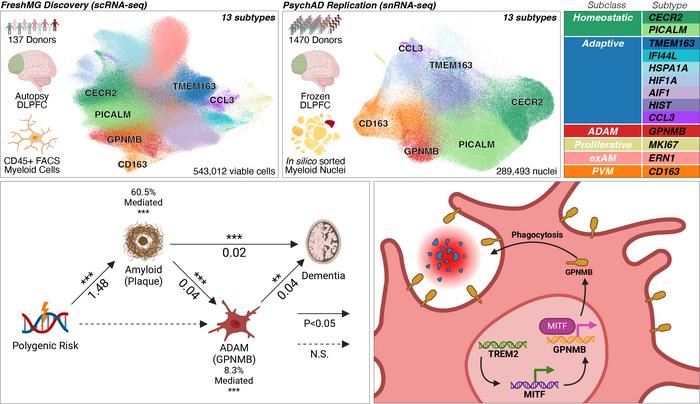
Graphical abstract of the work. Credit Mount Sinai Health System.

By profiling brain tissue at this unprecedented scale, the team identified six subclasses comprising 13 distinct subtypes of myeloid cells, characterizing how these populations adapt during aging and disease progression.

Crucially, the researchers identified a disease-associated subtype of microglia that becomes increasingly abundant as Alzheimer’s disease advances. Rather than contributing to neurodegeneration, these cells appear to play a protective role by increasing their ability to engulf and clear harmful material from the brain.

The study further identified a molecular pathway involving the proteins TREM2, MITF, and GPNMB that is required to maintain this protective microglial state. Experiments in both human tissue and mouse models demonstrated that the beneficial effects of these cells depend strictly on TREM2 signaling.

“Our study provides the clearest picture yet of how the brain’s immune cells adapt during aging and Alzheimer’s disease,” said Donghoon Lee, PhD, Assistant Professor of Genetics and Genomic Sciences and Psychiatry at Mount Sinai, and first and corresponding author of the paper.

“By identifying the specific immune cells that appear to protect the brain—and the molecular signals they rely on—we have uncovered potential new targets for therapies aimed at slowing Alzheimer’s disease progression.”

Beyond identifying this protective microglial population, the study helps explain why genetic variants in immune-related genes such as TREM2 and APOE increase Alzheimer’s risk. Ultimately, the findings provide a roadmap for developing therapies that strengthen the brain’s natural immune defenses.

Editorial Notes:

  • This article was edited by a Neuroscience News editor.
  • Journal paper reviewed in full.
  • Additional context added by our staff.

About this Alzheimer’s disease research news

Author: Elizabeth Dowling (Media Contact)
Source: The Mount Sinai Hospital / Mount Sinai School of Medicine
Contact: Elizabeth Dowling – The Mount Sinai Hospital / Mount Sinai School of Medicine
Image: Graphical abstract credit goes to Mount Sinai Health System

Original Research: Peer-Reviewed Publication “Plasticity of human microglia and brain perivascular macrophages in aging and Alzheimer’s disease” by Donghoon Lee, Panos Roussos, et al. Nature Genetics

DOI: 10.1038/s41588-026-02716-6

Tuesday, August 11, 2026

Study of Brain Immune Cells Reveals New Clues to Alzheimer’s Disease Progression

 How will your competent? doctor use this to prevent your likely dementia? NOTHING LIKE USUAL!

Your risk of dementia, has your doctor told you of this?  Your doctor is responsible for preventing this! Is s/he willing to prevent this?

1. A documented 33% dementia chance post-stroke from an Australian study?   May 2012.

2. Then this study came out and seems to have a range from 17-66%. December 2013.`    

3. A 20% chance in this research.   July 2013.

4. Dementia Risk Doubled in Patients Following Stroke September 2018 

You do know your doctor is TOTALLY FUCKING INCOMPETENT  in everything stroke related, right?

 Your incompetent doctor knew nothing of TREM2, right?

  • NMOSD (2 posts to March 2018)

Study of Brain Immune Cells Reveals New Clues to Alzheimer’s Disease Progression

Summary: Researchers have mapped over 830,000 brain immune cells, discovering a protective subtype of microglia that expands as Alzheimer’s disease progresses. Driven by the TREM2 molecular pathway, these cells actively help clear harmful material from the brain. The findings provide a new roadmap for developing therapies focused on strengthening the brain’s natural immune defenses rather than targeting amyloid plaques alone.

Key Facts:

  • Unprecedented Scale: The study analyzed over 830,000 myeloid-origin immune cells from 1,607 donors, providing the most detailed reference to date of immune cell changes across aging and disease.
  • Protective Microglia Subtype: A specific, disease-associated subtype of microglia becomes more abundant as Alzheimer’s advances, acting to protect the brain by engulfing and clearing harmful material.
  • Crucial Molecular Pathway: The beneficial, protective effects of these immune cells rely entirely on a molecular signaling pathway involving the proteins TREM2, MITF, and GPNMB.

Source: Mount Sinai Hospital / Mount Sinai School of Medicine

The brain’s immune cells are increasingly recognized as key players in Alzheimer’s disease, but exactly how they change as the disease develops has remained unclear. Now, a groundbreaking study published in Nature Genetics provides the most comprehensive map to date of these cells.

Researchers from the Icahn School of Medicine at Mount Sinai have identified a protective subtype of brain immune cell that expands as Alzheimer’s disease progresses, uncovering the molecular pathway that enables these cells to help defend the brain. The findings offer new insights that could inform future Alzheimer’s therapies.

Led by Donghoon Lee, PhD, and Panos Roussos, MD, PhD, the team analyzed more than 830,000 myeloid-origin immune cells of the brain. This included microglia—the brain’s resident immune cells—and perivascular macrophages, which are crucial for modulating immune responses. The cells were sourced from the prefrontal cortex of 1,607 donors spanning a wide range of ages and Alzheimer’s disease pathology stages.

Donghoon Lee graphical abstract.
Graphical abstract of the work. Credit Mount Sinai Health System.

By profiling brain tissue at this unprecedented scale, the team identified six subclasses comprising 13 distinct subtypes of myeloid cells, characterizing how these populations adapt during aging and disease progression.

Crucially, the researchers identified a disease-associated subtype of microglia that becomes increasingly abundant as Alzheimer’s disease advances. Rather than contributing to neurodegeneration, these cells appear to play a protective role by increasing their ability to engulf and clear harmful material from the brain.

The study further identified a molecular pathway involving the proteins TREM2, MITF, and GPNMB that is required to maintain this protective microglial state. Experiments in both human tissue and mouse models demonstrated that the beneficial effects of these cells depend strictly on TREM2 signaling.

“Our study provides the clearest picture yet of how the brain’s immune cells adapt during aging and Alzheimer’s disease,” said Donghoon Lee, PhD, Assistant Professor of Genetics and Genomic Sciences and Psychiatry at Mount Sinai, and first and corresponding author of the paper.

“By identifying the specific immune cells that appear to protect the brain—and the molecular signals they rely on—we have uncovered potential new targets for therapies aimed at slowing Alzheimer’s disease progression.”

Beyond identifying this protective microglial population, the study helps explain why genetic variants in immune-related genes such as TREM2 and APOE increase Alzheimer’s risk. Ultimately, the findings provide a roadmap for developing therapies that strengthen the brain’s natural immune defenses.

Editorial Notes:

  • This article was edited by a Neuroscience News editor.
  • Journal paper reviewed in full.
  • Additional context added by our staff.

About this Alzheimer’s disease research news

Author: Elizabeth Dowling (Media Contact)
Source: The Mount Sinai Hospital / Mount Sinai School of Medicine
Contact: Elizabeth Dowling – The Mount Sinai Hospital / Mount Sinai School of Medicine
Image: Graphical abstract credit goes to Mount Sinai Health System

Original Research: Peer-Reviewed Publication “Plasticity of human microglia and brain perivascular macrophages in aging and Alzheimer’s disease” by Donghoon Lee, Panos Roussos, et al. Nature Genetics
DOI: 10.1038/s41588-026-02716-6

Tuesday, September 10, 2019

New Study Points to Targetable Protective Factor in Alzheimer’s Disease

Your doctor better be following this carefully since you have a likely chance of getting it. 

Your chances of getting dementia.

1. A documented 33% dementia chance post-stroke from an Australian study?   May 2012.

2. Then this study came out and seems to have a range from 17-66%. December 2013.

3. A 20% chance in this research.   July 2013.

4. Dementia Risk Doubled in Patients Following Stroke September 2018 

5. Parkinson’s Disease May Have Link to Stroke March 2017


New Study Points to Targetable Protective Factor in Alzheimer’s Disease

Posted on by


Credit: gettyimages/Creatista
If you’ve spent time with individuals affected with Alzheimer’s disease (AD), you might have noticed that some people lose their memory and other cognitive skills more slowly than others. Why is that? New findings indicate that at least part of the answer may lie in differences in their immune responses.
Researchers have now found that slower loss of cognitive skills in people with AD correlates with higher levels of a protein that helps immune cells clear plaque-like cellular debris from the brain [1]. The efficiency of this clean-up process in the brain can be measured via fragments of the protein that shed into the cerebrospinal fluid (CSF). This suggests that the protein, called TREM2, and the immune system as a whole, may be promising targets to help fight Alzheimer’s disease.
The findings come from an international research team led by Michael Ewers, Institute for Stroke and Dementia Research, Ludwig-Maximilians-Universität München, Germany, and Christian Haass, Ludwig-Maximilians-Universität München, Germany and German Center for Neurodegenerative Diseases. The researchers got interested in TREM2 following the discovery several years ago that people carrying rare genetic variants for the protein were two to three times more likely to develop AD late in life.
Not much was previously known about TREM2, so this finding from a genome wide association study (GWAS) was a surprise. In the brain, it turns out that TREM2 proteins are primarily made by microglia. These scavenging immune cells help to keep the brain healthy, acting as a clean-up crew that clears cellular debris, including the plaque-like amyloid-beta that is a hallmark of AD.
In subsequent studies, Haass and colleagues showed in mouse models of AD that TREM2 helps to shift microglia into high gear for clearing amyloid plaques [2]. This animal work and that of others helped to strengthen the case that TREM2 may play an important role in AD. But what did these data mean for people with this devastating condition?
There had been some hints of a connection between TREM2 and the progression of AD in humans. In the study published in Science Translational Medicine, the researchers took a deeper look by taking advantage of the NIH-funded Alzheimer’s Disease Neuroimaging Initiative (ADNI).
ADNI began more than a decade ago to develop methods for early AD detection, intervention, and treatment. The initiative makes all its data freely available to AD researchers all around the world. That allowed Ewers, Haass, and colleagues to focus their attention on 385 older ADNI participants, both with and without AD, who had been followed for an average of four years.
Their primary hypothesis was that individuals with AD and evidence of higher TREM2 levels at the outset of the study would show over the years less change in their cognitive abilities and in the volume of their hippocampus, a portion of the brain important for learning and memory. And, indeed, that’s exactly what they found.
In individuals with comparable AD, whether mild cognitive impairment or dementia, those having higher levels of a TREM2 fragment in their CSF showed a slower decline in memory. Those with evidence of a higher ratio of TREM2 relative to the tau protein in their CSF also progressed more slowly from normal cognition to early signs of AD or from mild cognitive impairment to full-blown dementia.
While it’s important to note that correlation isn’t causation, the findings suggest that treatments designed to boost TREM2 and the activation of microglia in the brain might hold promise for slowing the progression of AD in people. The challenge will be to determine when and how to target TREM2, and a great deal of research is now underway to make these discoveries.
Since its launch more than a decade ago, ADNI has made many important contributions to AD research. This new study is yet another fine example that should come as encouraging news to people with AD and their families.
References:
[1] Increased soluble TREM2 in cerebrospinal fluid is associated with reduced cognitive and clinical decline in Alzheimer’s disease. Ewers M, Franzmeier N, Suárez-Calvet M, Morenas-Rodriguez E, Caballero MAA, Kleinberger G, Piccio L, Cruchaga C, Deming Y, Dichgans M, Trojanowski JQ, Shaw LM, Weiner MW, Haass C; Alzheimer’s Disease Neuroimaging Initiative. Sci Transl Med. 2019 Aug 28;11(507).
[2] Loss of TREM2 function increases amyloid seeding but reduces plaque-associated ApoE. Parhizkar S, Arzberger T, Brendel M, Kleinberger G, Deussing M, Focke C, Nuscher B, Xiong M, Ghasemigharagoz A, Katzmarski N, Krasemann S, Lichtenthaler SF, Müller SA, Colombo A, Monasor LS, Tahirovic S, Herms J, Willem M, Pettkus N, Butovsky O, Bartenstein P, Edbauer D, Rominger A, Ertürk A, Grathwohl SA, Neher JJ, Holtzman DM, Meyer-Luehmann M, Haass C. Nat Neurosci. 2019 Feb;22(2):191-204.

Friday, March 9, 2018

Boosting the brain's immune cells may prevent or reduce severity of Alzheimer's disease

You'll need this. So if your hospital is so incompetent they are not following  and implementing Alzheimers prevention research into protocols then you will need to find one that does. It is all up to YOU, your doctor and hospital have not been following research for decades.

Your chances of getting dementia.

1. A documented 33% dementia chance post-stroke from an Australian study?   May 2012.
2. Then this study came out and seems to have a range from 17-66%. December 2013.
3. A 20% chance in this research.   July 2013.


https://www.news-medical.net/news/20180308/Boosting-the-brains-immune-cells-may-prevent-or-reduce-severity-of-Alzheimers-disease.aspx


Sanford Burnham Prebys Medical Research Institute (SBP) researchers have published two new studies in Neuron that describe how TREM2, a receptor found on immune cells in the brain, interacts with toxic amyloid beta proteins to restore neurological function. The research, performed on mouse models of Alzheimer's disease, suggests boosting TREM2 levels in the brain may prevent or reduce the severity of neurodegenerative disorders including Alzheimer's disease.
"Our first paper identifies how amyloid beta binds to TREM2, which activates neural immune cells called microglia to degrade amyloid beta, possibly slowing Alzheimer's disease pathogenesis," says Huaxi Xu, Ph.D., professor and director of SBP's Neuroscience Initiative, Jeanne and Gary Herberger Leadership Chair in Neuroscience Research and senior author of the study. "The second study shows that increasing TREM2 levels renders microglia more responsive and reduces Alzheimer's disease symptoms."
Alzheimer's disease affects more than 47 million people worldwide, a number expected to grow as the population ages. One of the hallmarks of the disease is the accumulation of amyloid plaques that form between neurons and interfere with brain function. Many drug companies have been working for years to reduce amyloid beta production to thwart Alzheimer's-;but with minimal success.
"TREM2 offers a potential new strategy," says Xu. "Researchers have known that mutations in TREM2 significantly increase Alzheimer's risk, indicating a fundamental role for this particular receptor in protecting the brain. This new research reveals specific details about how TREM2 works, and supports future therapeutic strategies to strengthen the link between amyloid beta and TREM2, as well as increasing TREM2 levels in the brain to protect against pathological features of the disease."
Xu led the first study (TREM2 is a receptor for β-amyloid which mediates microglial function), showing that TREM2 binds quite specifically to amyloid beta. In particular, it connects with amyloid beta oligomers (proteins that bind together to form a polymer), which are the protein's most toxic configuration. Without TREM2, microglia were much less successful at binding to, and clearing out, amyloid beta.
Further investigation showed that removing TREM2 downregulated microglial potassium ion channels, impairing the electrical currents associated with the activation of these immune cells. In addition, TREM2 turned on a number of mechanisms associated with the amyloid beta response in microglia.
The second study (TREM2 Gene Dosage Increase Reprograms Microglia Responsivity and Ameliorates Pathological Phenotypes in Alzheimer's Disease Models), a collaboration led by with X. William Yang, M.D., Ph.D., professor in Jane and Terry Semel Institute for Neuroscience and Human Behavior, and Department of Psychiatry & Biobehavioral Sciences at David Geffen School of Medicine at UCLA, added TREM2 to a mouse model with aggressive Alzheimer's disease. They found that the added TREM2 signaling stopped disease progression and even restored cognitive function.
"These studies are important because they show that in addition to rescuing the pathology associated with Alzheimer's disease, we are able to reduce the behavioral deficits with TREM2," says Xu. "To our knowledge this provides convincing evidence that minimizing amyloid beta levels alleviates Alzheimer's disease symptoms." As they learn more about how TREM2 modulates the amyloid signals that put microglia to work, the Xu lab and other researchers have their work cut out for them.
"It could be beneficial in early stages to activate microglia to eat up amyloid beta," says Xu, "but if you over-activate them, they may release an overabundance of cytokines (causing extensive inflammation) damaging healthy synaptic junctions as a side-effect from overactivation."
Still, the ability to use the brain's existing immune mechanisms to clear amyloid offers intriguing possibilities.
"Going after microglia, rather than amyloid beta generation, may be a new research avenue for Alzheimer's disease," says Xu. "We could use brain immune cells to solve what's becoming a public health crisis."