Changing stroke rehab and research worldwide now.Time is Brain! trillions and trillions of neurons that DIE each day because there are NO effective hyperacute therapies besides tPA(only 12% effective). I have 523 posts on hyperacute therapy, enough for researchers to spend decades proving them out. These are my personal ideas and blog on stroke rehabilitation and stroke research. Do not attempt any of these without checking with your medical provider. Unless you join me in agitating, when you need these therapies they won't be there.

What this blog is for:

My blog is not to help survivors recover, it is to have the 10 million yearly stroke survivors light fires underneath their doctors, stroke hospitals and stroke researchers to get stroke solved. 100% recovery. The stroke medical world is completely failing at that goal, they don't even have it as a goal. Shortly after getting out of the hospital and getting NO information on the process or protocols of stroke rehabilitation and recovery I started searching on the internet and found that no other survivor received useful information. This is an attempt to cover all stroke rehabilitation information that should be readily available to survivors so they can talk with informed knowledge to their medical staff. It lays out what needs to be done to get stroke survivors closer to 100% recovery. It's quite disgusting that this information is not available from every stroke association and doctors group.

Showing posts with label toyota. Show all posts

Wednesday, November 27, 2019

Toyota launches new version of walking rehabilitation robot

Do you really think your stroke hospital will purchase this? I see nothing here that suggests that stroke survivors can get walking 100% recovered using this while in the hospital. 

Your doctor should be comparing this to all these:
the Esko exoskeleton
the Walk Again Project
the HULC exoskeleton system ready for soldier tests
Is this better than Cyberdyne Hal from Japan?
Or maybe the Delta6 Accelerator from  G.I. Joe: The Rise of Cobra?

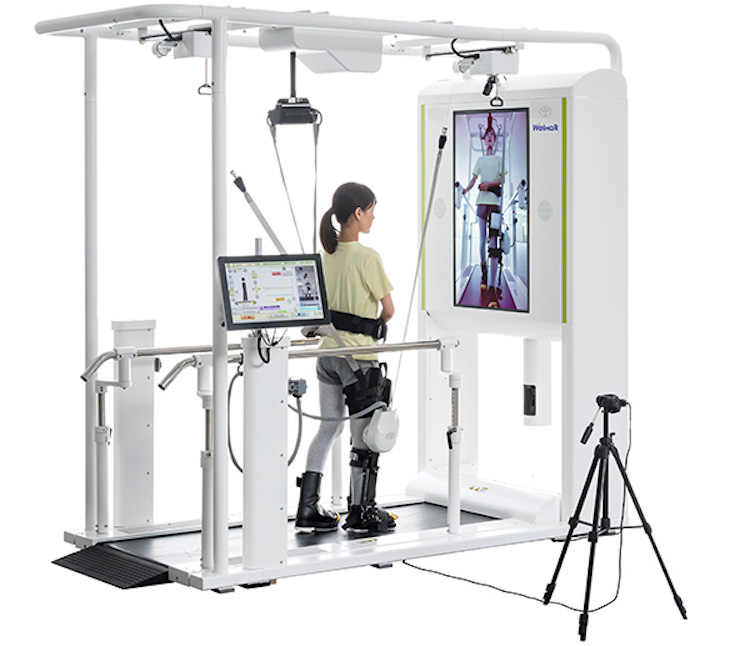
Toyota launches new version of walking rehabilitation robot

Toyota has launch the new version of its Welwalk WW-2000, a robot designed to provide rehabilitation support to individuals with lower limb paralysis as a result of stroke and other causes.
Orders for the new model commenced in November 2019 and planned to be delivered in February 2020.
The Welwalk WW-2000 upgrades the various features of the prior model (the Welwalk WW-1000), namely the rehabilitation support functions based on motor learning theory and the ease of use in clinical settings.
Specifically, it adds functions that display assistance settings in real time to improve abnormal gait as well as a game function that helps maintain motivation so patients continue their rehabilitation efforts.
The adoption of these new functions reduces burdens on therapists compared to the previous model while providing more efficient walking training to patients.
The prior model was provided on a rental basis to medical institution, but in light of requests from healthcare institutions and market assessments, the Welwalk WW-2000 will be made available for purchase with the aim of improving overall quality of service.
In addition, production will be implemented at the Motomachi Plant, with a sales target of 50 units sold to medical institutions annually.
In line with the vision of “freedom of mobility for all, and the joy of self-reliance”, Toyota has been developing rehabilitation assist robots in collaboration with Fujita Health University in Toyoake City, Aichi Prefecture since the end of 2007, with the robots used in pilot testing in healthcare settings and clinical research at medical institutions starting in 2011.
In 2017, rental of the Welwalk WW-1000, which was the first Toyota product to receive approval as a medical device, commenced.
The Welwalk WW-1000 received the 8th Robot Award in 2018, and to date, it has been used at approximately 80 medical institutions in Japan.
With the launch of the Welwalk WW-2000, Toyota hopes to bring the “joy of walking with one’s own feet” to even more patients while reducing burdens on therapists.
Prices being quoted by Toyota are $215,000 to purchase the hardware and then $450 a month in maintenance starting from the second year.

Thursday, April 13, 2017

Toyota Develops WelWalk Robotic Brace to Aid in Rehabilitation of Stroke Patients

Your doctor should be comparing this to all these:
the Esko exoskeleton
the Walk Again Project
the HULC exoskeleton system ready for soldier tests 
Is this better than Cyberdyne Hal from Japan?
Or maybe the Delta6 Accelerator from  G.I. Joe: The Rise of Cobra?

Toyota Develops WelWalk Robotic Brace to Aid in Rehabilitation of Stroke Patients

On Wednesday, Toyota launched a new robotic leg brace called the WelWalk WW-1000. The robotic exoframe is designed to help patients with partial paralysis walk again. The device is worn on the affected leg, with a large motor component at the knee joint that helps with functions such as supporting body weights and assisting with movements such as swinging the leg forward.
The WelWalk WW-1000 system will be made available to medical institutions in Japan later this year, with a rental model that charges a one-time fee of $9,000 and later $3,200 after that on a monthly basis. The WelWalk robotic leg brace could dramatically reduce recovery time for patients overcoming partial paralysis. The robotic exoframe has sensitivity levels that can be fine-tuned to a physiotherapist’s prescription.
WelWalk Robotic Leg Brace
Toyota has been working on robotics for decades now. Its R&D wing Toyota Research Institute is dedicated to creating technology that increases independence and improves the quality of life for an aging population. Last year, Hyundai showed off a slew of personal support robotic wearables that can supplement the mobility of the wearer. An increasing number of automakers are turning their attention towards overall mobility, i.e. beyond the everyday means of transportation.
In 2016, Honda unveiled ASIMO, a helper robot for the fast-aging population. The humanoid robot can perform tasks without the need for a human controlling its movements. In addition, it also created the Stride Management Assist device, which helps the elderly increase their stride as they walk, which eventually and helps them walk.
Japan’s aging population is large and continues to grow at a fast pace. Around 26 percent of its population is 65 or older compared to the global average of 8.5 percent. This calls for much-needed advancements in automated services industry to help in mobility and care for the aging population.
The field of robotic aids for rehabilitation is growing at a faster rate. Israeli manufacturer ReWalk Robotic created a battery-powered wearable exoskeleton to enable disabled people to stand upright and walk.
Toshiyuki Isobe, Toyota's chief officer for research, said WelWalk WW-1000 reflects the company's desire to apply robotics to increase independence. The company has also developed an R2-D2-like machine, called the Human Support Robot, whose mechanical arm can help bed-ridden people pick things up.
"Our vision is about trying to deliver mobility for everybody," said Isobe. "We have been developing industrial robotics for auto manufacturing, and we are trying to figure out how we can use that technology to fill social needs and help people more."
Author
Follow Anna Domanska on Twitter, Facebook & Google.

Saturday, June 29, 2013

Toyota Unveils Quartet of Healthcare Robots; Coming to a Hospital Near You Around 2013

I like the Walk Training Assist one.
http://www.medgadget.com/2011/11/toyota-unveils-quartet-of-healthcare-robots-coming-to-a-hospital-near-you-around-2013.html
First is the Walk Training Assist robot, which helps patients walk by using sensors to detect the intention to make a walking movement, and subsequently helping in swinging the knee forward.

Others at link with video.
Independent Walk Assist
Balance Training Assist
Patient Transfer Assist
8jaqenxu Toyota Unveils Quartet of Healthcare Robots; Coming to a Hospital Near You Around 2013

Toyota’s Human Support Robot to Help Patients Stuck in Bed at Home

It seems like it might be useful for survivors trying to live on their own at home. But thats not medical advice.
http://www.medgadget.com/2012/09/toyotas-human-support-robot-to-help-patients-stuck-in-bed-at-home.html
An interesting part of the robot is the interface, which works either through voice commands or by the user controlling it through a tablet.  Toyota is still quiet on the full feature set of the new robot, which is probably an early development version of a future device. Nevertheless, though it might still look too big and clunky, it can perform the most important job for a patient stuck in bed at home, which of course is to bring over the TV remote.

image from link
Toyota Human Support Robot 2 Toyotas Human Support Robot to Help Patients Stuck in Bed at Home