Your competent? doctor better be very familiar with this.
- creatine
(15 posts to February 2015)
The earliest one from 2015 is:
Not knowing of this is PURE INCOMPETENCE!
Is Creatine Supplementation for Brain Health Worth a Try?
 Jump to Key Points
Creatine supplements have been recently examined for their potential to improve brain health and prevent dementia. Given the lack of effective therapies for dementia, it is worth considering whether these supplements are safe and effective.
What Role Does Creatine Play in the Body?
Creatine is endogenously synthesized in the liver and kidneys, and its amino acid precursors are also provided by a variety of foods, including meat and vegetables. Most of the body’s creatine is stored in muscle cells as phosphocreatine; creatine serves to help replenish adenosine triphosphate during physical activity, which is why we have seen creatine supplements increasingly used in the setting of weight training and exercise over the past decade.
With the emerging understanding of its role in the brain, research on creatine supplementation has moved from the gym to the brain lab.
How Creatine May Affect Brain Health
Creatine is produced in the brain and retina through a process that involves the enzyme guanidinoacetate methyltransferase, which is highly expressed in glial cells. In addition to information on markers of creatine synthesis and activity, evidence is accumulating regarding the action of creatine in the brain.
- Creatine synthesized in liver/kidneys; brain/retina synthesis also occurs.
- Brain creatine transport defects (SLC6A8) cause severe neurologic dysfunction; no treatment.
- Small studies: supplementation ↑ brain creatine, but less than skeletal muscle.
- Healthy adults: possible short-term gains in mood, cognition, sleep; women may benefit more.
- Evidence for dementia/brain disorders remains limited; safety/dosing not fully established.
Interest in creatine for brain health grew out of the knowledge that creatine deficiency or dysfunction may adversely affect cognition. Defects in the creatine transporter (CRT) gene (SLC6A8) result in low brain creatine levels, along with severe neurologic symptoms, defined as CRT deficiency syndrome. The mechanism of neurologic dysfunction is still unclear, and currently there is no treatment for CRT deficiency syndrome.
The first step is to verify that creatine supplementation affects brain creatine levels. This is supported by a few small-scale human studies, but the increase is less than that seen in skeletal muscle.
Authors of a review noted that creatine supplementation may help improve mood, cognition, and sleep in healthy adults. The observed improvements were generally more notable among women than men, which the authors attributed to lower baseline endogenous creatine stores in women.
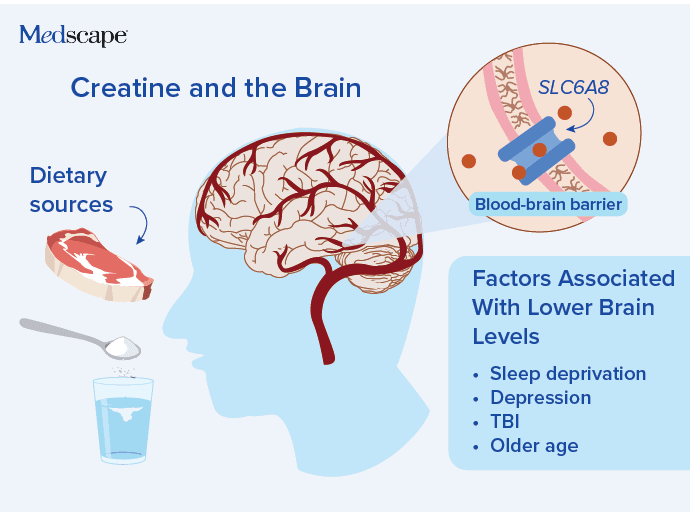
In a 2026 study in 29 sleep-deprived but otherwise healthy adults, 0.2 g/kg creatine monohydrate supplementation was associated with up to a 12% improvement of sleep deprivation-induced deterioration in cognitive skills. For a 150-lb adult, this dosage would be about 14 g of creatine per day.
Creatine Supplementation for Treating Brain Disorders
While experimental evidence suggesting that creatine supplementation may help healthy people does not automatically imply that extra creatine would be beneficial in the context of brain disease, there appears to be promise in the use of creatine supplements as an adjunctive treatment in some brain disorders.
According to a 2022 review in Nutrients, creatine supplementation may help reduce some symptoms of traumatic brain injury and concussion.
Creatine also has been explored as a possible treatment for Alzheimer’s disease symptoms or as a disease-modifying therapy. A single-arm pilot trial in 20 patients with Alzheimer’s disease found that 20 g/d creatine monohydrate for 8 weeks was associated with increased total brain creatine and modest improvements on cognitive tests.
Is There a Place for Creatine Supplementation for Healthy Adults?
The evidence is still not solid regarding potential benefits of creatine supplements for healthy individuals or for people who have dementia. And while creatine appears to be safe when used as a supplement for exercise and for building muscle, safety concerns have not been entirely ruled out. Furthermore, established dosing and dietary references are lacking.
Despite these shortcomings, it may be worthwhile for healthy adults or those with cognitive symptoms to try creatine supplements. So far, this supplement shows promise (albeit inconsistent) for short-term cognitive benefits, rather than a lasting impact on brain health. It is the short-lived nature of the effects that makes it worth trying. Many people use other supplements for brain health, like ginkgo biloba or ginseng, and can judge for themselves whether they see any benefits. The same principle applies to creatine – anyone taking it can assess if it improves their cognition or mood, without bearing the burden of deciphering whether a clinically undetectable effect is taking place.
Heidi Moawad, MD, is a neurologist and medical editor. She is on the teaching faculty at Case Western Reserve University. Dr Moawad resides in Cleveland, Ohio, and enjoys traveling, cooking, and taking exercise classes.


No comments:
Post a Comment