Really? You're that fucking late to the game?
I do coffee all day, takes that long to get in a 12 cup pot of coffee. This won't change my habit, it's mainly to reduce my dementia and Parkinsons risk and no one knows the amounts for that.
I'm still doing a 12 cup pot of coffee daily to prevent Parkinsons and frailty! Much more important than any problems it can cause.
How coffee protects against Parkinson’s Aug. 2014
Coffee May Lower Your Risk of Dementia Feb. 2013
Coffee drinkers rejoice! Drinking coffee could lower the risk of Alzheimer’s disease
And this: Coffee's Phenylindanes Fight Alzheimer's Plaque December 2018
New research suggests drinking coffee may reduce the risk of frailty May 2025
I think I'm in this category: I never get
the jitters or flushed skin.
Genetics determine how much coffee you can drink before it goes wrong
I'm doing a 12 cup pot of coffee a day with full fat milk to lessen my chances of dementia and Parkinsons. Tell me EXACTLY how much coffee to drink for that and I'll change. Yep, that is a lot more than the 400mg. suggested limit, I don't care! Preventing dementia and Parkinsons is vastly more important than whatever problems it can cause!
Of course, your fuckingly incompetent? doctor did nothing with this from 2+ years ago! And still hasn't created a 24 hour coffee station
This line is great: The findings indicate that even the Espresso Martini cocktail contains the espresso's beneficial compounds - and can contribute to staving off dementia.
The latest here:
AHA Finally Comes Out in Favor of Coffee
This transcript has been edited for clarity.
Welcome to Impact Factor, your weekly dose of commentary on a new medical study. I’m Dr F. Perry Wilson from the Yale School of Medicine.
If you walk into any hospital breakroom at 3 in the morning, you’re not going to find bowls of kale or treadmills. You’re going to find coffee. It is the raw fuel that keeps the medical system running. Perhaps all of modern civilization. So much of lifestyle medicine involves cutting back on enjoyable things — less carbs, less alcohol. But coffee, along with sex and sleep, is on my very short list of things that are both enjoyable and good for you.
- Moderate coffee intake (~3-5 cups/day) appears nonharmful; may be cardioprotective.
- Habitual coffee intake: BP neutral/↓; caffeine-naive users may have acute BP ↑.
- Unfiltered coffee raises LDL via cafestol; paper filtration/instant coffee ≈ no lipid effect.
- Coffee intake associated with ↓ type 2 DM, AF recurrence, stroke, HF, CAD risk.
- Energy drinks/high-dose caffeine: acute BP ↑; case reports of VF/sudden cardiac arrest.
Not everyone agrees of course, and cardiologists, for quite some time, were cautious about that most-consumed of all drugs: caffeine. They worried about its potential to promote arrhythmias and its effect on blood pressure with all the attendant downstream risks of stroke and heart attack. But the tide is clearly shifting.
Enter a massive new scientific statement from the American Heart Association (AHA), published in the journal Circulation, that comes out firmly, if not excessively, in favor of coffee. It’s a comprehensive look at Java’s effects on the cardiovascular system, synthesizing decades of occasionally conflicting research and reminding us that coffee is much more than a tasty caffeine-delivery mechanism.
Before we get to the actual clinical outcomes, we have to talk about how incredibly difficult it is to study this stuff. The statement’s authors rightly point out a glaring problem with the caffeine literature: Almost everything we know about caffeine in humans comes from observational studies of people drinking coffee and tea.
In case you haven’t been to a gas station convenience store lately, there are plenty of other ways to get caffeine into your system. The global coffee market is worth something like $200 billion. The global energy drink market is around half that but rising quickly.
Literature trying to examine the effects of caffeine — but using coffee as a proxy — introduces a lot of confounding. First, there is the classic healthy user effect. Moderate coffee drinkers (think 2-3 cups a day) might just have more organized, healthier lives in general compared to those who are slamming energy drinks, or conversely, those who strictly abstain because of underlying illness.
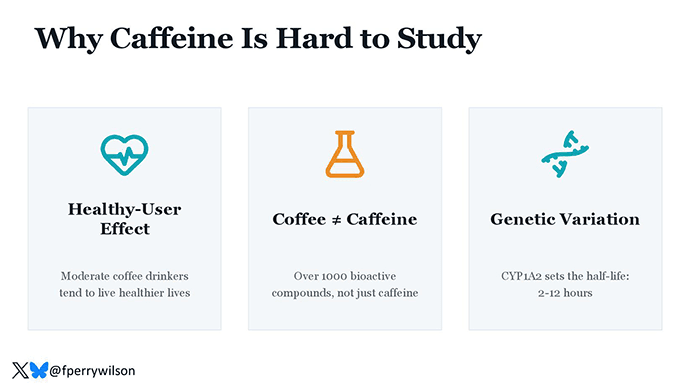
Second, coffee is not just liquid caffeine. It is a wildly complex chemical matrix containing more than 1000 biologically active compounds, including chlorogenic acids, diterpenes, melanoidins, and trigonelline. When an observational study says “coffee does X,” we are often left guessing whether it’s the caffeine acting directly as an adenosine receptor antagonist, or if it’s something else, say the polyphenols exerting an antioxidant effect on the gut microbiome.
And then there is the genetic lottery. Caffeine boasts nearly 100% oral bioavailability and peaks in the bloodstream within an hour, but how long it stays there is completely up to your DNA. Caffeine is almost entirely metabolized in the liver by the CYP1A2 enzyme. Thanks to specific genetic variants, the half-life of caffeine ranges from a rapid 2 hours to a sluggish 12 hours depending on who is drinking it. This means that population-level data on caffeine is always averaging out vastly different biological responses, making broad public health pronouncements incredibly tricky.
That being said, let’s dig into the hard numbers on cardiovascular risk factors, starting with the one that worries primary care docs the most: blood pressure.
If you take a caffeine-naive person and give them a dose, their blood pressure will predictably spike. That is not the case for habitual coffee drinkers. Actually, it’s sort of backwards, with increased coffee intake reducing blood pressure in that group.
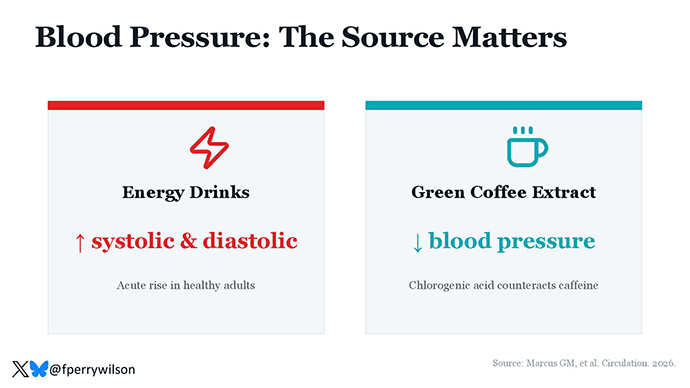
Note that I said “habitual coffee drinkers,” not “habitual caffeine-intakers.” The authors highlight that consuming energy drinks, which are packed with high concentrations of synthetic caffeine, results in significant, acute increases in both systolic and diastolic blood pressure among healthy adults. Meanwhile, green coffee bean extract has actually been shown to lower blood pressure, likely because the chlorogenic acid is counteracting the caffeine. So, the source matters.
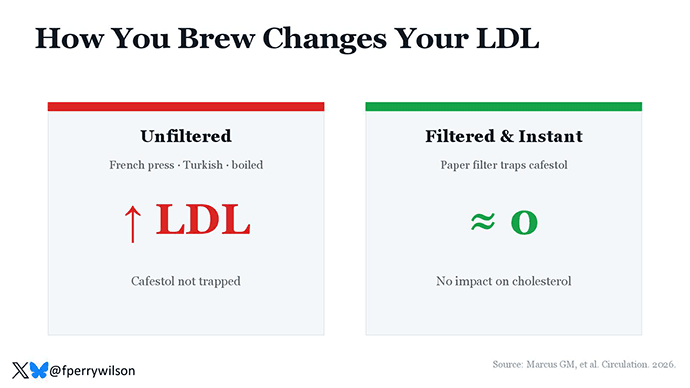
Speaking of the source, how you brew your morning cup can literally change your lipid panel. The statement highlights a weird physiological quirk: unfiltered coffee (think French press, Greek, Turkish, or Scandinavian boiled coffee) contains high levels of a cholesterol-raising diterpene called cafestol. In double-blind, placebo-controlled randomized trials, cafestol has been definitively proven to raise LDL cholesterol. But if you simply run that same coffee through a paper filter, the cafestol is trapped. Filtered coffee and instant coffee have essentially zero impact on your cholesterol. A relief, though I do love a nice French press.
Then we have the diabetes paradox. If you look at large prospective cohort studies, habitual coffee consumption is associated with a lower risk for type 2 diabetes. A review of 28 cohort studies found a dose-dependent relationship: People drinking 3.5 cups a day had a 20% lower risk, and those hitting 5 cups a day saw a 30% reduction in risk.
But in lab studies, drinking coffee impairs glucose tolerance, which should not protect against diabetes. The AHA authors suggest the long-term benefit is driven by the noncaffeine components of the bean: magnesium, chromium, chlorogenic acid, which may improve insulin sensitivity. Again, coffee is much more than caffeine.
The heart of the matter, so to speak, may be arrhythmias. For an entire generation, the reflex action for a patient presenting with palpitations or atrial fibrillation (AFib) was to tell them to immediately stop drinking coffee. It made sense. Caffeine is a stimulant, stimulants increase heart rate, ergo, stimulants cause arrhythmias.
But the data tell a completely different story. Observational meta-analyses consistently show that moderate coffee consumption is associated with either a neutral or lower risk for AFib. But we don’t even have to rely on observational data here. The statement highlights a landmark randomized trial in which patients with a history of AFib who were scheduled for elective cardioversion were randomized to either avoid caffeine entirely or consume at least one cup of caffeinated coffee daily. The result? The coffee group had a statistically significant 39% reduction in the risk for recurrent AFib. This is why the latest American College of Cardiology and AHA guidelines explicitly advise clinicians against telling patients to cut out caffeine to reduce AFib risk.
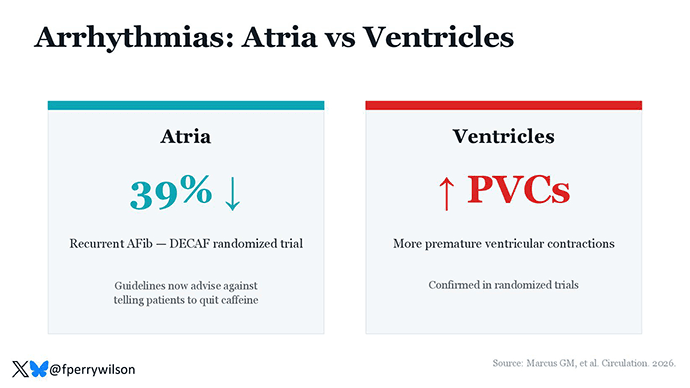
It’s not all lattes and mochaccinos in the arrhythmia world, though. While caffeine might soothe the atria, it seems to irritate the ventricles. Randomized trials confirm that even normal amounts of caffeinated coffee can significantly increase the frequency of premature ventricular contractions. So there you go, there’s no free lunch. Or free coffee.
When we step back and look at hard cardiovascular outcomes, the picture remains rosy for coffee drinkers. For coronary artery disease, consumption of up to six cups a day showed no increased risk, with the lowest risk clustering around those drinking 2-3 cups daily.
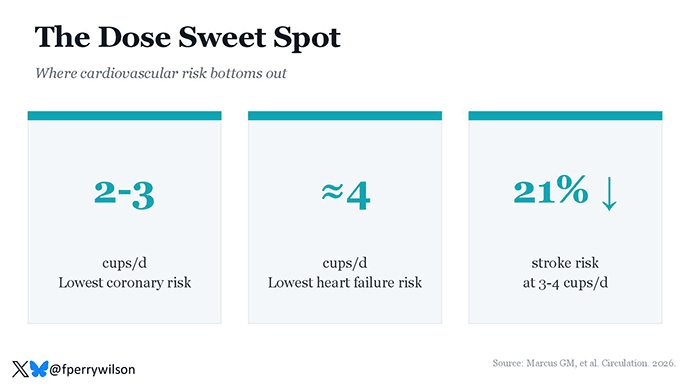
Heart failure follows a similar J-shaped curve. Across massive cohorts, the absolute lowest risk for incident heart failure was observed in individuals drinking exactly four cups of coffee a day. Stroke data echoes this as well, showing a U-shaped association where moderate consumption of 3-4 cups a day yields a highly significant 21% reduction in stroke risk.
But before we write a blanket prescription for unlimited caffeine, the AHA panel draws a very hard line at synthetic and high-dose consumption. The salutary effects we see with coffee and tea absolutely do not translate to the massive, concentrated doses found in energy drinks, pre-workout powders, or caffeine pills.
The medical literature has many case reports of young, otherwise healthy people suffering ventricular fibrillation and sudden cardiac arrest shortly after slamming highly concentrated energy drinks. In short, just go for the real stuff.
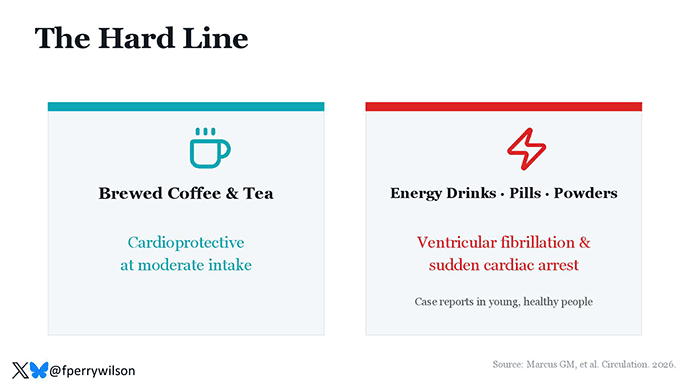
In the end, this AHA Scientific Statement forces us to embrace a bit of nuance. Moderate caffeine consumption, around three to five 8-ounce cups of brewed coffee, is not clearly harmful. In fact, it might be one of the very few behavioral interventions that is both highly enjoyable and genuinely cardioprotective.
It is rare in medicine that we get to look at our patients, review their daily habits, and tell them to carry on doing exactly what they love. So I think we should take the W here. Enjoy your morning cup of Joe. Maybe run it through a paper filter and, yeah, avoid the Red Bull.
F. Perry Wilson, MD, MSCE, is an associate @fperrywilsonprofessor of medicine and public health and director of Yale’s Clinical and Translational Research Accelerator. His science communication work can be found in the Huffington Post, on NPR, and here on Medscape. His book, How Medicine Works and When It Doesn’t, is available now.


No comments:
Post a Comment