Use the labels in the right column to find what you want. Or you can go thru them one by one, there are only 34,389 posts. Searching is done in the search box in upper left corner. I blog on anything to do with stroke. DO NOT DO ANYTHING SUGGESTED HERE AS I AM NOT MEDICALLY TRAINED, YOUR DOCTOR IS, LISTEN TO THEM. BUT I BET THEY DON'T KNOW HOW TO GET YOU 100% RECOVERED. I DON'T EITHER BUT HAVE PLENTY OF QUESTIONS FOR YOUR DOCTOR TO ANSWER.
Changing stroke rehab and research worldwide now.Time is Brain!trillions and trillions of neuronsthatDIEeach day because there areNOeffective hyperacute therapies besides tPA(only 12% effective). I have 523 posts on hyperacute therapy, enough for researchers to spend decades proving them out. These are my personal ideas and blog on stroke rehabilitation and stroke research. Do not attempt any of these without checking with your medical provider. Unless you join me in agitating, when you need these therapies they won't be there.
What this blog is for:
My blog is not to help survivors recover, it is to have the 10 million yearly stroke survivors light fires underneath their doctors, stroke hospitals and stroke researchers to get stroke solved. 100% recovery. The stroke medical world is completely failing at that goal, they don't even have it as a goal. Shortly after getting out of the hospital and getting NO information on the process or protocols of stroke rehabilitation and recovery I started searching on the internet and found that no other survivor received useful information. This is an attempt to cover all stroke rehabilitation information that should be readily available to survivors so they can talk with informed knowledge to their medical staff. It lays out what needs to be done to get stroke survivors closer to 100% recovery. It's quite disgusting that this information is not available from every stroke association and doctors group.
Tuesday, May 26, 2026
Time Matters: Southeast Georgia Health System Recognized For Excellence in Stroke Care
Anytime 'care' is mentioned with stroke; I THINK FUCKING FAILURE since if they were ANY GOOD AT ALL, they would proudly announce recovery statistics much better than these!
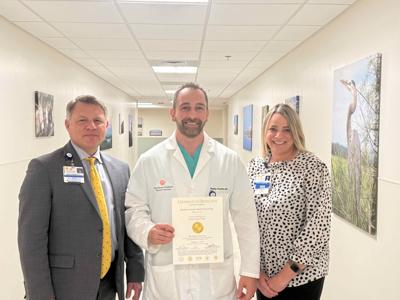
Paul Trumbull, PT, MBA, director
of Rehabilitation, Sports Medicine and Neurodiagnostics; Phillip P.
Amodeo, MD, a board-certified neurologist at Southeast Georgia Physician
Associates–Neurology; and Cynthia Gahm, RN, coordinator, Stroke
Program.
Southeast
Georgia Health System has once again demonstrated its commitment to
excellence in stroke care, earning the 2025 Certificate of Distinction
from The Joint Commission for Advanced Certification as a Primary Stroke
Center at its Brunswick Campus and as an Acute Stroke Ready Hospital at
its Camden Campus.
The
Joint Commission, an independent, not-for-profit organization that
accredits and certifies health care organizations across the United
States, awards these certifications to hospitals that meet rigorous
national standards in stroke care and patient safety.
“This
continued recognition from The Joint Commission reflects the unwavering
dedication of our physicians, nurses and interdisciplinary care teams,”
says Paul Trumbull, PT, MBA, director of Rehabilitation, Sports
Medicine and Neurodiagnostics. “Achieving advanced certification
requires strict adherence to evidence-based clinical guidelines, rapid
diagnosis and treatment protocols, and seamless coordination across
departments. Receiving this distinction again underscores our commitment
to delivering the highest level of stroke care to our community.”
Stroke
remains a leading cause of serious long-term disability and death in
the United States. According to the Centers for Disease Control and
Prevention, someone in the U.S. experiences a stroke every 40 seconds. A
stroke occurs when a clot or bleeding interrupts blood flow to the
brain, potentially causing permanent disability or death.
“That’s
why we say, ‘Time is brain,’” says Cynthia Gahm, RN, coordinator for
Southeast Georgia Health System’s Stroke Program. “Approximately two
million brain cells die every minute during a stroke. While treatments
can potentially stop or even reverse symptoms, those treatments are
extremely time sensitive.”
May
is National Stroke Awareness Month, serving as an important reminder
for community members to learn the warning signs of stroke and seek
immediate medical attention. According to the American Heart
Association, every 15 minutes that passes between the onset of an
ischemic stroke and administration of a clot-busting medication can
significantly impact a patient’s recovery and long-term function.
The
Health System’s Stroke Team encourages everyone to “BE FAST” and call
9-1-1 immediately if they or someone they know experiences any of the
following symptoms:
• Balance — Sudden loss of balance
• Eyes — Vision loss or difficulty seeing
• Face — Uneven smile or facial droop
• Arm — Weakness or numbness in one arm
• Speech — Slurred speech or confusion
• Time — Call 9-1-1 immediately and note when symptoms began
A sudden, severe headache with no known cause may also be a warning sign of stroke.
“Strokes
are medical emergencies,” Gahm adds. “Symptoms can worsen quickly, even
if they initially appear mild. Timely assessment and treatment are
critical to improving outcomes.”
To
earn the Certificate of Distinction, the Health System underwent a
comprehensive on-site review during which Joint Commission experts
evaluated compliance with national standards, stroke-specific
performance measures and program leadership. The certification process
helps ensure patients receive timely, coordinated care designed to
improve outcomes and reduce long-term disability.
Because
both hospitals are designated Remote Treatment Stroke Centers, local
first responders transport stroke patients there for emergency
treatment. The Stroke Programs have also received multiple American
Heart Association achievement awards recognizing their commitment to
providing care based on the latest research and evidence-based
guidelines.
“This
achievement truly represents a team effort,” adds Trumbull. “From EMS
partners and emergency department clinicians to neurologists, radiology
teams, rehabilitation specialists and support staff, every individual
plays a vital role in delivering rapid, lifesaving stroke care.”
For more information about the Southeast Georgia Health System Stroke Program, visitsghs.org/stroke.


No comments:
Post a Comment