Changing stroke rehab and research worldwide now.Time is Brain! trillions and trillions of neurons that DIE each day because there are NO effective hyperacute therapies besides tPA(only 12% effective). I have 523 posts on hyperacute therapy, enough for researchers to spend decades proving them out. These are my personal ideas and blog on stroke rehabilitation and stroke research. Do not attempt any of these without checking with your medical provider. Unless you join me in agitating, when you need these therapies they won't be there.

What this blog is for:

My blog is not to help survivors recover, it is to have the 10 million yearly stroke survivors light fires underneath their doctors, stroke hospitals and stroke researchers to get stroke solved. 100% recovery. The stroke medical world is completely failing at that goal, they don't even have it as a goal. Shortly after getting out of the hospital and getting NO information on the process or protocols of stroke rehabilitation and recovery I started searching on the internet and found that no other survivor received useful information. This is an attempt to cover all stroke rehabilitation information that should be readily available to survivors so they can talk with informed knowledge to their medical staff. It lays out what needs to be done to get stroke survivors closer to 100% recovery. It's quite disgusting that this information is not available from every stroke association and doctors group.

Thursday, September 30, 2021

Prognostic Value of Neutrophil-to-Lymphocyte Ratio in Stroke: A Systematic Review and Meta-Analysis

 What the fuck is the use of predicting poor outcome? I'd fire the lot of you.

Prognostic Value of Neutrophil-to-Lymphocyte Ratio in Stroke: A Systematic Review and Meta-Analysis

Wenxia Li1, Miaomiao Hou1, Zhibin Ding1, Xiaolei Liu1, Yuan Shao2 and Xinyi Li1,2*
  • 1Shanxi Academy of Medical Sciences, Shanxi Bethune Hospital, Tongji Shanxi Hospital, Third Hospital of Shanxi Medical University, Taiyuan, China
  • 2Shanxi Medical University, Taiyuan, China

Background: Stroke has become a major problem around the world, which is one of the main causes of long-term disability. Therefore, it is important to seek a biomarker to predict the prognosis of patients with stroke. This meta-analysis aims to clarify the relationship between the neutrophil-to-lymphocyte ratio (NLR) and the prognosis of stroke patients.

Methods: This study was pre-registered in PROSPERO (CRD42020186544). We performed systematic research in PubMed, Web of Science, and EMBASE databases for studies investigating the prognostic value of NLR. Based on the enrolled studies, patients were divided into the low-NLR cohort and the high-NLR cohort. Odds ratios (ORs) with 95% confidence intervals (CIs) were extracted and analyzed by the Review Manager 5.3 and Stata 12.0 software. Heterogeneity was estimated by using Cochran's Q test and I2 value. Sensitivity analyses and subgroup analyses were also performed to explore the potential sources of heterogeneity. Publication bias was assessed with funnel plots and assessed by Egger's tests.

Results: Forty-one studies with 27,124 patients were included. In the overall analysis, elevated NLR was associated with an increased mortality in acute ischemic stroke (AIS) patients (OR = 1.12, 95% CI = 1.07–1.16) and in acute hemorrhagic stroke (AHS) patients (OR = 1.23, 95% CI = 1.09–1.39), poorer outcomes in AIS patients (OR = 1.29, 95% CI = 1.16–1.44), and in AHS patients (OR = 1.11, 95% CI = 1.03–1.20). While in terms of hemorrhagic transformation (HT), elevated NLR was associated with an increased incidence of HT in AIS patients (OR = 1.15, 95% CI = 1.08–1.23).

Conclusions: This study demonstrated that elevated NLR was significantly associated with poor prognosis of stroke patients. High NLR is associated with a 1.1- to 1.3-fold increased risk of poor outcomes of AIS/AHS patients. NLR could be helpful as a potential prognostic biomarker to guide clinical decision making.

Systematic Review Registration: https://www.crd.york.ac.uk/prospero/display_record.php?ID=CRD42020186544.

Introduction

With almost 6 million deaths and more than 10% of all mortality every year, stroke has become one of the predominant threats to human health (1). There are two types of strokes, one is ischemic stroke, which accounts for 85% of all acute stroke, and the other is hemorrhagic stroke. According to previous reports, about 40% of all stroke deaths are attributable to hemorrhagic stroke (2). Currently, the major treatment for acute ischemic stroke is reperfusion therapy, which includes intravenous tissue plasminogen activator and endovascular therapy (EVT) (3). Exploring the key factors that affect the prognosis of stroke patients is crucial for clinicians to design appropriate treatments to improve the clinical efficacy and prognosis to stroke patients.

As we all know, there are two important pathophysiological mechanisms of stroke including oxidative stress and inflammation. After stroke, the inflammatory response is activated and plays a significant role in secondary brain injury (4). In recent years, the immunity has emerged as a new breakthrough target in the treatment strategy for acute stroke. Meanwhile, it is non-displaceable in predicting a poor prognosis (5). However, it is a complex process that can induce the activation and immunosuppression of a variety of inflammatory cells. Previous studies have found the different roles of neutrophils and lymphocytes in the progression and prognosis after stroke. Neutrophils could re-infiltrate the ischemic site in the first few hours after stroke, and then release chemical mediators related to increased tissue damage and poor neurological prognosis (6). At the same time, stroke could trigger a special immunosuppressive state (4), such as the activation of neutrophils, which leads to a decrease in lymphocytes (7), and certain types of lymphocytes are considered to be important brain protective immune regulators; the decrease of these lymphocytes may lead to deterioration of nerve function (8). Recently, the neutrophil-to-lymphocyte ratio (NLR) has become a powerful predictor of death in patients with cardiovascular disease or peripheral arterial occlusive disease. Previous studies reported a correlation between stroke severity and NLR determined at admission. Several studies suggested that the initial NLR was associated with mortality and infarct size in ischemic stroke patients.

However, the value of NLR in predicting the poor prognosis of stroke patients is still controversial. Some studies showed that NLR had no obvious effect on mortality (9, 10), while some studies demonstrated that a high NLR was an independent predictor of poor clinical outcomes in patients with stroke (11, 12). Thus, the aim of this study was to perform a meta-analysis to clear the relationship between NLR and the prognosis in patients with stroke.

More at link.


Ultra-Short Duration Hypothermia Prevents Intracranial Pressure Elevation Following Ischaemic Stroke in Rats

Will your stroke doctors and hospital be competent enough to get research going in humans that definitely answers the question? Previous hypothermia research showed no definitive evidence in clinical studies.


Ultra-Short Duration Hypothermia Prevents Intracranial Pressure Elevation Following Ischaemic Stroke in Rats

Daniel Omileke1,2, Debbie Pepperall1,2, Steven W. Bothwell1,2, Nikolce Mackovski1,2, Sara Azarpeykan1,2, Daniel J. Beard1,2, Kirsten Coupland1,2, Adjanie Patabendige1,2 and Neil J. Spratt1,2,3*
  • 1The School of Biomedical Sciences and Pharmacy, University of Newcastle, Callaghan, NSW, Australia
  • 2Hunter Medical Research Institute, New Lambton, NSW, Australia
  • 3Department of Neurology, John Hunter Hospital, Hunter New England Local Health District, New Lambton, NSW, Australia

There is a transient increase in intracranial pressure (ICP) 18–24 h after ischaemic stroke in rats, which is prevented by short-duration hypothermia using rapid cooling methods. Clinical trials of long-duration hypothermia have been limited by feasibility and associated complications, which may be avoided by short-duration cooling. Animal studies have cooled faster than is achievable in patients. We aimed to determine whether gradual cooling at a rate of 2°C/h to 33°C or 1°C/h to 34.5°C, with a 30 min duration at target temperatures, prevented ICP elevation and reduced infarct volume in rats. Transient middle cerebral artery occlusion was performed, followed by gradual cooling to target temperature. Hypothermia to 33°C prevented significant ICP elevation (hypothermia ΔICP = 1.56 ± 2.26 mmHg vs normothermia ΔICP = 8.93 ± 4.82 mmHg; p = 0.02) and reduced infarct volume (hypothermia = 46.4 ± 12.3 mm3 vs normothermia = 85.0 ± 17.5 mm3; p = 0.01). Hypothermia to 34.5°C did not significantly prevent ICP elevation or reduce infarct volume. We showed that gradual cooling to 33°C, at cooling rates achievable in patients, had the same ICP preventative effect as traditional rapid cooling methods. This suggests that this paradigm could be translated to prevent delayed ICP rise in stroke patients.

Introduction

Stroke is the second leading cause of death worldwide and the number one cause of permanent disability in adults (1, 2). A good collateral flow network is associated with better neurological outcome after stroke (3, 4). The collateral circulation provides residual perfusion to the “at-risk” penumbral tissue and slows down the progression of the infarct core.

Dramatic elevations in intracranial pressure (ICP) occur after experimental ischaemic stroke in animals - in young and aged rats, as well as rats of different strains (57). Our preliminary data indicates a significant ICP rise also occurs in stroke patients at 24 h (8). This ICP rise is a potential mechanism for collateral failure associated with delayed infarct expansion, worsening stroke outcome in patients (9, 10). We have previously shown that an increase in ICP causes a dramatic decrease in collateral blood flow and may therefore be responsible for collateral failure (9). Experimental studies have shown that ICP elevation occurs even after small strokes (5, 6, 11, 12) which may explain why it has gone unnoticed in patients with minor stroke, as ICP is normally only measured in large hemispheric stroke, due to the invasive nature of the procedure (13). Short-duration therapeutic hypothermia is a potent, easily implemented strategy that we have recently shown to have robust efficacy in preventing ICP elevation 24 h after stroke in rats (5–7). Multiple previous studies have shown that hypothermia also reduces infarct volume and improves functional outcome after experimental stroke (14), although at the time of these studies the effect on ICP was unknown, and the presumed mechanism of neuroprotection was by modification of a wide range of cell death mechanisms (14, 15). The effects of hypothermia on ICP elevation therefore suggests that direct effects on tissue perfusion via collateral vessels may be an important mechanism of hypothermic cytoprotection. Several early-phase clinical stroke trials using hypothermia as a treatment measure have shown feasibility. However, there is a significant mismatch in cooling duration used in clinical studies, from that shown to be effective in many experimental studies (16). Clinical trials of hypothermia have an average cooling duration of 24 h, with many maintaining hypothermia for up to 72 h (15). In contrast, the vast majority of experimental studies have cooled for 1–6 h (14). Additionally, rodent studies typically achieve target temperature within 10–20 min (14), a rate that cannot be achieved when cooling a human. The necessity of long-duration hypothermia to achieve therapeutic outcome in stroke is questionable. Current protocols resulted from very early clinical studies in patients with extremely large, “malignant” middle cerebral artery (MCA) infarcts, in whom rebound ICP elevation during rewarming was extremely problematic, and on occasion fatal (17). However, these durations are logistically extremely challenging, and increase the risk of complications such as pneumonia (18). Moreover, our experimental data suggests short-duration cooling may prevent rebound ICP elevation, thus obviating the need for very prolonged rewarming. The mismatch between protocols shown to be effective in experimental studies, and those tested in clinical trials, needs to be addressed if there is any hope of translating therapeutic hypothermia for stroke treatment.

We hypothesized that a clinically achievable gradual cooling protocol may require even less time at target temperature than current methods to prevent ICP elevation post-stroke. A milder target temperature for a short duration is easier to achieve and would potentially increase feasibility. We previously showed that hypothermia to 35°C did not lead to a significant increase in ICP 24 h after stroke. However, a slight ICP rise was seen, suggesting that 35°C may be close to the threshold for hypothermia ICP rise prevention (6).

We aimed to determine the benefits of ultra-short duration hypothermia at target temperature on both ICP elevation and infarct volume reduction post-stroke. For this, two hypothermia target temperatures (33 and 34.5°C) were investigated to identify the most feasible hypothermia regimen that still effectively prevented ICP elevation. The “ultra-short” duration refers to the 30 min at target temperatures, which is far shorter than previous studies of short duration cooling (14). We chose 34.5°C, slightly lower than the mildest effective target of 35°C from our previous work, to allow for our use of a gradual paradigm with less time at target temperature than in the previous study. ICP was measured epidurally using a fiber-optic catheter system. Epidural measurements were preferred in this study due to the increased risk of brain damage associated with other methods of ICP monitoring (19). Any damage to the brain has the potential to alter ICP, and therefore influence the primary outcome of this study. Moreover, previous studies have found that epidural ICP recordings correlate well with intraventricular recordings (20, 21), which are the “gold standard” of ICP measurements in humans (19). Additionally, the use of a fiber-optic probe provides high fidelity ICP signals when inserted and sealed in the epidural space (19, 22).

More at link


End-of-Life Care Decision-Making in Stroke

You'll want to make sure your loved never hears the DNR, the nocebo effect might occur and your loved one completes the “self-fulfilling prophecy” by dying. You'll have to ask what is the objective reason the patient is expected to die. See how badly your stroke doctors know nothing factual about stroke:

All guesswork like this:

Mercury astronaut Scott Carpenter suffers stroke; full recovery expected

Oops! 

 Scott Carpenter - Obituary

End-of-Life Care Decision-Making in Stroke

  • 1Yale School of Medicine, New Haven, CT, United States
  • 2Division of Neurocritical Care and Emergency Neurology, Yale School of Medicine, New Haven, CT, United States

Stroke is one of the leading causes of death and long-term disability in the United States. Though advances in interventions have improved patient survival after stroke, prognostication of long-term functional outcomes remains challenging, thereby complicating discussions of treatment goals. Stroke patients who require intensive care unit care often do not have the capacity themselves to participate in decision making processes, a fact that further complicates potential end-of-life care discussions after the immediate post-stroke period. Establishing clear, consistent communication with surrogates through shared decision-making represents best practice, as these surrogates face decisions regarding artificial nutrition, tracheostomy, code status changes, and withdrawal or withholding of life-sustaining therapies. Throughout decision-making, clinicians must be aware of a myriad of factors affecting both provider recommendations and surrogate concerns, such as cognitive biases. While decision aids have the potential to better frame these conversations within intensive care units, aids specific to goals-of-care decisions for stroke patients are currently lacking. This mini review highlights the difficulties in decision-making for critically ill ischemic stroke and intracerebral hemorrhage patients, beginning with limitations in current validated clinical scales and clinician subjectivity in prognostication. We outline processes for identifying patient preferences when possible and make recommendations for collaborating closely with surrogate decision-makers on end-of-life care decisions.

Introduction: Epidemiology of Life-Sustaining Therapy for Severe Stroke Patients

Stroke is a leading cause of death and long-term disability in the United States (US) (1, 2). The term “stroke” for this review focuses on two subtypes: acute ischemic stroke (AIS) and intracerebral hemorrhage (ICH). Clinicians are often confronted with issues related to end-of-life (EOL) care for stroke patients, such as code status, dysphagia care, and airway management (3). In order to tailor these decisions to patients' wishes, goals-of-care (GOC) discussions regarding acceptable quality of life (QoL) that require collaboration with surrogate decision-makers of incapacitated patients are needed.

Code status changes are among the earliest decisions that may occur during hospitalization for severe stroke. In practice, do-not-resuscitate (DNR) orders are often placed as early as within 24 hours of emergency department admission for both ICH (4) and AIS (5) patients. Approximately 13–26% of stroke patients receive DNR orders within 24 hours of admission (4, 5), with higher proportions of DNR status among those who later die of stroke (6, 7). There is concern that the act of making a patient DNR by itself affects clinicians' impressions of prognosis and independently increases the likelihood of mortality in AIS (5) and ICH (8, 9). This possible “self-fulfilling prophecy” is a well-established concern in stroke care (10).

In the days to weeks after admission, issues of nutrition and airway management often come to the forefront of decision-making. Percutaneous endoscopic gastrostomy (PEG) placement is currently performed throughout the US in 8.8% of patients with AIS (11) and 10.4% for ICH (12), with variation amongst institutions (11, 12). Over half of PEG placements for AIS occur in the first week of admission (13). For stroke patients who have difficulty maintaining an open airway or who require prolonged mechanical ventilation, tracheostomy in the US is commonly performed 6–14 days after stroke onset (14, 15), with increasing numbers over the past two decades (14). Rates of life-sustaining interventions are higher in minority patients than white patients (16), including PEG (17, 18) and tracheostomy (18).

In conjunction with these decisions, surrogates and clinical teams often decide to forgo life-sustaining measures and instead pursue comfort measures only (CMO). Withdrawal of life-sustaining therapy (WLST) is more common in neuro-intensive care units (Neuro-ICUs) than medical intensive care units (MICUs) (19), with up to 26% of all ICH patients in one single-center series undergoing WLST (20). Almost half of all stroke deaths occur inpatient (21), and hospitalized stroke patients have extensive palliative care needs (22, 23) that may not always be met. In one single-center US study from 2009-2015, about 4% of AIS patients were discharged to hospice (22).

In this brief review, we discuss the issues that arise when making EOL care decisions regarding stroke patients. We discuss prognostication tools, their limitations, methods to determine an incapacitated patient's wishes including advance care planning documentation (ACP) and best practices for shared decision-making with surrogates.

Prognostication: Limitations of Clinical Scales

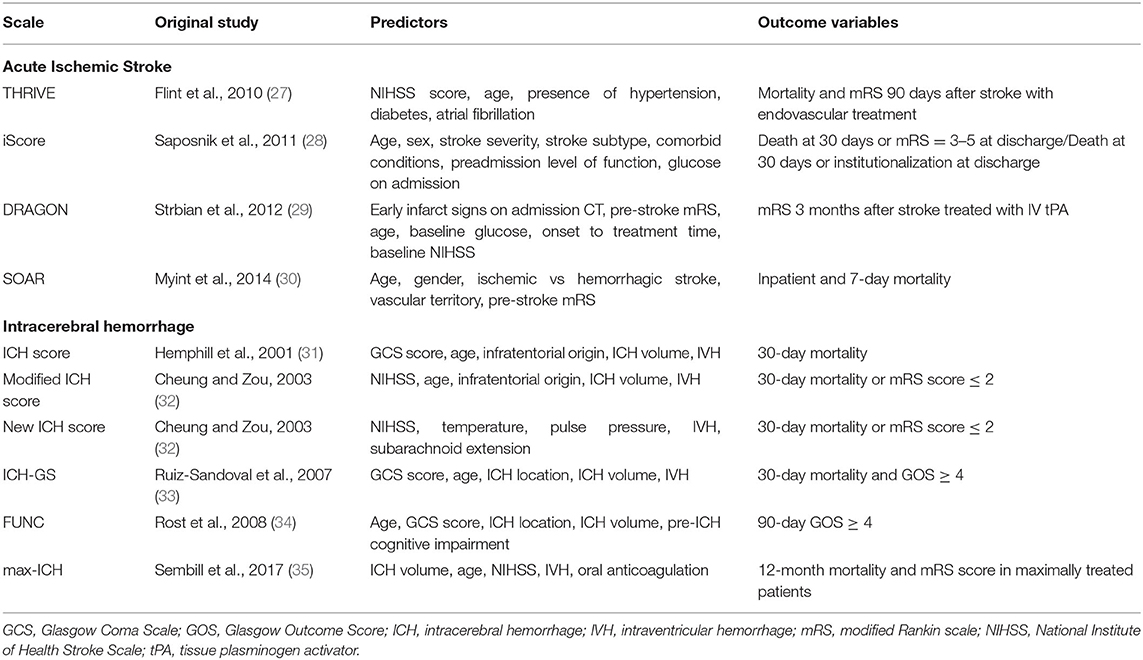
One factor in EOL decision-making involves prognostication of long-term outcome or natural disease history. Multiple clinical scales have been developed to predict mortality and functional outcome after stroke (2426), several of which have been externally validated (Table 1).

TABLE 1
www.frontiersin.org

Table 1. Selected clinical scales developed for acute ischemic stroke and intracerebral hemorrhage.

Common predictor variables in AIS scales include age, stroke severity, pre-stroke functional status, comorbidities, and stroke subtype (24), with some scales utilizing imaging characteristics (36).

For ICH, many prognostication scales are based on variations of the “original” ICH score (33, 3740), which was initially published with 30-day mortality data utilizing age, Glasgow Coma Scale at admission, ICH location, ICH volume, and presence of intraventricular hemorrhage (31).

Some published data suggest that scales largely outperform the “subjective” opinion of clinicians at predicting mortality and functional disability (4143). However, these studies generally involved asking clinicians to prognosticate expected outcomes from hypothetical patient vignettes, which simplify and distill information that would otherwise be available in real-world clinical practice. In a comparison of the predictions of clinicians against common prognostication scales for 3-month functional status in real-world ICH patients, clinicians outperformed scales with regards to predictive accuracy (44).

This finding points towards the first of several limitations of prognostication scales—scales generate predictions using cohort data, yet prediction for individual patients may depend on variables not captured by scales. Furthermore, few models have been assessed for calibration (45) and robust external validation (25, 46), limiting their generalizability. Most scales were developed retrospectively, and data used to generate them include local practice patterns with regards to WLST, potentially incorporating the self-fulfilling prophesy. Finally, scales may not predict outcomes that are most important to patients and families, as the same functional outcome may lead to different perceptions of QoL for different patients. Clinicians have been shown to be poor at predicting a patient's future QoL, an inherently subjective quality, after stroke (4749).

Despite these limitations, disclosing the results of a prognostication scale for a patient to a clinician impacts that clinician's clinical impression (50). Awareness of the limitations of scales can help ensure that the clinician utilizes these tools to complement clinical judgment rather than replace it. Recent studies suggest that making predictions based on clinical data from hospital day 5 rather than at admission may improve prognostication accuracy (51). Given the lack of objective tools for accurate prognostication and the potential for clinician bias to factor into decision-making, delaying prognostication may lead to improved prediction accuracy and clinical outcomes.

Goals-of-Care Conversations: Determining Patients' Wishes

Besides accurate neuro-prognostication, the ideal timing of GOC discussions regarding acceptable QoL for hospitalized stroke patients requires several considerations. GOC discussions, once initiated, are often iterative (1). Prognostic information should be tailored by amount and timing to the preferences of patients and families (52).

The aim of GOC discussions should be to ascertain the patient's wishes, or best estimates thereof, in order to provide goal-concordant care. As a means to this end, ACPs and surrogate decision-makers represent two sources of information for clinicians.


EXPRESS: The coronal plane maximum diameter of deep intracerebral hemorrhage predicts functional outcome more accurately than hematoma volume

Completely and totally fucking useless for survivors. Survivors want you to reduce the hematoma volume. GET THERE! Predictions like this have no value for survivors.

EXPRESS: The coronal plane maximum diameter of deep intracerebral hemorrhage predicts functional outcome more accurately than hematoma volume


First Published September 27, 2021 Research Article Find in PubMed 

Background: 

Among prognostic imaging variables, the hematoma volume on admission CT has long been considered the strongest predictor of outcome and mortality in intracerebral hemorrhage (ICH).

Aims:  

To examine whether different features of hematoma shape are associated with functional outcome in deep ICH.

Methods: 

We analyzed 790 patients from the ATACH-2 trial, and 14 shape features were quantified. We calculated Spearman’s Rho to assess the correlation between shape features and 3-month modified Rankin scale (mRS) score, and the ROC-AUC to quantify the association between shape features and poor outcome defined as mRS>2 as well as mRS>3.

Results: 

Among 14 shape features, the maximum ICH diameter in the coronal plane was the strongest predictor of functional outcome, with a maximum coronal diameter >~3.5 cm indicating higher 3-month mRS scores. The maximum coronal diameter versus hematoma volume yielded a Rho of 0.40 vs 0.35 (p=0.006), an AUC[mRS>2] of 0.71 vs 0.68 (p=0.004), and an AUC[mRS>3] of 0.71 vs 0.69 (p=0.029). In multiple regression analysis adjusted for known outcome predictors, the maximum coronal diameter was independently associated with 3-month mRS (p<0.001).

Conclusions:  

A coronal-plane maximum diameter measurement offers greater prognostic value in deep ICH than hematoma volume. This simple shape metric may expedite assessment of admission head CTs, offer a potential biomarker for hematoma size eligibility criteria in clinical trials and may substitute volume in prognostic ICH scoring systems.

Prediction of Stroke Infarct Growth Rates by Baseline Perfusion Imaging

What the fuck good does predicting infarct volumes do for survivor recovery? Useless crapola with no solution provided to reduce these infarct volumes. Just maybe you want to  substantially reduce infarct size by stopping the 5 causes of the neuronal cascade of death in the first week saving billion of neurons for each person.

Prediction of Stroke Infarct Growth Rates by Baseline Perfusion Imaging

 
Originally publishedhttps://doi.org/10.1161/STROKEAHA.121.034444Stroke. ;0:STROKEAHA.121.034444

Background and Purpose:

Computed tomography perfusion imaging allows estimation of tissue status in patients with acute ischemic stroke. We aimed to improve prediction of the final infarct and individual infarct growth rates using a deep learning approach.

Methods:

We trained a deep neural network to predict the final infarct volume in patients with acute stroke presenting with large vessel occlusions based on the native computed tomography perfusion images, time to reperfusion and reperfusion status in a derivation cohort (MR CLEAN trial [Multicenter Randomized Clinical Trial of Endovascular Treatment for Acute Ischemic Stroke in the Netherlands]). The model was internally validated in a 5-fold cross-validation and externally in an independent dataset (CRISP study [CT Perfusion to Predict Response to Recanalization in Ischemic Stroke Project]). We calculated the mean absolute difference between the predictions of the deep learning model and the final infarct volume versus the mean absolute difference between computed tomography perfusion imaging processing by RAPID software (iSchemaView, Menlo Park, CA) and the final infarct volume. Next, we determined infarct growth rates for every patient.

Results:

We included 127 patients from the MR CLEAN (derivation) and 101 patients of the CRISP study (validation). The deep learning model improved final infarct volume prediction compared with the RAPID software in both the derivation, mean absolute difference 34.5 versus 52.4 mL, and validation cohort, 41.2 versus 52.4 mL (P<0.01). We obtained individual infarct growth rates enabling the estimation of final infarct volume based on time and grade of reperfusion.

Conclusions:

We validated a deep learning-based method which improved final infarct volume estimations compared with classic computed tomography perfusion imaging processing. In addition, the deep learning model predicted individual infarct growth rates which could enable the introduction of tissue clocks during the management of acute stroke.

Proxy Measure of Insulin Resistance Predictive of Stroke

 If you have diabetes go directly to your doctor with this, get tested. And if found, DEMAND EXACT STROKE PROTOCOLS THAT PREVENT THIS UPCOMING STROKE.

Proxy Measure of Insulin Resistance Predictive of Stroke


Study found relationship between estimated glucose disposal rate and first-time stroke(Why just first time stroke?)

Insulin resistance in people with type 2 diabetes was predictive of stroke, according to a Swedish nationwide cohort study.

Patients with type 2 diabetes with less insulin resistance as measured by estimated glucose disposal rate (eGDR) saw a significantly lower risk for any kind of first-time stroke over a median 5.6 years of follow-up, reported Alexander Zabala, MD, of the Karolinska Institute in Stockholm.

This association also appeared to be graded, with the less insulin resistance a person had correlating with an even lower risk for stroke in a fully adjusted model, Zabala said in a presentation at the virtual European Association for the Study of Diabetes (EASD) meeting.

For the analysis, insulin resistance was quantified using eGDR, calculated using the variables of waist circumference, presence of hypertension, and HbA1c. Zabala explained, however, that there is another version of this formula for eGDR that swaps out waist circumference for body mass index. And while insulin resistance can also be measured with the hyperinsulinemic-euglycemic clamp method, this method is not suitable for large-scale clinical use due to the high cost and invasiveness, he said. In addition, using eGDR as a proxy for insulin resistance can also be used in a type 1 diabetic population.

Compared with patients who had an eGDR of less than 4 mg/kg/min -- considered the highest grade of insulin resistance -- patients falling into the three categories of less insulin resistance had 23%, 32%, and 40% lower risks for stroke, respectively:

  • eGDR 4-5.99 (HR 0.77, 95% CI 0.69-0.87)
  • eGDR 6-7.99 (HR 0.68, 95% CI 0.58-0.80)
  • eGDR 8+ (HR 0.60, 95% CI 0.48-0.76)

Some factors in the eGDR equation held a higher estimated relative risk for stroke, Zabala reported. Specifically, the presence of hypertension was the factor underlying insulin resistance that most strongly predisposed someone to a stroke. Following that, HbA1c was the second most important clinical factor in this equation, succeeded by waist circumference.

The benefit of less insulin resistance didn't stop at just stroke risk, he noted. The same patterns were also seen with all-cause mortality, with less insulin resistance associated with a significantly lower risk for death:

  • eGDR 4-5.99 (HR 0.83, 95% CI 0.76-0.89)
  • eGDR 6-7.99 (HR 0.77, 95% CI 0.69-0.77)
  • eGDR 8+ (HR 0.72, 95% CI 0.59-0.88)

Nearly an identical pattern was seen when looking only at the risk for cardiovascular-related mortality as well, Zabala said. Compared with type 2 diabetes patients with the highest amount of insulin resistance, those falling into the lesser three categories of insulin resistance saw an 18%, 25%, and 35% lower risk for cardiovascular death, respectively.

The analysis included 104,697 people with type 2 diabetes identified through Sweden's National Diabetes Register. These data were combined with the country's Cause of Death Register, an in-patient registry, along with the longitudinal integrated database for health insurance and labor market studies.

Among this cohort, average age was 63 and about 46% were women. During the median 5.6 years of follow-up, there were a total of 4,201 incidences of stroke, representing 4% of this patient population. This included stroke, ischemic stroke, and hemorrhagic stroke; subarachnoid hemorrhages were not included.

Zabala said the relationship between insulin resistance and stroke risk was largely driven by ischemic stroke, as the risk for hemorrhagic stroke alone was not statistically significant.

The majority of the cohort had a moderate amount of insulin resistance, he noted. Among the total patient population, 24,706 had the highest degree of insulin resistance (eGDR<4); while 40,187 had an eGDR of 4-6; 21,042 had an eGDR of 6-8; and 18,762 had an eGDR of about 8.

Zabala said that not surprisingly, patients with the greatest amount of insulin resistance tended to have a longer duration of diabetes, higher HbA1c levels, higher systolic blood pressure, and were more likely to be treated with a combination of insulin and oral glucose-lowering therapies.

Study limitations, he said, included that the researchers were not able to adjust for specific type of diabetes medications, such as SGLT2 inhibitors, GLP-1 receptor agonists, or DPP-4 inhibitors.

  • author['full_name']

    Kristen Monaco is a staff writer, focusing on endocrinology, psychiatry, and nephrology news. Based out of the New York City office, she’s worked at the company since 2015.

Disclosures

Zabala and co-authors reported no disclosures.

Study identifies protein important for motor coordination and exercise performance

 Well your doctor should have been doing something like this from May 2017 already to prevent your muscle atrophy.

'Exercise-in-a-pill' boosts athletic endurance by 70 percent May 2017 

Or this?

A replacement for exercise? January 2020 

For each day a patient is in hospital lying in bed with minimal activity approximately 13% of muscular strength is lost (Ellis, Jackson, Liu, Molloy, & Paterson, 2013). (Correcting this is your doctors' responsibility. Don't let her weasel out of that responsibility.)

The latest here:

Study identifies protein important for motor coordination and exercise performance

Karolinska Institutet News|September 29, 2021

Researchers at Karolinska Institutet in Sweden have identified a protein that improves muscular metabolism, motor coordination and exercise performance in mice. The findings, published in Cell Metabolism, could be of therapeutic value for patients with muscle and neurological diseases, such as ALS.

Muscle health is a major determinant of overall health and the best way to keep muscles healthy is to exercise regularly. However, for some patients with debilitating diseases, exercise is not always possible. For that reason, researchers are looking for molecules that can by themselves bring about some of the benefits of physical exercise.

In the current study, researchers at Karolinska Institutet wanted to know how a muscle-produced protein called neurturin affects neuromuscular function. Understanding what signals mediate motor neuron and muscle communication is essential for exploring new treatments for muscle-related and neurological diseases, such as amyotrophic lateral sclerosis (ALS).


“We wanted to know if muscles can talk back to motor neurons by sending their own messages, and to find out what are the consequences of those signals,” saysJorge Ruas, professor at theDepartment of Physiology and Pharmacology, Karolinska Institutet, and corresponding author.

The researchers found that mice that were genetically modified to produce more neurturin in muscle cells significantly improved their muscle metabolism, exercise performance and motor coordination compared to regular mice.

Changed motor neuron identity

The high neurturin mice also had an increased number of motor neurons of a type that is more resistant to degeneration in diseases like ALS.

“To find out that a molecule released from muscle fibres can actually change motor neuron identity, shifting them to a type that is associated with more resistance to degeneration opens really exciting possibilities for the future,” Jorge Ruas adds.

As a next step, the researchers are hoping to explore the therapeutic possibilities of neurturin in mouse models of type 2 diabetes, obesity and ALS. They are also working on modifying the administration of neurturin to allow it to be used as a potential drug.

Could be of therapeutic value

“There’s much to be done, but we believe this could be of therapeutic value for patients with metabolic and neuromuscular diseases, such as type 2 diabetes and ALS,” says the study’s first authorJorge Correia, researcher at the Department of Physiology and Pharmacology, Karolinska Institutet.

The researchers note there were some limitations to the study, including the use of genetic tools and viral vectors to increase the levels of neurturin, which isn’t directly applicable from a therapeutic standpoint.


This study was financed by the Swedish Research Council, the Novo Nordisk Foundation, the Swedish Diabetes Foundation, the Strategic Research Program (SRP) in Diabetes, and The Lars Hiertas Memorial Foundation. Sandra Kleiner, Michael Stec and Naveen Khan are employees and shareholders of Regeneron Pharmaceuticals, Inc. Jorge Lira Ruas is a consultant for Bayer AG. There are no other reported conflicts of interest.

To read more, click here


Wednesday, September 29, 2021

Dietary antioxidants and risk of Parkinson's disease in two population-based cohorts

With your risk of Parkinsons it is your hospital's responsibility to have the dietician create protocols on this. 

Parkinson’s Disease May Have Link to Stroke March 2017 

The latest here:

Dietary antioxidants and risk of Parkinson's disease in two population-based cohorts

First published: 07 September 2017
Citations: 51

The copyright line for this article was changed on 15 September 2017 after original online publication.

Funding agencies: : Suppported by the Swedish Research Council.

Relevant conflicts of interest/financial disclosures: : Nothing to report.

Full financial disclosures and author roles may be found in the online version of this article.

ABSTRACT

Background: A neuroprotective effect of dietary antioxidants on Parkinson's disease (PD) risk has been suggested, but epidemiological evidence is limited.

Objectives: To examine the associations between intake of dietary antioxidant vitamins and total antioxidant capacity and risk of PD.

Methods: We prospectively assessed the relationships of dietary antioxidant vitamins C and E, ß-carotene, and total antioxidant capacity with PD risk in two population-based cohorts (38,937 women and 45,837 men).

Results: During a mean 14.9-year follow-up period, 1,329 PD cases were identified. Dietary intake of ß-carotene was associated with a lower risk of PD (hazard ratio: 0.86; 95% confidence interval: 0.78-0.95; Ptrend < 0.01 for women and hazard ratio: 0.91; 95% confidence interval: 0.84-0.99; Ptrend = 0.05 for men). An inverse association between dietary vitamin E and PD risk was found in women (hazard ratio: 0.87; 95% confidence interval: 0.79-0.96; Ptrend = 0.02). Dietary intake of vitamin C was inversely associated with PD risk in women at borderline significance (hazard ratio: 0.91; 95% confidence interval: 0.83-1.00; Ptrend = 0.04). There was no association between dietary total antioxidant capacity and PD risk in either women (hazard ratio: 0.93; 95% confidence interval: 0.84-1.02; Ptrend = 0.35) or men (hazard ratio: 1.00; 95% confidence interval: 0.93-1.07; Ptrend = 0.97).

Conclusion: Intake of dietary vitamin E and ß-carotene was associated with a lower risk of PD. © 2017 The Authors. Movement Disorders published by Wiley Periodicals, Inc. on behalf of International Parkinson and Movement Disorder Society.

Dietary antioxidants including vitamin C, E, and carotenoids have been suggested as neuroprotective agents for Parkinson's disease (PD) based on their property of reducing oxidative damage.1 Epidemiological evidence for a neuroprotective effect of dietary antioxidants on PD risk is, however, largely limited and inconsistent.2, 3 In addition, although not only vitamin C, E, and carotenes, but also several other compounds are dietary antioxidants, no previous study has yet examined the role of total dietary antioxidants on PD risk.

In this study, we estimated total antioxidant capacity (TAC) in a single estimate by taking into account summed effects of compounds from all relevant dietary antioxidants in the foods. We prospectively investigated the relationship of TAC, as well as the individual dietary antioxidant vitamins C and E and ß-carotene, with PD risk in two population-based cohorts.


Coffee can treat this debilitating condition, research shows -depression


More chances for your stroke hospital to prove they aren't completely incompetent by creating a 24 hour coffee station! You need to fire your board of directors, they don't know how to run a stroke hospital that should follow and implement research. I'm also doing it to prevent Parkinsons, does your doctor even know about that?

It is your stroke hospital's fault that you are depressed, they have NO 100% STROKE RECOVERY PROTOCOLS!

Coffee can treat this debilitating condition, research shows - depression

, MD, MS|September 29, 2021

Coffee is more popular than ever, according to a March 2020 survey conducted by the National Coffee Association. Seven in 10 Americans drink coffee every week, 62% drink it every day, and the average American coffee drinker consumes a bit more than 3 cups a day.

Depressed woman looking out at rain through window

Evidence shows that one of America's most popular drinks may enhance mood.

Americans sure love their joe. And, java may love its drinkers back. Recent research indicates that regular coffee consumption could ease depression. Here’s a look at the evidence.

Evidence of benefit

In a review published by Alan Leviton, a professor of Neurology at Harvard Medical School, the following two studies quantify the mood benefits of coffee:


In meta-analyses including more than 300,000 participants—with 8,000 exhibiting depression—researchers discovered that people who drank more coffee were at a decreased risk for depression compared with those who drank less or no coffee. The peak benefit occurred in those who drank about 400 mL per day, or 13 ounces. 

In a Korean study involving nearly 10,000 adults, also included in the review, researchers found that those drinking more than 2 cups a day exhibited a 32% lower prevalence of self-reported depression compared with those who did not drink coffee.

Results from a study published in Nutrients further support the antidepressant effects of coffee. In the study, Spanish researchers examined the relationship between coffee intake and the risk of depression in 14,413 university graduates, while controlling for adherence to the Mediterranean diet. Researchers used a food-frequency questionnaire to assess coffee intake.

The investigators found that those who drank at least 4 cups of joe a day were at significantly lower risk of depression compared with those who drank fewer than 1 cup a day. Of note, researchers observed no overall inverse linear dose-response association between coffee consumption and depression incidence.

The researchers noted that previous studies supported their findings involving extremes in coffee consumption. Furthermore, they found that decaffeinated coffee did not decrease the risk of depression.

Possible mechanisms

In the aforementioned Spanish study, researchers suggested two possible reasons why coffee could curb rates of depression.

“First, coffee is the main dietary source of caffeine. Caffeine is an alkaloid exerting a stimulant effect on the central nervous system and modulating the dopaminergic activity by nonspecific antagonism against A1/A2 adenosine receptors. A moderate amount of caffeine has a beneficial effect, improving psychomotor activity, vigilance level, and increasing the perception of feeling more energetic,” the authors wrote.


“Second, coffee has a high concentration of polyphenols, such as chlorogenic acid and trigonelline, which have anti-inflammatory potential. Thus, coffee consumption could protect against low-grade inflammation, which seems to be involved in the pathogenesis of depression. In fact, coffee is the main dietary source of polyphenols in some populations such as the US or Northern Europe, where the other prospective studies on coffee and depression had been conducted,” they added.

In his review, the Harvard researcher Alan Leviton mentions other possible mechanisms. First, polyphenol flavonoids found in brewed coffee are a rich source of antioxidants, and antioxidant intake has been linked to lower levels of depression in women. 

Leviton also explained that components of brewed coffee could influence the gut microbiome, fighting depression.

“Psychobiotics offer the promise of diminishing depressive symptoms, thereby justifying the claim that probiotics and prebiotics are capable of modulating depression and depressive mood. Support for this claim also comes from the observation that by metabolizing polyphenols (including those in brewed coffee), gut bacteria have the ability ‘to enhance the bioavailability of gut-derived, brain-penetrating, bioactive polyphenol metabolites that ultimately influence mechanisms associated with the promotion of resilience against psychological and cognitive impairment in response to stress,’” the author wrote. 

These metabolites that cross the blood-brain barrier include the neurotransmitters serotonin, norepinephrine, GABA, and dopamine, which are deficient in those who have depression.

Bottom line

While there appears to be evidence supporting the notion that coffee consumption could combat depression, it should be noted that there can be too much of a good thing. Specifically, the FDA recommends that healthy adults consume no more than 4 to 5 cups per day.

For more information regarding other health effects of coffee, click here.