Use the labels in the right column to find what you want. Or you can go thru them one by one, there are only 34,365 posts. Searching is done in the search box in upper left corner. I blog on anything to do with stroke. DO NOT DO ANYTHING SUGGESTED HERE AS I AM NOT MEDICALLY TRAINED, YOUR DOCTOR IS, LISTEN TO THEM. BUT I BET THEY DON'T KNOW HOW TO GET YOU 100% RECOVERED. I DON'T EITHER BUT HAVE PLENTY OF QUESTIONS FOR YOUR DOCTOR TO ANSWER.
Changing stroke rehab and research worldwide now.Time is Brain!trillions and trillions of neuronsthatDIEeach day because there areNOeffective hyperacute therapies besides tPA(only 12% effective). I have 523 posts on hyperacute therapy, enough for researchers to spend decades proving them out. These are my personal ideas and blog on stroke rehabilitation and stroke research. Do not attempt any of these without checking with your medical provider. Unless you join me in agitating, when you need these therapies they won't be there.
What this blog is for:
My blog is not to help survivors recover, it is to have the 10 million yearly stroke survivors light fires underneath their doctors, stroke hospitals and stroke researchers to get stroke solved. 100% recovery. The stroke medical world is completely failing at that goal, they don't even have it as a goal. Shortly after getting out of the hospital and getting NO information on the process or protocols of stroke rehabilitation and recovery I started searching on the internet and found that no other survivor received useful information. This is an attempt to cover all stroke rehabilitation information that should be readily available to survivors so they can talk with informed knowledge to their medical staff. It lays out what needs to be done to get stroke survivors closer to 100% recovery. It's quite disgusting that this information is not available from every stroke association and doctors group.
Tuesday, March 24, 2026
Lifelike 3D-Printed ‘Training Brains’ React Like Real Organs
With ANY BRAINS AT ALL in our stroke medical 'professionals' we could do research that tells us exactly what interventions work to stop the neuronal cascade of death in the first week! Putting the brain on a chip with brain organoids and this and we could solve a lot of stroke recovery questions. But nothing will occur; OUR 'PROFESSIONALS' ARE FUCKING INCOMPETENT!
Imagine what brain surgeons could do with a three-dimensional (3D)-printed model of the brain. Not a structural model printed in plastic and uniform throughout, but one that mirrors the heterogeneity of real human brain tissue — its mechanical, thermal, and electromagnetic properties.
Christopher O’ Bryan, PhD, MS
“If somebody has a brain tumor, you could take an MRI of their brain and make a 3D model from it that includes the tumor, and then practice surgery on that model,” said Christopher O’ Bryan, PhD, MS, assistant professor of mechanical and aerospace engineering at the University of Missouri (UM) in Columbia, Missouri. “You could learn how sound, electromagnetic waves, or physical insults interact with the brain to better understand concussions and traumatic brain injury.”
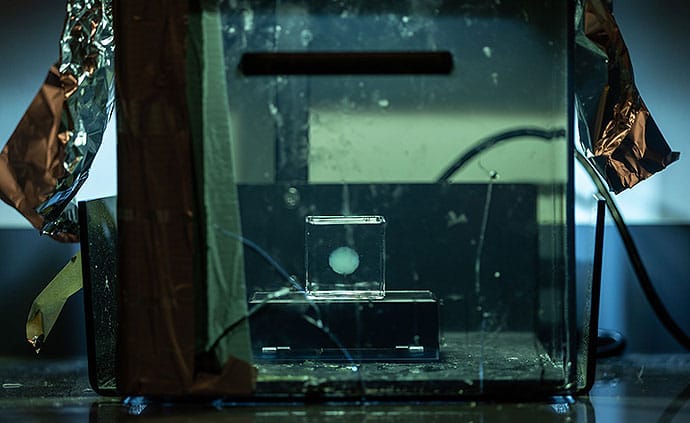
A scaled-down 3D model of the brain, about 15% of a real brain’s size.
O’Bryan and colleagues in UM’s College of Engineering recently published a study in the journal Materialia describing how the researchers designed a unique 3D printer ink made from a modified polymer — called a photo-crosslinkable poly(vinyl alcohol) methacrylate polymer — and then used it to print a scaled-down 3D model of the brain, about 15% of a real brain’s size. The scientists relied on a method called embedded 3D printing, crosslinking the polymer in a microgel bath, to achieve a model that mimicked the soft tissue and the structural complexities of a real human brain.
How They Did It
To provide a broader picture of why they conducted the study, O’Bryan described his lab’s goals. “The focus areas in our lab include the designing of soft materials, the testing of these materials, and then how to actually manufacture things out of these soft materials. And that’s especially challenging when you take into account that most soft materials are hydrogels and biopolymers which start out in a liquid phase ,” he said.
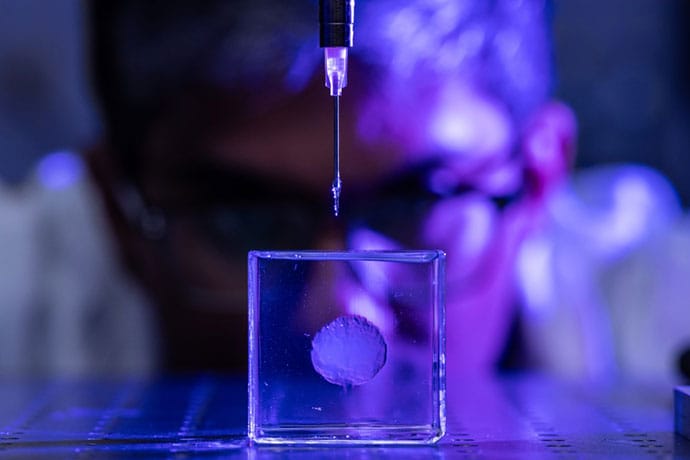
Researchers used embedded 3D printing, crosslinking the polymer with a gel bath to mimic brain tissue.
The researchers’ embedded 3D printing approach uses “sacrificial support baths,” jelly-like baths, which act as a supportive matrix during the printing phase. “What this allows us to do is to print materials as liquids and keep them as liquids until we’ve completely printed our structure, and then we crosslink the printed structure using heat or UV [ultraviolet] light to make it solid. Then we take it out of the gel bath, and it’s become a soft, deformable structure — meaning it can change shape when a force is applied,” O’Bryan said.



No comments:
Post a Comment