Use the labels in the right column to find what you want. Or you can go thru them one by one, there are only 34,178 posts. Searching is done in the search box in upper left corner. I blog on anything to do with stroke. DO NOT DO ANYTHING SUGGESTED HERE AS I AM NOT MEDICALLY TRAINED, YOUR DOCTOR IS, LISTEN TO THEM. BUT I BET THEY DON'T KNOW HOW TO GET YOU 100% RECOVERED. I DON'T EITHER BUT HAVE PLENTY OF QUESTIONS FOR YOUR DOCTOR TO ANSWER.
Changing stroke rehab and research worldwide now.Time is Brain!trillions and trillions of neuronsthatDIEeach day because there areNOeffective hyperacute therapies besides tPA(only 12% effective). I have 523 posts on hyperacute therapy, enough for researchers to spend decades proving them out. These are my personal ideas and blog on stroke rehabilitation and stroke research. Do not attempt any of these without checking with your medical provider. Unless you join me in agitating, when you need these therapies they won't be there.
What this blog is for:
My blog is not to help survivors recover, it is to have the 10 million yearly stroke survivors light fires underneath their doctors, stroke hospitals and stroke researchers to get stroke solved. 100% recovery. The stroke medical world is completely failing at that goal, they don't even have it as a goal. Shortly after getting out of the hospital and getting NO information on the process or protocols of stroke rehabilitation and recovery I started searching on the internet and found that no other survivor received useful information. This is an attempt to cover all stroke rehabilitation information that should be readily available to survivors so they can talk with informed knowledge to their medical staff. It lays out what needs to be done to get stroke survivors closer to 100% recovery. It's quite disgusting that this information is not available from every stroke association and doctors group.
Sunday, March 29, 2026
Spaulding Rehabilitation Spurs One Man's Courageous Recovery From a Stroke
If courage is required IT MEANS EVERYONE IN STROKE IS A COMPLETE FUCKING FAILURE!
AND HAS BEEN FOR DECADES!
Send
me personal hate mail on this: oc1dean@gmail.com. I'll print your complete
statement with your name(If you can't stand by your name don't bother replying anonymously) and my response in my blog. Or are you afraid
to engage with my stroke-addled mind? No excuses are allowed! You're
medically trained; it should be simple to precisely state EXACTLY WHERE I'M WRONG. I want to hear your excuses for failure(not getting to 100% recovery IS FAILURE!) so I can demolish them! You aren't solving to 100% recovery protocols with NO EXCUSES! I've
never received any communications from any stroke association. You'd
think they would want to talk to their fiercest critic, but no, they are
hiding under a rock someplace, probably don't even know I exist!
Swearing at me is allowed, I'll return
the favor.
Don't even attempt to use the excuse that brain research is hard.
Contributors: Susan Ehrenthal, MD; Barbara Voetsch, MD, PhD Mar 27, 2026 Patient Care Brain & Nervous System Conditions It often strikes without warning. And for those who survive, recovery is typically long and difficult. Shawn Harrington of Sandwich, Massachusetts, was 46 when he had a stroke. He was outside that January day preparing his home for an impending snowstorm. When he came inside, his fiancée, Kelli Davis, noticed he was slurring his words and the right side of his face was drooping Kelli, an occupational therapist by training, knew these symptoms were telltale signs of a stroke. She called 911 right away. Paramedics arrived minutes later. But Shawn, who had previously had a traumatic experience at a hospital, refused to go with them. Over the next two days, Kelli along with Shawn's father and adult son tried to convince Shawn to go to the hospital. When he started to lose function in his right arm and leg, he finally relented. Shawn initially sought medical care at local non-Mass General Brigham hospitals before eventually receiving inpatient and outpatient therapy through Spaulding Rehabilitation, a member of Mass General Brigham. While he isn't all the way back to his pre-stroke self, he has made incredible progress over the past two years. The minute I walked through the doors of Spaulding Rehabilitation Hospital Boston</a>, I knew he was where he needed to be, Kelli said. These people spoke my language. I knew he was in good hands Tackling physical, occupational, and speech therapy When Shawn first agreed to seek hospital care, Kelli drove him to a local community hospital. There, he was diagnosed with an ischemic stroke. The most common type of stroke, this happens when a blood vessel in the brain is blocked Later that day, Shawn was transferred to another local hospital for treatment. He then underwent a thrombectomy to break up the blood clot blocking the blood vessel. While the procedure was a success, his symptoms didn't improve. He couldn't speak clearly, his right arm was limp, and his right leg was weak. Now Kelli had to decide where Shawn should go for inpatient rehabilitation. Having previously worked within the Spaulding network and living in a town where Spaulding has an active presence, she chose Spaulding. During his stay at Spaulding Boston, Shawn spent about five hours each day doing a mix of physical therapy occupational therapy, speech therapy. Shawn, a former semi-professional soccer player, embraced the rigors of physical therapy. The sessions aimed to boost his strength and ability to get around. I think the physical therapists enjoyed working with him because they knew he'd try just about anything, Kelli noted. They worked me hard, but it was good for me, Shawn added. His occupational therapy focused on activities of daily living. Through these sessions, Shawn relearned how to do basic tasks like shaving, showering, getting dressed, and preparing meals. Regaining his fine motor skills was also a point of emphasis. He managed to move his thumb for the first time while he was in occupational therapy, Kelli recalled. We all cried. Speech therapy proved to be particularly tough. When he arrived at Spaulding, Shawn couldn't say anything. With a lot of hard work, he slowly made strides in his ability to speak, name objects, and read After almost two weeks at Spaulding, he had made good progress with his balance and ability to walk. The time had finally come to go home, one month to the day since his stroke. At that point, he didn't have much arm function, and he had about 25% intelligibility in his speech, Kelli said. He still had a lot of work to do, but safety-wise, he was ready to be discharged. Meeting the 'quarterback' of his care team Now that he was back home, Shawn began outpatient therapy at Spaulding Outpatient Center Sandwich. He started with physical therapy and occupational therapy, each taking place back-to-back, twice a week. In addition, he went for speech therapy at Spaulding Outpatient Center Plymouth Shawn's physical therapist, Kinley McCracken, PT, DPT, worked with him on his gross motor skills, gait, and balance through activities like kicking a soccer ball and walking on a treadmill. Meanwhile, his occupational therapist, Jillian Crehan, OTD, OTR/L, focused on tasks that would allow him to return to one of his loves: driving his Mustang. That meant enhancing his right-sided vision and ability to use his right arm to shift gears in the car.Jillian worked intensely with him on those things, and I did a lot of work with him on his arm at home, Kelli said. Slowly, things started to come back.About three months after his stroke, Shawn had his first visit with Spaulding physiatrist Susan Ehrenthal, MD. Physiatrists specialize in nonsurgical care for conditions that cause pain and impair normal, everyday functions. Through their breadth of training, they aim to rehabilitate the whole person, addressing the patient's physical, emotional, medical, and vocational needs. When Dr. Ehrenthal first met Shawn, he was showing signs of regaining movement in his right arm. But he was also experiencing shoulder pain and weakness, which she has treated with steroid injections. Dr. Ehrenthal's initial goal was to have Shawn practice the types of tasks he would do on a daily basis. These included folding laundry and holding a glass. Later, he incorporated guitar lessons to enhance fine motor movement in his right hand. Then there was the matter of his struggle with a condition common among people who have had a stroke: apraxia. That's where you know how to do something naturally, but if someone tells you to do it, you can't do it, Dr. Ehrenthal explained. For example, if you're apraxic, you might brush your teeth twice daily as part of your routine. But if I asked you in my office to brush your teeth, you wouldn't know how to put the toothpaste on your toothbrush.To treat his apraxia and continue sharpening his speaking skills, Dr. Ehrenthal referred Shawn for more speech therapy. Along with speech therapist Aubrey Sherman, SLP, at Spaulding Sandwich, he worked on functional communication—that is, doing everyday tasks such as talking on the phone or ordering food in a restaurant. Dr. Ehrenthal said her role as a physiatrist is like that of a quarterback on the football field. She oversees and coordinates all aspects of the patient's recovery, from physical, occupational, and speech therapy to visual rehabilitation, psychiatric care, and various other types of specialty care. I make sure my patients are getting appropriate treatment and taking steps to reduce the chance of another stroke, she said.Shawn with his fiancée, Kelli, and their 3 dogs.A stroke is a life-changing event. It often strikes without warning. And for those who survive, recovery is typically long and difficult.Shawn Harrington of Sandwich, Massachusetts, was 46 when he had a stroke. He was outside that January day preparing his home for an impending snowstorm. When he came inside, his fiancée, Kelli Davis, noticed he was slurring his words and the right side of his face was drooping. Kelli, an occupational therapist by training, knew these symptoms were telltale signs of a stroke. She called 911 right away. Paramedics arrived minutes later. But Shawn, who had previously had a traumatic experience at a hospital, refused to go with them. Over the next two days, Kelli along with Shawn's father and adult son tried to convince Shawn to go to the hospital. When he started to lose function in his right arm and leg, he finally relented. Shawn initially sought medical care at local non-Mass General Brigham hospitals before eventually receiving inpatient and outpatient therapy through Spaulding Rehabilitation, a member of Mass General Brigham. While he isn't all the way back to his pre-stroke self, he has made incredible progress over the past two years. "The minute I walked through the doors of Spaulding Rehabilitation Hospital Boston, I knew he was where he needed to be," Kelli said. "These people spoke my language. I knew he was in good hands.
"Tackling physical, occupational, and speech therapy
When Shawn first agreed to seek hospital care, Kelli drove him to a local community hospital. There, he was diagnosed with an ischemic stroke. The most common type of stroke, this happens when a blood vessel in the brain is blocked. Later that day, Shawn was transferred to another local hospital for treatment. He then underwent a thrombectomy to break up the blood clot blocking the blood vessel. While the procedure was a success, his symptoms didn't improve. He couldn't speak clearly, his right arm was limp, and his right leg was weak. Now Kelli had to decide where Shawn should go for inpatient rehabilitation. Having previously worked within the Spaulding network and living in a town where Spaulding has an active presence, she chose Spaulding. During his stay at Spaulding Boston, Shawn spent about five hours each day doing a mix of physical therapy, occupational therapy, speech therapy. Shawn, a former semi-professional soccer player, embraced the rigors of physical therapy. The sessions aimed to boost his strength and ability to get around. "I think the physical therapists enjoyed working with him because they knew he'd try just about anything," Kelli noted. "They worked me hard, but it was good for me," Shawn added. His occupational therapy focused on activities of daily living. Through these sessions, Shawn relearned how to do basic tasks like shaving, showering, getting dressed, and preparing meals. Regaining his fine motor skills was also a point of emphasis. "He managed to move his thumb for the first time while he was in occupational therapy," Kelli recalled. "We all cried. "Speech therapy proved to be particularly tough. When he arrived at Spaulding, Shawn couldn't say anything. With a lot of hard work, he slowly made strides in his ability to speak, name objects, and read.After almost two weeks at Spaulding, he had made good progress with his balance and ability to walk. The time had finally come to go home, one month to the day since his stroke. "At that point, he didn't have much arm function, and he had about 25% intelligibility in his speech," Kelli said. "He still had a lot of work to do, but safety-wise, he was ready to be discharged."
Shawn's physical therapist, Kinley McCracken, PT, DPT, worked with him on his gross motor skills, gait, and balance through activities like kicking a soccer ball and walking on a treadmill. Meanwhile, his occupational therapist, Jillian Crehan, OTD, OTR/L, focused on tasks that would allow him to return to one of his loves: driving his Mustang. That meant enhancing his right-sided vision and ability to use his right arm to shift gears in the car.
"Jillian worked intensely with him on those things, and I did a lot of work with him on his arm at home," Kelli said. "Slowly, things started to come back."
About three months after his stroke, Shawn had his first visit with Spaulding physiatrist Susan Ehrenthal, MD. Physiatrists specialize in nonsurgical care for conditions that cause pain and impair normal, everyday functions. Through their breadth of training, they aim to rehabilitate the whole person, addressing the patient's physical, emotional, medical, and vocational needs.
When Dr. Ehrenthal first met Shawn, he was showing signs of regaining movement in his right arm. But he was also experiencing shoulder pain and weakness, which she has treated with steroid injections.
Dr. Ehrenthal's initial goal was to have Shawn practice the types of tasks he would do on a daily basis. These included folding laundry and holding a glass. Later, he incorporated guitar lessons to enhance fine motor movement in his right hand.
Then there was the matter of his struggle with a condition common among people who have had a stroke: apraxia.
"That's where you know how to do something naturally, but if someone tells you to do it, you can't do it," Dr. Ehrenthal explained. "For example, if you're apraxic, you might brush your teeth twice daily as part of your routine. But if I asked you in my office to brush your teeth, you wouldn't know how to put the toothpaste on your toothbrush."
To treat his apraxia and continue sharpening his speaking skills, Dr. Ehrenthal referred Shawn for more speech therapy. Along with speech therapist Aubrey Sherman, SLP, at Spaulding Sandwich, he worked on functional communication—that is, doing everyday tasks such as talking on the phone or ordering food in a restaurant.
Dr. Ehrenthal said her role as a physiatrist is like that of a quarterback on the football field. She oversees and coordinates all aspects of the patient's recovery, from physical, occupational, and speech therapy to visual rehabilitation, psychiatric care, and various other types of specialty care.
"I make sure my patients are getting appropriate treatment and taking steps to reduce the chance of another stroke," she said.
Getting back out on the road Five months post-stroke, Shawn had shown so much improvement with his vision and right-arm movement that he was deemed safe to drive again. He was thrilled to get back out on the road.That was awesome. It was huge, he said.A month later, he completed his outpatient therapy at Spaulding Sandwich. The timing was ideal, as he and Kelli were about to head to Ireland for a vacation that they had postponed due to his stroke. His team at Spaulding Sandwich never took their eyes off the prize, whether that was getting to Ireland, driving his Mustang, or simply communicating better,; Kelli said. They were all awesome, Shawn agreed. Today, just over two years since his stroke, Shawn is still seeing Dr. Ehrenthal and making his way back. He continues to have weakness in his right arm, and he lacks dexterity in his right hand. Besides taking guitar lessons, he does a variety of at-home exercises and other activities to address these deficits, such as throwing a Frisbee or ball, or putting the dishes away. Barbara Voetsch, MD, PhD, a Mass General Brigham neurologist who started seeing Shawn while he was going to Spaulding Sandwich, referred him for a clinical trial examining the use of deep brain stimulation to enhance arm function. She also recommended him for a study exploring a possible association between head injuries and stroke risk. (Shawn has a concussion history from playing soccer.) Both studies are ongoing. In terms of speech, Kelli estimates that Shawn is about 75% back. He can handle basic conversations, like talking with family and friends. But he struggles recalling certain words at times and needs Kelli's help while speaking with doctors or scheduling medical appointments. Compared with the first several months following the stroke, progress for Shawn comes at a slower pace. In addition to regaining his communication skills, he hopes to return to activities like soccer, disc golf, tennis, pickleball, and painting. For now, he relishes the opportunity to drive his recent purchase—a 2020 Mustang GT California Special—along the ocean in nearby Falmouth. He is also able to play with the couple's three dogs and run his dog-sitting business. We have a huge sense of gratitude to Spaulding for turning such a negative experience into a positive experience," Kelli said. At every turn, every clinician has treated him with respect, kindness, and dignity.
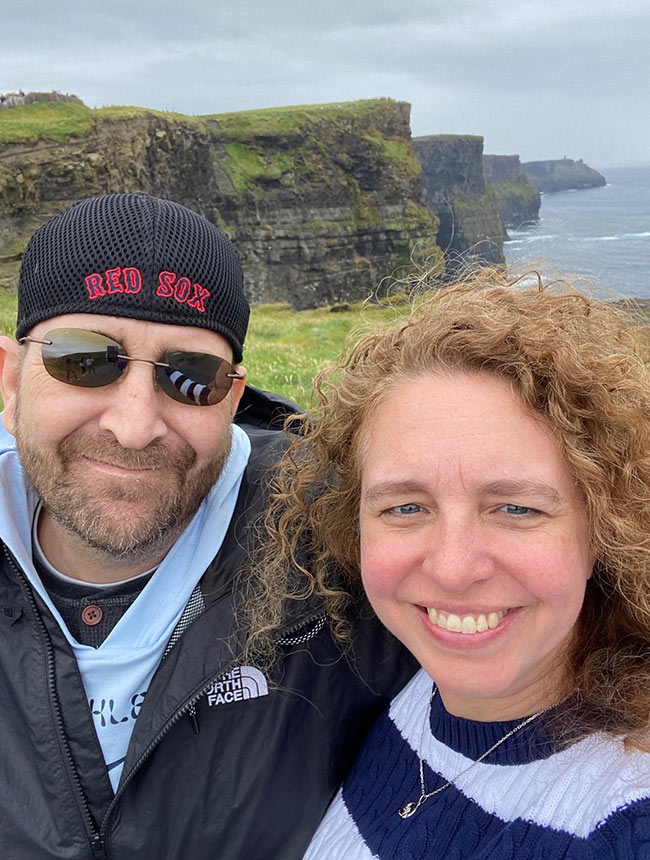
After Shawn completed his outpatient therapy, he and Kelli were able to go on their long-awaited vacation to Ireland.
Getting back out on the road
Five months post-stroke, Shawn had shown so much improvement with his vision and right-arm movement that he was deemed safe to drive again. He was thrilled to get back out on the road. "That was awesome. It was huge," he said.
A month later, he completed his outpatient therapy at Spaulding Sandwich. The timing was ideal, as he and Kelli were about to head to Ireland for a vacation that they had postponed due to his stroke.
"His team at Spaulding Sandwich never took their eyes off the prize, whether that was getting to Ireland, driving his Mustang, or simply communicating better," Kelli said.
"They were all awesome," Shawn agreed.
Today, just over two years since his stroke, Shawn is still seeing Dr. Ehrenthal and making his way back. He continues to have weakness in his right arm, and he lacks dexterity in his right hand. Besides taking guitar lessons, he does a variety of at-home exercises and other activities to address these deficits, such as throwing a Frisbee or ball, or putting the dishes away.
Barbara Voetsch, MD, PhD, a Mass General Brigham neurologist who started seeing Shawn while he was going to Spaulding Sandwich, referred him for a clinical trial examining the use of deep brain stimulation to enhance arm function. She also recommended him for a study exploring a possible association between head injuries and stroke risk. (Shawn has a concussion history from playing soccer.) Both studies are ongoing.
In terms of speech, Kelli estimates that Shawn is "about 75% back." He can handle basic conversations, like talking with family and friends. But he struggles recalling certain words at times and needs Kelli's help while speaking with doctors or scheduling medical appointments.
Compared with the first several months following the stroke, progress for Shawn comes at a slower pace. In addition to regaining his communication skills, he hopes to return to activities like soccer, disc golf, tennis, pickleball, and painting.
For now, he relishes the opportunity to drive his recent purchase—a 2020 Mustang GT California Special—along the ocean in nearby Falmouth. He is also able to play with the couple's three dogs and run his dog-sitting business.
"We have a huge sense of gratitude to Spaulding for turning such a negative experience into a positive experience," Kelli said. "At every turn, every clinician has treated him with respect, kindness, and dignity."


No comments:
Post a Comment