My opinion is that he blew the opportunity to DEMAND RECOVERY rather than 'care'! Because he'd been bamboozled by the medical staff not to rock the boat and declare them all FUCKING FAILURES FOR NOT SOLVING STROKE!
Advancing stroke care through lived experience
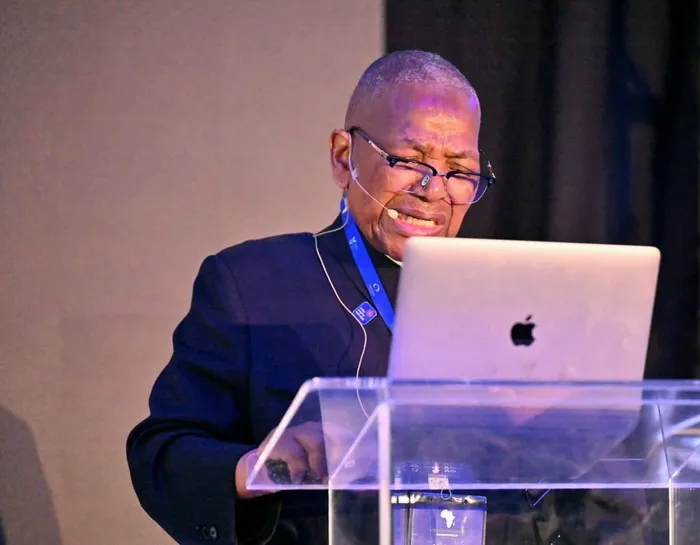
Good day Ladies and Gentleman
Thank you for giving me the opportunity to speak Dr. The opportunity that I do not take lightly
It is an immense honour to stand before you. I say “stand” intentionally.
The ease with which I moved through life, unassisted, changed on April 29, 2020.
That was the day I suffered a stroke, in the middle of Covid lockdown.
Every person in this room measures time differently.
For ministers and policymakers, time is fiscal years, budget cycles, five-year strategies.
For neurologists and Emergency Room (ER) doctors, time is golden hours — “time is brain.”
For physiotherapists, time is weeks of repetition, tracking degrees of movement.
For a stroke survivor, time is split into before and after. My split happened on April 29, 2020. In one second, the left side of my body went silent.
Imagine waking up in a house where half the light switches no longer work. You flip them. The rooms stay dark. That was my reality. My left arm hung like an anchor. My left leg refused my weight. My brain was sending commands into a void.
I fell at home. Lost all feeling on my left side. I rolled on the floor to reach the door. With my right hand, the only one still listening to me, I called for help.
Had I been alone, the story would be different. I was not. Within 15 minutes, my wife Ouma had me in a nearby hospital. I spent two weeks there.
I am living testimony to prompt attention. The right side of my body still carries my confidence. The left side is learning baby steps again.
To the emergency teams: you saved my life. You stopped the damage. You kept my heart beating. For that, I will be eternally grateful. You gave me back my breath.
But lying in that bed, staring at a left hand that felt like it belonged to a stranger, another question began to echo:
You saved my life… but what kind of life did you save it for?
That is the question I bring to this summit.
HALF THE BATTLE IS DONE
The global health system is excellent at acute survival. Falling mortality rates should be celebrated. The papers on thrombolysis should be published.
But survivors do not live in the acute ward. We live in our communities.
When stroke takes your dominant side, or even your non-dominant side, it takes your autonomy.
Try cutting meat with one hand. Try buttoning a shirt. Try tying a shoelace. Try opening a jar when your other hand will not grip. These are not minor inconveniences. They are daily, exhausting reminders of lost independence.
The physical trauma is visible. What is less visible, and what the system cannot afford to ignore, is the psychological toll.
When you lose control of half your body, you fight a silent war against despair every morning.
Grief becomes a companion. Grief for the ease you took for granted. Grief for the career that may slip away. Grief for the person you were the day before.
To ministers and policymakers: If your national stroke strategies end at hospital discharge, the job is half done.
To clinicians: The survivors in your care(NOT RECOVERY!) are not broken machines to be patched and discharged.
Mental health screening and psychological support must be integrated into stroke care(NOT RECOVERY!) from day one.
Treating the brain without treating the mind is a failure of medicine. We need the mind back to full function too.
REHABILITATION IS NOT A NICE-TO-HAVE; IT IS THE BATTLE
Once the acute crisis ends, the real heroes step in: our physiotherapists and occupational therapists.
To the physios in this room: you are the architects of our hope. When I could not lift my left leg, you did not see a permanent deficit. You saw neuroplasticity waiting to be unlocked.
You held me up when my effort failed. You celebrated a single millimeter of movement as if it were a star sporting performance.
Here is my appeal to Ministers and Policymakers:
Rehabilitation must not be a “nice-to-have.” It must be a regulated, defended standard of care(NOT RECOVERY!).
Right now, access to rehab is dictated by wealth, insurance caps, and geography. A survivor gets six weeks of intensive physio, then the insurance runs out. Or the public hospital needs the bed.
But neuroplasticity does not operate on an insurance calendar. The brain needs months, sometimes years, of repetitive, guided stimulation to build new pathways around dead tissue.
When a government cuts funding for long-term physiotherapy, it is not saving money.
It is losing potential. It is shifting the burden to family members who must quit jobs to become full-time carers. It is shifting the cost to social welfare because the survivor cannot return to work.
We need a systemic overhaul. Investing in long-term, community-based rehabilitation has a massive return. It turns dependent patients back into independent, tax-paying citizens. Into parents. Into community members.
Fund the long recovery, not just the emergency.
PREVENTION, EDUCATION, AND “NOTHING ABOUT US WITHOUT US”
Even as we fight for better rehab, we know the best stroke is the one that never happens.
Most strokes are preventable. Hypertension, poor diet, smoking, inactivity — these are manageable. But our public health messages are still hiding in pamphlets few people read.
We need aggressive, creative, culturally competent education.The message must be on buses. In sports broadcasts. In schools. If someone had recognized my symptoms one hour earlier, my left side might not be telling this story today.
Prevention is cheaper than a hospital bed. More importantly, it preserves human dignity. It keeps a citizen working and contributing.
This brings me to the core philosophy that must guide us: “Nothing about us, without us.”
I am grateful that patient voices are on this Summit programme. That shift is long overdue.
Historically, doctors wrote the guidelines. Politicians signed the budgets. Insurers dictated the timelines.The survivor was the passive recipient at the end of the chain.
This summit holds a promise that things are turning for the better. Change is coming. We are not just clinical outcomes or case studies. Stroke survivors are the reference group on what it means to live with stroke.
Give us a seat at the table. Our input can help ensure every cent spent, every study conducted, and every therapy implemented actually works in the real world.
CONCLUSION
To my fellow survivors: Look around this room.
We are proof that stroke altered our path, but did not end our journey. We are back on the road to recovery. We adapt. We overcome. With support, we keep going.
To the doctors, therapists, ministers, and leaders: Look at us again.Do not look at my left side and see what is missing. See what is here. See the resilience. The intellect. The passion. The unbroken will to contribute.
You have done a magnificent job of keeping our hearts beating.Now let us face the next challenge together: making those lives worth living.
Ministers: Fund long-term recovery, not just the ER.
Physiotherapists: Keep pushing us, even when we cry, because we need your belief.
Doctors: Treat our minds with the same urgency you treat our arteries.
Our healing is in your hands. Help us become the best version of ourselves again.
Let this World Stroke Summit be remembered not for the papers presented. Let it be remembered for the revolution it sparked — a revolution that shifts global healthcare(NOT RECOVERY!) from basic survival to full spectrum restoration of a humane existence in service of the common good.
Thank you for saving our lives. Now, stand with us. Work with us. Help us win our world back.
Please do not walk away.
I refuse to surrender to a stroke.
* This is a speech delivered by Sello Rasethaba at the World Stroke Summit held in Johannesburg from August 6 - 7.


No comments:
Post a Comment