Use the labels in the right column to find what you want. Or you can go thru them one by one, there are only 34,367 posts. Searching is done in the search box in upper left corner. I blog on anything to do with stroke. DO NOT DO ANYTHING SUGGESTED HERE AS I AM NOT MEDICALLY TRAINED, YOUR DOCTOR IS, LISTEN TO THEM. BUT I BET THEY DON'T KNOW HOW TO GET YOU 100% RECOVERED. I DON'T EITHER BUT HAVE PLENTY OF QUESTIONS FOR YOUR DOCTOR TO ANSWER.
Changing stroke rehab and research worldwide now.Time is Brain!trillions and trillions of neuronsthatDIEeach day because there areNOeffective hyperacute therapies besides tPA(only 12% effective). I have 523 posts on hyperacute therapy, enough for researchers to spend decades proving them out. These are my personal ideas and blog on stroke rehabilitation and stroke research. Do not attempt any of these without checking with your medical provider. Unless you join me in agitating, when you need these therapies they won't be there.
What this blog is for:
My blog is not to help survivors recover, it is to have the 10 million yearly stroke survivors light fires underneath their doctors, stroke hospitals and stroke researchers to get stroke solved. 100% recovery. The stroke medical world is completely failing at that goal, they don't even have it as a goal. Shortly after getting out of the hospital and getting NO information on the process or protocols of stroke rehabilitation and recovery I started searching on the internet and found that no other survivor received useful information. This is an attempt to cover all stroke rehabilitation information that should be readily available to survivors so they can talk with informed knowledge to their medical staff. It lays out what needs to be done to get stroke survivors closer to 100% recovery. It's quite disgusting that this information is not available from every stroke association and doctors group.
Showing posts with label vibratory insole. Show all posts
Showing posts with label vibratory insole. Show all posts
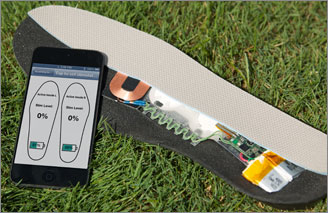
But do you just need these postural insoles from August 2017? Or do you have incompent doctors and hospital that don't have that already? Why do you accept complete incompetence?
Low-cost solution to address inadequate toe clearance in post-stroke gait.
Abstract
Background
Stroke
survivors suffer from hemiparesis and somatosensory impairments, which
adversely impact walking function, placing them at higher risks for
trips and falls. Augmented somatosensory inputs have been demonstrated
to improve static standing balance and postural control in
non-neurologically impaired, and in people post-stroke. Effects of
enhanced somatosensory input on post-stroke walking have not been
investigated.
Research question: We sought to
investigate whether enhancing somatosensory input using vibratory
insoles, can improve post-stroke gait.
Methods
Fifteen
individuals with chronic post-stroke hemiparesis and 15 age-similar
non-neurologically impaired controls participated in this
cross-sectional study. Enhanced somatosensory stimulation was delivered
using a pair of tactor-embedded insoles, providing suprathreshold
vibratory stimulation to the bottom of the feet. Participants walk over
an instrumented treadmill with self-selected speeds, under 5 stimulation
conditions: No insole in shoe (NT), insoles in shoe with no vibration
(BOFF), vibration under both feet (BON), vibration under one foot only
(ION, CON), in a randomized order. Kinetics and kinematics during
walking were recorded and analyzed offline.
Results
Our
hypothesis that vibratory stimulations applied to the bottom of the
feet would improve gait kinetics and kinematics in the paretic legs of
individuals with chronic post-stroke hemiparesis was partially
supported. We observed increased ankle dorsiflexion in the paretic legs
with vibratory insoles.
Significance
Vibratory
stimulations applied at suprathreshold intensity to the bottom of the
feet to augment somatosensory feedback can be used as a low-cost
solution to address the inadequate toe clearance during walking in
people post-stroke, which is an important goal in post-stroke
rehabilitation.
Boston researchers find vibratory
stimulation applied to the sole of the foot using novel piezoelectric
technology shows promise for fall prevention
(BOSTON) — Findings
published today in the Archives of Physical Medicine and Rehabilitation
show that imperceptible vibratory stimulation applied to the soles of
the feet improved balance by reducing postural sway and gait variability
in elderly study participants. The vibratory stimulation is delivered
by a urethane foam insole with embedded piezoelectric actuators, which
generates the mechanical stimulation. The study was conducted by
researchers from the Institute for Aging Research (IFAR) at Hebrew
SeniorLife, Beth Israel Deaconess Medical Center, the Wyss Institute for
Biologically Inspired Engineering at Harvard University, and Harvard
Medical School, all of Boston, Massachusetts; and Merck Sharpe and Dohme
(MSD) Consumer Care, Inc., of Memphis, Tennessee.
These findings are significant because poor balance and an
irregular gait are directly related to fall risk. Falls are the leading
cause of death from injury among seniors. Risk increases with age and
even the fear of falling can reduce quality of life.
1 in 3 seniors falls each year, and 25% of those who fall suffer moderate to severe injuries, such as hip fractures.
Only 25% of hip fracture patients make a full recovery; 40% require nursing home care; and nearly 25% die within 12 months.
By 2020, the annual direct and indirect cost of fall injuries is expected to reach nearly $55 billion.
“Although loss of sensation in the feet is a common problem among
elderly people that can impair balance and gait and result in falls,
there are currently no interventions available that can reverse sensory
impairments and prevent these dangerous consequences,” said study lead
author Lewis Lipsitz, M.D., Director of the Institute for Aging
Research. “We were very excited to discover that small amounts of
vibratory noise applied to the soles of the feet may be able to do just
that.” Using
the principle of stochastic resonance, vibrating insoles designed at
the Wyss Institute use small piezoelectric actuators to deliver
imperceptible mechanical vibrations to feet, enhancing detection of
nerve signals. Insoles similar to these have been shown to reduce
walking variability and improve balance in the elderly. Credit:
Harvard’s Wyss Institute
This study follows earlier research that looked at how the physical
principle of stochastic resonance could be applied to mitigate deficits
in the human somatosensory systems that develop due to disease, injury,
or age. The somatosensory system informs us about objects in our
external environment through touch. Receptors are distributed all over
the body and different types of receptors respond to many different
kinds of stimuli. Stochastic resonance (SR) is a phenomenon whereby the
detectability of weak signals in certain types of systems can be
improved through the careful addition of low-amplitude white noise. This
may seem paradoxical because noise is usually thought to reduce our
ability to detect a signal, for example, we may have difficulty hearing
someone talking to us at a noisy party, but the principle of SR states
in fact that a certain low level of white noise can actually enhance
signal detection.
Earlier studies by Wyss Institute Core Faculty member James Collins,
Ph.D., a Professor of Medicine and Biomedical Engineering at Boston
University, have shown that imperceptible vibratory noise applied to the
feet can improve balance in healthy young and elderly subjects and
patients with diabetic neuropathy and stroke. IFAR researchers showed
that this approach could significantly reduce the stride-, stance- and
swing-time variability exhibited in walking by elderly people with a
history of falling down. However the devices that delivered the
stimulation in the earlier IFAR studies required large energy sources,
limiting their practical and portable application.
Following the experiments with these limiting early devices, the
device was completely redesigned by Wyss Institute researchers to use
piezoelectric actuators to improve portability and energy efficiency.
Piezoelectric actuators convert electrical energy into mechanical
signals, such as pressure or movement of some kind. These actuators,
inserted into a typical insole using a standard manufacturing process,
are driven by a small encasement on the tongue of the shoe that contains
a tiny circuit and rechargeable battery.
The vibrating insole study enrolled 12 elderly volunteers in good
health, between the ages of 65 and 90 years old. Two piezoelectric
actuators to deliver the vibratory stimulation were placed in the medial
arch region of commonly-available insoles. Then, participants underwent
a battery of tests that measured their balance and assessed their gait.
They were also given a timed “Get Up and Go” test, which measured how
long it took participants to stand up from sitting, walk three meters,
turn around, walk back, and sit down again.
Results of this study demonstrated that the vibratory insoles
significantly improved performance on the timed “Get Up and Go” test,
reduced the range of postural sway, and reduced the variability of
walking. Also, the effect of the insoles persisted throughout the course
of a day.
This study was supported by Merck Sharpe and Dohme (MSD) Consumer
Care, Inc., Memphis, Tennessee, the National Institute on Aging,
Bethesda, Maryland, and the Wyss Institute for Biologically Inspired
Engineering at Harvard University, Boston, Massachusetts.
Postural control requires
numerous inputs interacting across multiple temporospatial scales. This
organization, evidenced by the “complexity” contained within standing
postural sway fluctuations, enables diverse system functionality.
Age-related reduction of foot-sole somatosensation reduces standing
postural sway complexity and diminishes the functionality of the
postural control system. Sub-sensory vibrations applied to the foot
soles reduce the speed and magnitude of sway and improve mobility in
older adults. We thus hypothesized that these vibration-induced
improvements to the functionality of the postural control system are
associated with an increase in the standing postural sway complexity.
Method
Twelve healthy older adults
aged 74 ± 8 years completed three visits to test the effects of foot
sole vibrations at 0 % (i.e., no vibration), 70 and 85 % of the sensory
threshold. Postural sway was assessed during eyes-open and eyes-closed
standing. The complexity of sway time-series was quantified using
multiscale entropy. The timed up-and-go (TUG) was completed to assess
mobility.
Results
When standing without
vibration, participants with lower foot sole vibratory thresholds
(better sensation) had greater mediolateral (ML) sway complexity (r2 = 0.49, p < 0.001), and those with greater ML sway complexity had faster TUG times (better mobility) (r2 = 0.38, p
< 0.001). Foot sole vibrations at 70 and 85 % of sensory threshold
increased ML sway complexity during eyes-open and eyes-closed standing (p
< 0.0001). Importantly, these vibration-induced increases in
complexity correlated with improvements in the TUG test of mobility (r2 = 0.15 ~ 0.42, p < 0.001 ~ 0.03).
Conclusions
Sub-sensory foot sole
vibrations augment the postural control system functionality and such
beneficial effects are reflected in an increase in the physiologic
complexity of standing postural sway dynamics.
Postural control requires
numerous inputs interacting across multiple temporospatial scales. This
organization, evidenced by the “complexity” contained within standing
postural sway fluctuations, enables diverse system functionality.
Age-related reduction of foot-sole somatosensation reduces standing
postural sway complexity and diminishes the functionality of the
postural control system. Sub-sensory vibrations applied to the foot
soles reduce the speed and magnitude of sway and improve mobility in
older adults. We thus hypothesized that these vibration-induced
improvements to the functionality of the postural control system are
associated with an increase in the standing postural sway complexity.
Method
Twelve healthy older adults
aged 74 ± 8 years completed three visits to test the effects of foot
sole vibrations at 0 % (i.e., no vibration), 70 and 85 % of the sensory
threshold. Postural sway was assessed during eyes-open and eyes-closed
standing. The complexity of sway time-series was quantified using
multiscale entropy. The timed up-and-go (TUG) was completed to assess
mobility.
Results
When standing without
vibration, participants with lower foot sole vibratory thresholds
(better sensation) had greater mediolateral (ML) sway complexity (r2 = 0.49, p < 0.001), and those with greater ML sway complexity had faster TUG times (better mobility) (r2 = 0.38, p
< 0.001). Foot sole vibrations at 70 and 85 % of sensory threshold
increased ML sway complexity during eyes-open and eyes-closed standing (p
< 0.0001). Importantly, these vibration-induced increases in
complexity correlated with improvements in the TUG test of mobility (r2 = 0.15 ~ 0.42, p < 0.001 ~ 0.03).
Conclusions
Sub-sensory foot sole
vibrations augment the postural control system functionality and such
beneficial effects are reflected in an increase in the physiologic
complexity of standing postural sway dynamics.
Fig. 1
Vibratory Shoe
Insoles. Stochastic resonance was delivered to the soles of the feet via
controlled vibratory stimuli. Vibrations were generated by
piezo-electric actuators mounted within the insoles and driven by a
control unit (black box) secured to the outside top of the shoe
Full article at link, you can quiz your doctor on it to explain 'stochastic resonance' and the 'complexity theory of aging'.