Changing stroke rehab and research worldwide now.Time is Brain! trillions and trillions of neurons that DIE each day because there are NO effective hyperacute therapies besides tPA(only 12% effective). I have 523 posts on hyperacute therapy, enough for researchers to spend decades proving them out. These are my personal ideas and blog on stroke rehabilitation and stroke research. Do not attempt any of these without checking with your medical provider. Unless you join me in agitating, when you need these therapies they won't be there.

What this blog is for:

My blog is not to help survivors recover, it is to have the 10 million yearly stroke survivors light fires underneath their doctors, stroke hospitals and stroke researchers to get stroke solved. 100% recovery. The stroke medical world is completely failing at that goal, they don't even have it as a goal. Shortly after getting out of the hospital and getting NO information on the process or protocols of stroke rehabilitation and recovery I started searching on the internet and found that no other survivor received useful information. This is an attempt to cover all stroke rehabilitation information that should be readily available to survivors so they can talk with informed knowledge to their medical staff. It lays out what needs to be done to get stroke survivors closer to 100% recovery. It's quite disgusting that this information is not available from every stroke association and doctors group.

Showing posts with label vitamin D3. Show all posts

Wednesday, May 6, 2026

We Asked Doctors Which Supplements Actually Support Healthy Aging—These Are the 9 They Recommended

 If your doctor hasn't already given you supplement protocols(amounts and timing)THEN YOU HAVE AN INCOMPETENT DOCTOR! No question about that. 

We Asked Doctors Which Supplements Actually Support Healthy Aging—These Are the 9 They Recommended

Supplements are everywhere these days, promising to help improve nearly every facet of your health—some also say they can boost longevity or promote healthy aging.

Taking supplements can’t guarantee that you’ll live longer, and many products aren’t doctor-approved or backed by medical research.

But certain products stand out amongst the rest when it comes to helping you age well. Here are the nine supplements experts recommend.

Talk to your doctor before trying new supplements to see if they’re right for you. Some can negatively interact with certain prescription medications or worsen symptoms of underlying health conditions.

1. Omega-3 (Fish Oil)

Exploratory studies have found that omega-3, which is found in fish oil capsules, is associated with better memory.1 It may also be able to help slow biological aging when combined with vitamin D and exercise.

“Omega-3 fatty acids reduce chronic inflammation and support heart and brain health, [as well as] healthy aging,” John Rinker, MD, internal medicine physician at OSF HealthCare, told Health.

Fish oil capsules themselves have also been linked to lower rates of cardiovascular disease, Thomas Perls, MD, MPH, professor of medicine at the Boston University Chobanian & Avedisian School of Medicine and director of the New England Centenarian Study, told Health. However, research is mixed.2

Who should take it: Most people over 40 can take 1-2 grams of omega-3 fish oil capsules per day, Rinker said. Just be sure to avoid high doses if you’re taking a blood thinner, Kien Vuu, MD, author and performance and longevity medicine consultant, told Health.

2. Vitamin D3 + K2

Vitamin D3 and K2 are often combined into one supplement because they work together in a very specific way, and are “critical for immune balance, bone health, and vascular strength,” Vuu said.3

Also known as cholecalciferol, “vitamin D3 is necessary for calcium absorption for bone and muscle strength,” Chris Renna, DO, family medicine physician and founder of LifeSpan Medicine, told Health. It can also support immune function and create healthy skin, he said.4

Meanwhile, vitamin K2 is used to make proteins involved in blood clotting and bone metabolism. Plus, it may help prevent the buildup of minerals in your arteries.56

Who should take it: Supplements containing both vitamins D3 and K2 are specifically helpful for people over 50, Rinker said. But people should use caution if they’re taking Warfarin, or if they have existing calcium disorders or kidney dysfunction, he said.7

3. B Vitamins

There are eight types of B vitamins, and each one plays a crucial role in your health. They help with metabolism, DNA production, and immune system function, and can “protect neural pathways and enhance energy,” said Vuu.89

For older adults, deficiencies in vitamin B can contribute to health issues such as cardiovascular disease, stroke, cognitive disorders, mental health issues, and more.10

Researchers have suggested that vitamin B12, in particular, may be involved in aging at the cellular level, but evidence is still preliminary.11

Who should take it: If bloodwork shows that you have low vitamin B levels, your doctor might recommend you take a complex supplement once daily.

4. Magnesium

While most people take magnesium to improve sleep or reduce stress, experts said it could help with healthy aging, too.

Magnesium deficiency has been linked to increased chronic inflammation and other concerning cellular changes, which may raise people's risk of conditions such as heart disease, cancer, and Alzheimer’s disease.12

Plus, low levels of magnesium can also mess with your sleep, which is connected to longevity.13

Who should take it: “Magnesium typically helps most adults, especially those with a deficiency,” Rinker said. That can be diagnosed with a blood test.14 There are many different types and formulations of magnesium supplements, and a healthcare provider can help you choose which one might work best.15

5. CoQ10

Coenzyme Q10, or CoQ10, is an antioxidant that’s abundant in the body. It also helps with mitochondrial function, where it provides energy for cell growth.16 This is “vital to high-energy-demanding organs like our brain, heart, and skeletal muscle,” Renna explained.

As you age, your CoQ10 levels naturally decline. But research suggests taking CoQ10 supplements may help reduce inflammation, support heart health, and protect cells from damage called oxidative stress.1718

Who should take it: Some research suggests CoQ10 could lower “blood pressure and blood sugar, which may not be helpful to some people taking medicine prescribed to do those same things,” said Renna.1920

6. Fiber

According to Vuu, fiber supports your gut barrier’s integrity and calms chronic inflammation.21 It’s also been associated with a lower risk of all-cause mortality, as well as a lower risk of death from cardiovascular disease or cancer.22

Who should take it: The vast majority of Americans don’t get enough fiber each day.23 If you struggle to hit your goals, daily fiber supplements containing psyllium (Metamucil) or wheat dextrin (Benefiber) could help improve your gut and immune health as you age.24

7. Calcium

As you age, your bones get weaker. This increases the risk of conditions like osteoporosis, and in turn, bone fractures.25

Calcium supplements may help prevent this. The mineral has been linked to improved bone strength and bone density.2627

Who should take it: Most people don't get enough calcium, and a supplement can be helpful if you struggle to get enough in your diet.28 However, excess calcium can be dangerous—have a healthcare provider check your levels before starting a supplement, particularly if you have other health conditions.26

8. Creatine

Creatine is often thought of as a “bodybuilder supplement.” But according to Rinker, creatine can help people preserve muscle mass and reduce the risk of muscle wasting, or sarcopenia, as they get older. It could “also help with inflammation and joint health,” he added.29

Some evidence suggests that creatine supplementation for older adults can enhance memory, though more research is needed.30

Who should take it: Most creatine comes in powder form that’s mixed into beverages, and it can be taken anytime. The supplement is great for active people, but use it with caution if you have existing kidney issues.31

9. Curcumin (Turmeric)

Curcumin—the main active ingredient in turmeric—helps tamp down inflammation in the body, Darshan Shah, MD, surgeon, longevity medicine specialist, and founder of Next Health, told Health.

Because of this, it could be helpful for longevity purposes. One study suggested curcumin may have a positive effect against neurodegenerative diseases, cognitive decline, and sarcopenia.32 Another review found that taking curcumin extract may be able to relieve knee pain from osteoarthritis.33

Who should take it: Oral turmeric supplements are popular and could be beneficial for people with inflammatory conditions, Rinker said. "But it's advisable to exercise caution if you have gallstones or [gastrointestinal] sensitivity," he added.34

Monday, May 26, 2025

Does Vitamin D Slow Cellular Aging?

 Why you want longer telomeres, except for this research.

You'll want your competent? doctor to step in here. I'm not medically trained so don't listen to me.

Does Vitamin D Slow Cellular Aging?

We’ve long known that vitamin D plays a central role in bone health, immune function, and mood regulation. But new research suggests it may also help defend against one of aging’s most fundamental processes: the shortening of telomeres.

A newly published study from the VITAL trial, one of the largest and most rigorous supplement trials to date, found that four years of daily vitamin D3 supplementation slowed the rate of telomere shortening in adults over age 50. The findings point to a potential role for vitamin D in preserving cellular health and supporting healthy aging.

The Study: Vitamin D and Telomere Protection

Telomeres are protective end caps at the ends of chromosomes that help maintain DNA stability during cell division. Over time, telomeres naturally shorten due to aging and stress, which can lead to cell dysfunction, chronic

[in-fluh-mey-shuhn] noun

Your body’s response to an illness, injury or something that doesn’t belong in your body (like germs or toxic chemicals).

Learn More
inflammation, and an increased risk of age-related disease.

The VITAL Telomere study included 1,031 participants (average age 65) who received either:

  • 2,000 IU/day of vitamin D3(If this is one of those large pills, I can't do it in one pill.)
  • 1 gram/day of marine omega-3 fatty acids
  • Both
  • Or a placebo

People had their leukocyte telomere length (LTL) measured at baseline, year 2, and year 4 using a high-precision PCR method.

Key findings:

  • Those taking vitamin D3 experienced 140 base pairs less telomere loss over 4 years compared to placebo (Each time a cell divides, bases are lost from the ends of the telomeres on each chromosome.)
  • On average, telomere length in the vitamin D group was 0.035 kilobases longer per year.
  • Omega-3 supplementation showed no significant impact on telomere length.

The researchers concluded that daily vitamin D3 may have an anti-cellular aging effect by reducing telomere attrition, especially when taken consistently over multiple years.

Why This Matters for Super Agers

Telomeres aren’t just a marker of age; they’re a mechanism. Shortened telomeres have been linked to heart disease, cancer, Alzheimer’s, diabetes, and more.

While telomere length is influenced by genetics, it’s also shaped by lifestyle, including stress levels, diet, physical activity, and nutrient status. The VITAL trial adds vitamin D3 to the short list of interventions with randomized, placebo-controlled evidence showing an effect on telomere preservation.

For Super Agers focused on staying biologically younger for longer, this matters. Preserving telomere length could mean preserving vitality.

Should You Take Vitamin D3 For Longevity?

This study isn’t a call to mega-dose vitamin D; it’s about long-term, moderate, consistent use under medical supervision. The study authors say: “Our findings that vitamin D supplementation preserved telomere length in the VITAL trial suggest a promising role for vitamin D in slowing a pathway for biological aging and age-related chronic disease. We believe that replication of these results in a separate randomized trial will be important before changing general guidelines for vitamin D intake.” In the meantime, here’s what you can do:

1. Ask Your Doctor About Vitamin D Testing

Vitamin D levels vary based on sun exposure, age, skin tone, and other factors. Blood testing (25-hydroxyvitamin D) can determine if supplementation is appropriate.

2. If Recommended, Stay Consistent

The telomere benefit in this study was observed after four years of daily vitamin D supplementation, not short-term use. Consistency matters.

3. Don’t Rely on Omega-3s for This Particular Benefit

While marine omega-3 fatty acids are beneficial for heart and brain health, this study did not find evidence that they preserve telomeres.

4. Layer Vitamin D with Other Longevity Habits

Telomere health is multifactorial. Combine supplementation with:

At the cellular level, telomere length is one of the clearest indicators of biological wear and tear. This new study shows that daily vitamin D3, at a safe, research-backed dose, may help preserve telomere length over time.

That doesn’t mean vitamin D is a magic bullet. But it’s a low-cost, low-risk intervention that might buy your cells a little more time.

The information provided in this article is for educational and informational purposes only and is not intended as health or medical advice. Do not use this information to diagnose or treat any health condition. Always consult a qualified healthcare provider regarding any questions you may have about a medical condition or health objectives. Read our disclaimers.

Wednesday, March 12, 2025

The Effect of Vitamin D Supplementation on Functional Outcomes in Patients Undergoing Rehabilitation After an Ischemic Stroke: A Prospective, Single-Blind, Randomized, Placebo-Controlled Study

 Your competent? doctor has known of this for years. What was done? NOTHING? So, you don't have a functioning stroke doctor, do you?

  • vitamin D3 (6 posts to June 2013)
  • The latest here:

    The Effect of Vitamin D Supplementation on Functional Outcomes in Patients Undergoing Rehabilitation After an Ischemic Stroke: A Prospective, Single-Blind, Randomized, Placebo-Controlled Study            

                                     by 1, 2, 3,4 and 5,6,*
    1
    Department of Pediatric Infectious Diseases, Wroclaw Medical University, 50-368 Wroclaw, Poland
    2
    Institute of Health Sciences, University of Opole, 45-060 Opole, Poland
    3
    Department of Non-Procedural Clinical Science, Faculty of Medicine, Wroclaw University of Science and Technology, 51-377 Wroclaw, Poland
    4
    Department of Internal Medicine with Angiology Subdivision, Regional Specialist Hospital in Wroclaw, 51-124 Wroclaw, Poland
    5
    Division of Clinical Physiotherapy and Rehabilitation, University Centre of Physiotherapy and Rehabilitation, Faculty of Physiotherapy, Wroclaw Medical University, 50-368 Wroclaw, Poland
    6
    Department of Neurological Rehabilitation, Regional Specialist Hospital in Wroclaw, 51-128 Wroclaw, Poland
    *
    Author to whom correspondence should be addressed.
    J. Clin. Med. 2025, 14(6), 1848; https://doi.org/10.3390/jcm14061848
    Submission received: 13 January 2025 / Revised: 25 February 2025 / Accepted: 6 March 2025 / Published: 9 March 2025
    (This article belongs to the Special Issue Advances in Rehabilitation Care for Geriatric Diseases)

    Abstract

    Background/Objectives: 

    A vitamin D deficiency is prevalent in post-stroke patients and may impair neurological recovery. While observational studies highlight the neuroprotective role of vitamin D, there is limited evidence from interventional studies evaluating its impact on functional recovery during stroke rehabilitation. This study aimed to assess whether daily vitamin D3 supplementation enhances functional recovery. 

    Methods: 

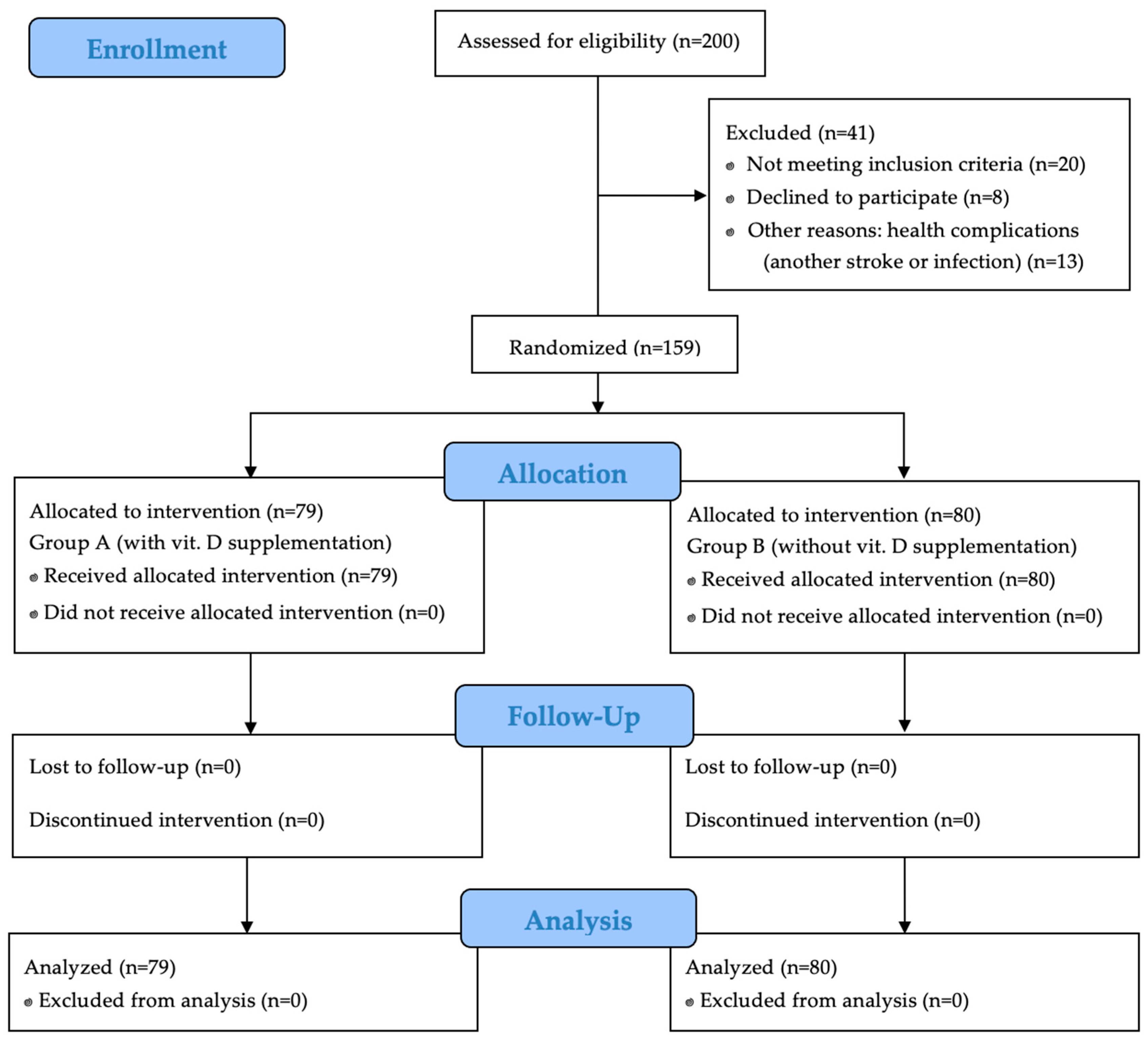
     This prospective, randomized, placebo-controlled, single-blind study included 159 patients (mean age: 62.5 ± 8.4 years) with a first ischemic stroke that were admitted for early rehabilitation. The participants were randomly allocated to receive 2000 IU of vitamin D3 daily (n = 79) or a placebo (n = 80) for six weeks. The functional outcomes were measured using the Barthel index (BI) and modified Rankin scale (mRS) at baseline and after 42 days. The serum 25-hydroxyvitamin D [25(OH)D] and insulin-like growth factor 1 (IGF-1) levels were analyzed. 

    Results: 

    Vitamin D3 supplementation significantly increased the serum 25(OH)D levels (p < 0.001). Supplementation was associated with improved BI scores (β = 0.07, p = 0.006). A higher BMI (β = −0.06, p = 0.033), higher NIHSS scores (β = −0.18, p = 0.036), hypertension, and statin use negatively impacted functional recovery. Anticoagulant use was correlated with higher mRS scores, indicating greater disability (p = 0.04). 

    Conclusions: 

     Vitamin D3 supplementation positively influences the functional outcomes during post-stroke rehabilitation, supporting its potential role in enhancing neuroplasticity and recovery. Larger multi-center trials are needed to confirm these findings and optimize vitamin D supplementation strategies.

    1. Introduction

    Every year, millions of people worldwide experience a stroke, regardless of race, origin, or socioeconomic status [1]. Cerebrovascular diseases, including strokes, rank as the second leading cause of death globally [2]. The full recovery of function and perception occurs in only 10% of patients. Approximately 15% of stroke patients die in the early phase, while 25% experience a recurrent stroke. The risk of recurrence is highest within the first and second years following the initial event. Individuals who have experienced a stroke are at a significantly greater risk of a second stroke compared to their peers of the same age and sex who have not had a stroke [3]. Stroke prevention strategies focus primarily on behavioral and lifestyle factors [4]. Hence, managing risk factors plays a crucial role in medical care. Strokes are the leading cause of disability in individuals over the age of 45 [5].
    Stroke timing critically influences the potential for neuroplasticity and functional recovery, particularly during the early phase of rehabilitation. Indeed, recent findings underscore the importance of initiating therapy promptly to leverage optimal brain reorganization [6]. It is generally accepted that cortical reorganization peaks 7–14 days post-stroke and persists for approximately one month [7]. Early rehabilitation reduces disability at the end of the rehabilitation period, lowering future healthcare costs. Global concerns about vitamin D deficiencies are increasing, affecting nearly half of the population worldwide [8,9].
    A vitamin D deficiency is now recognized as a public health issue. Recent population-based studies indicate that low vitamin D levels predict future strokes. Poland, characterized by limited sunlight exposure, is among the countries where vitamin D deficiencies are prevalent [10,11]. Low serum 25-hydroxyvitamin D (25[OH]D) levels are linked to cardiovascular, musculoskeletal, infectious, autoimmune, and malignant diseases [12]. Vitamin D has been shown to have neuroprotective, neuromuscular, and osteoprotective properties, potentially reducing cognitive and functional impairments in post-stroke patients [13]. The current literature suggests that vitamin D supplementation and neuroprotective diets can enhance the efficacy of stroke rehabilitation and recovery.
    Vitamin D is believed to support neurological function and recovery through several interconnected pathways. First, vitamin D receptors (VDRs) are expressed in various regions of the central nervous system, including the cortex and hippocampus, suggesting that vitamin D can exert both genomic and non-genomic effects on neuronal survival and plasticity [14,15]. In the setting of an ischemic stroke, vitamin D may mitigate neuroinflammation by downregulating pro-inflammatory mediators such as interleukin 6 (IL-6) and tumor necrosis factor alpha (TNF-α), potentially limiting secondary neuronal damage [16,17]. Furthermore, vitamin D has been shown to influence the expression of neurotrophic factors—such as nerve growth factor (NGF) and brain-derived neurotrophic factor (BDNF)—which are crucial for neuronal repair and synaptic plasticity [18]. Additional research also points to an improvement in endothelial function and microcirculatory blood flow under optimal vitamin D levels, contributing to reduced ischemic injury in the affected brain tissue [19]. Collectively, these mechanisms support the hypothesis that an adequate vitamin D status may facilitate improved functional recovery and neurorehabilitation outcomes in post-stroke patients.
    However, interventional studies remain scarce, highlighting the urgent need for randomized controlled trials (RCTs) to evaluate the impact of vitamin D supplementation on stroke outcomes [20]. Therefore, this study aimed to determine whether vitamin D3 supplementation influences the functional recovery in patients undergoing a 6-week neurological rehabilitation program during the regenerative–compensatory phase.

    More at link.

    Sunday, November 17, 2019

    Combination therapy with vitamin D3, progesterone, omega-3 fatty acids and glutamine reverses coma and improves clinical outcomes in patients with severe traumatic brain injuries: A case series

    You can ask your doctors if anything here would help in stroke recovery. Doesn't know, then the correct and only answer is for them to contact researchers to get an answer.  Not doing anything, call the president and ask what the fuck is the responsibility of the stroke doctors. Delivering the status quo of stroke rehab means that the stroke president also needs to be fired.  Or you could look up these:

    Combination therapy with vitamin D3, progesterone, omega-3 fatty acids and glutamine reverses coma and improves clinical outcomes in patients with severe traumatic brain injuries: A case series

    How to cite this article:
    Matthews LR, Danner OK, Ahmed YA, Dennis-Griggs DM, Frederick A, Clark C, Moore R, DuMornay W, Childs EW, Wilson KL. Combination therapy with vitamin d3, progesterone, omega 3-fatty acids and glutamine reverses coma and improves clinical outcomes in patients with severe traumatic brain injuries: A case series. International Journal of Case Reports and Images 2012;4(3):143–149.


    Abstract


    Introduction: Traumatic brain injury (TBI) is a major public health problem and a leading cause of death and disability in the United States. Management of patients with TBI has changed very little over the last 20 years.
    Case Series: A case series of three patients with severe TBIs who were aggressively treated with vitamin D3, progesterone, omega 3-fatty acids, and enteral glutamine for six weeks, termed neuroceutical augmentation for traumatic brain injury (NATBI), with very favorable outcomes.
    Conclusion: A large clinical study trial using these four supplements (NATBI) together is warranted.

    Keywords: Traumatic brain injury, Vitamin D3, Omega-3 fatty acids, Loveza, Progesterone, Cerebral edema, Glutamine

    Introduction

    Traumatic brain injury (TBI) is a major public health problem. According to CDC it affects over 1.7 million people annually in U.S. with 275,000 hospitalizations and 52,000 deaths. [1] The medical cost for treating TBI patients in the United States in 2010 was $76.5 billion and rising annually. [1] Primary causes for TBI include the following: motor vehicle crashes, falls, assaults and sports or recreation-related injuries (concussions). Finding the right treatment to reduce mortality rates and improve the clinical outcomes in TBI patients has been elusive.
    Management of patients with TBI has changed very little over the last 20 years. Advancements in the treatment of TBI requires great understanding of the biochemical mechanisms of the brain during a normal resting state as well as the metabolism after a severe traumatic event. Brain metabolism is markedly altered during TBI. After the initial insult to the brain, the brain's metabolism is altered and can increase up to 140% of its normal metabolism.
    Vitamin D (a steroid hormone) and omega-3 fatty acids (an essential fatty acid) are both very powerful anti-inflammatory agents that reduce cerebral edema and swelling. Glutamine becomes an essential amino acid during stress and produces the extra glucose (via the Cori cycle) that is used by the injured brain and the extra glucose used by the immune response system to fight off infection during stress. Progesterone (also a steroid hormone) is a neuroprotector of injured brain cells and potentiates the effect of vitamin D.
    These agents are all immune modulators which work synergistically to prevent secondary brain injury by limiting or decreasing inflammation; an increasing well-recognized cause of ongoing brain swelling after a primary injury. They are also neuroprotectors that makes the neurons more resistant to stress, ischemia, hypothermia, hyperthermia, hypoglycemia, hyperglycemia, hypotension, and hypertension. Immune modulation with nutritional supplements is a rapidly advancing field with a very promising future in treating TBI as well as other critically injured/ill patients.
    We present a case series of three patients with severe TBIs who were aggressively treated with vitamin D3, progesterone, omega-3 fatty acids and enteral glutamine for up to six weeks, termed neuroceutical augmentation for traumatic brain injury (NATBI), with very favorable outcomes. [2] [3] [4] [5] Patients in a coma with severe TBI (Glascow Coma Score <8) who were admitted to a Level I trauma center were evaluated in a prospective observational study. Patients were treated with a neuroceutical combination of vitamin D3, omega-3 fatty acids, progesterone, and glutamine initially via a nasogastric tube and later orally for six weeks. Primary outcomes were mortality rate and return to recovery which was defined as a Glascow Coma Score (GCS) of 10 or greater.NATBI protocol works on multiple levels and neuroprotective pathways in TBI patients by down regulating cytokine production, preventing oxidative stress (free radical oxygen formation), decreasing cerebral edema, and inflammation, thus limiting secondary brain injury in contradistinction to progesterone therapy alone (Protect III study). [3] [4] [5] In addition, our NATBI regimen is relatively inexpensive, safe, and very effective at reducing brain and systemic inflammation post-injury.
    Leslie R Matthews1, Omar K Danner1, Y A Ahmed2, Diane M Dennis-Griggs1, Alexis Frederick1, Clarence Clark1, Ronald Moore1, Wilson DuMornay1, Ed W Childs1, Kenneth L Wilson1
    1Morehouse School of Medicine, Department of Surgery, 720 Westview Drive, SW, Atlanta, GA, USA.
    2Department of Epidemiology, King Saud University, College of Pharmacy, Riyadh, Kingdom of Saudia of Arabia.

    doi:10.5348/ijcri-2013-03-281-CS-2

    Address correspondence to:
    Leslie Ray Matthews
    MD, FACS, 720 Westview Drive
    SW, Atlanta
    Georgia 30228
    USA
    Phone: (404) 6162391
    Fax: (404) 6161417
    Email: lematthews@msm.edu

    Access full text article on other devices

    Access PDF of article on other devices

    [HTML Abstract]   [PDF Full Text] [Print This Article]
    [Similar article in Pumed] [Similar article in Google Scholar]


    Saturday, December 15, 2018

    Association between vitamin D status and cognitive impairment in acute ischemic stroke patients: a prospective cohort study

    I see nothing here that suggests that this is being written up as a stroke protocol and distributed worldwide to all stroke hospitals and doctors. Isn't that the minimum needed to 'do no harm'? 

    Is this just Vitamin D or D3? Inquiring minds want to know.  Does low vitamin D cause this problem or the underlying reason that initially caused the low levels the real problem? Have you actually identified the root cause?

    Vitamin D3 Could Help Prevent, Repair Cardiovascular System Damage

    The latest here:

    Association between vitamin D status and cognitive impairment in acute ischemic stroke patients: a prospective cohort study


    Authors Chen H, Liu Y, Huang G, Zhu J, Feng W, He J
    Received 11 September 2018
    Accepted for publication 18 November 2018
    Published 10 December 2018 Volume 2018:13 Pages 2503—2509
    DOI https://doi.org/10.2147/CIA.S187142
    Checked for plagiarism Yes
    Review by Single-blind
    Peer reviewers approved by Dr Andrew Yee
    Peer reviewer comments 3
    Editor who approved publication: Dr Wu

    Huijun Chen,1,* Yuntao Liu,1,* Guiqian Huang,1,* Jie Zhu,2 Wenqian Feng,2 Jincai He1

    1Department of Neurology, The First Affiliated Hospital of Wenzhou Medical University, Wenzhou 325000, China; 2Department of Mental Health, Mental Health School, Wenzhou Medical University, Wenzhou 325000, China

    *These authors contributed equally to this work

    Objective: Previous studies found that low vitamin D levels were modestly associated with risk of stroke and poor functional outcome after stroke. In addition, vitamin D deficiency has been linked with cognitive decline. Our study aimed to explore the potential relationship between vitamin D levels in the short-term acute phase of ischemic stroke and cognitive impairment at 1 month.
    Methods: In total, 354 ischemic stroke patients were consecutively enrolled in the study and received 1-month follow-up. The serum levels of vitamin D were measured within 24 hours after admission. Cognitive function was evaluated by the Mini-Mental State Examination (MMSE) at 1 month after acute ischemic stroke. Cognitive impairment was defined according to different education levels.
    Results: According to MMSE scores, 114 participants (32.2%) had cognitive impairment at 1 month. Patients with vitamin D deficiency were more likely to have cognitive impairment than those with vitamin D insufficiency and vitamin D sufficiency (P<0.001). After adjusting for potential confounders in our Cox proportional hazards model, vitamin D deficiency was independently associated with the development of cognitive impairment in acute ischemic stroke patients.
    Conclusion: Independent of established risk factors, vitamin D deficiency in the short-term phase of ischemic stroke was associated with a higher incidence of 1-month cognitive impairment.

    Keywords: vitamin D, cognitive impairment, ischemic stroke, Mini-Mental State Examination
    This work is published and licensed by Dove Medical Press Limited. The full terms of this license are available at https://www.dovepress.com/terms.php and incorporate the Creative Commons Attribution - Non Commercial (unported, v3.0) License. By accessing the work you hereby accept the Terms. Non-commercial uses of the work are permitted without any further permission from Dove Medical Press Limited, provided the work is properly attributed. For permission for commercial use of this work, please see paragraphs 4.2 and 5 of our Terms.
    Download Article [PDF]  View Full Text [HTML][Machine readable]