Have your competent? doctor evaluate this for bringing into the hospital.Can't do that? PURE INCOMPETENCE!
Could Your Webcam Help With Dementia and Stroke Rehab? This Startup Thinks So
Grocery shopping or putting food away involves more than memory. You need to recognize objects, decide what to do with them, and coordinate your movements. For someone experiencing cognitive difficulties, those familiar routines can become challenging.
South Korean company InTheTech is developing EYAS Dual around that connection between thinking and movement. Its platform combines cognitive exercises with physical actions, using a camera to let people interact with activities such as sorting recycling or shopping for groceries.
The potentially useful part is how the company intends to deliver it: through ordinary computers, tablets, and smartphones, without requiring a dedicated rehabilitation machine.
“It runs on any device you already own, no hardware purchase,” InTheTech representative Lucy Lee told me during our interview.
The direction is clear. InTheTech wants to make movement-based cognitive training easier to bring into care facilities and, eventually, people’s homes.
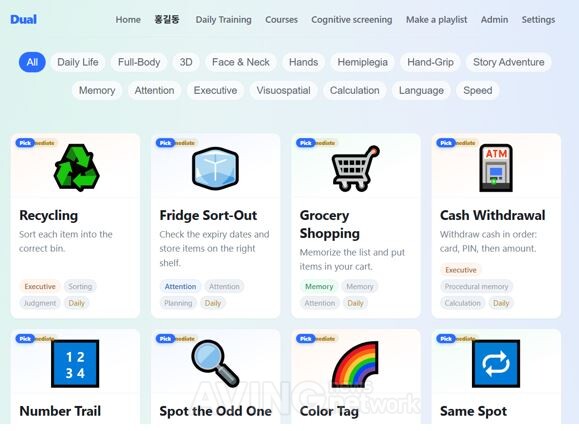
Cognitive rehabilitation training program screen of ‘EYAS Dual’ | Image provided by INTHETECH
During the demonstration, I noticed that much of the interaction involved the arms and upper body. I asked Lee what moving an arm adds compared with tapping a touchscreen.
She explained that the goal is to practice actions such as reaching and grasping while completing a cognitive task. For example, a person might need to identify an item, decide where it belongs, and move it to the appropriate location.
This approach is generally called dual-task training: combining a physical activity with a thinking task. It is an established area of rehabilitation research, and there is evidence supporting its potential.
An August 2026 review published in PLOS Digital Health examined 23 randomized trials involving 1,674 older adults with cognitive decline. It found that dual-task programs delivered outside clinics could improve cognitive performance, including a modest average advantage over other active interventions.
InTheTech’s technology also has a published research history. A 2023 randomized study involving 60 stroke patients used the company’s virtual-reality content as part of an eight-week rehabilitation program and reported encouraging cognitive and functional results.
Context: the earlier program combined adapted VR exercises with workbook training in a hospital setting. The broader review covered different interventions and patient groups. Neither establishes that EYAS Dual will produce the same outcomes.
Lee made that distinction during our conversation, explaining that the research supports the general training method while validation of the new product is still underway.
The platform could also be useful to therapists and caregivers. According to InTheTech, it starts with an assessment, selects exercises, and generates reports from session data, including response times and movement measurements. Automating some of that work could make progress easier to follow and reduce administrative effort.
Using consumer hardware for a medical application is entirely plausible. FDA-authorized software such as EndeavorRx already runs on mobile devices at home. What matters is the particular software’s evidence and authorized use.
Pricing is also provisional. Lee suggested approximately $50 per month, or $30 per month for home use, while emphasizing that the business model was unfinished. At the time of our interview, demos were available, but the product had not launched. A subsequent public release date remains unconfirmed.
What interests me most is the possibility of making a useful rehabilitation approach easier to access through familiar hardware. InTheTech’s next challenge is to show that EYAS Dual can turn that convenience into measurable benefits in people’s everyday lives. InTheTech plans to showcase EYAS Dual at CES 2027 and is competing for a CES Innovation Award.


No comments:
Post a Comment