With your risk of dementia post stroke will your incompetent? doctor do nothing with this?
Your doctor is responsible for preventing this! Is
s/he willing to prevent this?
1. A documented 33% dementia chance post-stroke from an Australian study? May 2012.
2. Then this study came out and seems to have a range from 17-66%. December 2013.`
3. A 20% chance in this research. July 2013.
4. Dementia Risk Doubled in Patients Following Stroke September 2018
The latest here:
Potential root cause of Alzheimer’s may have just been discovered
A small shift in a brain molecule may explain how Alzheimer’s disease turns from an abnormal nerve connection to a condition affecting memories, a new study suggests.
According to previous research, abnormal protein clumps known as amyloid plaques and tau tangles are the key drivers of Alzheimer’s.
The clumps are a hallmark of a wider breakdown in which nerve cells become overactive, lose their connections and see supporting cells turn reactive. But how these changes link to cognitive decline remains one of the disease’s central mysteries.
The new study, from the Institute of Basic Science in South Korea, says a receptor protein molecule, ERBB4, may be the missing link.
An abnormal activation of this molecule in nerve cells called excitatory neurons can initiate several Alzheimer’s-related problems at once.
Researchers found that a distinct population of excitatory neurons emerged early in the Alzheimer’s process and they carried the ERBB4 receptor. The receptor allows nerve cells to respond to external signals.
In the study, researchers first probed two types of brain cells, called astrocytes and microglia, which support neurons and help remove unwanted connections. Researchers have long suspected that the normal clean-up functions of astrocytes and microglia are compromised in Alzheimer’s disease.
Researchers found that in mice with Alzheimer’s symptoms, astrocytes and microglia removed increasing numbers of healthy excitatory neuron connections.
They also found that non-neuronal cells in the brain, known as glial cells, were unbalancing the signals meant for accelerating nerve activity and those for stopping it.
This kind of imbalance sometimes appears before major cognitive symptoms become obvious in Alzheimer’s patients.
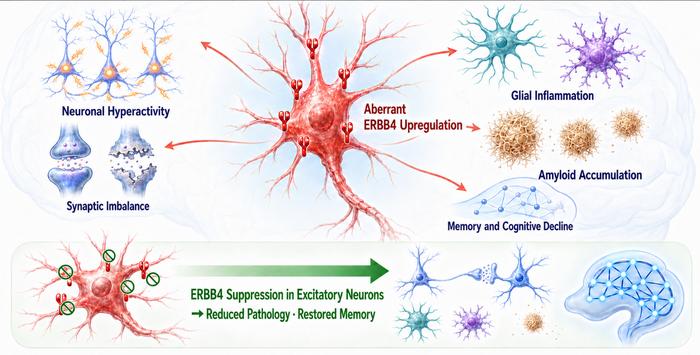
To understand the root cause of this imbalance, researchers looked at which genes were active within individual cell nuclei.
In healthy brains, the ERBB4 receptor is found mainly in neurons that inhibit signals and help apply brakes to brain activity. But in Alzheimer’s, ERBB4 was found in excitatory neurons responsible for driving brain activity.
The findings indicate that Alzheimer’s may not only damage neurons, but also push some of them into an abnormal state.
Researchers discovered that a single intervention targeting the ERBB4 receptors could address many of the Alzheimer’s symptoms.
-that-was-selectively-enriched-in.jpeg)
They used gene-editing technology to eliminate ERBB4 receptors from excitatory neurons in the hippocampus, the brain region key to forming memories.
The intervention quieted hyperactive nerve cells and corrected several abnormalities.
The mice's astrocytes and microglia became less reactive, their brain plaque build-up declined and the mice performed better on tests of memory and spatial cognition.
Researchers noticed that when ERBB4 was activated in a small number of excitatory neurons in otherwise healthy mice, the rodents developed excessive brain activity and cognitive impairment.
They examined post-mortem tissue from nearly 450 people and found that ERBB4 expression was elevated in excitatory neurons affected by Alzheimer’s disease.
“These findings identify aberrant ERBB4 expression in excitatory neurons as an early driver of AD pathophysiology and a potential therapeutic target across neurodegenerative diseases,” scientists concluded.


No comments:
Post a Comment